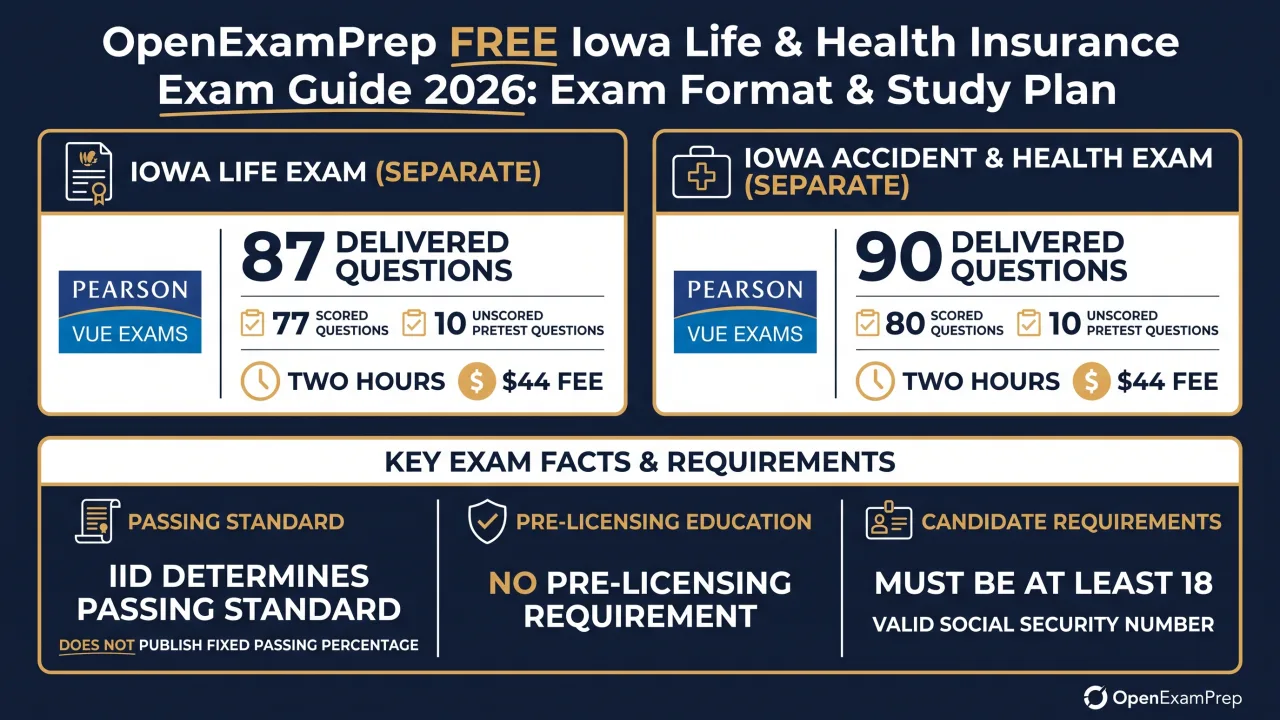
Iowa Life & Health Is Two Exams, Not One Combined Exam
To earn both Life and Accident & Health authority in Iowa, a resident applicant takes two separate Pearson VUE exams for the Iowa Insurance Division (IID): Life (12-IA-01) and Accident & Health (12-IA-02). Each exam has a general-knowledge part and an Iowa-specific part. Passing only one exam qualifies you to apply for only that line.
The current Pearson VUE Iowa candidate handbook lists both exams at two hours and $44 each. The Iowa content outlines, effective January 1, 2026, publish the exact scored and pretest question counts.
2026 Exam Format at a Glance
| Exam | Code | General knowledge | Iowa-specific | Total delivered | Time | Fee |
|---|---|---|---|---|---|---|
| Life | 12-IA-01 | 50 scored + 5 pretest | 27 scored + 5 pretest | 87 | 2 hours | $44 |
| Accident & Health | 12-IA-02 | 50 scored + 5 pretest | 30 scored + 5 pretest | 90 | 2 hours | $44 |
Pretest questions are unscored, mixed among the scored questions, and not identified. Answer every question because there is no penalty for an incorrect answer.
What passing score do you need?
Do not build your plan around an unofficial percentage. The current official handbook says IID determines the passing score, but it does not publish a fixed percentage or state that candidates must earn 70% on each part. Pearson reports a pass or fail; a failing report includes a numeric score and diagnostic information for both the general and Iowa portions.
Start Free Iowa Life & Health Practice
Use the free Iowa Life & Health study guide and free Iowa practice questions to study both lines. Keep the official 2026 outline open and mark each topic as you complete it.
Exact 2026 Life Exam Blueprint
The Life exam has 77 scored questions and 10 unscored pretest questions. The official outline assigns scored questions as follows:
| Life section | Scored questions |
|---|---|
| General: Types of policies | 15 |
| General: Policy riders, provisions, options, and exclusions | 15 |
| General: Application, underwriting, and policy delivery | 12 |
| General: Retirement and other insurance concepts | 8 |
| Iowa: Laws and rules common to all lines | 15 |
| Iowa: Life-only laws and rules | 12 |
| Total scored | 77 |
Highest-value Life topics
The first two general sections account for 30 of 50 scored general questions. Prioritize term, whole, universal, variable, and indexed life; annuities; riders; beneficiaries; premium modes; grace and reinstatement provisions; nonforfeiture and settlement options; exclusions; and incontestability.
The 12-question Iowa Life block includes replacement, disclosure and solicitation, group-life provisions, policy loans, viatical and life settlements, credit life, incontestability, and life and annuity suitability. Iowa's official consumer guidance states that an individual life policy has a 10-day free-look period, while replacement transactions receive 30 days.
Exact 2026 Accident & Health Exam Blueprint
The Accident & Health exam has 80 scored questions and 10 unscored pretest questions. Its scored-question allocation is:
| Accident & Health section | Scored questions |
|---|---|
| General: Types of policies | 16 |
| General: Policy provisions, clauses, and riders | 15 |
| General: Social insurance | 6 |
| General: Other insurance concepts | 5 |
| General: Field underwriting procedures | 8 |
| Iowa: Laws and rules common to all lines | 15 |
| Iowa: Accident & Health-only laws and rules | 15 |
| Total scored | 80 |
Highest-value Accident & Health topics
Types of policies plus provisions and riders account for 31 of 50 scored general questions. Study disability income, medical expense coverage, HMO/PPO/POS plans, HSAs and HRAs, Medicare supplements, long-term care, renewability, claims provisions, exclusions, deductibles, coinsurance, and riders before lower-weight material.
The Iowa-specific block covers licensing and unfair practices plus individual and group health rules, required benefits, Medicare supplements, long-term care and the Iowa partnership program, HAWK-I, HIPIOWA, the Affordable Care Act, and the No Surprises Act.
Iowa Rules Shared by Both Exams
Both Iowa-specific outlines devote 15 scored questions to laws and rules common to all lines. That makes this block more valuable than any single Iowa Life-only category. Study:
- IID and commissioner powers, examinations, hearings, penalties, and cease-and-desist authority
- Producer applications, appointments, license changes, temporary licenses, exemptions, and continuing education
- Misrepresentation, rebating, unfair discrimination, false advertising, unfair claims settlement, defamation, coercion, and intimidation
- The Iowa Insurance Fraud Act, producer responsibilities, electronic delivery, and guaranty-association concepts
The Iowa Life and Health Insurance Guaranty Association's basic protection includes up to $300,000 in life-insurance death benefits, subject to statutory eligibility, exclusions, and aggregate limits. It is a safety net for an insolvent member insurer, not a reason to recommend or purchase a policy.
Iowa Licensing Steps in the Correct Order
1. Choose the line or lines you need
Register for Life (12-IA-01), Accident & Health (12-IA-02), or both. Iowa does not require a pre-licensing course, so you may schedule without completing a mandatory number of course hours.
2. Schedule with Pearson VUE
Create a Pearson VUE account and reserve a test-center or OnVUE appointment. The handbook says reservations must be made at least 24 hours before the desired date, subject to availability. Each exam costs $44.
3. Use the January 2026 outline as your checklist
The exam is based on the published general and Iowa-specific outlines. Do not rely on a generic combined-exam outline or a prep provider's invented percentages.
4. Take the exam
For a physical test center, arrive 30 minutes early and bring two current forms of signature identification. The registration name must exactly match the IDs. Online candidates should run the OnVUE system test and prepare a quiet, private room; the handbook says online exams do not allow unscheduled breaks.
5. Apply through NIPR after passing
Pearson says results are uploaded for licensing in about three to four business days. Complete the NIPR application within 90 days of passing. IID lists the initial producer license fee as $50.
6. Complete fingerprinting when required
An initial Iowa resident producer applicant must complete the state and federal background-check process. Submit the NIPR application first; its confirmation provides the IID Fieldprint code and NPN needed to schedule. IID currently lists fingerprinting at $34.35 at an Iowa Fieldprint site or $36.35 outside Iowa, with results generally reaching IID in three to five business days.
No Pre-Licensing Does Not Mean No Product Training
Iowa has no pre-licensing education requirement for the producer exams, but licensed producers need product-specific training before selling certain products:
- Annuities: one Iowa-approved four-credit training course
- Indexed products: at least one four-credit indexed-products course before advice or a sales presentation
- Long-term care: eight initial credits before selling, then four credits during each CE term
Resident producers with major lines generally complete 36 approved CE credits per CE term, including three ethics credits. Iowa producer licenses use a three-year term, so do not confuse ongoing CE with pre-exam education.
A Two-Week Study Plan Built from the Real Blueprint
Days 1-4: Product foundations
For Life, compare term, whole, universal, variable, indexed life, and annuities. For Accident & Health, compare disability, medical expense, managed care, Medicare supplement, long-term care, and limited-benefit policies. Build tables that force you to state who bears risk, how premiums behave, and when benefits are paid.
Days 5-7: Provisions and application work
Drill beneficiaries, riders, premium and nonforfeiture options, settlement choices, underwriting, policy delivery, health renewability, claims provisions, deductibles, coinsurance, exclusions, and replacement. Review explanations until you can reject every distractor, not merely recognize the correct option.
Days 8-11: Iowa law every day
Start with the common 15-question Iowa block because it appears on both exams. Then split into Life-only and Accident & Health-only rules. Use the statute and rule citations printed beside each topic in the official outline whenever a prep explanation seems uncertain.
Days 12-14: Separate simulations
Run Life and Accident & Health as separate timed exams. Do not combine their scores. After each set, sort misses into product knowledge, policy language, Iowa law, or reading error, then review the weakest category before taking another mixed set.
Exam-Day and Retake Checklist
- Confirm whether the appointment is at a test center or through OnVUE.
- Match the legal name in Pearson VUE to the identification exactly.
- For a test center, bring the two forms of current ID specified in the handbook.
- For OnVUE, complete the system test and clear the room before check-in.
- Answer every item; pretest questions are indistinguishable and wrong answers carry no penalty.
- If you fail, use the numeric and diagnostic report to rebuild the weak portion. Pearson requires a 24-hour wait before making a reexamination reservation.
- Change or cancel at least 48 hours before the appointment to avoid forfeiting the exam fee.
Best Next Step
Download the official Pearson handbook and January 2026 content outline first. Then open the free Iowa study guide, take a short diagnostic in the Iowa practice bank, and study in the exact scored-question order above. That sequence prevents the most expensive mistake: preparing for a generic combined Life & Health exam that Iowa does not offer.

 Free CE
 Buy on Amazon
 Study guide on Mometrix
 Prep course on Achievable
 Take courses on Udemy