GES Deputy Director: prepare for recognition and uncued recall
This page concerns promotion from AD I to Deputy Director, not promotion from Deputy to Director II. Moving up a rank does not automatically appoint a District/Regional Director, committee chair or Principal Spending Officer. Those responsibilities depend on the actual post and lawful delegation. Study directorate-level judgment without assuming that rank alone grants executive powers.
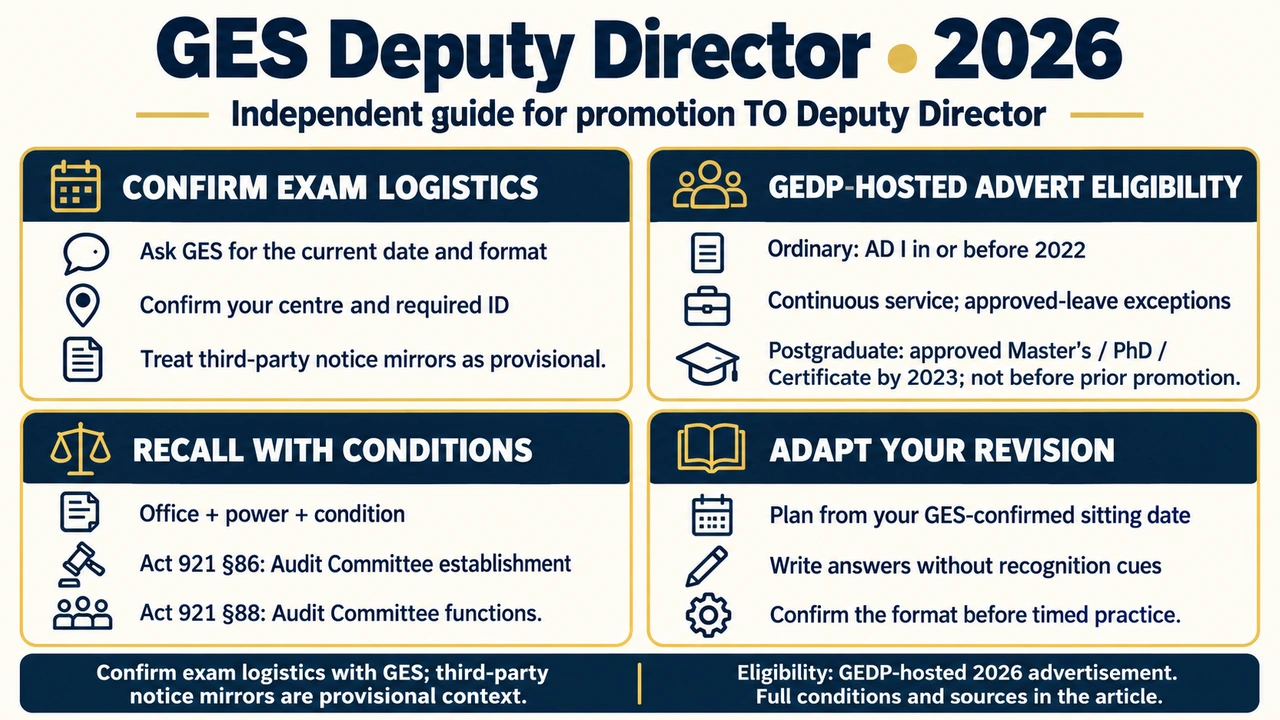
The 2026 advertisement hosted on GEDP and two images of a GES-letterhead notice dated 19 October 2026 (schedule and ID, page 1; formats and study areas, page 2) provide the cycle details below. The images are third-party GESHub mirrors, not files hosted on ges.gov.gh; we have not independently authenticated a first-party counterpart or established GEDP portal ownership from a current GES link. Confirm your personal admission, centre and any subsequent change with your GES office. This source limitation is different from evidence that a notice or policy does not exist.
The 2026 format, timing and eligibility evidence
| Parameter | Detail in the mirrored notice / GEDP advertisement |
|---|---|
| Deputy paper | 75 items: 60 multiple-choice/true-false + 15 fill-in-the-blank |
| Sitting | 4 November 2026, 9:00–11:00 am; 120 minutes |
| Ordinary route | AD I promotion in or before 2022, continuously at post except approved leave |
| Postgraduate route | Approved programme and the exact certificate/promotion-date conditions below |
| Study outline | Eight broad areas; no percentage weights on the two pages examined |
| Scoring/fees | No fixed raw cut-off or fee established by those two pages; follow the applicable cycle/admission instructions |
The 15 fill-in items are 20% of item count, not necessarily 20% of marks. 120/75=1.6 minutes=96 seconds per item on average. An editorial rehearsal allocation could be 60 objective items×75 seconds=75 minutes, 15 fill-ins×2 minutes=30 minutes, leaving 15 minutes for review. Those are not official section timers. Follow the actual paper's instructions on answering, marks and review.
The advertisement gives an ordinary AD I in-or-before 2022 route and separate postgraduate provisions. A Master's/PhD programme must be GES-approved; the certificate must be obtained in or before 2023 and not before the previous promotion. “Not before” includes equality; a blanket two-year waiver is inaccurate. The out-of-turn postgraduate wording mentions interviews, rather than guaranteeing promotion or exemption from all selection stages. The application window was 17 August–28 September 2026. Under Mode of Application, applicants are asked to upload a passport photograph, the last promotion/appointment/upgrading letter, and the highest academic certificate being used for the promotion application. That general document list is not expressly limited to the postgraduate route.
For admission, check Staff ID, assigned index and centre through the notice's GES-office instructions. Bring the national ID bearing name/photo; quote Staff ID/index as instructed. The two mirrored pages do not explicitly require a separate physical staff-ID card. They also do not settle every possible scoring or administration policy: omission cannot establish that GES has never issued a cut-off or another instruction.
Our independent Deputy practice questions, flashcards and cheat sheet support revision; they are not official GES past papers or a prediction of live questions.
Eight study areas and a fill-in practice method
The mirrored notice lists eight broad areas, with no percentage weights on the two pages examined:
- Knowledge of the Ministry of Education and Ghana Education Service
- School and Classroom Management
- Theories of Teaching and Learning
- Curriculum Development
- Assessment/Evaluation
- Office Practices
- Contemporary National and International Issues
- Educational Administration and Management
The five teaching groups below organize revision across those areas. They are our editorial framework, not five official weighted domains. Do not neglect office practices or current national/international issues while studying the Acts.
For uncued recall, cover an answer, write it, then check the name, scope and condition. These four practice clusters organize our revision; the notice does not promise that its 15 fill-ins follow them:
- Statutory references: Act 1049 structure/delivery; Act 1023 regulators; Act 921 spending controls; Act 663 as amended 914/1139 procurement.
- Office and body: SMC versus Board of Governors; NTC versus GES; PSO versus Audit Committee. Recall the power and its holder together.
- Numbers with conditions: A 15-day deadline needs its event and account/tax scope; a rate needs the resident payment category and exemption assumptions.
- Educational models: Recall a named supervision/change framework, then apply it to a school case. A model is not a statutory mandate or an official weighted domain.
Domain 1: education structure and directorate governance
Act 1049: structure, management and governing bodies
Read the original Pre-Tertiary Education Act, 2020 text (a mirrored legislative PDF), especially these distinctions:
- Section 1: Basic education is 2 years KG + 6 primary + 3 JHS = 11 years. Secondary education is 3 years SHS or 3 years TVET. These are two broad categories; SHS and TVET are alternative secondary pathways.
- Sections 2 and 4: District Education offices manage basic schools through Education Service/Local Government Service collaboration; Regional Education Directorates manage SHS; the TVET Service manages pre-tertiary TVET institutions. District Assemblies provide basic-school infrastructure. Section 4 does not itself assign all special education to Regional Directorates; inclusive-education duties appear in section 5.
- Sections 9, 31–32: GES manages human resources for basic/SHS delivery. District Directorates collaborate with Assemblies and religious educational units; Assemblies have specified public-basic-school and budget responsibilities. Decentralization is not an automatic transfer of teacher licensing or every employment decision to an Assembly.
- Section 10: The original Council has 12 members: chairperson; nine specified representatives; one female educationist; Director-General. Teacher associations share a rotating representative, not three permanent union seats. A 2026 Ministry statement reported by ISD describes a proposed faith-representation amendment; a proposal does not itself change the statutory list.
- Section 37: An SMC manages a public basic school; a Board of Governors manages a public SHS, under GES rules. A PTA/parent association supports the school but cannot replace statutory staffing, disciplinary or fee authority.
Section 53 repeals Acts 506 and 778 while saving lawful instruments and acts already in force until reviewed, cancelled or terminated.
Act 1049 establishes the TVET Service for delivery; CTVET, established under Act 1023, is the regulator. Keep service delivery, regulation and the actual officeholder's delegation separate.
Act 1023: five regulators, five different jobs
The Education Regulatory Bodies Act, 2020 establishes GTEC, CTVET, NTC, NaSIA and NaCCA.
| Body | Distinction to apply in a scenario |
|---|---|
| NTC | Regulates the teaching profession, teacher registration/licensing and professional development; GES employment is different. Section 63 requires the Registrar to be a registered teacher with at least 10 years' professional experience, appointed by the President under Article 195, for 4 years renewable for one further term. |
| NaSIA | Inspects standards and registers pre-tertiary institutions. Section 89 distinguishes a recommendation for closure after consultation/advice from emergency closure after specified consultations; an inspection query is not automatic closure. |
| NaCCA | Sections 103–104 cover pre-tertiary curriculum/assessment standards and learning materials excluding TVET institutions. |
| GTEC | Tertiary regulation/accreditation; it brings together the former NCTE/NAB functions, rather than managing SHS delivery. |
| CTVET | TVET regulation, standards, accreditation, assessment and certification; distinct from the TVET Service's institutional delivery. |
Practice application: A weak SHS lesson, an unregistered teacher and an unsuitable textbook involve different functions. Support instruction through school/GES supervision, refer teacher-registration issues to NTC, and check approved learning materials within NaCCA's scope. Do not give all three jobs to NaSIA simply because it inspects schools.
Delegation exercise: A District Director asks a Deputy-ranked officer to prepare a monitoring report. Separate preparing evidence, recommending action and issuing an authorized decision. Record who must approve and who remains accountable; do not equate a drafting assignment with a legal power to close a school, terminate staff or sign any contract. For Act 1049 repeal questions, consult its repeal-and-savings provision rather than assuming every older education provision vanishes without saved instruments or arrangements.
Domain 2: public finance, audit and procurement
Read the MoF-hosted Act 921 text alongside amendments and applicable regulations. The 2025 PFM amendment, Act 1136, adds fiscal-responsibility/Fiscal Council provisions and other changes; Act 921 is not an entirely unamended 2016 rulebook. The operational distinctions here concern the specified sections, not a claim to reproduce a fully consolidated Act.
- Section 7, Principal Spending Officer: Regularity of expenditure, commitments within authorized ceilings, resources and internal controls. Delegation does not remove the PSO's ultimate responsibility. Holding AD I or Deputy rank alone does not make an officer a PSO.
- Section 32, virement: The Minister can authorize specified reallocations on a PSO request; wage/salary movements are restricted to wages/salaries within the same vote. Spending-plan changes require prior written approval. Capital-to-recurrent virement is prohibited; transfers between covered entities require Parliamentary supplementary-estimate approval. A cash balance is not authorization.
- Section 47, revenue: Authority to collect and retain IGF, Parliamentary appropriation and budget/commitment controls are separate questions. A school's retained cash is not automatically available for any expense.
- Section 52, assets: Custody, asset registers and proper disposal/accountability. The Board of Survey procedure is in procurement Act 663 section 83, not established by PFM section 52.
- Sections 86–88, Audit Committee: Section 86 establishes it, 87 concerns composition and 88 assigns functions, including follow-up on audit/Parliamentary recommendations and implementation reporting. It is not the spending-approval body or a replacement for internal audit.
- Sections 96–97: Offences and surcharge are different. Under 97 the Minister, after due inquiry, may surcharge attributable loss/deficit/property damage caused or contributed to by negligence or misconduct; recovery and contributory responsibility have statutory conditions. A headteacher cannot automatically impose that surcharge by virtue of rank.
- L.I.2378 regulation 133, reconciliation: For a bank account outside the TSA, the PSO prepares and submits monthly reconciliation to the Controller and Accountant-General within 15 days after month-end; TSA accounts follow the CAGD timetable. Match the cash book to the bank statement, investigate differences and document outstanding items. Reconciliation is not permission to spend.
Procurement, commitment control and disposal
Use the PPA's Act 663/914 text and resources with later amendments, including Act 1139 (2025), and Public Procurement Regulations 2022, L.I.2466.
- Methods: Competitive tendering is the general goods/works/services rule under section 35, subject to authorized alternatives; consultancy selection has its own Part Six rules. RFQ under 42–43 is for qualifying readily available goods, works or technical services within applicable thresholds, requesting as widely as practicable and comparing quotations from at least 3 independent sources under the conflict-of-interest rules. Do not apply shopping automatically to every consultancy or memorize an obsolete cedi limit.
- Single-source: Section 40 requires a statutory justification and PPA Board approval. Urgency caused by delay in planning does not manufacture the unforeseen-urgency ground. A method approval does not waive budget or commitment requirements.
- Splitting: Artificially dividing a planned procurement to evade the applicable method/approval threshold is prohibited. Properly planned lots are not automatically unlawful.
- Act 1139: New 24A(1) prohibits commencing procurement coming under the PPA or central tender review committee without the Minister's commitment authorization, regardless of method; 24A(2) bars the Board, a tender review committee or an entity tender committee from approval without that authorization in the application. Sections 92A/B address unauthorized commitments and unverified payments. MoF implementation guidance also explains funding sources, routing and commitment controls: apply relevant budget directives as well as the statutory triggers, rather than assuming “low value” or “IGF” removes all controls.
- Stores/disposal: Record receipts and authorized issues, including the Store Issue Voucher. Under 83, the entity head convenes a Board of Survey, obtains its technical report/recommendation and approves the disposal; 84 lists permitted disposal methods. Accidental loss or abnormal deterioration requires the loss procedure before boarding/disposal. A board recommendation alone is not permission for a private sale.
School finance scenario: Before paying for repairs, establish the approved purpose and budget, the officer's delegation, lawful method, required commitment/method approvals, delivery verification, voucher authorization and applicable tax withholding. Retain supporting records and reconcile the bank. For Capitation Grant activities, use the approved SPIP and current grant instructions; do not assume a universal 50/30/20 allocation. Act 1049 section 46 also requires school estimates to go to the appropriate governing body under budget guidelines.
Resident withholding tax: a conditional worked case
The GRA income-tax withholding schedule lists 3% goods,5% works and7.5% entity general services for the stated resident contract categories above GH¢2,000 per annum. Agent status, payment category and exemptions matter; individual-service entries are separate. Do not apply this shorthand to nonresident payments, employment tax or VAT withholding.
Assume a school is required to withhold, the payee is a resident company, neither payment is exempt, the annual threshold is met, and the income-tax withholding bases are GH¢40,000 general services and GH¢20,000 works. Then 40,000×7.5%=3,000 and 20,000×5%=1,000: total GH¢4,000. File/pay the withheld tax within 15 days after the month of payment ends. A correct multiplication with the wrong tax category, base or deadline remains a wrong decision.
Domain 3: leadership, supervision and office decisions
- SWOT/PESTEL: Internal strengths/weaknesses versus external opportunities/threats; political, economic, social, technological, environmental, legal factors for the wider scan. Translate a finding into an owner, action and evidence of progress rather than merely reciting initials.
- Instructional/managerial leadership: Improving teaching and learning differs from maintaining facilities, records, timetables and compliance; a functioning directorate needs both.
- Change: Lewin's familiar unfreezing–moving/change–refreezing sequence is one conceptual framework. Kotter's own account describes the original eight-step model and its evolution into accelerators; urgency and a guiding coalition begin the approach. Neither is an official GES scoring formula.
- Supervision: Goldhammer's five stages are pre-observation conference, observation, analysis/strategy, supervision conference, postconference analysis. Glickman's developmental approach matches supervisory support to teacher development and the situation; directive, collaborative and nondirective approaches are a broad continuum, with later accounts distinguishing directive-control and directive-informational forms. Do not treat three labels as the only possible classification in every edition.
- Office practice: Keep references, minutes, action owners, deadlines and authorized signatories clear. An attendance record, an admission record and an asset register answer different questions. Preserve corrections and documentary trails; circulate personal data only through appropriate channels.
Applied leadership case: When a circuit's reading results fall, verify comparable data, inspect instruction, agree support with SISOs/headteachers, allocate lawful resources and set a review date. Do not jump from a low mean score to misconduct, automatic closure or an unsupported curriculum change.
Domain 4: curriculum, assessment and indicators
NaCCA's CCP resources cover the JHS B7–B9 programme. Revise all six competencies: Critical Thinking and Problem Solving; Creativity and Innovation; Communication and Collaboration; Cultural Identity and Global Citizenship; Personal Development and Leadership; Digital Literacy. Use assessment FOR learning to adjust teaching, AS learning for learner monitoring and OF learning for summary judgments.
WAEC's BECE School page gives 30% continuous assessment+70% external examination=100%. This is a BECE rule, not a promotion-paper mark allocation. The 2026 MoE budget lists NST at P2, P4, P6; a planned budget activity does not prove that every test has already been administered.
For an item,p=correct/scored responses; 36/60=0.60. For equal upper/lower groups of 20 with 18 versus 10 correct,D=(18-10)/20=0.40. In general, D is the difference between group proportions. Review a negative result for a faulty key, wording, instruction or sample before choosing a remedy.
UIS defines GER/NER by an education level and its whole official-age population. GER counts all ages enrolled at that level and can exceed 100%; ordinary NER counts official-age learners enrolled at that level and conceptually cannot. For hypothetical primary ages 6–11, population 10,000, all-age primary enrolment 8,000 and primary-age pupils in primary 6,000: GER 80%, NER 60%. An isolated Basic 3/age 8 calculation is not this standard level indicator. Adjusted NER can include primary-age pupils already in secondary. GPI divides the female value of a specified indicator by the male value; female GER / male GER=1 means GER parity, not identical raw enrolment.
Domain 5: conduct, employment and CPD source dates
Use the officially hosted GES Code, revised June 2017 as the dated source for these clauses, alongside current lawful employment directives and applicable agreements; this is not a claim that every later circular has been consolidated here.
- Section 3.8: Prohibits corporal punishment and physical pain such as flogging. Protect a learner, document/report safeguarding concerns through the proper channels, and refer suspected crimes to police. GES employment discipline, NTC professional licensing and criminal proceedings have different authorities.
- Section 3.15(vi): Continuous absence for 10 working days or more without permission or reasonable excuse engages vacation-of-post provisions. Verify attendance, permission and the explanation before following the competent authority's process; a single absence does not establish this ten-day condition.
- Section 6.4(8): Interdiction protects an investigation: the Code describes an employee under investigation whose continued presence is likely to interfere, and justification where the alleged offence could be grave. It is not a finding of guilt. The Code says 50% of salary, excluding allowances, not a separately defined “basic salary” formula. If proceedings do not end in dismissal or termination, the withheld salary is restored with interest at the prevailing rate. Restoration is not limited to complete exoneration. The Code limits interdiction to 3 months, with Public Services Commission approval required for extension. This differs from the Code's punitive suspension after a finding.
- Part 7: Disciplinary authority follows the actual office and prescribed procedure; promotion rank is not an automatic power to dismiss another employee.
Under Labour Act 651 section 57, a qualifying worker with the medical certificate receives at least 12 weeks' maternity leave and full remuneration/benefits. Under subsection (3), maternity leave may be extended for at least 2 additional weeks where confinement is abnormal or two or more babies are born in the same confinement; medically certified pregnancy/confinement illness has further provisions. A nursing mother has one paid hour daily; the statutory definition concerns a child suckling for a period of not more than 1 year, not an unconditional year after returning to work. Study leave with pay requires the applicable GES approval, rather than promotion rank alone.
CPD: label the version before memorizing the number
The NTC's June 2021 framework gives suggested three-year total points: Principal Superintendent 80, AD II 85, AD I 90, Deputy 95. These are not all “rank-based activity” points: its detailed allocation is 22+30+38=90 for AD I and 26+30+39=95 for Deputy, across rank-based, mandatory and recommended categories. The current NTC training page discusses CPD reforms. This 2021 table alone does not establish the operative 2026 renewal target; check your current NTC/TMP notice before acting on a points requirement. Do not turn a historical table or a reported annual figure into an undated current licensing rule.
Final revision for 4 November and an earlier-start framework
This article was first published 29 October; a six-week plan cannot describe the time remaining before 4 November. Use this editorial 31 October–3 November sequence, adapting to your existing preparation:
| Day | Priority | Recall/output |
|---|---|---|
| 31 October | Education Acts and eight areas | Write the body/office/mandate map from memory, then correct every mismatch |
| 1 November | Finance, procurement and tax | Explain 7/32/47/52/86/88/97; calculate the conditional withholding example; distinguish 1136 from 1139 |
| 2 November | Conduct, leadership and indicators | Recall interdiction conditions, dated CPD totals, supervision stages and GER/NER denominators |
| 3 November | Mixed timed rehearsal and admission | If useful, rehearse 60 objective + 15 uncued prompts within 120 minutes; review errors, confirm ID/centre and rest |
Readers beginning 29–30 October can add a diagnostic and logistics check. Uncued practice prompts you create are not represented as official fill-in questions. Avoid repeatedly testing easy facts while leaving an entire notice area unseen.
For a future cycle or an earlier start, a six-week reference framework is still useful: week 1 education Acts/regulators; week 2 PFM/audit; week 3 procurement/tax; week 4 leadership/assessment/indicators; week 5 conduct/curriculum/office practice; week 6 mixed recall and rehearsal. A suggested 40–80 hours across six weeks is an optional workload range, not a GES requirement or the time available now. Recheck future notices and current policy versions before reuse.
Sources and document versions
The linked sections identify the source for each rule: GEDP-hosted 2026 advertisement; third-party mirrors of the 19 October 2026 candidate notice; original Act 1049 text; CTVET-hosted Act 1023; MoF Act 921 and Parliament Act 1136/1139; PPA procurement resources and L.I.2466; GES June 2017 Code; Labour Ministry Act 651; NTC June 2021 framework/current reform-training page; NaCCA, WAEC, UIS and the 2026 MoE budget. The L.I.2378 copy hosted by the Office of the Special Prosecutor has a misleading filename: identify the instrument from its title, not the URL. Source dates matter; a historical rule, a proposed amendment and a current instruction are different forms of evidence.


 Buy on Amazon