Which Bocconi Test and Which Admission Year?
Reviewed 30 October 2026 for 2027–28 entry. Bocconi University is in Milan, Italy. This guide covers its standard Online Bocconi Test for undergraduate admission, taken during the 2026–27 testing cycle for entry in the following academic year. It does not describe the university's Master's or MBA selection tests. World Bachelor in Business and the Bocconi–HEC double degree have dedicated selection procedures and timelines.
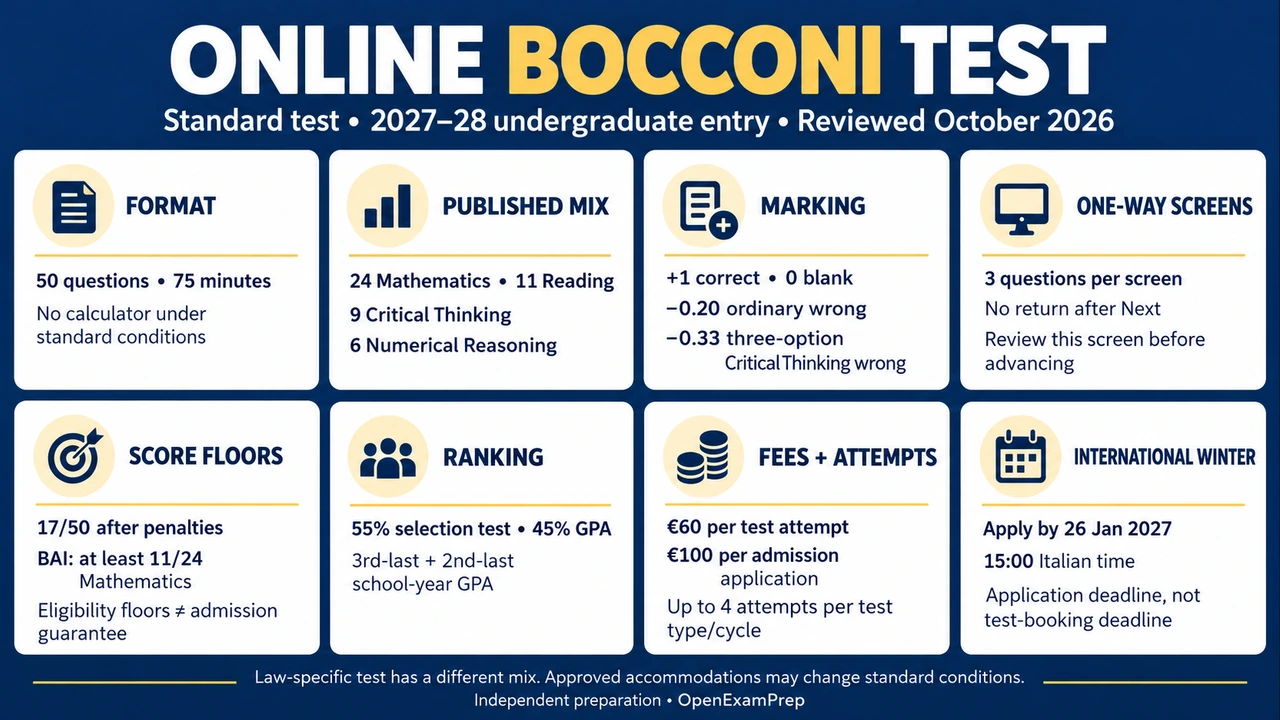
For standard undergraduate selection, the admission test contributes 55% of the ranking and the third-last and second-last secondary-school-year GPA contributes 45%. Bocconi does not consider CVs, recommendation letters or motivational letters in this selection. This is a weighting system, not permission to add an unconverted score out of 50 directly to a GPA out of 10. Bocconi's admissions page defines the required application elements.
The standard test is accepted for both Undergraduate School and Law School programs. Law applicants can instead choose the Online Bocconi Test – Law, which is accepted only for Law School programs, including the Italian-taught integrated Law degree and English-taught Global Law. The standard test's Mathematics-heavy blueprint must not be confused with the Law version: the latter has 5 Mathematics, 11 Reading, 6 Numerical Reasoning, 18 Logic and Critical Thinking, and 10 Verbal Reasoning questions.
SAT and ACT results are alternative selection tests; LSAT is an additional option for Law. Bocconi uses an internal comparison of accepted results, so a homemade raw-score conversion or a universal admission percentile is unreliable. Taking the Bocconi test in English or Italian is independent of the degree's teaching language. An English proficiency qualification such as TOEFL concerns a separate enrollment requirement; it is not a replacement for the admission selection test. Check the requirements for your program and entry year, rather than copying an older enrollment table.
Quick Snapshot: The Standard Online Test
| Feature | Current rule for 2027–28 admission |
|---|---|
| Total questions and time | 50 multiple-choice questions in 75 minutes |
| Mathematics | 24 questions, or 48% of the total |
| Reading Comprehension | 11 questions, or 22% |
| Critical Thinking | 9 questions, or 18% |
| Numerical Reasoning | 6 questions, or 12% |
| Presentation | Mixed subjects and difficulty; three questions per screen with no return to previous screens |
| Marking | +1 correct, 0 unanswered, −0.2 incorrect; −0.33 for incorrect three-option Critical Thinking answers |
| General test-score minimum | 17/50 after penalties, not a guaranteed admission score |
| Additional BAI condition | At least 11/24 Mathematics points for Mathematical and Computing Sciences for Artificial Intelligence |
| Test fee | €60 for each attempt, separate from the admission application |
| Attempt cap | Four attempts per test type in this admission cycle |
These figures come from the official Online Bocconi Test page. The standard and Law blueprints both total 50, but their different content serves different program choices.
One-Way Screens: Practice Decisions Before Moving On
The 2027–28 Instructions and Rules of Conduct, section 3.2, specifies three questions per screen and no backward navigation after selecting Next. The final summary is not a whole-test answer-editing pass. A strategy based on flagging every difficult item and returning at the end will therefore fail.
The arithmetic gives 75 ÷ 50 = 1.5 minutes, or 90 seconds per question, and approximately 4.5 minutes for a full three-question screen. These are planning averages, not separate timers or a requirement to spend the same time on every item.
- Inspect the current screen before committing all your time. Work efficiently on items you can solve, then decide what to do with the remaining item before advancing.
- Use your practice evidence to set a stopping point. A 120-second checkpoint on a stalled problem can be a useful drill, but it is an editorial technique, not a university rule. A difficult item may deserve more time if you have a clear solution route.
- Do not count hypothetical future points as certain. Spending four minutes on one problem consumes time, but it does not automatically cost three correct answers elsewhere. Compare time spent, accuracy and omissions in your own timed practice.
Rehearse three-question pages with earlier pages unavailable. Finish reviewing each page's choices before moving forward; do the detailed learning review only after the practice session ends.
What to Study Across the Four Areas
Use the official topic list alongside our Bocconi practice questions and study guide. Our exercises are independent practice, not released university questions or proof that a particular question will appear.
Mathematics: 24 Questions
The published syllabus reaches beyond algebra. Build a checklist that includes:
- Algebra and functions: powers, radicals, equations, inequalities, systems, absolute values, elementary graphs, inverse and composite functions. For a quadratic with nonzero leading coefficient, Vieta's identities are
x₁ + x₂ = −b/aandx₁x₂ = c/a. - Exponentials and logarithms: manipulate expressions while checking domains;
log_b(xy) = log_b(x) + log_b(y)requires positivexandy, and a valid baseb > 0,b ≠ 1. - Plane and analytic geometry: triangles, quadrilaterals, circles, coordinates, distances, straight lines and parabolas; connect a diagram to an equation before calculating.
- Trigonometry: sine, cosine, tangent and identities; do not omit this area simply because an older prep summary focuses on algebra.
- Sets, counting and probability: permutations, combinations, inclusion-exclusion, conditional probability, total probability and Bayes' theorem. For two finite sets,
|A ∪ B| = |A| + |B| − |A ∩ B|prevents double-counting. - Numbers, units and statistics: percentages, unit conversions, frequencies, central tendency and dispersion. A table can require choosing the right denominator before performing any arithmetic.
These are topic families, not published percentages within Mathematics. For a diagnostic, record whether an error came from missing knowledge, choosing the wrong method, arithmetic or time pressure.
Reading Comprehension: 11 Questions
Work from the passage, not from your views about its subject. The university describes comprehension of information and meaning; do not rely on an invented fixed list of passage genres. Useful practice tasks include locating an explicit detail, explaining a qualification, and deciding whether an inference is supported.
Underline quantifiers such as some, all and only. An option changing “some firms experienced higher costs” into “every firm experienced higher costs” adds a claim the text does not establish. When two answers sound plausible, identify the exact sentence that supports each and reject any requiring an extra assumption.
Critical Thinking: 9 Questions
The official description includes evaluating propositions from supplied data and assessing claims against short arguments. For three-option items, distinguish:
- True: the conclusion follows from the supplied information.
- False: the supplied information contradicts the conclusion.
- Cannot deduce: the information neither establishes nor contradicts it.
“Not proved true” does not mean “false.” Practice conditional reasoning and counterexamples: If P, then Q supports If not Q, then not P, but it does not establish If Q, then P. These are useful reasoning tools, not a claim that every test question follows one template.
Numerical Reasoning: 6 Questions
The challenge is often selecting relevant table or chart data, not advanced arithmetic. Read the unit, time period, population and denominator before calculating. Practice without a calculator under the standard test conditions:
- A 20% rise followed by a 20% fall gives
1.20 × 0.80 = 0.96, a 4% net decrease. - A share rising from 12% to 18% increases by 6 percentage points, or 50% relative to the original share.
- 16⅔% equals 1/6, whereas 16.67% is an approximation; 12.5% = 1/8 and 37.5% = 3/8 exactly.
Use the Bocconi cheat sheet and flashcards for retrieval practice, then apply the method to unfamiliar data instead of memorizing isolated answers.
Negative Marking: Calculate the Score Before Choosing a Strategy
Separate ordinary wrong answers from three-option Critical Thinking wrong answers. For example, 31 correct, 7 blank, 9 ordinary wrong and 3 three-option Critical Thinking wrong accounts for all 50 questions and gives:
31 − (9 × 0.2) − (3 × 0.33) = 31 − 1.80 − 0.99 = 28.21 points.
The following expected-value examples assume one correct answer, equal probabilities among the remaining options, genuinely eliminated wrong options, and no additional time cost. They explain the mathematics; they do not guarantee a gain on a particular attempt.
| Illustrative decision | Expected points |
|---|---|
| Five options, ordinary −0.2 penalty, uniform guess | 1/5 − (4/5 × 0.2) = +0.04 |
| Four remaining options, ordinary penalty | 1/4 − (3/4 × 0.2) = +0.10 |
| Three remaining options, ordinary penalty | 1/3 − (2/3 × 0.2) = +0.20 |
| Two remaining options, ordinary penalty | 1/2 − (1/2 × 0.2) = +0.40 |
| Three-option Critical Thinking, uniform guess | 1/3 − (2/3 × 0.33) ≈ +0.1133 |
| Two remaining options, Critical Thinking penalty | 1/2 − (1/2 × 0.33) = +0.335 |
More generally, if your probability of being correct is p and the wrong-answer deduction is c, the expectation is p − c(1 − p). It is positive when p > c/(1 + c): above 1/6, approximately 16.67%, for c = 0.2, or above 33/133, approximately 24.81%, for c = 0.33. Use the published decimal penalty; replacing 0.33 with one-third changes the arithmetic.
A positive average does not remove the risk of losing points. Eliminating an option incorrectly also invalidates the equal-probability calculation. You cannot know your exact marked score while answering, so “leave blanks when your live score is near 17” is not a usable rule. In practice, compare answering and omission decisions against your error log and available time. An omission scores zero; an attempted answer can raise or lower the result.
Eligibility Floors, Ranking and Selecting Your Attempt
The 17/50 minimum includes penalties. Reaching it meets the general test-score floor; it does not prove that your documents, school qualification or other conditions are satisfied, and it does not guarantee a place. BAI additionally requires 11/24 Mathematics points. A high GPA cannot replace that specific Mathematics condition.
For example, a candidate with 24.6 overall and 10.2 Mathematics clears the overall floor but misses the BAI Mathematics floor. That result alone establishes neither admission to another program nor complete application eligibility.
The ranking uses 55% test and 45% GPA. Follow the application portal's instructions for the third-last and second-last years, excluding physical education, behavior and religion from the requested GPA calculation. There is no basis here for publishing a universal “35 guarantees admission” target or a fixed Bocconi-to-SAT conversion.
Taking the test does not submit an admission application. The score appears at the end, and the report is normally available within 48 hours. In Apply2B, select the valid Bocconi attempt you want evaluated; the university says its certificate need not be uploaded for this selection step. Do not assume all attempts are automatically imported and the best silently chosen. If you provide different accepted selection results, such as Bocconi and SAT, the portal compares the submitted results for ranking.
An Early attempt can remain usable for Winter within the same 2027–28 cycle. Scores from earlier admission cycles and simulation results are not valid substitutes. Save the report and reference information, but remember that receiving a report does not by itself certify compliance with the test rules.
Booking, Fees and the International Winter Calendar
First check your applicant category. It follows your secondary-school background, not your passport alone. A student attending an international school in Italy under a non-Italian system can be an international applicant. Italian applicants attending an Italian secondary school in Italy have a different calendar, including Spring; international applicants use Early and Winter for this cycle.
For testing in this cycle, applicants must already hold a secondary-school diploma or be completing it in the 2026–27 school year. This is not a permitted early practice attempt for students graduating in a later school year. Other admission conditions, including the recognized diploma and applicable age requirements, must also be checked on the admissions page.
As of this review, International Early has closed. For International Winter 2027:
| Action | Published date or window |
|---|---|
| Submit the admission application | 25 November 2026–26 January 2027, closing at 15:00 Italian time |
| Book an Online Bocconi attempt | International booking closes 19 January 2027 |
| Take the final available test | 21 January 2027, subject to availability and booking at least 48 hours beforehand |
| Allow for platform closures | 7–8 December 2026 and 17 December 2026–1 January 2027, inclusive |
These are three different deadlines, not interchangeable dates. Use Italian local time, including its seasonal clock changes, rather than assuming a fixed offset from your country. Italian applicants should consult their own calendar instead of applying the international booking cutoff or assuming International Spring is available.
Each attempt costs €60. The separate €100 application fee applies to each application: applying to both Undergraduate School and Law School requires separate applications and fees, and a new selection session requires a new application. Thus one attempt plus one application is €160; two attempts plus one application is €220; four attempts plus one application is €340. Tuition, language testing and optional preparation are separate costs.
The maximum is four attempts per test type in the cycle, not a fresh allowance on 1 January. Additional purchases must be at least 24 hours apart, and tests cannot occur on the same day or on consecutive days. Those purchase and test-spacing rules are different constraints.
Read the current conduct document before paying. Its withdrawal provision requires action within 14 calendar days of purchase and before the booked test date; it is not a blanket “all test fees are nonrefundable” rule. For a Wednesday test, its date/language-change example allows changes only until Monday at 23:59, so do not assume a deadline measured from your preferred Wednesday start time. The application fee is separately nonrefundable once the application is submitted. Documented exceptional absences and technical interruptions have their own conditions; contact the designated support channel promptly rather than assuming a free retake.
Rehearse the Actual Remote Setup
The test is audio- and video-recorded for later checks. A quiet session with no warning is not proof of acceptance, and the rules do not describe continuous live human supervision. Use the current platform's technical instructions for Safe Exam Browser and ProctorExam, including supported devices and software versions.
Prepare a desktop or laptop with the necessary permissions, webcam and microphone, plus a smartphone or tablet for the additional camera. Use a stable permitted network; the current rules prohibit hotspots. Position the second device so that your body, hands, desk and computer screen can be checked, and rehearse the required room scan. The full document controls room suitability, visibility and wired-peripheral requirements; do not improvise a public or open-plan testing location.
Under standard conditions, calculators, notes and formula sheets are prohibited. The permitted desk items include your computer, identification, one pen or pencil, two blank A4 sheets, permitted drink container and access credentials. Do not reduce the full rules to “only paper and pen,” or assume an unlisted device is allowed because it is switched off. Follow any additional checks during the session and do not reason aloud or obtain outside assistance.
Applicants requesting disability or specific-learning-disorder accommodations must apply at least five business days before the test and follow the university's documentation and approval process. Approved measures govern the individual session; arrange them before relying on extra time or assistive tools. A short blog checklist cannot replace the complete current instructions.
Worked Practice Across All Four Areas
These original examples teach methods. Their answer counts and the four-option knowledge checks below are editorial learning formats, not a reproduction of every live-test screen.
Sample 1: Mathematics — Logarithms and Domains
Question: For which real values of x does log₂(x) + log₂(x − 2) = 3 hold?
- A)
x = −2andx = 4 - B)
x = 4only - C)
x = 2only - D)
x = 8only - E) No real
x
Solution: Both logarithms need positive arguments, so x > 2. The product rule gives log₂(x(x − 2)) = 3, hence x(x − 2) = 8. Factor x² − 2x − 8 = (x − 4)(x + 2) = 0. Reject x = −2 because it violates the domain. Choice B is correct; checking only the quadratic would incorrectly admit both roots.
Sample 2: Numerical Reasoning — Compounded Changes
Question: A firm raises a component's price by 25% in Q1, discounts that price by 20% in Q2, then raises the Q2 price by 10% in Q3. What is the net change from the original price?
- A) +15.0%
- B) +12.5%
- C) +10.0%
- D) +5.0%
- E) 0.0%
Solution: Start at 100: 100 × 1.25 = 125, then 125 × 0.80 = 100, then 100 × 1.10 = 110. The net increase is 10%, Choice C. Adding the three percentages gives a misleading answer because each applies to a different base.
Sample 3: Critical Thinking — An Unproved Overlap
Passage: Every startup accepted into the Milan FinTech Accelerator has at least two technical co-founders and an audited compliance protocol. Some startups with an audited compliance protocol receive seed grants from regional banks.
Statement: At least one accepted startup receives a regional-bank seed grant.
- A) True
- B) False
- C) Cannot deduce
Solution: Accepted startups and grant recipients are two subsets within the larger group with an audited protocol. They could overlap, or all grant recipients could be outside the accepted group. Both arrangements satisfy the passage. The answer is Choice C, not False merely because the overlap is unproved.
Sample 4: Reading — A Qualified Inference
Fictional practice passage: Carbon border adjustments are often praised for equalizing compliance costs between domestic manufacturers and foreign exporters. In the pilot sectors described here, however, downstream domestic assemblers experienced higher input-cost volatility when tariff credits were recalculated quarterly rather than annually.
Question: Which statement is supported?
- A) Border adjustments never equalize compliance costs.
- B) Assemblers prefer quarterly recalculation.
- C) Recalculation frequency can affect input-cost stability for domestic assemblers.
- D) Foreign exporters are exempt in every pilot sector.
- E) Annual recalculation eliminates all input-price changes.
Solution: Choice C captures the stated relationship without turning it into a universal claim. A and E overgeneralize; B invents a preference; D invents an exemption. The fictional passage is reasoning material, not a claim about a real empirical study.
An Adaptable Four-Week Preparation Plan
This is an editorial example, not a required course length or a promise that four weeks is sufficient. Adjust it to your diagnostic, school commitments and available test dates.
- Week 1 — Diagnose and rebuild Mathematics. Try the university-linked simulation or an appropriate diagnostic, review each error, and make a topic checklist. Revisit domains, equations, graphs, geometry and trigonometry. A set of 25–30 untimed Mathematics exercises can reveal gaps; do not treat that number as a readiness threshold.
- Week 2 — Quantitative interpretation. Practice counting, probability, sets, statistics and units. Work through multi-column tables and compound percentages on two blank A4 sheets. Explain why your chosen denominator and unit are correct before calculating.
- Week 3 — Evidence and deductions. Alternate passage comprehension with data-based propositions and short arguments. Use the flashcards for retrieval, then construct a counterexample whenever a claim is not forced by the premises. Continue reviewing weak Mathematics topics.
- Week 4 — Timed execution and repair. Use 50-question, 75-minute practice with one-way three-question pages and the correct penalties. Review wrong, slow and omitted items afterwards. Rehearse the actual computer, camera and room arrangements early enough to resolve problems before the booking deadline.
Start from the simulation linked on the official test page; a simulation score cannot be submitted for admission. For independent additional practice, use our question bank. Track the reason for each error and your progress across all four areas rather than chasing an unofficial “guaranteed admission” score.
Primary Sources and Year Boundaries
- Online Bocconi Test: current format, syllabus, marking, eligibility, booking and attempt selection
- 2027–28 Instructions and Rules of Conduct: navigation, equipment, purchase changes and compliance
- International Admissions: 2027–28 selection, applications and fees
- Applicant categories: school background and separate transfer procedures
- SAT and ACT: accepted alternative selection results
- Results and Enrollment: language and enrollment procedures
At review, the last page still labels its detailed enrollment timetable 2026–27. Do not transfer those old enrollment dates or language-testing deadlines to 2027–28; use your current admission offer and updated university instructions. The current test page, conduct document and admissions calendar establish the testing and application facts above.
