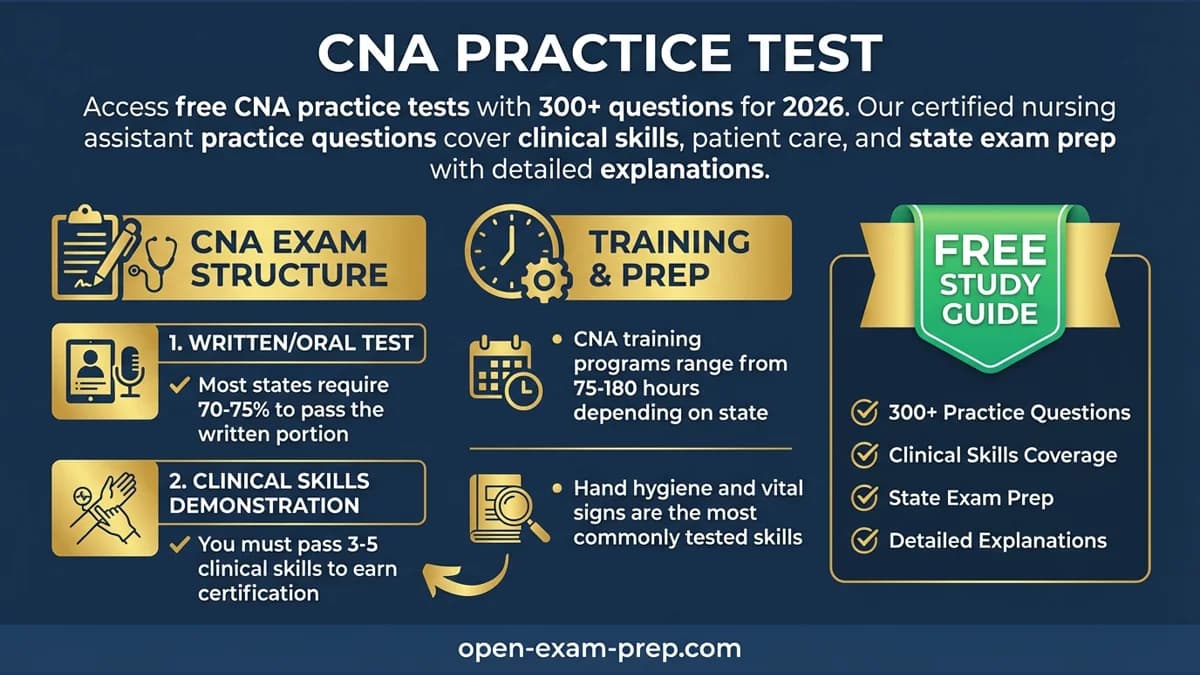
Free CNA Practice Test 2026 (Built Around the Real NNAAP Exam)
This is a free CNA practice test organized the way the real exam is actually built. Most states certify nursing assistants through the NNAAP (National Nurse Aide Assessment Program), owned by NCSBN and delivered by Credentia. The questions below mirror the official NNAAP written content areas and their weights, so your study time matches where points actually are on test day. Every question has an answer explanation, and the full bank is 100% free with AI tutoring built in.
Start the free CNA practice test | Read the full CNA study guide
How the CNA Exam Is Structured (2026)
The CNA exam has two separate parts, and you must pass both. Most states use NNAAP/Credentia; some use other vendors (Prometric, Headmaster/D&S, Pearson VUE), but the structure is similar.
| Component | What it is | Passing requirement |
|---|---|---|
| Written (or Oral) exam | NNAAP: 70 multiple-choice items = 60 scored + 10 unscored pretest | Set per form (commonly about 70-80% of scored items) |
| Skills evaluation | 5 hands-on skills in ~30 minutes, scored by a Nurse Aide Evaluator | Must pass all 5 skills |
Key facts that competitors often get wrong:
- The written exam is 70 items, but only 60 count toward your score; 10 are unscored pretest questions you cannot tell apart.
- The oral version replaces 10 written items with 10 reading-comprehension items for candidates who prefer questions read aloud.
- In the skills test, Hand Hygiene (handwashing) is always one of your 5 skills, and you are always given one measurement skill (blood pressure, radial pulse, respirations, urinary output, or weight) that you must record on a Recording Sheet.
- The other skills are drawn from a 23-skill NNAAP pool (full list in our CNA study guide).
NNAAP Written Exam Content Areas (Official Weights)
This is the breakdown of the 60 scored written questions, straight from the NNAAP Written Exam Content Outline. Study in proportion to these weights.
| Content area | Weight | ~Scored questions |
|---|---|---|
| Physical Care Skills | 64% | ~38 |
| - Activities of Daily Living | 22% | ~13 |
| - Basic Nursing Skills | 35% | ~21 |
| - Self-Care / Independence (Restorative) | 7% | ~4 |
| Role of the Nurse Aide | 26% | ~16 |
| - Communication | 7% | ~4 |
| - Client Rights | 8% | ~5 |
| - Legal and Ethical Behavior | 5% | ~3 |
| - Member of the Health Care Team | 6% | ~4 |
| Psychosocial Care Skills | 10% | ~6 |
| - Emotional and Mental Health Needs | 8% | ~5 |
| - Spiritual and Cultural Needs | 2% | ~1 |
Takeaway: about two-thirds of the written exam is hands-on physical care (especially Basic Nursing Skills and ADLs). If your study time is limited, weight it here first, then Role of the Nurse Aide, then Psychosocial.
Free CNA Practice Questions by Content Area
Below are sample questions in the NNAAP style, grouped by content area. The full free bank goes much deeper. Open the full free CNA practice test.
Physical Care Skills - Activities of Daily Living (22%)
1. When assisting a client with eating who can feed themselves, the nurse aide should:
- A. Feed the client to save time
- B. Position the client upright (about 90 degrees) and within reach of the food
- C. Have the client lie flat to prevent choking
- D. Leave the room until the client finishes
Answer: B. Sitting upright at roughly 90 degrees reduces aspiration risk and supports independence. Lying flat increases choking risk; feeding a client who can self-feed removes their independence; leaving is a safety risk.
2. While giving perineal care to a female client, the nurse aide should wipe:
- A. From back to front
- B. From front to back
- C. In a circular motion
- D. From side to side
Answer: B. Always wipe front to back (clean to dirty) to avoid moving bacteria from the rectal area toward the urethra, which prevents urinary tract infections.
Physical Care Skills - Basic Nursing Skills (35%, the largest single area)
3. What is the FIRST thing a nurse aide should do before any client care?
- A. Check the client's chart
- B. Introduce themselves
- C. Perform hand hygiene
- D. Put on gloves
Answer: C. Hand hygiene is the single most important infection-control measure and comes before and after client contact. Gloves do not replace handwashing.
4. The normal resting pulse rate for a healthy adult is:
- A. 40-60 beats per minute
- B. 60-100 beats per minute
- C. 100-120 beats per minute
- D. 80-140 beats per minute
Answer: B. A normal adult resting pulse is 60-100 bpm. Below 60 (bradycardia) or above 100 (tachycardia) at rest should be reported to the nurse.
5. A nurse aide notices a small reddened area over a client's tailbone that does not fade. The aide should:
- A. Massage the reddened area firmly
- B. Apply a heating pad
- C. Report it to the nurse and reposition the client
- D. Ignore it unless the skin breaks
Answer: C. Non-blanching redness over a bony prominence is an early pressure injury (Stage 1). Report it and relieve the pressure by repositioning. Never massage reddened bony areas; it can worsen tissue damage.
Physical Care Skills - Self-Care / Independence / Restorative (7%)
6. The main goal of restorative care is to:
- A. Do tasks for the client so they rest
- B. Help the client regain or maintain as much independence as possible
- C. Speed up the morning routine
- D. Reduce the nurse aide's workload
Answer: B. Restorative care promotes the client's highest level of independent function (for example, encouraging self-feeding or using range-of-motion exercises), not doing everything for them.
Role of the Nurse Aide - Communication & Client Rights (15%)
7. A client's family member asks the nurse aide about the client's medical diagnosis. The aide should:
- A. Explain what they know
- B. Refer the family to the nurse or physician
- C. Look it up in the chart and report back
- D. Guess based on the medications
Answer: B. Discussing diagnoses is outside the CNA scope of practice and may breach confidentiality. Refer clinical questions to the nurse or physician.
8. Before entering a client's room to provide care, the nurse aide should always:
- A. Knock and identify themselves, then explain the care
- B. Enter quickly to save time
- C. Wait for the client to call out
- D. Pull the curtain without speaking
Answer: A. Knocking, identifying yourself, and explaining the procedure respects the client's right to privacy and dignity and obtains cooperation before care.
Role of the Nurse Aide - Legal and Ethical Behavior (5%)
9. A nurse aide sees a coworker hit a client. The aide is required to:
- A. Confront the coworker privately and keep it between them
- B. Report the abuse to the supervisor or nurse immediately
- C. Wait to see if it happens again
- D. Tell the client's family only
Answer: B. Witnessed abuse must be reported to a supervisor/nurse immediately. Nurse aides are mandatory reporters; failing to report can cost your certification and harm the client.
Psychosocial Care Skills - Emotional, Mental Health, Spiritual & Cultural (10%)
10. A client with dementia becomes agitated during the evening. The BEST approach is to:
- A. Argue with the client to correct them
- B. Use a calm voice, reduce noise, and redirect to a familiar activity
- C. Restrain the client for safety
- D. Leave the client alone in a dark room
Answer: B. Sundowning agitation responds to a calm, low-stimulation environment and gentle redirection. Arguing increases distress; restraints require a clinical order and are a last resort, not a CNA decision.
CNA Eligibility and Training Hours (2026)
Federal OBRA law sets the floor; states often go higher.
- Federal minimum: 75 training hours (at least 16 supervised clinical hours).
- Many states require more, commonly 100 to 180 hours (for example, several states require 120+; a handful exceed 150).
- After training, you must pass both the written/oral exam and the 5-skill evaluation.
- Most states allow about 3 attempts to pass; some allow more (a few permit up to 4) before you must retrain. Confirm your state's limit and the 24-month window in your candidate handbook.
- Many states also require a background check; some require current CPR/BLS certification.
Always confirm details on your state registry or the official Credentia candidate handbook, since hours, vendors, and retake rules vary by state.
Recertification: Keep Your CNA Active
Under federal rules, a nursing assistant must not go more than 24 months without paid nurse-aide work. Most states renew certification every 2 years and require proof of paid caregiving hours during that period; some also require continuing education. If you exceed 24 months without paid work, you generally must retrain and retest to return to the registry.
A 4-Week Free CNA Study Plan
| Week | Focus | What to do |
|---|---|---|
| 1 | Diagnostic + Basic Nursing Skills (35%) | Take a timed practice test, then drill infection control, vital signs, and safety. |
| 2 | ADLs (22%) + skills checklists | Practice hygiene, feeding, transfers, perineal care; rehearse the 5-skill procedure steps out loud. |
| 3 | Role of the Nurse Aide (26%) + Psychosocial (10%) | Drill communication, client rights, abuse reporting, dementia care, cultural/spiritual needs. |
| 4 | Mixed full-length practice | Take full, timed, mixed practice tests; review every miss and re-drill weak cues. |
How to Use Free Practice Tests Effectively
- Take a diagnostic first to find your weakest content area.
- Practice the 5 hands-on skills out loud, narrating each step (the evaluator scores specific steps, including hand hygiene).
- Study in proportion to the weights above; do not over-study the 10% Psychosocial area.
- Always perform hand hygiene in skill scenarios; forgetting it is one of the most common skills-test failures.
- Review every wrong answer, write the cue you missed (for example, "clean to dirty," "report don't treat," "upright to feed"), and re-drill it.
What You Get on OpenExamPrep (Free)
- Hundreds of CNA practice questions with answer explanations, organized by NNAAP content area
- An AI tutor for instant explanations, procedure walkthroughs, and a custom study plan (free daily limit: 10 AI interactions)
- Coverage of both the written exam and the 5-skill clinical evaluation
- Mobile-friendly practice with progress tracking - no credit card, no paywall
Stop paying for CNA prep. Start your free CNA practice test now and read the full CNA study guide.


 Buy on Amazon
 Flashcards on Mometrix
 Practice exams on ExamEdge
 Take courses on Udemy