Connecticut Life & Health Exam: The Current 2026 Snapshot
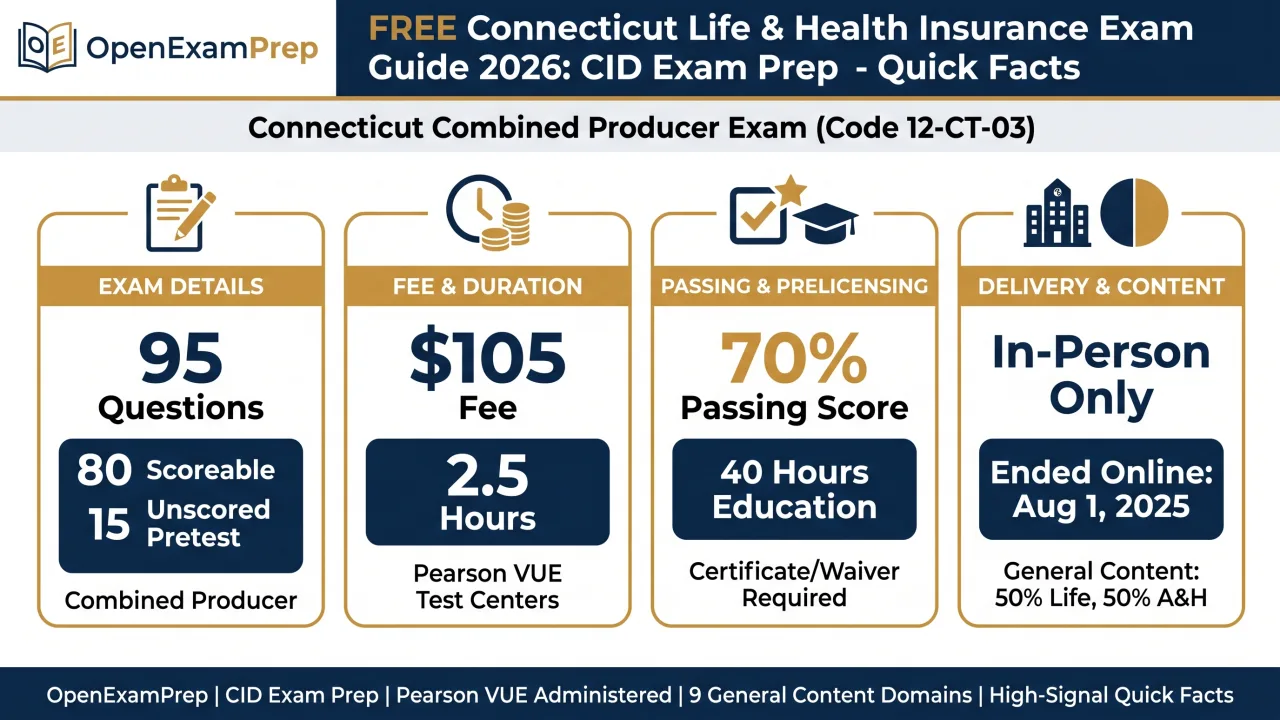
Connecticut calls the combined license examination Life, Accident & Health or Sickness Producer. The current exam is 12-CT-03, administered by Pearson VUE for the Connecticut Insurance Department (CID). It costs $105, allows 2.5 hours, and is delivered only at a Pearson VUE test center.
| Item | Current rule |
|---|---|
| Exam code | 12-CT-03 |
| Delivered questions | 95 total: 80 scoreable and 15 unscored pretest |
| General knowledge | 50 scoreable + 10 pretest |
| Connecticut-specific law | 30 scoreable + 5 pretest |
| Passing score | 70% |
| Time | 2.5 hours |
| Exam fee | $105 |
| Delivery | In-person Pearson VUE test center only |
| Prelicensing education | 40 hours for the combined line |
These figures come from the current Connecticut candidate handbook and content outline. The outline is effective October 27, 2025. Connecticut discontinued online insurance exams on August 1, 2025, so ignore older pages that still describe remote testing.
Question-count trap: 12-CT-03 does not have 145 questions. It delivers 95. The 80 scoreable questions are 50 general plus 30 state-specific; the other 15 are unidentified pretest questions and do not affect your score.
Choose the Right Exam
| License exam | Code | Fee | Time | Required education |
|---|---|---|---|---|
| Life Producer | 12-CT-01 | $65 | 2 hours | 20 hours |
| Accident & Health or Sickness Producer | 12-CT-02 | $65 | 2 hours | 20 hours |
| Combined Life, Accident & Health or Sickness Producer | 12-CT-03 | $105 | 2.5 hours | 40 hours |
Take 12-CT-03 when you want both producer lines. Do not accidentally register for the Certified Insurance Consultant examination or apply as a Fraternal Agent; CID warns that neither is a substitute for the producer path.
Official 12-CT-03 Blueprint
The general-knowledge outline is split evenly between life and accident-and-health content. The published domain weights total 100%:
| General-knowledge domain | Weight |
|---|---|
| Life: types of policies | 15% |
| Life: riders, provisions, options, and exclusions | 15% |
| Life: application, underwriting, and delivery | 12% |
| Life: retirement and other insurance concepts | 8% |
| Accident & health: types of policies | 16% |
| Accident & health: provisions, clauses, and riders | 15% |
| Accident & health: social insurance | 6% |
| Accident & health: other insurance concepts | 5% |
| Accident & health: field underwriting | 8% |
The Connecticut-specific section has 30 scoreable questions:
| State-law group | Scoreable questions |
|---|---|
| Rules common to life, health, property, and casualty | 18 |
| Rules pertinent to life insurance only | 5 |
| Rules pertinent to accident and health only | 7 |
This is more useful than generic advice to “study life and health equally.” The state section is 37.5% of all scoreable questions, and 18 of its 30 questions concern rules common across producer lines. Make licensing, commissioner authority, unfair trade practices, privacy, guaranty-association concepts, and producer responsibilities a major study block.
What to Study in Each Domain
Life: products and contract mechanics
Know term, whole, universal, variable, indexed, joint-life, survivorship, and annuity designs. Compare what is guaranteed, who bears investment risk, how premiums work, and when cash value exists. Then drill riders and provisions: waiver, guaranteed insurability, accidental death, term riders, other-insured riders, beneficiary designations, loans, nonforfeiture, dividends, settlement options, incontestability, suicide, and misstatement of age.
Application questions test signatures, representations, receipts, replacement, privacy disclosures, insurable interest, risk classification, delivery, and basic contract law. Retirement questions include qualified versus nonqualified plans, group life, Social Security, needs analysis, taxation, and modified endowment contracts.
Accident and health: policy design and claims rules
Compare disability income, AD&D, medical expense coverage, HMOs, PPOs, POS plans, FSAs, HSAs, HRAs, Medicare supplements, group insurance, COBRA, long-term care, and limited-benefit policies. Learn mandatory policy provisions, renewability classifications, exclusions, cost sharing, preauthorization, coordination of benefits, and field underwriting.
Connecticut law
Use the actual outline as your checklist. It cites Connecticut General Statutes Title 38a and state regulations beside each tested topic. Focus first on the 18-question common-law group, then the five life-only and seven health-only groups. The state outline includes producer licensing, appointments, fiduciary handling of premiums, policy delivery, unfair practices, replacements, privacy, life solicitation and illustrations, annuities, health-policy standards, HUSKY, Medicare supplements, long-term care, and the Affordable Care Act marketplace.
The outline names exchanges and marketplaces; learn that Access Health CT is Connecticut's state marketplace, but do not replace the full federal and state outline with marketplace trivia.
A High-Yield Study Plan
Step 1: Build from the official outline
Download the current outline and turn every line into one of three labels: know, shaky, or unknown. Study by domain weight, not by chapter length in a commercial course. A long chapter can represent a small domain; a short Connecticut-law chapter can represent many scoreable questions.
Step 2: Learn comparisons, not isolated definitions
Create compact tables for:
- term, whole, universal, variable, and indexed life;
- owner, insured, beneficiary, applicant, and producer;
- revocable versus irrevocable beneficiaries;
- immediate versus deferred and fixed versus variable annuities;
- HMO, PPO, and POS plans;
- noncancelable, guaranteed renewable, conditionally renewable, and cancelable policies;
- deductible, copayment, coinsurance, elimination period, and probationary period;
- Medicare, Medicare Advantage, Medicare Supplement, Medicaid, and Social Security disability benefits.
Step 3: Interleave Connecticut law
Do not postpone state law until the final day. Pair each national topic with its Connecticut layer: life products with solicitation and replacement, health products with required provisions, and sales conduct with licensing and unfair-practice rules.
Step 4: Practice under the real time limit
Ninety-five delivered questions in 150 minutes gives about 95 seconds per question. Practice mixed sets, answer direct definition questions quickly, flag long scenarios, and return after securing easier points. Because pretest questions are unidentified, answer every item as if it counts.
Start with the free Connecticut Life & Health study guide and practice questions. Use explanations to identify why each distractor is wrong, then return to the corresponding official-outline line.
Registration and Exam-Day Checklist
- Complete the 40-hour approved combined prelicensing course, unless CID grants a waiver.
- Create a Pearson VUE account and schedule 12-CT-03 at least 24 hours before the desired appointment.
- Select English or Spanish when reserving. On the Spanish exam, Pearson permits switching between Spanish and English.
- Change or cancel at least 48 hours before the appointment to preserve transfer or refund eligibility.
- Arrive at least 30 minutes early with your prelicensing certificate or waiver letter.
- Bring two current signed IDs. The primary ID must be government-issued, photo-bearing, and signed; the registration name must match exactly.
Pearson treats expired ID as expired even if the issuing authority offers a renewal grace period. Missing required documents can mean denied admission and forfeiture of the fee.
Results, Retakes, and the License Application
The passing score is 70%, but a successful report says only “pass”; it does not show a numeric score. A failed report provides diagnostic information for major general-knowledge areas. Connecticut scores the current exam as one whole examination.
There is no overall attempt limit for this producer exam. CID says candidates must wait 24 hours before scheduling again. Before retaking, use the diagnostic report and the official outline to rebuild the weakest domains rather than rereading everything.
After passing:
- Allow one to two business days for the result to upload to the national database.
- Apply through the National Insurance Producer Registry.
- Apply within one year of passing. Otherwise CID says the course and examination must be repeated.
- Choose Insurance Producer, not Fraternal Agent or Certified Insurance Consultant.
CID currently lists a $140 initial producer-license fee and states that this producer license does not require fingerprints. Exam results are verified electronically; applicants do not upload the score report.
After Licensure
Connecticut resident producers with Life or Accident & Health authority complete 24 continuing-education credits per renewal period: 21 general credits and three laws/regulations/ethics credits. After the initial period, an individual license renews every two years on the last day of the producer's birth month. Check the current CID producer page before renewal because fees and procedures can change.
Best Next Step
Open the official content outline beside the free CT Life & Health materials. Work domain by domain, keep Connecticut law in every study session, and use the candidate handbook again when you are ready to schedule.

 Free CE
 Prep course on Achievable
 Study guide on Mometrix
 Buy on Amazon
 Take courses on Udemy