Complete ASE Certification Study Guide for 2026
Earning your ASE certification is one of the most important steps you can take to advance your automotive career. Whether you're targeting a single certification or aiming for ASE Master Technician status, this comprehensive study guide will help you pass your exams on the first try.
Ready to practice? Test your knowledge with our free ASE practice questions covering all A-Series exams.
What is ASE Certification?
ASE (Automotive Service Excellence) is a professional certification organization that tests and certifies automotive professionals in the United States. Founded in 1972, ASE has certified over 250,000 technicians and is the industry-standard credential for automotive repair professionals.
Why Get ASE Certified?
| Benefit | Description |
|---|---|
| Higher Pay | Certified technicians earn 15-25% more than non-certified peers |
| Career Advancement | Required by many dealerships and high-end repair shops |
| Industry Recognition | Nationally recognized credential that proves your expertise |
| Customer Trust | ASE Blue Seal logo signals professionalism to customers |
| Job Security | Employers prefer and often require ASE certification |
ASE A-Series Exam Overview
The Automobile & Light Truck (A-Series) is ASE's core certification track, running from A1 through A9. Master Automobile Technician status is earned by passing tests A1 through A8 - note that A9 (Light Vehicle Diesel) is NOT required for Master status. Each test also includes about 10 unscored research questions mixed in with the scored questions, so always answer every question.
Exam Structure (Official 2026 Specs)
| Exam | Topic | Scored Questions | Time Limit |
|---|---|---|---|
| A1 | Engine Repair | 45 | 1 hr 15 min |
| A2 | Automatic Transmission/Transaxle | 45 | 1 hr 15 min |
| A3 | Manual Drive Train & Axles | 40 | 1 hr |
| A4 | Suspension & Steering | 40 | 1 hr |
| A5 | Brakes | 45 | 1 hr 15 min |
| A6 | Electrical/Electronic Systems | 50 | 1 hr 30 min |
| A7 | Heating & Air Conditioning | 50 | 1 hr 15 min |
| A8 | Engine Performance | 50 | 1 hr 15 min |
| A9 | Light Vehicle Diesel Engines | 50 | 1 hr 15 min |
Note: Scored-question counts and time limits come directly from ASE's Dates, Fees & Test Times page. Counts and times vary by test - A6 Electrical is the longest at 90 minutes. ASE does not publish official pass rates; industry estimates put first-time pass rates around 60-70%, with A6 and A8 consistently considered the toughest.
ASE Certification Requirements
Experience Requirements
To become certified, you must pass the test and prove two years of relevant hands-on work experience. Formal training can substitute for part of this:
- Two years of full-time hands-on work experience, or
- One year of work experience plus relevant formal training (training can substitute for up to one year)
- A diploma from an ASE Education Foundation (formerly NATEF) accredited program can count as one full year; a two-year accredited associate degree can satisfy the entire requirement
You can register and take a test before you meet the experience requirement (except X1). You'll receive a score report, but you won't earn the certification or certificate until your work-experience form is on file.
Testing Process
- Create a myASE account at ase.com
- Register for your chosen tests during an open registration window
- Pay one $34 registration fee per order, plus $62 per standard test
- Schedule within 90 days at one of 450+ Prometric centers (US/Canada) or remotely via ProProctor
- Take the test(s) on computer
- Submit your work-experience form and receive your results
Detailed Breakdown: A1-A8 Exam Content
A1: Engine Repair (16% of Master Certification)
Key Topics:
- Engine diagnosis and repair
- Cylinder head and valve train
- Engine block assembly
- Lubrication and cooling systems
- Fuel, ignition, and exhaust systems
Study Focus:
- Understand compression test interpretation
- Master valve timing concepts
- Know oil pressure testing procedures
- Study cylinder leakage testing
Common Question Types:
- "Technician A says... Technician B says..." scenarios
- Diagnostic procedure sequencing
- Tool identification and use
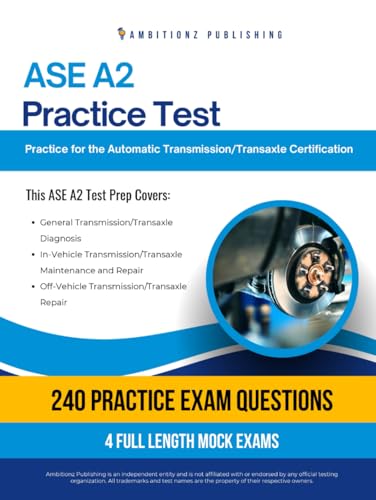
A2: Automatic Transmission/Transaxle
Key Topics:
- Transmission diagnosis and repair
- In-vehicle transmission service
- Off-vehicle transmission repair
- Torque converters
- Hydraulic systems
Study Focus:
- Understand hydraulic pressure tests
- Master valve body operation
- Know clutch pack clearances
- Study TCM diagnosis and reprogramming
A3: Manual Drive Train & Axles
Key Topics:
- Clutch diagnosis and repair
- Transmission diagnosis and repair
- Drive shaft and half-shaft service
- Differential diagnosis and repair
- Four-wheel drive systems
Study Focus:
- Understand gear ratio calculations
- Master differential noise diagnosis
- Know 4WD engagement systems
- Study limited-slip differential operation
A4: Suspension & Steering
Key Topics:
- Steering systems diagnosis and repair
- Suspension systems diagnosis and repair
- Wheel alignment diagnosis and adjustment
- Tire and wheel service
Study Focus:
- Understand alignment angles (camber, caster, toe)
- Master power steering system diagnosis
- Know suspension component wear patterns
- Study electronic steering systems
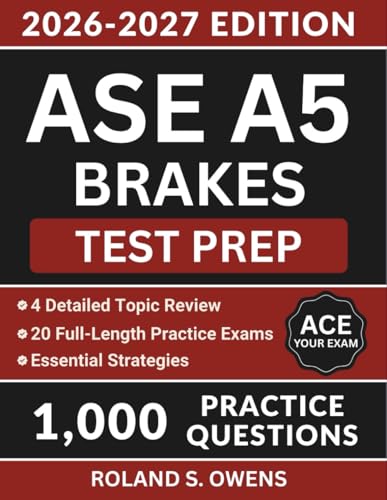
A5: Brakes (Often the First Exam to Take)
Key Topics:
- Hydraulic system diagnosis and repair
- Drum brake diagnosis and repair
- Disc brake diagnosis and repair
- Power assist units diagnosis and repair
- ABS, TCS, and ESP systems
Study Focus:
- Understand brake fluid types and compatibility
- Master ABS operation and diagnosis
- Know proportioning valve function
- Study electronic brake control systems
Tip: Many technicians take A5 first because brake work is familiar from daily shop tasks, making it one of the more approachable A-Series tests to build momentum.
A6: Electrical/Electronic Systems (Most Challenging)
Key Topics:
- General electrical system diagnosis
- Battery and starting systems
- Charging systems
- Lighting systems
- Gauges, warning devices, and driver information
Study Focus:
- Ohm's Law - Know it cold: V = I x R
- Series and parallel circuits - Be able to calculate voltage drops
- Wiring diagrams - Practice reading schematics
- Multimeter usage - Understand all functions
- CAN bus systems - Study network communication basics
Critical Formulas:
| Formula | Application |
|---|---|
| V = I x R | Calculate voltage, current, or resistance |
| P = V x I | Calculate power consumption |
| Rt = R1 + R2 (series) | Total resistance in series circuits |
| 1/Rt = 1/R1 + 1/R2 (parallel) | Total resistance in parallel circuits |
A7: Heating & Air Conditioning
Key Topics:
- A/C system diagnosis and repair
- Refrigerant recovery, recycling, and handling
- Heating and engine cooling systems
- Operating systems and related controls
Study Focus:
- Understand refrigeration cycle
- Master pressure gauge interpretation
- Know EPA 609 regulations
- Study electronic climate control systems
A8: Engine Performance (Most Comprehensive)
Key Topics:
- General engine diagnosis
- Computerized engine controls
- Fuel, air induction, and exhaust systems
- Emissions control systems
- Ignition systems
Study Focus:
- Understand OBD-II diagnostic trouble codes
- Master scan tool data interpretation
- Know fuel trim analysis
- Study emission control system operation
- Understand catalytic converter efficiency testing
Essential Skills:
- Reading and interpreting scan data
- Understanding fuel trim (short-term and long-term)
- Diagnosing O2 sensor performance
- Interpreting Mode $06 data
A9: Light Vehicle Diesel Engines (Not Required for Master)
A9 is a separate, optional A-Series test - it is not part of the A1-A8 Master Automobile Technician requirement, but it's valuable for technicians working on light-duty diesel pickups and SUVs.
Key Topics:
- General diesel engine diagnosis
- Cylinder head and valve train
- Fuel injection systems (common rail, unit injectors)
- Air induction, exhaust, and emission systems (DPF, EGR, SCR/DEF)
- Engine electrical and computerized controls
Tip: Passing A9 (a diesel test) plus A6 (electrical) is one route to qualify for the advanced L2 Electronic Diesel Engine Diagnosis Specialist test.
8-Week ASE Study Schedule
| Week | Focus | Action Items |
|---|---|---|
| 1 | A5 Brakes | Review brake systems, take practice test |
| 2 | A4 Suspension | Study alignment angles, practice scenarios |
| 3 | A1 Engine Repair | Focus on compression/leakdown testing |
| 4 | A7 HVAC | Study refrigeration cycle, EPA 609 |
| 5 | A6 Electrical | Priority: Ohm's Law, circuits, schematics |
| 6 | A8 Engine Performance | OBD-II, scan data, fuel trims |
| 7 | A2/A3 Transmission | Hydraulic tests, gear ratios |
| 8 | Review & Practice | Focus on weak areas, take full practice exams |
ASE Test-Taking Strategies
1. Read Carefully
ASE questions often include:
- "Technician A says... Technician B says..." - Evaluate both statements separately
- "What is the MOST likely cause..." - Look for the primary issue
- "What should be done FIRST..." - Consider safety and logical sequence
2. Use the Process of Elimination
- Eliminate obviously wrong answers
- Compare remaining options
- Choose the most complete and accurate answer
3. Manage Your Time
- Time limits vary by test (60-90 minutes) - roughly 1.5-2 minutes per question
- A6 Electrical gives the most time (90 minutes); A3 and A4 give 60 minutes
- Don't spend too long on any single question
- Mark difficult questions and return to them
4. Answer Every Question
- There is no penalty for wrong answers
- An educated guess is better than no answer
- Eliminate wrong choices to improve odds
ASE Advanced Certifications (L-Series)
After earning Master status, consider these advanced certifications:
| Exam | Title | Description |
|---|---|---|
| L1 | Advanced Engine Performance Specialist | Complex driveability and emissions diagnosis (requires A8) |
| L2 | Electronic Diesel Engine Diagnosis Specialist | Medium/heavy diesel engine controls |
| L3 | Light Duty Hybrid/Electric Vehicle Specialist | Hybrid and EV systems (requires A6 and A8) |
| L4 | Advanced Driver Assistance Systems (ADAS) Specialist | Radar, camera, and sensor calibration |
Note: Each Advanced Level (L-series) test costs $124 in 2026. L1, L2, and L3 carry prerequisite certifications.
ASE Certification Costs (2026)
| Item | Cost |
|---|---|
| Registration Fee (per order, any number of tests) | $34 |
| Standard Test (A-series, each) | $62 |
| Advanced Level Test (L1-L4, each) | $124 |
| Recertification Test (standard, each) | $62 |
| Recertification cap (per order) | $186 in tests ($220 max total) |
| ASE Renewal App (A1-A9 recert) | $52/year |
| Total for Master Status (8 tests, one order) | $530 |
Master Automobile status (A1-A8) in a single order costs $34 registration + 8 x $62 = $530. Because the registration fee is charged per order, registering several tests together is cheaper than one at a time. ASE collects sales tax in many states. Verify current fees on the ASE Dates, Fees & Test Times page.
Free ASE Practice Resources
Start Practicing Today
- 500+ ASE-style practice questions covering all A-Series exams
- Detailed explanations for every answer
- AI tutor to explain difficult concepts
- Progress tracking by topic area
Additional Study Materials
- Official ASE Study Guides - Download free at ase.com/study-guides
- Motor Age ASE Test Prep - Comprehensive training manuals
- Delmar ASE Test Preparation - Textbook-style study guides
- YouTube ASE Channels - Free video instruction
ASE Certification FAQs
How long is ASE certification valid?
ASE certifications are valid for 5 years. You must recertify before expiration to maintain your credentials.
Can I take multiple ASE exams in one day?
Yes, but ASE recommends taking no more than 2-3 exams per day to avoid mental fatigue.
What happens if I fail an ASE exam?
You can retake failed exams. You must register and pay the $62 test fee again (plus the $34 registration fee if it's a new order), and rescheduling is subject to test-center availability.
Do ASE certifications transfer between states?
Yes, ASE is a national certification recognized throughout the United States.
How much more do ASE-certified technicians earn?
According to industry data, ASE-certified technicians earn 15-25% more than non-certified peers. Master Technicians often earn an additional premium.
Your Path to ASE Master Technician Status
Becoming an ASE Master Technician is a significant achievement that demonstrates comprehensive expertise in automotive repair. Follow this roadmap:
- Gain Experience - Complete 2 years of relevant work
- Start with A5 - Brakes is a familiar, approachable starting point
- Build Confidence - Take A4 and A1 next
- Tackle Challenges - A6 and A8 require the most preparation
- Complete the Set - Pass remaining exams
- Maintain Credentials - Recertify every 5 years
Final Tips for Success
- Study consistently - 1-2 hours daily beats cramming
- Take practice tests - They reveal knowledge gaps
- Focus on weak areas - Don't just study what you know
- Understand principles - Don't just memorize facts
- Get hands-on practice - Theory plus experience equals success
Good luck with your ASE certification journey!

 1 Job Wiki
 Free CE
 Buy on Amazon