Real Estate vs Property & Casualty
Every home sale requires homeowners insurance, making this the "no-brainer dual license." Real estate agents who add P&C can cross-sell insurance at every closing and build a passive renewal book worth $50,000-$100,000+ within five years.
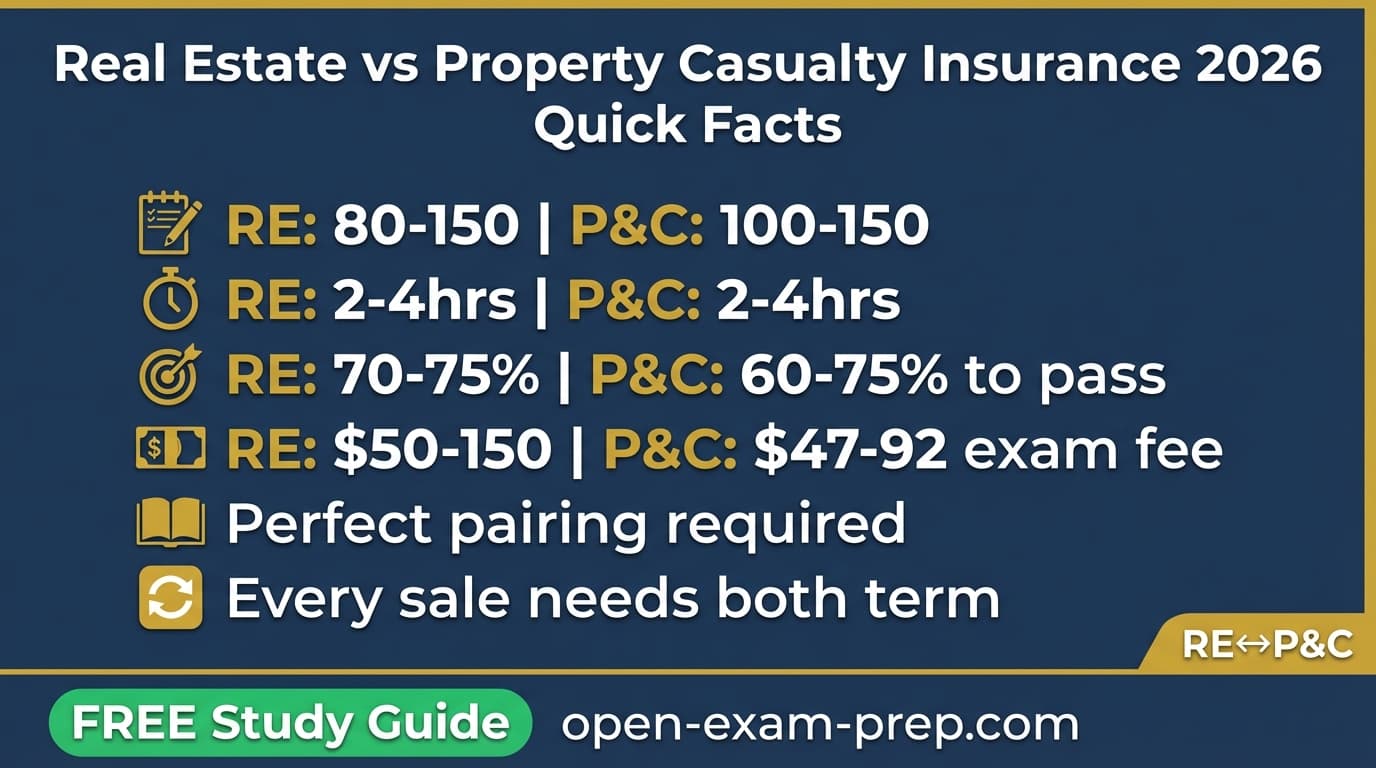
Side-by-Side Comparison
| Feature | Real Estate | Property & Casualty |
|---|---|---|
| Full Name | Real Estate Salesperson License Exam | Property & Casualty Insurance License Exam |
| Exam Cost | $50 - $100 (varies by state) | $35 - $184 (varies by state) |
| Passing Score | 70 - 75% (varies by state) | 70% (most states) |
| Questions | 100 - 150 (national + state portions) | 100 - 150 (varies by state) |
| Time Limit | 2.5 - 4 hours (varies by state) | 2 - 3 hours (varies by state) |
| Study Time | 100 - 200 hours over 4 - 12 weeks (including pre-licensing coursework) | 35 - 60 hours over 2 - 4 weeks |
| Difficulty | Moderate to Difficult | Moderate |
| Prerequisites | Pre-licensing course completion (60 - 180 hours, varies by state) | Pre-licensing course completion (20 - 52 hours, varies by state) |
| Exam Body | State Real Estate Commission (administered by PSI, Pearson VUE, or state-specific providers) | State Department of Insurance (administered by PSI or Prometric) |
Key Differences
- 1Real estate transactions are high-value but one-time ($5,000-$8,400 commission per sale); P&C insurance provides lower per-sale commission ($150-$600) but compounds annually through renewals
- 2Real estate requires 60-180 hours of pre-licensing ($400-$1,200 total); P&C requires only 20-52 hours ($300-$600 total), making it significantly faster and cheaper to obtain
- 3Real estate income is entirely transactional with zero residual component; P&C builds a renewable book of business valued at 1.5-2.5x annual revenue
- 4Real estate is market-cyclical (tied to interest rates, housing supply, economic conditions); P&C insurance is mandatory and recession-resistant
- 5Every real estate closing is a natural P&C sales opportunity (lender-mandated homeowners insurance), creating an organic cross-sell pipeline
- 6Real estate agents work variable schedules including evenings and weekends; P&C insurance work is primarily business hours with predictable scheduling
- 7Real estate median salary is $56,320 (BLS); P&C median is $47,768 (ZipRecruiter), but combined dual-license income significantly exceeds either alone
What Each Exam Allows You To Do
Real Estate
- Represent buyers and sellers in residential and commercial real estate transactions
- List properties for sale and conduct marketing campaigns
- Negotiate purchase agreements and manage the closing process
- Lease residential and commercial properties
- Conduct comparative market analyses
- Build referral networks with lenders, inspectors, and insurance agents
- Manage property transactions from listing to closing
Property & Casualty
- Sell homeowners, renters, and condo insurance
- Sell personal and commercial auto insurance
- Sell commercial property and general liability insurance
- Sell business owner's policies (BOPs) and umbrella policies
- Sell workers' compensation and professional liability insurance
- Sell inland marine, ocean marine, and specialty lines
- Cross-sell P&C products to real estate clients at or after closing
Who Should Take Each Exam?
Take the Real Estate if you...
- →Self-starters who thrive on high-value transactions
- →People with strong local networks and community presence
- →Individuals who enjoy the tangible reward of helping people find homes
- →Those who prefer varied daily activities over routine
- →People comfortable with income volatility and 100% commission structures
Take the Property & Casualty if you...
- →Real estate professionals who want to capture insurance revenue from every closing
- →People who prefer building recurring revenue through client retention
- →Those who enjoy working with both personal and commercial clients
- →Individuals who want predictable, compounding income
- →Anyone in the real estate ecosystem (title, mortgage, property management)
Which Should You Take First?
For most people entering real estate, the real estate license should come first because it takes longer to obtain (60-180 hours of pre-licensing) and the home transaction is the anchor product that creates the insurance cross-sell opportunity. However, if you already have your real estate license and are considering adding P&C, do not hesitate: the P&C license requires only 20-52 hours of pre-licensing, costs $300-$600, and can be completed in 3-5 weeks. The return on investment is immediate, as you can begin offering homeowners insurance quotes to every buyer at your very next closing. If you are starting from scratch with neither license and want income as quickly as possible, consider getting the P&C license first (faster to obtain) and using it to establish income while completing the longer real estate pre-licensing coursework. Either way, the goal is to hold both licenses within 3-6 months.
At a Glance: Real Estate vs Property & Casualty
Median Salary
$56,320
Real Estate
$47,768
Property & Casualty
Pass Rate
50-61%
Real Estate
50-65%
Property & Casualty
Study Time
100-200 hrs
Real Estate
35-60 hrs
Property & Casualty
Total Cost
$400-$1,200
Real Estate
$300-$600
Property & Casualty
Real Estate
High-value transactions, local networking, and helping people find homes
Property & Casualty
Compounding renewal income, recession-resistant revenue, and cross-selling at every closing
Start preparing today:
Key Facts: Real Estate vs Property & Casualty
- 1Every home purchase in the United States requires homeowners insurance (lender mandate), making the real estate + P&C dual license the most natural cross-sell combination in financial services.
- 2A real estate agent closing 20 home sales per year can generate $10,000-$30,000 in additional first-year P&C insurance commissions with minimal extra prospecting effort.
- 3P&C insurance renewal commissions compound annually: after 5 years of cross-selling to 20 homebuyers per year, the insurance renewal book alone can generate $33,000-$51,000 in annual passive income.
- 4The P&C license requires only 20-52 hours of pre-licensing coursework at a total cost of $300-$600, making it one of the fastest and cheapest professional credentials available to real estate agents.
- 5Fewer than 10% of real estate agents currently hold a P&C insurance license, creating a significant competitive advantage for those who do.
- 6P&C retention rates average 85-90%, meaning the vast majority of policies you write renew year after year, creating a compounding income base that grows over time.
- 7The combined real estate + P&C income at the 5-year mark can exceed $100,000-$150,000 when both transaction commissions and insurance renewals are factored together.
- 8A P&C insurance book of business is a sellable asset valued at 1.5-2.5x annual revenue, providing a retirement asset that pure real estate transactions cannot create.
Why This Comparison Matters
$10K-$30K/yr
Cross-Sell Income for RE Agents
Real estate agents closing 20 home sales/year add $10,000-$30,000 in first-year P&C commissions with zero extra prospecting.
$50K-$100K
5-Year Renewal Book Value
P&C renewals compound at 85-90% retention. After 5 years of cross-selling, the insurance book alone generates $50K-$100K annually.
<10%
RE Agents Hold a P&C License
Fewer than 10% of real estate agents hold a P&C license, creating a massive competitive advantage for those who do.
This is the comparison every real estate agent should read, because every single home purchase requires homeowners insurance. Mortgage lenders mandate it before funding. That means every buyer you represent WILL purchase a policy from someone — the only question is whether that someone is you or a stranger on the internet. A P&C license turns your existing client pipeline into an insurance revenue stream with zero extra prospecting.
The economics are transformative. P&C renewal commissions compound at 85-90% retention, so after 5-7 years of cross-selling to 20 homebuyers per year, you can build a $50,000-$100,000 annual renewal income stream on top of your real estate commissions. Add auto insurance bundling and the numbers grow even faster. Despite this, fewer than 10% of real estate agents hold a P&C license — meaning early adopters enjoy a massive competitive and financial advantage.
What Each Exam Covers
Real Estate Exam Topics
Pass Rate: 50 - 61% first-time pass rate (varies by state; source: state real estate commission data)
Property & Casualty Exam Topics
Pass Rate: 50 - 65% (varies by state; source: state insurance department data and PSI/Prometric reports)
Salary & Income Comparison
Real Estate Sales Agent
$56,320
Median Annual Salary
Range: $28,000 - $120,000+
BLS, May 2024 (agents); broker median $72,280
Top-producing agents in active markets earn $200,000-$500,000+. The income variance in real estate is extreme: 50-70% of new agents earn under $30,000 in year one.
Property & Casualty Insurance Agent
$47,768
Median Annual Salary
Range: $31,530 - $95,000+
ZipRecruiter, 2024; BLS Insurance Sales Agents median $60,370
P&C agents specializing in commercial lines or owning agencies can earn $150,000-$300,000+. Agency owners with large books of business (1,000+ policies) can earn $300,000-$500,000+ through combined personal production and agency profit sharing.
| Commission Detail | Real Estate | Property & Casualty |
|---|---|---|
| First-Year Commission | 2.5 - 3% of sale price (gross), split with brokerage | 10 - 20% of annual premium |
| Renewal Commission | None - real estate is purely transactional with zero residual income | 10 - 15% of premium on annual renewals |
| Income Model | On a $400,000 home sale with a 5.5% total commission, the selling agent's side is approximately $11,000, split with the brokerage. A new agent on a 50/50 split nets $5,500. A senior agent on an 80/20 split nets $8,800. Average agents close 8-12 transactions per year, generating $44,000-$105,600 in gross commission before expenses (marketing, MLS dues, E&O insurance, gas, staging, etc.). | P&C insurance pays 10-20% of the annual premium on new business and 10-15% on every annual renewal. A typical homeowners policy premium of $1,500-$3,000/year generates $150-$600 in first-year commission and $150-$450 in annual renewal commission. Auto policies at $1,200-$2,400/year generate similar commissions. Because P&C coverage is mandatory (auto by law, homeowners by lender), clients renew year after year with 85-90% retention rates. This creates a compounding income stream that grows every year as you add new clients while retaining existing ones. |
Real estate agents earn a median of $56,320 (BLS) versus $47,768 for P&C agents (ZipRecruiter), but the headline numbers are misleading. New real estate agents with under 2 years of experience earn a median of just $16,300 (NAR), while first-year P&C agents typically earn $30,000-$40,000 thanks to renewal income building from month one.
The real story is the dual-license income. A real estate agent who adds a P&C cross-sell practice generating $15,000-$25,000 in annual commission earns $71,000-$81,000 combined — and the insurance side grows every year through renewals. Top dual-license producers report combined incomes of $150,000-$300,000, with the P&C renewal book providing a recession-resistant financial foundation.
Total Cost to Get Licensed
| Expense | Real Estate | Property & Casualty |
|---|---|---|
| Pre-Licensing Education | $200 - $1,000 (60-180 hour state-approved course) | $150 - $500 (20-52 hour state-approved course) |
| Exam Fee | $50 - $100 (state exam fee) | $35 - $184 (varies by state) |
| License Fee | $100 - $300 (state license application) | $15 - $200 (state application and license fee) |
| Background Check | $30 - $80 (fingerprinting and background check) | $50 - $100 (fingerprinting and background check; may be waived if already on file) |
| Total Investment | $400 - $1,200 (most candidates spend $500-$800; additional ongoing costs include MLS dues, board fees, E&O insurance) | $300 - $600 (most candidates spend $350-$450) |
A Day in the Life
Real Estate Professional
A real estate agent begins the morning with a team meeting reviewing new listings and pending transactions. At 10:00 AM, the agent takes a pre-approved buyer couple to tour three homes, discussing neighborhood amenities, school ratings, and recent comparable sales at each property. After lunch, the agent prepares a listing presentation for a homeowner meeting at 2:00 PM, including a comparative market analysis, staging recommendations, and marketing plan. At 4:00 PM, the agent negotiates an inspection repair request between a buyer client and the seller's agent via phone. The evening includes hosting a broker's open house from 5:00-7:00 PM and following up with the day's leads before wrapping up.
Property & Casualty Professional
A Property & Casualty agent starts the day reviewing five policy renewals flagging for rate increases and calling each client to explain the changes and shop alternative carriers if needed. At 10:30 AM, the agent meets with a small business owner to review their BOP (business owner's policy), general liability, and workers' compensation coverage ahead of renewal, recommending an umbrella policy for additional protection. After lunch, the agent quotes homeowners and auto bundle packages for three referrals from a partner real estate agent, then follows up on a commercial auto fleet quote for a landscaping company. The afternoon includes processing two new homeowners policy applications received from yesterday's closings and preparing a coverage review presentation for a property management firm with 30 rental units.
Career Paths & Progression
Real Estate Career Path
0-2 years
Residential Sales Agent
$28K-$45K
2-5 years
Specialist (Luxury/Commercial)
$60K-$120K
5-10 years
Team Leader / Top Producer
$120K-$250K
10+ years
Broker / Brokerage Owner
$200K-$500K+
Property & Casualty Career Path
0-2 years
Personal Lines Agent (Auto & Home)
$30K-$45K
2-5 years
Multi-Line Agent / Cross-Seller
$50K-$95K
5-10 years
Commercial Lines Specialist
$100K-$200K
10+ years
Agency Owner
$200K-$500K+
Real estate agents progress from residential sales to specialization (luxury, commercial, investment) and ultimately brokerage ownership. P&C agents advance from personal lines to commercial lines, where single accounts generate $5,000-$50,000+ in annual premium. The most powerful trajectory combines both: real estate as the client acquisition engine and P&C as the retention and wealth-building engine, creating two sellable assets.
Start preparing today:
Should Real Estate Agents Get a Property & Casualty License?
Benefits
- +Every home closing is a guaranteed insurance cross-sell opportunity: the buyer MUST purchase homeowners insurance (lender mandate), and you are already at the closing table
- +The math is compelling: 20 home sales/year at $500-$1,500 per insurance commission = $10,000-$30,000 in immediate new income, plus compounding renewals that can reach $50,000-$100,000+ within 5-7 years
- +P&C renewal income eliminates the feast-or-famine cycle that forces 75-80% of new real estate agents out of the industry within two years
- +Cross-selling insurance builds deeper client relationships and generates more referrals: clients who rely on you for both real estate and insurance are significantly more loyal and more likely to refer friends and family
- +The P&C book of business becomes a sellable retirement asset (valued at 1.5-2.5x annual revenue), giving real estate professionals an asset they cannot build through transactions alone
Considerations
- !Proper disclosure is required when cross-selling insurance to real estate clients: clients must understand the dual capacity and that insurance purchase is not a condition of real estate services
- !Some real estate brokerages restrict outside business activities; verify your brokerage agreement permits insurance sales or find a brokerage that encourages it
- !You will need to maintain continuing education for both licenses (typically 15-24 hours biennially each) and comply with two separate regulatory frameworks
The Verdict: Adding a P&C license to a real estate license is the single highest-ROI professional development investment available to real estate agents. For $300-$600 and 3-5 weeks of study, you gain access to a revenue stream that every single one of your existing and future clients will generate. The fact that fewer than 10% of real estate agents hold this dual license means that early adopters have a significant competitive advantage in client service, income stability, and long-term wealth building. If you are a real estate agent without a P&C license, getting one should be your top professional priority this year.
Job Outlook & Industry Trends
3% (2024-2034, BLS), approximately 46,300 openings/year
Real Estate Job Growth (2024-2034)
4% (2024-2034, BLS for insurance sales agents), approximately 47,000 openings/year
Property & Casualty Job Growth (2024-2034)
The BLS projects 3% growth for real estate agents and 4% growth for insurance sales agents through 2034, with approximately 46,300 and 47,000 annual openings respectively. P&C insurance benefits from an unprecedented retirement wave: nearly 50% of the current insurance workforce will retire by 2028, creating massive opportunities for new agents. For dual-license holders, the convergence is ideal — real estate provides the client pipeline and P&C captures the mandatory insurance purchase at every closing.
Study Strategy & Tips
RE Pre-Licensing
Complete real estate pre-licensing coursework
- Complete 60-180 hour state-approved pre-licensing course
- Build glossary of 200+ real estate terms
- Focus on contracts & agency (20-25%) and property ownership (15-18%)
- Practice real estate math: commissions, prorations, LTV ratios
RE Exam Prep & Pass
Intensive review and pass real estate exam
- Take 3-5 full-length timed practice exams
- Drill state-specific laws (15-25% of exam — most common fail area)
- Memorize Fair Housing protected classes
- Schedule and pass the real estate exam
P&C Pre-Licensing
Complete P&C coursework (leverage RE knowledge)
- Complete 20-52 hour P&C pre-licensing course
- Master homeowners forms HO-1 through HO-8 (partly familiar from RE)
- Learn coinsurance formula and ACV vs. replacement cost
- Study auto coverage parts and liability concepts
P&C Exam & Licensing
Pass P&C exam and submit both license applications
- Take 3-5 P&C practice exams under timed conditions
- Drill state insurance regulations (15-20% of exam)
- Schedule and pass the P&C exam
- Submit license applications and begin cross-selling at your next closing
Total Duration: 8-14 weeks for both licenses (part-time study)
Real Estate Study Tips
- 1Build a glossary of 200+ real estate terms and review it daily. Terms like "encumbrance," "lis pendens," "estoppel," and "hypothecation" will appear on the exam, and you cannot answer questions about concepts you cannot define.
- 2Master contracts and agency law (20-25% of exam). Know the difference between express and implied agency, the duties owed to clients vs. customers, and termination of agency relationships.
- 3Practice real estate math problems daily: commission calculations, prorations (daily method), loan-to-value ratios, capitalization rates, and net operating income. These are among the easiest points on the exam if you practice.
- 4Study Fair Housing laws thoroughly. The seven federal protected classes (race, color, religion, national origin, sex, familial status, disability) are tested heavily, plus any state-specific additions.
Property & Casualty Study Tips
- 1Focus on homeowners policy forms (HO-1 through HO-8) since this knowledge directly applies to your real estate practice. Know the difference between named-peril (HO-1, HO-2) and open-peril (HO-3, HO-5) coverages, including the 16 named perils.
- 2Master the coinsurance formula: (insurance carried / insurance required) x loss = recovery. This is the most commonly tested calculation on the P&C exam and applies directly to client conversations about adequate coverage.
- 3Learn liability insurance concepts thoroughly (25-30% of exam): occurrence vs. claims-made triggers, CGL policy structure, personal liability vs. commercial general liability, and defense cost provisions.
- 4Study auto insurance coverage parts in detail: liability, medical payments, uninsured/underinsured motorist, and physical damage. Know split limits vs. combined single limits.
- 5Understand the valuation methods: actual cash value (replacement cost minus depreciation) vs. replacement cost value. These appear in multiple exam sections and are essential for client consultations.
Ready to Start Studying?
Free practice questions, study guides, and AI tutoring for the matching exam resources.
Frequently Asked Questions
QCan real estate agents legally sell insurance to their clients?
Yes, real estate agents can legally sell insurance to their real estate clients in all 50 states, provided they hold the appropriate insurance license and make proper disclosures. There is no regulatory prohibition against dual practice. The key requirement is disclosure: when transitioning from your real estate agent role to your insurance agent role, you must clearly inform the client that you are now acting in a separate capacity as a licensed insurance agent, that the insurance recommendation is separate from the real estate transaction, and that the client is under no obligation to purchase insurance from you. This disclosure should be documented in writing. Most real estate brokerages permit dual licensing, but you should verify your brokerage agreement does not restrict outside business activities. Some agents keep the roles cleanly separated by introducing the insurance conversation after closing rather than during the transaction itself. Others provide an insurance quote as a "complimentary service" during the home-buying process, allowing the client to compare it against their own shopping. Either approach is acceptable as long as proper disclosure is made.
QHow much extra can a real estate agent earn by adding a P&C insurance license?
The additional income depends on your transaction volume and how consistently you cross-sell. Here is the math using conservative assumptions: An agent closing 20 home sales per year with an average homeowners premium of $2,200 and a 15% commission rate earns approximately $6,600 in first-year homeowners insurance commissions. Add auto insurance bundling (average $1,800 premium per household at 12% commission) and you add another $4,320, for a total of approximately $10,920 in year-one insurance commissions. The compounding effect is where the real value appears. Year two, your 20 new policies plus approximately 17 renewals from year one generate approximately $14,500. By year five, you have approximately 150-170 active policies generating $33,000-$51,000 in annual renewal commission. By year ten, the renewal book can exceed $66,000-$100,000 annually. This is passive income that requires only modest servicing effort (handling renewal questions, processing changes). For the cost of $300-$600 and 3-5 weeks of study, adding a P&C license is likely the highest return-on-investment professional decision a real estate agent can make.
QIs the Property & Casualty exam harder than the real estate exam?
The difficulty levels are comparable, but they test different types of knowledge. The real estate exam has a first-time pass rate of 50-61%, while the P&C exam has a pass rate of 50-65%. The real estate exam is broader in scope, covering property law, contract law, finance, appraisal, taxation, fair housing, and extensive state-specific regulations across 100-150 questions. The P&C exam is narrower but more technical, with emphasis on specific insurance policy provisions, coverage triggers, valuation calculations (coinsurance formula, actual cash value), and regulatory compliance. For real estate agents adding the P&C license, there is good news: your real estate background gives you a head start on property-related concepts. You already understand property valuations, mortgage requirements, and the basic risks associated with property ownership. The areas requiring the most new learning are liability insurance concepts, auto insurance coverage structures, and the coinsurance formula. Most real estate agents report that the P&C exam felt slightly easier than their real estate exam, primarily because the pre-licensing course was shorter and the material more focused.
QHow long does it take for a real estate agent to add a P&C license?
Most real estate agents can obtain their P&C license in 3-5 weeks from start to finish. The timeline breaks down as follows: Pre-licensing coursework takes 1-3 weeks depending on your state's hour requirements (20-52 hours) and whether you choose an intensive format or self-paced online study. Self-study and practice exams take an additional 1-2 weeks. Scheduling the exam through PSI or Prometric typically has a 3-7 day wait in most markets. The exam itself takes 2-3 hours. After passing, the license application process takes 1-3 weeks depending on your state's processing speed and whether you need a new background check (if you already have one on file from your real estate license, some states will accept it). The total investment is approximately $300-$600 for pre-licensing course, exam fee, license fee, and background check. Many real estate agents complete the P&C licensing process during a slow period in their real estate business (January-February or late summer), allowing them to start cross-selling immediately when transaction volume picks back up.
QShould I work with an insurance agency or sell insurance independently as a real estate agent?
This depends on your volume, commitment level, and comfort with insurance operations. There are three common models for real estate agents adding P&C. First, **partner with an existing insurance agency**: you refer your real estate clients to a P&C agency in exchange for a referral fee or revenue share. This is the easiest model but generates the lowest income (typically 25-50% of what you would earn selling directly). Second, **affiliate with a carrier or agency as a producer**: you get appointed with one or more insurance carriers through an independent agency or aggregator. You sell the policies yourself, earn full commission, and the agency handles back-office operations (policy servicing, billing, claims). This is the most popular model for real estate agents because it provides full commission with minimal administrative burden. Third, **build your own independent insurance agency**: you get directly appointed with multiple carriers, handle all operations yourself, and keep 100% of commission. This model maximizes income but requires significant time investment in insurance operations. For most real estate agents, the second model (affiliating with an existing agency as a producer) offers the best balance of income and simplicity. You can typically set this up within 2-4 weeks of receiving your license, and many independent agencies actively recruit real estate agents because of their built-in client pipeline.
QWhat insurance products should real estate agents focus on selling?
Start with homeowners insurance, which is the most natural cross-sell because every buyer must have it before closing. This single product creates the entry point for the entire insurance relationship. Once you have the homeowners policy, immediately offer an auto insurance bundle: most carriers offer 10-25% multi-policy discounts, and clients benefit from consolidated coverage and billing. After homeowners and auto, the next products to introduce (typically at the first annual review) are umbrella liability coverage (especially for clients with significant assets or investment properties) and, for rental property investors, landlord insurance and rent guarantee policies. If you work with small business owners or self-employed buyers, you can extend into commercial general liability, business owner's policies, and professional liability coverage. The key insight is to start simple, homeowners and auto, and expand the product suite over time as the client relationship deepens. Do not try to sell every product at closing. Instead, use the annual policy review as a natural touchpoint to identify new coverage needs and, not coincidentally, to stay top of mind for real estate referrals.
10 free AI interactions per day
Free exam resources
Start Studying the Exact Exam
Use the comparison to choose a path, then move into the matching practice questions, study guide, and flashcards.

 Pre-licensing on AceableAgent
Third-party resources · We may earn a commission from purchases.

PROPERTY AND CASUALTY INSURANCE LICENSE EXAM PREP 2025-2026: 350+ Practice Questions, Detailed Answer, Explanations, and Prep Insights
By Publishing, Cerebro
$34.88 · 
 Take courses on Udemy
 Online course on Mometrix
 Prep course on Achievable
Related Exam Comparisons
Stay Updated
Get free exam tips and study guides delivered to your inbox.