Life & Health vs Property & Casualty
L&H agents protect people through life insurance, health coverage, and annuities, while P&C agents protect property and liability through auto, home, and commercial coverage. L&H pays higher upfront commissions (40-115% of premium), P&C builds compounding renewal income — most successful agents hold both licenses.
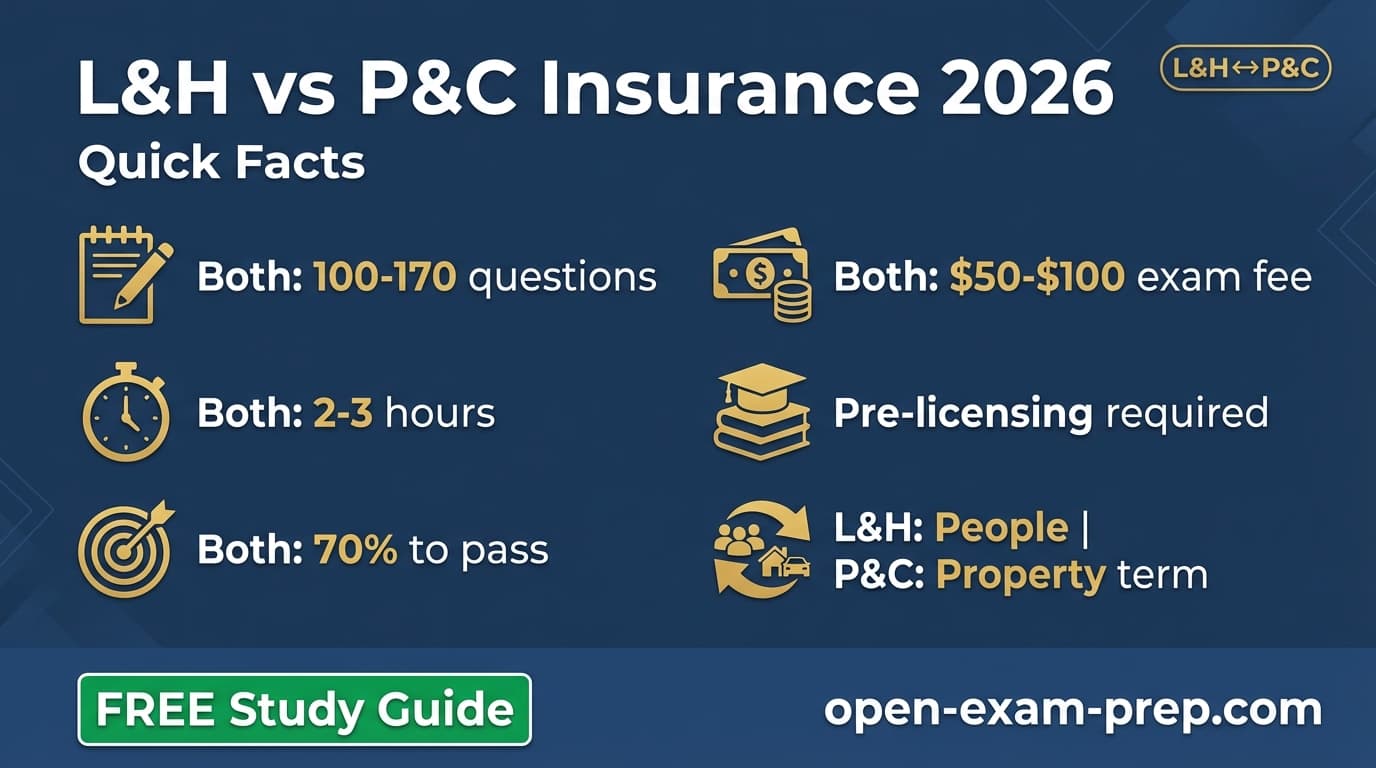
Side-by-Side Comparison
| Feature | Life & Health | Property & Casualty |
|---|---|---|
| Full Name | Life & Health Insurance License Exam | Property & Casualty Insurance License Exam |
| Exam Cost | $35 - $184 (varies by state) | $35 - $184 (varies by state) |
| Passing Score | 70% (most states) | 70% (most states) |
| Questions | 100 - 150 (varies by state) | 100 - 150 (varies by state) |
| Time Limit | 2 - 3 hours (varies by state) | 2 - 3 hours (varies by state) |
| Study Time | 40 - 70 hours over 2 - 4 weeks | 35 - 60 hours over 2 - 4 weeks |
| Difficulty | Moderate | Moderate |
| Prerequisites | Pre-licensing course completion (20 - 40 hours, varies by state) | Pre-licensing course completion (20 - 52 hours, varies by state) |
| Exam Body | State Department of Insurance (administered by PSI or Prometric) | State Department of Insurance (administered by PSI or Prometric) |
Key Differences
- 1L&H protects PEOPLE (life, health, disability, long-term care, annuities); P&C protects THINGS and LIABILITY (homes, cars, businesses, lawsuits)
- 2L&H pays massive upfront commission (40-115% first-year premium on life) but modest renewals; P&C pays moderate upfront (10-20%) with strong annual renewals that compound over decades
- 3L&H agents earn higher median salaries ($88,968 L&H vs. $47,768 P&C per ZipRecruiter), but P&C renewal income creates predictable wealth over time
- 4L&H sales require deep personal conversations about death, illness, and aging; P&C sales are more transactional and product-focused
- 5L&H exam emphasizes life/health policy types, tax treatment, and qualified plans; P&C exam emphasizes property valuations, liability concepts, and auto insurance
- 6P&C clients MUST buy insurance (auto is legally required, lenders require homeowners); L&H products are mostly voluntary, making prospecting harder
- 7L&H agents build fewer, deeper relationships; P&C agents build broader portfolios of hundreds or thousands of clients
- 8Most successful agents hold BOTH licenses, covering every client need and maximizing revenue per relationship
What Each Exam Allows You To Do
Life & Health
- Sell individual and group life insurance policies (term, whole, universal, variable)
- Sell health insurance plans (individual, group, Medicare Supplement, ACA marketplace)
- Sell disability income insurance
- Sell long-term care insurance
- Sell annuities (fixed, variable, indexed)
- Advise clients on estate planning insurance needs
- Help business owners with key person and buy-sell insurance
Property & Casualty
- Sell homeowners, renters, and condo insurance
- Sell personal and commercial auto insurance
- Sell commercial property and general liability insurance
- Sell business owner's policies (BOPs)
- Sell workers' compensation insurance
- Sell inland marine and ocean marine insurance
- Sell umbrella and excess liability policies
- Sell surety and fidelity bonds
Who Should Take Each Exam?
Take the Life & Health if you...
- →People who enjoy deep, relationship-driven sales
- →Those motivated by high first-year commission potential
- →Individuals interested in financial planning and estate protection
- →Career changers seeking uncapped earning potential
- →Anyone comfortable discussing sensitive life topics (death, illness, aging)
Take the Property & Casualty if you...
- →People who enjoy building large client portfolios with recurring revenue
- →Those who prefer tangible, easy-to-understand products (cars, homes, businesses)
- →Individuals who want steady, compounding renewal income
- →Anyone interested in commercial insurance and business clients
- →People comfortable with high-volume client relationships
Which Should You Take First?
For most aspiring insurance professionals, taking the Property & Casualty exam first is the slightly better starting point. P&C products are tangible and intuitive (everyone understands car and home insurance), making the learning curve gentler for industry newcomers. The mandatory nature of most P&C products (auto insurance is legally required, homeowners insurance is lender-required) means easier prospecting and faster initial client acquisition. However, if you are motivated by high-commission sales, are drawn to financial planning, or already have a network of people who trust you with personal conversations, starting with Life & Health may be more lucrative from day one. The honest industry answer is: plan to get BOTH licenses within your first 6 months. Most agencies expect dual-licensed agents, and every client you write for one line is a warm lead for the other. Start with whichever exam feels less intimidating, build confidence, then sit for the second within 30-60 days.
At a Glance: Life & Health vs Property & Casualty
Median Salary
$88,968
Life & Health
$47,768
Property & Casualty
Pass Rate
55-70%
Life & Health
50-65%
Property & Casualty
Study Time
40-70 hrs
Life & Health
35-60 hrs
Property & Casualty
Total Cost
$300-600
Life & Health
$300-600
Property & Casualty
Life & Health
High first-year commissions, relationship-driven sales, and financial planning careers
Property & Casualty
Steady compounding renewal income, high-volume client portfolios, and agency ownership
Start preparing today:
Key Facts: Life & Health vs Property & Casualty
- 1Life & Health insurance agents earn a median salary of $88,968 (ZipRecruiter 2024) compared to $47,768 for Property & Casualty agents, though both fall under the BLS insurance sales agent median of $60,370.
- 2Life insurance commissions range from 40-115% of the first-year premium, making a single whole life sale potentially worth $4,000-$5,750 on a $5,000 annual premium policy.
- 3Property & Casualty renewal commissions compound annually: an agent writing 100 policies per year at 15% commission can build a renewal book exceeding $80,000 annually by year five.
- 4The L&H exam pass rate ranges from 55-70% and the P&C exam pass rate ranges from 50-65%, both varying significantly by state, with the P&C exam generally considered slightly harder due to technical calculation requirements.
- 5Nearly 50% of the current insurance workforce is expected to retire by 2028, creating approximately 47,000 annual job openings and an unprecedented opportunity for new agents to acquire established books of business.
- 6Dual-licensed agents (holding both L&H and P&C) see 20-30% higher client retention rates than single-line agents, according to the Independent Insurance Agents & Brokers of America.
- 7The total cost to obtain either an L&H or P&C license ranges from $300-$600, making insurance licensing one of the most affordable professional credentials in financial services.
- 8Approximately 15-20% of exam content overlaps between L&H and P&C exams (state regulations, ethics, contract law), so passing the first exam gives a meaningful head start on the second.
Why This Comparison Matters
$4,000-$5,750
Per-Sale Commission (L&H)
A single whole life policy with $5,000 annual premium pays 80-115% first-year commission to the agent.
$80,000+
Annual Renewal Book (P&C)
Writing 100 policies/year at 15% commission builds a passive renewal book exceeding $80K by year five.
20-30%
Higher Retention (Dual License)
Dual-licensed agents see 20-30% better client retention per IIABA. Cross-selling both lines locks in clients.
This is the foundational choice every aspiring insurance professional faces. Life & Health agents build deep, relationship-driven practices around sensitive topics — life insurance, health coverage, disability, and retirement planning. Property & Casualty agents build high-volume portfolios of essential products — auto, home, commercial, and liability coverage — that renew annually and compound passive income over decades.
The industry overwhelmingly favors dual-licensed agents. According to the IIABA, agencies that cross-sell L&H to P&C clients see 20-30% higher client retention. The most successful agents don't choose between these licenses — they get both within 60-90 days and build comprehensive risk management practices that capture every client need.
What Each Exam Covers
Life & Health Exam Topics
Pass Rate: 55 - 70% (varies by state; source: state insurance department data and PSI/Prometric reports)
Property & Casualty Exam Topics
Pass Rate: 50 - 65% (varies by state; source: state insurance department data and PSI/Prometric reports)
Salary & Income Comparison
Life & Health Insurance Agent
$88,968
Median Annual Salary
Range: $45,000 - $150,000+
ZipRecruiter, 2024; BLS Insurance Sales Agents median $60,370
Top-performing L&H agents in metropolitan areas regularly exceed $200,000. Agents who build a substantial annuity or group benefits book can earn $300,000 or more within 5-7 years.
Property & Casualty Insurance Agent
$47,768
Median Annual Salary
Range: $31,530 - $95,000+
ZipRecruiter, 2024; BLS Insurance Sales Agents median $60,370
P&C agents who build substantial commercial lines books or own their own agencies can earn $150,000-$300,000+. Agency owners with large books of business often earn $500,000+ through combined commission and agency profit sharing.
| Commission Detail | Life & Health | Property & Casualty |
|---|---|---|
| First-Year Commission | 40 - 115% of first-year premium (life); 3 - 7% of premium (health) | 10 - 20% of annual premium |
| Renewal Commission | 2 - 10% of premium on life renewals; 3 - 7% ongoing for health | 10 - 15% of premium on each renewal |
| Income Model | Life insurance commissions are heavily front-loaded: you may earn 80-115% of the entire first-year premium upfront on whole life or universal life policies, then collect modest renewal commissions of 2-10% annually. Health insurance pays lower but steadier commissions of 3-7% of premium, recurring as long as the client maintains their policy. Annuity commissions typically range from 1-7% of the deposit amount. The blended model rewards relationship building, as a mature book of 300+ clients generates substantial passive renewal income. | P&C commissions follow a steady, compounding model. You earn 10-20% of the annual premium on new business, and then 10-15% every time that client renews (which happens annually for most P&C policies). Unlike life insurance, P&C clients MUST renew every year because auto insurance is legally required, mortgage lenders require homeowner's insurance, and businesses need liability coverage to operate. A single client paying $2,000/year in premiums generates $200-$300 in commission annually, indefinitely. After 5 years of writing 100 policies per year, an agent can have 500 policies generating $100,000-$150,000 in pure renewal income. |
According to ZipRecruiter 2024 data, Life & Health agents earn a median of $88,968 versus $47,768 for Property & Casualty. The BLS reports all insurance sales agents at $60,370 median, with the top 10% exceeding $125,000. L&H medians are elevated by agents selling annuities and group benefits; P&C medians are depressed by captive agents on salary-plus-commission structures.
The real income divergence happens at the 5-10 year mark. Experienced P&C agents with 500+ policies earn $100,000-$150,000 from renewals alone. Experienced L&H agents in group benefits or annuities reach $150,000-$300,000+. Agency owners in either line frequently earn $300,000-$500,000+.
Total Cost to Get Licensed
| Expense | Life & Health | Property & Casualty |
|---|---|---|
| Pre-Licensing Education | $150 - $500 (20-40 hour state-approved course) | $150 - $500 (20-52 hour state-approved course) |
| Exam Fee | $35 - $184 (varies by state; PSI or Prometric) | $35 - $184 (varies by state; PSI or Prometric) |
| License Fee | $15 - $200 (state application and license fee) | $15 - $200 (state application and license fee) |
| Background Check | $50 - $100 (fingerprinting and background check) | $50 - $100 (fingerprinting and background check; may be waived if already on file from L&H) |
| Total Investment | $300 - $600 (most candidates spend approximately $350-$450) | $300 - $600 (most candidates spend approximately $350-$450; slightly less if background check already completed) |
A Day in the Life
Life & Health Professional
A Life & Health agent starts the morning reviewing client files before a 10:00 AM appointment with a young couple who just had their first child. Over coffee at their kitchen table, the agent conducts a needs analysis: existing employer coverage, mortgage balance, income replacement requirements, college funding goals. The agent recommends a $500,000 30-year term life policy for each parent and a supplemental health insurance plan to cover gaps in employer coverage. The afternoon includes a phone call with a 58-year-old client approaching retirement to review annuity options, followed by a group benefits presentation to a small business owner considering offering health insurance to her 12 employees for the first time.
Property & Casualty Professional
A Property & Casualty agent begins the day processing three auto policy renewals flagged for rate changes and calling those clients to explain adjustments. At 11:00 AM, the agent meets with a commercial client who owns a restaurant to review their business owner's policy, general liability, liquor liability, and workers' compensation coverage ahead of renewal. After lunch, the agent quotes homeowners insurance for two referrals from a local real estate agent, follows up with a contractor about a commercial auto fleet policy, and ends the day running a comparative rating for a family that wants to bundle their auto and home coverage. The agent processes 15-20 client touchpoints throughout the day.
Career Paths & Progression
Life & Health Career Path
0-2 years
Captive Agent (MetLife, Prudential, NYL)
$35K-$50K
2-5 years
Independent Agent / Multi-Carrier
$60K-$120K
5-8 years
Specialist (Estate Planning, Group Benefits)
$120K-$200K
8+ years
General Agent / MGA
$200K-$400K+
Property & Casualty Career Path
0-2 years
Personal Lines Agent (Auto & Home)
$30K-$50K
2-5 years
Multi-Line Agent
$55K-$100K
5-8 years
Commercial Lines Specialist
$100K-$200K
8+ years
Agency Owner
$200K-$500K+
Both paths lead to agency ownership, consulting, or carrier-side leadership. L&H agents typically progress from captive to independent, then specialize in estate planning, executive benefits, or group health — often earning CLU or ChFC designations. P&C agents move from personal lines to commercial lines, where single accounts generate $5,000-$50,000+ in annual premium, and pursue CPCU or CIC designations. Agency ownership in P&C creates a sellable asset valued at 1.5-2.5x annual revenue.
Start preparing today:
Should You Get Both the L&H and P&C Licenses?
Benefits
- +Cover every insurance need a client has, dramatically increasing revenue per client and lifetime value
- +Cross-selling L&H to P&C clients increases retention by 20-30% (IIABA data), meaning your renewal book compounds faster
- +Most agencies and carriers expect or require dual-licensed agents, giving you significantly more employment and appointment options
- +The overlapping exam content (state regulations, ethics, general principles) means the second license is 25-30% easier to earn after passing the first
- +Creating a complete risk management practice makes your book of business more valuable if you ever sell your agency (books with both lines command premium valuations)
Considerations
- !Studying for both exams requires 75-130 hours total, though the overlap reduces the combined time vs. studying independently
- !Maintaining two licenses means double the continuing education requirements (typically 24 hours per license biennially, though many states allow overlapping CE credits)
- !Early-career agents may struggle to develop expertise in both areas simultaneously; some mentors recommend mastering one line for 6-12 months before adding the other
The Verdict: Getting both the L&H and P&C licenses is the industry standard for successful insurance professionals, and the data overwhelmingly supports it. Dual-licensed agents earn more, retain clients longer, and build more valuable books of business. The only question is timing. If you are entering insurance as a career, plan to hold both licenses within your first 6 months. If you are adding insurance as a supplemental license (e.g., you are primarily a real estate agent or financial advisor), start with the license most relevant to your existing client base and add the second within a year.
Job Outlook & Industry Trends
4% (2024-2034, BLS)
Life & Health Job Growth (2024-2034)
4% (2024-2034, BLS)
Property & Casualty Job Growth (2024-2034)
The BLS projects 4% growth for insurance sales agents through 2034, with approximately 47,000 new openings annually. The real opportunity is the massive retirement wave: nearly 50% of the current insurance workforce will retire by 2028, creating unprecedented opportunities for new agents to acquire established books of business. Industry associations have flagged this "talent gap" as their most pressing challenge — making 2025-2030 arguably the best window to enter insurance in a generation.
Study Strategy & Tips
Foundation
Shared material + first exam pre-licensing
- Complete pre-licensing course (20-40 hours)
- Study shared content: regulations, ethics, contract law
- Begin first exam practice questions
First Exam
Intensive prep and pass first exam
- Focus on exam-specific topics (L&H or P&C)
- Take 3-5 full-length timed practice exams
- Schedule and pass first exam
Second Exam Prep
Leverage overlap for second license
- Complete second pre-licensing course
- Focus on unique second-exam content only
- Skip shared material already mastered
Pass & Apply
Pass second exam and get licensed
- Take 2-3 practice exams for second license
- Schedule and pass second exam
- Submit license applications for both
Total Duration: 8-12 weeks for both licenses (part-time study)
Life & Health Study Tips
- 1Master the differences between term, whole life, universal life, and variable life insurance before anything else. These distinctions form the backbone of 35-40% of the exam and are the most frequently tested concepts.
- 2Create a comparison chart of health insurance plan types (HMO, PPO, EPO, POS) including cost-sharing mechanics, referral requirements, and network rules. Exam questions often present scenarios requiring you to identify the correct plan type.
- 3Memorize the tax treatment rules: life insurance death benefits are generally income-tax-free (IRC Section 101), annuity withdrawals follow LIFO for tax purposes, and the 10% early withdrawal penalty applies before age 59 1/2. Tax questions appear on every state exam.
- 4Study the "7-pay test" for Modified Endowment Contracts (MECs), the contestability period (2 years in most states), and the free-look period (10-30 days depending on state). These regulatory details are high-frequency test items.
- 5Take at least 3-5 full-length practice exams under timed conditions. The L&H exam covers enormous breadth, so repetition with practice questions is the single most effective study strategy. Focus extra time on questions you get wrong.
Property & Casualty Study Tips
- 1Focus on named perils vs. open perils (all-risk) coverage distinctions. The exam frequently tests whether a specific loss scenario is covered under a named-peril homeowners policy (HO-1, HO-2) versus an open-peril policy (HO-3, HO-5). Know the 16 named perils by heart.
- 2Master auto insurance coverage parts: liability (Part A), medical payments (Part B), uninsured/underinsured motorist (Part C), and physical damage (Part D). Understand split limits vs. combined single limits, and know when each coverage applies in real scenarios.
- 3Learn the coinsurance formula inside and out: (insurance carried / insurance required) x loss = recovery. The exam will present calculation problems where the insured carries less than the required 80% coinsurance, and you must compute the penalty.
- 4Create flashcards for Commercial General Liability (CGL) policy exclusions and the difference between occurrence-based and claims-made coverage triggers. Commercial lines questions are heavily weighted and trip up many test-takers.
- 5Practice calculating actual cash value (ACV = replacement cost minus depreciation) vs. replacement cost value (RCV). These valuation methods appear in multiple question types across property, auto, and commercial coverages.
Ready to Start Studying?
Free practice questions, study guides, and AI tutoring for the matching exam resources.
Frequently Asked Questions
QWhich insurance license should I get first, Life & Health or Property & Casualty?
The best starting license depends on your personality, existing network, and career goals. Property & Casualty is generally recommended as the first license for most newcomers because the products are tangible and intuitive (everyone understands cars and homes), the demand is mandatory (auto insurance is legally required, homeowners insurance is lender-required), and the sales conversations are less emotionally complex. This makes P&C an excellent training ground for developing insurance sales skills. However, if you are naturally drawn to financial planning, comfortable discussing sensitive life topics, or have an existing network of people who trust you with personal matters, starting with Life & Health can be more lucrative from day one due to higher per-sale commissions. The most practical approach is to take whichever exam feels less intimidating first, build confidence and momentum, then sit for the second exam within 30-60 days. Most agencies expect dual-licensed agents, so plan for both regardless of which comes first.
QHow much do Life & Health vs Property & Casualty agents actually earn?
Income varies dramatically based on experience, specialization, and business model. According to ZipRecruiter 2024 data, L&H agents earn a median of $88,968 while P&C agents earn $47,768. The BLS reports all insurance sales agents at a median of $60,370 with the top 10% exceeding $125,000. However, these figures are misleading in isolation. L&H medians are elevated by agents selling high-value products like group benefits and annuities. P&C medians are depressed by captive agents on salary-plus-commission structures. In practice, first-year agents in either line typically earn $35,000-$55,000 while building their client base. By years 3-5, competent agents in either specialty commonly earn $80,000-$120,000. The real income divergence happens at the senior level: L&H agents who specialize in executive benefits or group health brokerage can reach $200,000-$400,000, while P&C agents who build large commercial books or own agencies can match or exceed those figures through compounding renewal income. Dual-licensed agents consistently outearn single-line agents at every career stage.
QIs the Life & Health exam harder than the Property & Casualty exam?
Neither exam is definitively harder, but they test different cognitive skills. The L&H exam pass rate (55-70%) is slightly higher than the P&C pass rate (50-65%), which might suggest P&C is harder, but this is partly because P&C has more calculation-based questions (coinsurance formulas, actual cash value calculations, depreciation) that trip up candidates who are weak in math. The L&H exam covers an enormous breadth of material: life insurance policy types, health insurance plans, annuities, qualified plans, tax treatment, and disability/long-term care insurance. Many candidates find the sheer volume of L&H material more challenging to memorize, even though individual questions may be less computational. The P&C exam is more narrowly focused but goes deeper into technical concepts like coverage triggers, policy exclusions, and valuation methods. If you are comfortable with math and analytical reasoning, you may find P&C easier. If you are better at memorization and conceptual understanding, L&H may feel more natural. Both exams require 35-70 hours of dedicated study for well-prepared candidates.
QCan I sell both Life & Health and Property & Casualty insurance with one license?
No. Life & Health and Property & Casualty are separate licenses in all 50 states and require separate exams, separate pre-licensing courses, and separate license applications. This is because the products, regulations, and professional knowledge required are fundamentally different. L&H involves financial protection for people (life insurance, health insurance, disability, annuities) and is regulated differently due to the long-term nature of the contracts and the vulnerability of the populations served. P&C involves protection for property and liability, with different actuarial principles, policy structures, and claims processes. To sell both lines, you must hold both licenses and maintain continuing education for each. The good news is that most states allow you to take both exams on the same day or within the same testing window, and the combined cost is only $600-$1,200 total. Many pre-licensing providers offer bundled L&H + P&C courses at a discount. There is no rule against studying for both simultaneously if you have the capacity.
QWhat is the commission difference between Life & Health and Property & Casualty insurance?
The commission structures are fundamentally different and create distinct income patterns. Life insurance pays a front-loaded commission of 40-115% of the first-year annual premium. On a whole life policy with a $5,000 annual premium, the agent might earn $4,000-$5,750 upfront. However, renewal commissions on life policies are modest (2-10%), and once a term life policy is in force, there is little ongoing work. Health insurance pays a steadier 3-7% of premium for as long as the policy is active, creating reliable recurring income. Property & Casualty pays 10-20% of the annual premium on new business and 10-15% on each annual renewal. A P&C auto policy at $1,500/year pays the agent $150-$300 per year, forever, as long as the client stays. The key economic insight is that L&H creates income spikes (great for cash flow) while P&C creates compounding income (great for wealth building). A P&C agent with 500 active policies averaging $1,800 in premium earns approximately $135,000 per year in renewal commission alone, without writing a single new policy. This is why agency valuations in P&C are often higher per dollar of revenue than in L&H: the renewal income is more predictable.
QHow long does it take to get both insurance licenses?
Most motivated candidates can earn both the L&H and P&C licenses within 60-90 days from starting their first pre-licensing course. Here is a realistic timeline: Pre-licensing for your first exam takes 1-3 weeks depending on your state's hour requirements (20-52 hours of coursework) and whether you choose self-paced online or classroom instruction. Add 1-2 weeks of self-study and practice exams after completing the pre-licensing course. Schedule and pass the first exam. Then begin pre-licensing for the second exam, which will go faster because 15-20% of the content overlaps. Most candidates need only 1-2 weeks of additional study for the second exam. From start to finish: 4-8 weeks for both licenses is common for full-time students, or 8-12 weeks for those studying part-time while working. Some ambitious candidates complete both in as little as 4-5 weeks by taking an intensive bundled course. After passing both exams, the license application process takes 1-4 weeks depending on your state's processing time and background check requirements. Budget approximately $600-$1,200 total for both licenses including pre-licensing courses, exam fees, license applications, and background checks.

Your AI study companion · 10 free interactions a day
Free exam resources
Start Studying the Exact Exam
Use the comparison to choose a path, then move into the matching practice questions, study guide, and flashcards.
Third-party resources · We may earn a commission from purchases.
Life & Health Insurance License Mastery 2025-2026: Complete Study Guide with 500 Practice Questions and Detailed Answer Explanations
By Harris, Josephine Yvette
$19.99 · 
 Prep course on Achievable
 Online course on Mometrix
 Take courses on Udemy
Third-party resources · We may earn a commission from purchases.

Property and Casualty Insurance License Exam Study Guide: Property Casualty Insurance Book and Practice Test Questions [3rd Edition]
By Tpb Publishing
$34.99 ·
Take courses on UdemyOnline course on MometrixPrep course on AchievableRelated Exam Comparisons
Stay Updated
Get free exam tips and study guides delivered to your inbox.