NMLS MLO vs Life & Health
Both licenses serve homebuyers at the biggest financial moment of their lives. MLOs earn higher per-loan income ($4,000-$5,000) but face market cycles, while L&H agents build recession-resistant renewal income — together they form the complete "homebuyer advisor" package.
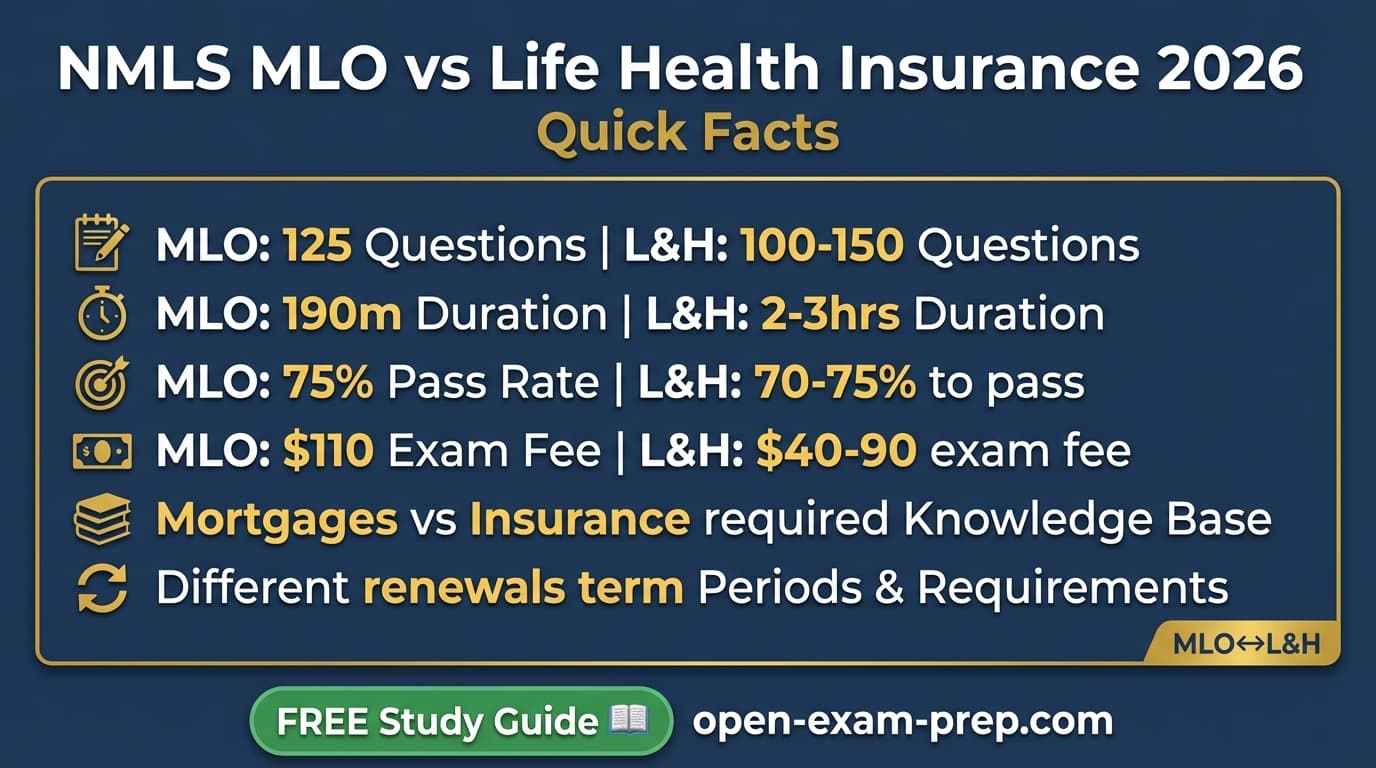
Side-by-Side Comparison
| Feature | NMLS MLO | Life & Health |
|---|---|---|
| Full Name | NMLS SAFE Mortgage Loan Originator (MLO) License Exam | Life & Health Insurance License Exam |
| Exam Cost | ~$110 (NMLS exam fee) | $35 - $184 (varies by state) |
| Passing Score | 75% (nationally standardized) | 70% (most states) |
| Questions | 125 (115 scored + 10 unscored pilot questions) | 100 - 150 (varies by state) |
| Time Limit | 190 minutes (3 hours 10 minutes) | 2 - 3 hours (varies by state) |
| Study Time | 60 - 100 hours over 3 - 6 weeks | 40 - 70 hours over 2 - 4 weeks |
| Difficulty | Moderate to Difficult | Moderate |
| Prerequisites | 20 hours of NMLS-approved pre-licensing education (federal requirement) | Pre-licensing course completion (20 - 40 hours, varies by state) |
| Exam Body | Nationwide Multistate Licensing System (NMLS), administered by Prometric | State Department of Insurance (administered by PSI or Prometric) |
Key Differences
- 1MLO commission is larger per transaction (~$4,000-$5,000 per $400K loan at 1%) but entirely one-time; L&H commission is smaller per sale but generates compounding renewal income for years
- 2The NMLS exam is federally standardized through the SAFE Act (125 questions, 75% passing score, 190 minutes); the L&H exam varies by state (100-150 questions, 70% passing, 2-3 hours)
- 3MLO income is highly cyclical, tied to interest rates and housing activity (2022-2023 rate spikes caused 40-60% income declines for many MLOs); L&H income is recession-resistant
- 4The NMLS exam has a 54-56% first-time pass rate compared to 55-70% for L&H, making the MLO exam slightly more challenging on average
- 5MLO licensing is federally regulated (SAFE Act) with a standardized national exam; insurance licensing is state-regulated with varying requirements in each state
- 6Total licensing cost: MLO runs $500-$1,000 vs. $300-$600 for L&H insurance
- 7Both licenses serve homebuyers at the same life event, creating a natural "mortgage + life insurance" cross-sell package
- 8MLO requires 20 hours of federal pre-licensing education; L&H requires 20-40 hours of state-approved pre-licensing coursework
What Each Exam Allows You To Do
NMLS MLO
- Originate residential mortgage loans (conventional, FHA, VA, USDA)
- Take mortgage applications and counsel borrowers on loan options
- Process and submit loan packages to underwriting
- Advise homebuyers on loan products, rates, and qualification requirements
- Work with real estate agents, appraisers, and title companies
- Serve as a federally licensed mortgage professional in any state (with state-specific add-on)
Life & Health
- Sell individual and group life insurance policies (term, whole, universal, variable)
- Sell health insurance plans (individual, group, Medicare Supplement)
- Sell disability income and long-term care insurance
- Sell annuities (fixed, variable, indexed)
- Advise clients on estate planning and financial protection needs
- Help business owners with key person insurance and buy-sell agreements
- Cross-sell life insurance to mortgage clients for mortgage protection
Who Should Take Each Exam?
Take the NMLS MLO if you...
- →People who enjoy complex financial transactions and problem-solving
- →Those who want higher per-transaction income ($4,000-$5,000+ per loan)
- →Individuals comfortable with federal regulatory compliance (TILA, RESPA, ECOA)
- →People who thrive in a fast-paced, deadline-driven environment
- →Those interested in the real estate ecosystem and housing finance
Take the Life & Health if you...
- →People who build deep, trust-based relationships
- →Those motivated by residual, compounding income over time
- →Individuals interested in financial planning and family protection
- →Career changers seeking recession-resistant income
- →Anyone who wants to pair insurance with mortgage or real estate services
Which Should You Take First?
The choice between MLO and L&H first depends on your income needs and risk tolerance. If you want higher per-transaction income and are comfortable with cyclical market conditions, the MLO license provides larger immediate paychecks ($4,000-$5,000 per loan). If you want to build long-term passive income and prefer recession-resistant revenue, L&H insurance is the stronger foundation. From a pure exam-preparation perspective, the L&H exam is slightly easier (higher pass rate, lower passing score, shorter pre-licensing requirement) and less expensive to obtain ($300-$600 vs. $500-$1,000). Strategically, the ideal approach is to obtain both licenses and position yourself as a comprehensive homebuyer advisor. If you are already in the mortgage industry, adding L&H is a high-ROI move: every borrower who takes out a mortgage should be asked about life insurance to protect that obligation. If you are already in insurance, adding the MLO license captures the larger mortgage commission and positions you as a one-stop homebuyer resource.
At a Glance: NMLS MLO vs Life & Health
Median Salary
$74,180
NMLS MLO
$88,968
Life & Health
Pass Rate
54-56%
NMLS MLO
55-70%
Life & Health
Study Time
60-100 hrs
NMLS MLO
40-70 hrs
Life & Health
Total Cost
$500-1,000
NMLS MLO
$300-600
Life & Health
NMLS MLO
Higher per-transaction income ($4K-$5K per loan) in the real estate ecosystem
Life & Health
Recession-resistant compounding renewal income and long-term financial planning careers
Start preparing today:
Key Facts: NMLS MLO vs Life & Health
- 1Mortgage loan officers earn a median salary of $74,180 (BLS, May 2024), while Life & Health insurance agents earn a median of $88,968 (ZipRecruiter, 2024), a difference of approximately $14,800 in favor of insurance.
- 2MLO commission per transaction (~$4,000-$5,000 on a $400K loan) is larger than most individual insurance policy commissions, but MLO income is entirely one-time with no residual component.
- 3The NMLS SAFE exam has a first-time pass rate of 54-56%, making it one of the more challenging financial services licensing exams, compared to 55-70% for the Life & Health exam.
- 4The NMLS exam is nationally standardized (125 questions, 75% passing, 190 minutes) while L&H exams vary by state (100-150 questions, 70% passing, 2-3 hours).
- 5MLO income is highly cyclical: during the 2022-2023 interest rate spike, many loan officers experienced 40-60% income declines, while L&H insurance income remained stable.
- 6Every mortgage borrower is a natural life insurance prospect because the mortgage creates a debt obligation that life insurance can protect, making MLO + L&H a natural dual-license combination.
- 7Total licensing cost for MLO ($500-$1,000) is higher than L&H insurance ($300-$600), and the MLO license additionally requires a credit report review and potential surety bond.
- 8Loan officer job growth (2% through 2034, ~20,300 openings/year) significantly trails insurance sales agent growth (4%, ~47,000 openings/year), partly because the insurance industry faces a massive retirement wave with 50% of the workforce retiring by 2028.
Why This Comparison Matters
$4,000-$5,000
Per-Loan MLO Commission
At ~1% of a $400K mortgage, each closed loan generates a large one-time payout — but zero residual income.
Recession-Resistant
L&H Income Stability
Families maintain life and health coverage regardless of rate cycles — L&H renewal income held steady through the 2022-2023 rate spike that cut MLO earnings 40-60%.
$4,400-$6,200
Homebuyer Package Revenue
Dual-licensed professionals earn mortgage commission plus life insurance commission on every home purchase, with ongoing insurance renewals for decades.
The NMLS MLO license and the Life & Health insurance license serve the exact same client at the exact same moment — the homebuyer making the largest financial commitment of their life. The mortgage creates the debt obligation; life insurance protects the family's ability to maintain it. A dual-licensed professional can deliver a complete "homebuyer package" in a single conversation, capturing $4,400-$6,200 per transaction plus decades of insurance renewal income.
The critical distinction is income cyclicality. MLO income is among the most volatile in financial services — the 2022-2023 rate spike cut many loan officers' earnings by 40-60% while L&H agents' renewal books continued paying monthly without interruption. Despite the obvious synergy, few professionals hold both licenses because mortgage and insurance operate in separate ecosystems. The professional who bridges that gap captures revenue from both transactions and builds a counter-cyclical career that weathers any market.
What Each Exam Covers
NMLS MLO Exam Topics
Pass Rate: 54 - 56% first-time pass rate (source: NMLS annual reports)
Life & Health Exam Topics
Pass Rate: 55 - 70% (varies by state; source: state insurance department data)
Salary & Income Comparison
Mortgage Loan Officer
$74,180
Median Annual Salary
Range: $35,000 - $150,000+
BLS, May 2024
Top-producing loan officers in active markets can earn $200,000-$500,000+ annually. However, income is highly correlated with interest rate environments and housing market activity. During the 2020-2021 refinancing boom, many MLOs earned record incomes; during the 2022-2023 rate spike, many experienced 40-60% income declines.
Life & Health Insurance Agent
$88,968
Median Annual Salary
Range: $45,000 - $150,000+
ZipRecruiter, 2024; BLS Insurance Sales Agents median $60,370
Top L&H agents specializing in group benefits, executive plans, or annuity sales earn $200,000-$400,000+. The key differentiator is that L&H income is recession-resistant: people maintain life and health coverage even during economic downturns.
| Commission Detail | NMLS MLO | Life & Health |
|---|---|---|
| First-Year Commission | ~1% of loan amount (typically 0.5-1.5%, varies by employer and loan type) | 40 - 115% of first-year premium (life); 3 - 7% of premium (health) |
| Renewal Commission | None - mortgage commission is a one-time per-transaction payment | 2 - 10% on life renewals; 3 - 7% ongoing for health |
| Income Model | MLO compensation follows a per-transaction model. On a $400,000 mortgage, the loan officer typically earns approximately 1% ($4,000) in commission or origination fee income. Some employers pay a base salary plus reduced commission, while others offer 100% commission with higher splits. The CFPB prohibits loan officers from being compensated based on loan terms (rate, points), so compensation is strictly tied to loan amount. There is no residual income: once the loan closes, income from that transaction is complete. The average MLO closes 3-5 loans per month, generating $12,000-$25,000 in monthly gross commission during normal market conditions. | Life & Health insurance provides a blended income model combining large upfront commissions with compounding residual income. A $5,000 annual premium whole life policy pays the agent $2,000-$5,750 in first-year commission. Health insurance policies pay a steadier 3-7% of premium annually, recurring as long as the client maintains coverage. Annuities pay 1-7% of the deposit amount. Unlike mortgage origination, every insurance sale continues paying the agent for years through renewal commissions, creating a financial base that grows with each client added to the book. |
The BLS reports mortgage loan officers at a median of $74,180 (May 2024), while ZipRecruiter places L&H agents at $88,968. Per-transaction income favors the MLO — a single $400K mortgage generates roughly $4,000-$5,000 at 1% — but that income is entirely one-time with no residual component. MLO earnings swung wildly during 2020-2023, while L&H agents' renewal books held steady.
The real divergence is long-term. L&H agents who specialize in group benefits or annuities reach $200,000-$400,000+, and every past client continues generating renewal income. A dual-licensed professional combining MLO transaction income with L&H renewals can realistically earn $100,000-$200,000 annually, with the insurance side providing increasing stability as the book grows.
Total Cost to Get Licensed
| Expense | NMLS MLO | Life & Health |
|---|---|---|
| Pre-Licensing Education | $200 - $500 (20-hour NMLS-approved pre-licensing education) | $150 - $500 (20-40 hour state-approved course) |
| Exam Fee | ~$110 (NMLS national exam fee) | $35 - $184 (varies by state) |
| License Fee | $100 - $300 (state-specific MLO license application + NMLS processing) | $15 - $200 (state application and license fee) |
| Background Check | $50 - $100 (FBI criminal background check + credit report) | $50 - $100 (fingerprinting and background check) |
| Total Investment | $500 - $1,000 (most candidates spend approximately $600-$800; additional surety bond may be required in some states) | $300 - $600 (most candidates spend approximately $350-$450) |
A Day in the Life
NMLS MLO Professional
A Mortgage Loan Officer starts the morning reviewing rate sheets from three wholesale lenders and locking rates for two borrowers whose purchase contracts are approaching closing deadlines. At 9:30 AM, the MLO takes a new loan application from a first-time homebuyer referred by a real estate agent partner, explaining FHA loan requirements, minimum down payment, and mortgage insurance premiums. At 11:00 AM, the MLO calls an underwriter to discuss a condition on a loan in process that requires additional documentation. After lunch, the MLO meets with a self-employed borrower to review two years of tax returns and discuss non-QM loan options. The afternoon includes preparing two pre-approval letters, following up with three real estate agents about pipeline referrals, and attending a local real estate networking event from 5:00-6:30 PM.
Life & Health Professional
A Life & Health insurance agent begins the day with a phone consultation with a 35-year-old client who just had a second child, reviewing their existing coverage and recommending an increase from $500,000 to $1,000,000 in term life insurance to account for the additional dependent and recent home purchase. At 10:30 AM, the agent conducts a needs analysis for a couple who received a referral from their mortgage lender: the couple just closed on a $450,000 home and the agent recommends a $450,000 30-year term life policy for each spouse plus supplemental disability income coverage. After lunch, the agent reviews three annual health insurance renewals, comparing current plans against marketplace alternatives. The afternoon includes a group benefits presentation to a 20-employee dental practice considering employer-sponsored life and disability coverage, followed by client follow-up calls and policy application processing.
Career Paths & Progression
NMLS MLO Career Path
0-2 years
Junior Loan Officer (Bank/Brokerage)
$35K-$55K
2-5 years
Loan Officer with Referral Network
$70K-$120K
5-8 years
Niche Specialist (Jumbo/FHA-VA/Commercial)
$120K-$200K
8+ years
Branch Manager / Brokerage Owner
$200K-$500K+
Life & Health Career Path
0-2 years
Captive Agent (Individual Life & Health)
$35K-$55K
2-5 years
Independent Agent / Multi-Carrier
$65K-$120K
5-8 years
Specialist (Group Benefits, Annuities, Estate)
$120K-$250K
8+ years
General Agent / MGA / Agency Owner
$250K-$400K+
MLOs advance from junior originator to niche specialist (jumbo, FHA/VA, commercial) to branch manager or brokerage owner. L&H agents progress from captive to independent, then specialize in group benefits, annuities, or estate planning — earning CLU or ChFC designations. Holding both licenses creates a comprehensive homebuyer advisor practice where insurance renewals stabilize the cyclical mortgage business.
Start preparing today:
Should You Get Both an MLO License and a Life & Health License?
Benefits
- +Every mortgage borrower is a natural life insurance prospect: the mortgage creates the debt obligation, and life insurance protects the family's ability to maintain that obligation if the breadwinner dies
- +The combined "homebuyer package" generates approximately $4,400-$6,200 per transaction ($4K-$5K mortgage commission + $400-$1,200 life insurance commission) plus ongoing renewal income from insurance
- +L&H renewal income provides a financial floor during mortgage market downturns (rising rate environments, housing slowdowns), creating counter-cyclical income stability
- +The cross-sell is natural and non-pushy: "You just took on a $400K mortgage. A $400K term life policy at $25-$40/month ensures your family keeps the home if something happens to you."
- +Dual licensing positions you as a comprehensive homebuyer advisor, differentiating you from single-service competitors and generating more referrals
Considerations
- !The NMLS license requires annual continuing education (8 hours, including NMLS-specific content) in addition to L&H CE requirements (typically 24 hours biennially), creating a combined CE obligation
- !Mortgage origination is time-intensive during active markets, potentially limiting the time available for insurance sales and client servicing
- !Compliance requirements differ substantially between federal mortgage regulations (CFPB oversight) and state insurance regulations (Department of Insurance oversight), requiring familiarity with two separate regulatory frameworks
The Verdict: The MLO + L&H dual license is an underutilized combination with compelling economics. The natural client overlap (every homebuyer needs both a mortgage and life insurance), the counter-cyclical income profiles (mortgage booms when rates are low; insurance is steady regardless), and the per-transaction revenue increase ($4,400-$6,200 combined vs. $4,000-$5,000 MLO-only) make a strong case for holding both licenses. The main barrier is that mortgage and insurance operate in separate professional ecosystems, so you must proactively build the cross-sell workflow into your practice. For any MLO looking to add income stability or any insurance agent looking to capture larger per-transaction revenue, adding the other license is a high-ROI career move.
Job Outlook & Industry Trends
2% (2024-2034, BLS for loan officers), approximately 20,300 openings/year
NMLS MLO Job Growth (2024-2034)
4% (2024-2034, BLS for insurance sales agents), approximately 47,000 openings/year
Life & Health Job Growth (2024-2034)
Loan officer growth is projected at just 2% (2024-2034) with ~20,300 annual openings, constrained by interest rate sensitivity. Insurance sales agents fare better at 4% growth with ~47,000 annual openings — and nearly 50% of the current insurance workforce is expected to retire by 2028, creating an unprecedented talent gap. Holding both licenses lets you capture higher MLO per-transaction income during favorable markets while insurance renewals provide a structural floor.
Study Strategy & Tips
NMLS Pre-Licensing
Complete 20-hour federal pre-licensing requirement
- Enroll in NMLS-approved 20-hour pre-licensing course
- Study federal laws: TILA, RESPA, ECOA, HMDA, FCRA
- Learn Loan Estimate and Closing Disclosure forms
- Begin practice questions on mortgage products
NMLS Exam Prep & Pass
Intensive NMLS exam preparation
- Focus on scenario-based federal law questions (23-25% of exam)
- Master loan products: conventional, FHA, VA, USDA
- Study ethics, prohibited practices, and consumer protection
- Take 5-6 full-length practice exams (target 80%+)
- Schedule and pass the NMLS SAFE exam
L&H Pre-Licensing
Complete state pre-licensing and core L&H content
- Enroll in state-approved 20-40 hour pre-licensing course
- Study life insurance types: term, whole, universal, variable
- Create comparison charts for health plans: HMO, PPO, EPO, POS
- Learn annuity mechanics and tax treatment rules
L&H Exam Prep & Pass
Pass L&H exam and submit both license applications
- Focus on life insurance policies (35-40% of exam)
- Master health insurance provisions (25-30% of exam)
- Study state regulations and ethics (15-20% of exam)
- Take 3-5 full-length practice exams
- Schedule and pass the L&H exam, submit license applications
Total Duration: 6-10 weeks for both licenses (sequential study)
NMLS MLO Study Tips
- 1Master the federal laws: TILA (Truth in Lending Act), RESPA (Real Estate Settlement Procedures Act), ECOA (Equal Credit Opportunity Act), HMDA (Home Mortgage Disclosure Act), and FCRA (Fair Credit Reporting Act). These laws comprise 23-25% of the exam and are the most frequently failed section.
- 2Understand the Loan Estimate (LE) and Closing Disclosure (CD) forms inside and out. Know the timing requirements (LE within 3 business days of application, CD at least 3 business days before closing), tolerance levels for fee changes, and what triggers a new waiting period.
- 3Study loan product types in detail: conventional (conforming and jumbo), FHA (minimum down payment, MIP rules), VA (entitlement, funding fee, no PMI), and USDA (eligibility, geographic requirements). Know the qualifying differences between each program.
- 4Learn the prohibited practices thoroughly: steering, loan flipping, equity stripping, redlining, and dual compensation. Ethics and fraud prevention questions comprise 15-17% of the exam and often present scenario-based questions requiring judgment.
- 5Take at least 5-6 full-length practice exams. The NMLS exam has a 54-56% first-time pass rate, so rigorous practice is essential. Focus on the "why" behind each answer, not just memorization, because the exam tests application of knowledge to scenarios.
Life & Health Study Tips
- 1Focus on the life insurance section first (35-40% of exam). Master the differences between term, whole life, universal life, and variable life insurance. Know policy provisions like the grace period, reinstatement rules, nonforfeiture options, and settlement options.
- 2Create comparison charts for health plan types (HMO, PPO, EPO, POS) covering premiums, deductibles, copays, coinsurance, out-of-pocket maximums, referral requirements, and network restrictions.
- 3Memorize tax treatment rules: Section 101 (death benefits generally income-tax-free), LIFO treatment for annuity withdrawals, Section 1035 exchanges, and the 10% early withdrawal penalty before age 59 1/2.
- 4Study state-specific regulations carefully (15-20% of exam): licensing requirements, unfair trade practices, replacement regulations, and the free-look period for your state.
- 5Use practice exams as your primary study tool in the final week. The L&H exam rewards breadth of knowledge, and practice exams expose gaps efficiently.
Ready to Start Studying?
Free practice questions, study guides, and AI tutoring for the matching exam resources.
Frequently Asked Questions
QWhich license pays more, NMLS MLO or Life & Health insurance?
The answer depends on your time horizon and market conditions. On a per-transaction basis, the MLO license generates more income: a $400,000 mortgage produces approximately $4,000-$5,000 in commission (at 1% of loan amount), while an individual life insurance policy might pay $500-$5,750 depending on the product and premium. However, the MLO commission is a one-time payment with no residual income. The L&H agent earns renewal commissions on every policy sold, creating a compounding income base that grows each year. The BLS reports MLO median salary at $74,180, while ZipRecruiter places L&H agents at a median of $88,968. The most important distinction is income stability. MLO income swings dramatically with interest rate cycles: during the 2020-2021 refinance boom, many MLOs earned record incomes of $200,000-$500,000+. During the 2022-2023 rate spike, many of those same MLOs saw income drop 40-60%. L&H insurance income is fundamentally recession-resistant because people maintain their life and health coverage regardless of economic conditions. Over a full economic cycle (7-10 years), a disciplined L&H agent with a growing renewal book will typically match or exceed MLO cumulative earnings while experiencing far less income volatility.
QIs the NMLS exam harder than the Life & Health insurance exam?
The NMLS SAFE exam is generally considered slightly more difficult than the L&H insurance exam, based on pass rate data and candidate feedback. The NMLS first-time pass rate is 54-56% compared to 55-70% for L&H. The NMLS exam requires a 75% passing score (you can miss approximately 29 of 115 scored questions), while most state L&H exams require 70%. The NMLS exam is heavily weighted toward federal regulatory compliance (TILA, RESPA, ECOA, HMDA, FCRA), which requires not just memorization but the ability to apply regulations to specific lending scenarios. Many candidates struggle with the scenario-based questions that require judgment calls about compliance situations. The L&H exam covers broader material (life insurance, health insurance, annuities, disability, long-term care, tax treatment) but relies more on memorization and classification rather than regulatory application. The L&H exam is also state-specific, meaning you can use state-targeted study materials, while the NMLS exam is nationally standardized with a uniform state content section. If you are strong with regulatory compliance and analytical reasoning, the NMLS exam may feel manageable. If you prefer memorization-based exams, L&H may be more comfortable.
QCan a mortgage loan officer also sell life insurance?
Yes, a mortgage loan officer can sell life insurance if they hold a valid Life & Health insurance license in addition to their MLO license. There is no regulatory prohibition against holding both licenses. However, the cross-sell must be handled with proper disclosure and compliance. The Consumer Financial Protection Bureau (CFPB) regulations prohibit MLOs from conditioning mortgage terms on the purchase of other products, so you cannot imply that buying life insurance will affect the borrower's mortgage rate or approval. The insurance sale must be clearly presented as a separate, voluntary transaction. In practice, most dual-licensed MLO/insurance agents introduce the life insurance conversation after the loan has been approved or at closing, when the borrower's financial picture is clear and the mortgage terms are locked. The script is straightforward: "Congratulations on your loan approval. You are about to take on a $400,000 obligation. Have you considered how your family would maintain the mortgage payments if something happened to you? I am also a licensed insurance agent and can help you explore your options, but this is completely separate from your mortgage." This approach is compliant, natural, and converts at a high rate because the borrower is already thinking about financial commitment.
QWhat is the "homebuyer package" strategy for dual-licensed professionals?
The "homebuyer package" is a practice model where a professional holding both MLO and L&H licenses provides a comprehensive financial solution for homebuyers: mortgage financing plus life insurance protection. The concept is simple but powerful. Every homebuyer needs a mortgage (unless paying cash) and should have life insurance to protect the mortgage obligation. Instead of the buyer working with separate professionals for each need, the dual-licensed advisor handles both, providing a seamless experience. The economics are compelling: on a $400,000 home purchase, the mortgage commission is approximately $4,000-$5,000 (at 1% of loan amount), and the life insurance commission is approximately $400-$1,200 for a 30-year term policy matching the mortgage amount, plus $50-$150 in annual renewal commission. Combined, each transaction generates $4,400-$6,200 in immediate income plus recurring insurance renewal income. Over time, the insurance renewal base from hundreds of past mortgage clients creates a substantial passive income stream. The key to executing this strategy is workflow integration: the life insurance conversation should be a standard step in your loan origination process, introduced after loan approval and positioned as responsible financial planning rather than a sales pitch.
QHow does income stability compare between mortgage origination and insurance?
Income stability is the most significant practical difference between these two careers. Mortgage origination income is among the most cyclical in financial services. It is directly tied to three variables the MLO cannot control: interest rates (set by the Federal Reserve and market forces), housing supply and demand (driven by construction, demographics, and inventory), and general economic conditions (employment, consumer confidence, lending standards). When these variables are favorable (low rates, strong economy, ample inventory), MLOs can earn exceptionally well. When they are unfavorable (high rates, recession, tight inventory), income can drop precipitously. The 2022-2023 period demonstrated this vividly: as the Federal Reserve raised rates from near-zero to over 5%, mortgage volume collapsed and thousands of loan officers left the industry. Life & Health insurance income has a fundamentally different character. Life insurance policies are long-term contracts that remain in force regardless of economic conditions. Health insurance is a necessity that people maintain through recessions. The L&H agent's renewal book continues generating commissions every month whether the economy is booming or contracting. An L&H agent with 500 active policies generating $80,000 in annual renewal income receives that income during recessions, housing crashes, and rate spikes. For this reason, many mortgage professionals add L&H insurance specifically to create a counter-cyclical income buffer.
QWhat are the continuing education requirements for each license?
Both licenses require ongoing continuing education (CE), but the structures differ. The NMLS MLO license requires **8 hours of annual continuing education**, including 3 hours of federal law and regulations, 2 hours of ethics (including fraud, consumer protection, and fair lending), and 2 hours of nontraditional mortgage lending. The remaining 1 hour covers elective topics. This CE must be completed through NMLS-approved providers, and failure to complete CE by December 31 each year results in the inability to renew the license. Additionally, MLOs must maintain their NMLS record, which includes annual filing and renewal fees. The L&H insurance license typically requires **24 hours of continuing education every two years** (biennially), though this varies by state. Many states require specific CE topics such as ethics, long-term care, and flood insurance. Some states accept online CE courses, while others require classroom attendance for certain topics. The combined CE obligation for a dual-licensed professional is approximately 32 hours over a two-year cycle (8 hours annually for NMLS + 24 hours biennially for insurance). While this is a meaningful time investment, it is manageable and ensures that dual-licensed professionals stay current on evolving regulations and products in both fields.
10 free AI interactions per day
Free exam resources
Start Studying the Exact Exam
Use the comparison to choose a path, then move into the matching practice questions, study guide, and flashcards.
Third-party resources · We may earn a commission from purchases.

NMLS Study Guide 2026-2027 - 5 Full-Length Practice Tests, SAFE MLO Exam Prep Secrets Book for the Mortgage Loan Originator Exam: [4th Edition]
By Bowling, Matthew
$39.99 · 
 MLO pre-licensing on Aceable Mortgage
 Take courses on Udemy
 Flashcards on Mometrix
Third-party resources · We may earn a commission from purchases.

Life and Health Insurance License Exam Prep 2025-2026: Ace Your First Try with Proven Strategy, Full-Length Practice Tests, Detailed Answer Explanations
By Publishing, Sageway
$24.99 ·
Flashcards on MometrixTake courses on Udemy Prep course on Achievable
Related Exam Comparisons
Stay Updated
Get free exam tips and study guides delivered to your inbox.