Real Estate vs Life & Health
Two accessible commission-based careers with very different income patterns: real estate pays one-time transaction commissions ($56,320 median), while L&H insurance builds compounding renewal income ($88,968 median). Every homebuyer is a natural life insurance prospect, making this a powerful dual-license combination.
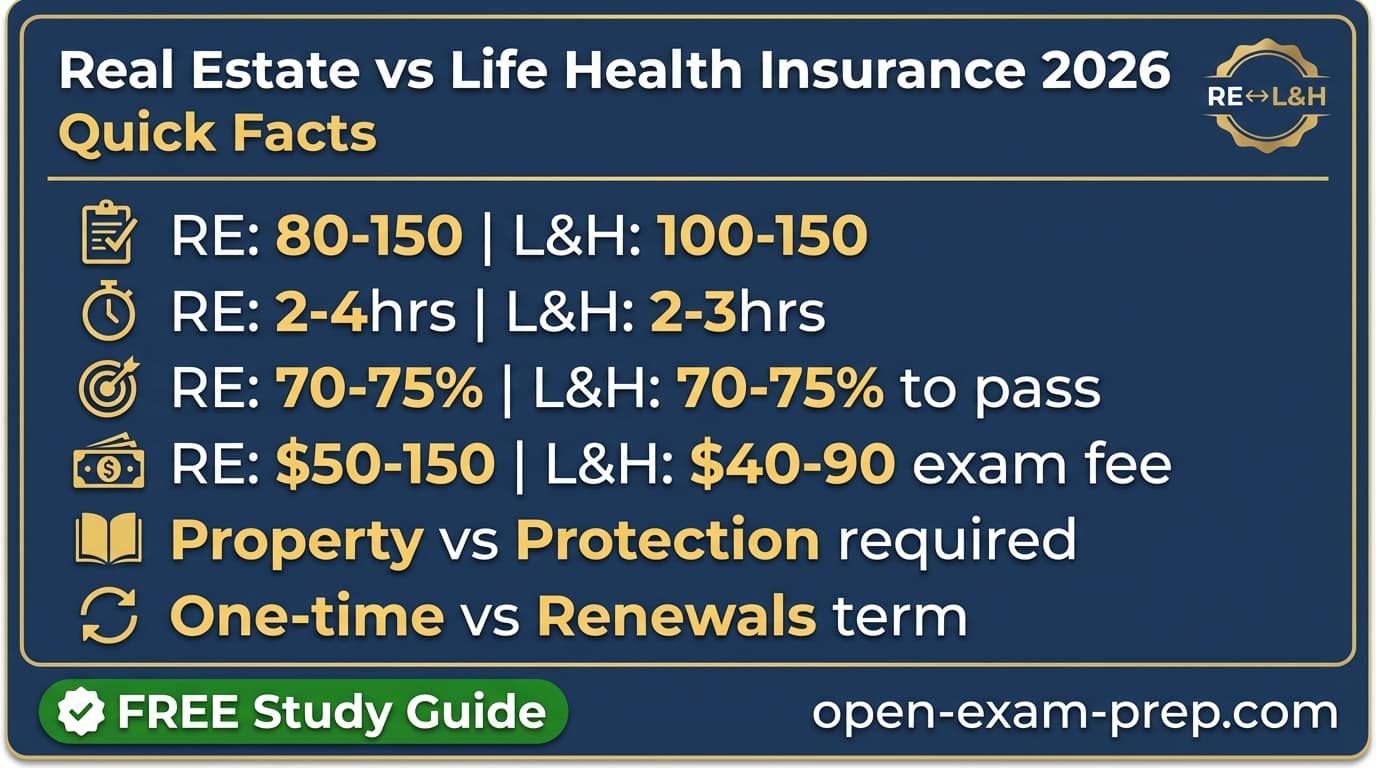
Side-by-Side Comparison
| Feature | Real Estate | Life & Health |
|---|---|---|
| Full Name | Real Estate Salesperson License Exam | Life & Health Insurance License Exam |
| Exam Cost | $50 - $100 (varies by state) | $35 - $184 (varies by state) |
| Passing Score | 70 - 75% (varies by state) | 70% (most states) |
| Questions | 100 - 150 (national + state portions) | 100 - 150 (varies by state) |
| Time Limit | 2.5 - 4 hours (varies by state) | 2 - 3 hours (varies by state) |
| Study Time | 100 - 200 hours over 4 - 12 weeks (including pre-licensing coursework) | 40 - 70 hours over 2 - 4 weeks |
| Difficulty | Moderate to Difficult | Moderate |
| Prerequisites | Pre-licensing course completion (60 - 180 hours, varies dramatically by state) | Pre-licensing course completion (20 - 40 hours, varies by state) |
| Exam Body | State Real Estate Commission (administered by PSI, Pearson VUE, or state-specific providers) | State Department of Insurance (administered by PSI or Prometric) |
Key Differences
- 1Pre-licensing time commitment differs massively: real estate requires 60-180 hours of coursework (varies by state) vs. only 20-40 hours for Life & Health insurance
- 2Total licensing cost: real estate runs $400-$1,200 vs. $300-$600 for L&H insurance, making insurance significantly cheaper to enter
- 3Income model: real estate is 100% transactional with zero residual income; L&H insurance builds compounding renewal income that pays you for years after each sale
- 4First-year earnings: 50-70% of new real estate agents earn less than $30,000 in year one; L&H agents with strong networks can earn $40,000-$60,000 in year one from commissions
- 5Real estate commissions per transaction are larger ($5,000-$8,400 net on a $400K home) but infrequent; L&H commissions are smaller per sale but accumulate across hundreds of policies
- 6Real estate requires evening and weekend availability for showings and open houses; insurance allows more traditional business-hour scheduling
- 7Real estate income is highly cyclical (tied to housing market, interest rates, seasons); insurance income is recession-resistant (people maintain life and health coverage in downturns)
- 8Natural pairing: every homebuyer needs life insurance to protect their mortgage, making these licenses complementary
What Each Exam Allows You To Do
Real Estate
- Represent buyers and sellers in residential real estate transactions
- List properties for sale and conduct open houses
- Negotiate purchase agreements and counteroffers
- Guide clients through inspections, appraisals, and closing
- Lease residential and commercial properties
- Conduct comparative market analyses (CMAs)
- Build referral networks with lenders, inspectors, and contractors
Life & Health
- Sell individual and group life insurance policies
- Sell health insurance plans (individual, group, Medicare Supplement)
- Sell disability income and long-term care insurance
- Sell annuities (fixed, variable, indexed)
- Advise clients on estate planning and retirement income needs
- Help business owners with key person and buy-sell insurance
- Cross-sell insurance products to existing professional networks
Who Should Take Each Exam?
Take the Real Estate if you...
- →People who enjoy face-to-face client interaction and networking
- →Self-starters comfortable with 100% commission income
- →Individuals who want flexible schedules (evenings and weekends required)
- →Those drawn to tangible products (homes) and local community involvement
- →People with strong local market knowledge and social networks
Take the Life & Health if you...
- →People who build deep, trust-based client relationships
- →Those motivated by high first-year commission potential
- →Individuals interested in financial planning and wealth protection
- →Career changers with existing professional networks to leverage
- →Anyone seeking residual, compounding income over time
Which Should You Take First?
If you are deciding between these two licenses, the answer depends on your financial runway and risk tolerance. If you have 6-12 months of savings and are comfortable with a slow income ramp, real estate offers higher per-transaction earnings and the excitement of working with tangible properties. If you need income sooner and want to build a sustainable income base, Life & Health insurance is the better starting point: the licensing is faster (2-4 weeks vs. 4-12 weeks), cheaper ($300-$600 vs. $400-$1,200), and the renewal commission model means every sale you make today continues paying you in future years. The strategically optimal answer is to get both licenses, starting with whichever aligns with your immediate opportunity. Real estate agents who add L&H can offer life insurance to every homebuyer, and insurance agents who add real estate can capture the home purchase transaction. If forced to choose one, L&H insurance offers more predictable income and lower startup costs.
At a Glance: Real Estate vs Life & Health
Median Salary
$56,320
Real Estate
$88,968
Life & Health
Pass Rate
50-61%
Real Estate
55-70%
Life & Health
Study Time
100-200 hrs
Real Estate
40-70 hrs
Life & Health
Total Cost
$400-1,200
Real Estate
$300-600
Life & Health
Real Estate
Tangible property sales, local networking, and high per-transaction commissions
Life & Health
Compounding renewal income, financial planning careers, and faster licensing
Start preparing today:
Key Facts: Real Estate vs Life & Health
- 1Real estate agents earn a median salary of $56,320 (BLS, May 2024) while Life & Health insurance agents earn a median of $88,968 (ZipRecruiter, 2024), a difference of over $32,000.
- 2Real estate pre-licensing requires 60-180 hours of coursework depending on state, while L&H insurance requires only 20-40 hours, making insurance significantly faster to enter.
- 3Total cost to obtain a real estate license ($400-$1,200) is roughly double the cost of an L&H insurance license ($300-$600).
- 4Real estate commission is one-time per transaction (2.5-3% of sale price with broker split), while L&H insurance pays renewal commissions (2-10% on life, 3-7% on health) that compound annually.
- 5Approximately 75-80% of new real estate agents leave the industry within their first two years, primarily due to income volatility, compared to approximately 50-60% attrition in insurance.
- 6The real estate exam first-time pass rate is 50-61%, comparable to the L&H exam pass rate of 55-70%, though the real estate exam requires significantly more study time due to broader subject matter.
- 7Every homebuyer is a natural life insurance prospect (mortgage protection need), making real estate + L&H one of the most powerful dual-license combinations for cross-selling.
- 8The insurance industry projects 50% workforce retirement by 2028, creating approximately 47,000 annual openings, while real estate projects 46,300 annual openings driven primarily by agent turnover.
Why This Comparison Matters
75-80%
New RE Agent Attrition
Three-quarters of new real estate agents leave the industry within two years, primarily due to the feast-or-famine income cycle with zero residual income.
$30,000/yr
L&H Renewal Income (Year 2)
A second-year L&H agent with 100 active health clients at $500/month premium and 5% commission earns ~$30K in pure renewal income before writing new policies.
Natural Cross-Sell
Homebuyer → Life Insurance
Every homebuyer needs mortgage protection. Dual-licensed agents convert closings into $200-$600 immediate commission plus annual renewals on every transaction.
Both licenses offer accessible entry into commission-based careers without a college degree, but the financial architecture is fundamentally different. Real estate is 100% transactional with zero residual income — each closing is a one-time event, creating the feast-or-famine cycle that drives 75-80% of new agents out within two years. Life & Health insurance builds compounding renewal income where every sale continues paying for years, giving agents a growing financial floor.
What makes this pairing uniquely powerful is the natural client overlap: every homebuyer needs mortgage protection life insurance. Dual-licensed agents convert real estate closings into insurance sales with no additional prospecting, while insurance renewals smooth out real estate's income volatility. The professionals who earn the most over a 10-year career are those who hold both licenses and leverage each client relationship across multiple product lines.
What Each Exam Covers
Real Estate Exam Topics
Pass Rate: 50 - 61% first-time pass rate (varies by state; source: state real estate commission data)
Life & Health Exam Topics
Pass Rate: 55 - 70% (varies by state; source: state insurance department data and PSI/Prometric reports)
Salary & Income Comparison
Real Estate Sales Agent
$56,320
Median Annual Salary
Range: $28,000 - $120,000+
BLS, May 2024 (agents); broker median $72,280
Top-producing real estate agents in major metropolitan markets routinely earn $200,000-$500,000+. Real estate brokers who manage teams and take overrides on agent production can earn $300,000-$1,000,000+. However, 50-70% of new agents earn less than $30,000 in their first year.
Life & Health Insurance Agent
$88,968
Median Annual Salary
Range: $45,000 - $150,000+
ZipRecruiter, 2024; BLS Insurance Sales Agents median $60,370
Top L&H agents earn $200,000-$400,000+ through high-value niches like group benefits, executive plans, and annuity sales. Agents who build books of 500+ clients can generate $100,000+ in pure renewal income annually.
| Commission Detail | Real Estate | Life & Health |
|---|---|---|
| First-Year Commission | 2.5 - 3% of sale price (gross), split with brokerage (typically 50/50 to 70/30) | 40 - 115% of first-year premium (life); 3 - 7% of premium (health) |
| Renewal Commission | None - each transaction is a one-time event with no residual income | 2 - 10% annually on life renewals; 3 - 7% ongoing for health policies |
| Income Model | Real estate operates on a pure transaction-based model. On a $400,000 home sale, the total commission is approximately 5-6% ($20,000-$24,000), split between the listing and buyer's agent. Each agent's share (2.5-3%) is then split with their brokerage, often 50/50 for new agents improving to 70/30 or 80/20 for top producers. The agent's net on a $400,000 sale might be $5,000-$8,400 depending on their split. There is zero residual income: once the transaction closes, the income stops until the next deal. This creates a feast-or-famine cycle that is the defining financial challenge of real estate careers. | Life & Health insurance provides a blended income model with both upfront and residual components. Life insurance pays a large front-loaded commission (40-115% of the first-year premium), then modest annual renewals. Health insurance pays a steadier recurring commission (3-7% of premium) for as long as the client maintains their policy. Annuity commissions range from 1-7% of the deposit amount. The critical difference from real estate is that every sale you make today continues paying you commissions in future years, creating a compounding income base that grows as your client roster expands. |
Real estate agents earn a median of $56,320 (BLS, May 2024) while L&H insurance agents earn $88,968 (ZipRecruiter, 2024). The gap is partly explained by income distribution: 50-70% of new RE agents earn less than $30,000 in year one, while first-year L&H agents typically earn $35,000-$55,000 with steady growth from renewal commissions.
Over a 10-year career, L&H agents who write 8-10 policies per month generally out-earn RE agents closing 12-15 transactions per year, because the insurance renewal base compounds annually while real estate demands constant new transactions. Top RE agents in major markets can reach $300,000-$1,000,000+, but top L&H agents reach $200,000-$400,000 through a more replicable path of systematic client acquisition plus compounding renewals.
Total Cost to Get Licensed
| Expense | Real Estate | Life & Health |
|---|---|---|
| Pre-Licensing Education | $200 - $1,000 (60-180 hour state-approved course; varies widely by state and provider) | $150 - $500 (20-40 hour state-approved course) |
| Exam Fee | $50 - $100 (state exam fee) | $35 - $184 (varies by state) |
| License Fee | $100 - $300 (state license application) | $15 - $200 (state application and license fee) |
| Background Check | $30 - $80 (fingerprinting and background check) | $50 - $100 (fingerprinting and background check) |
| Total Investment | $400 - $1,200 (most candidates spend $500-$800; additional costs include MLS dues $200-$500/year and brokerage fees) | $300 - $600 (most candidates spend $350-$450) |
A Day in the Life
Real Estate Professional
A real estate agent starts the morning reviewing new MLS listings and preparing a comparative market analysis for an afternoon listing appointment. At 10:00 AM, the agent meets a first-time homebuyer couple for a showing tour of four properties in their target neighborhood, answering questions about school districts, property taxes, and potential renovation costs. After lunch, the agent presents a listing proposal to homeowners looking to sell, discussing pricing strategy, staging recommendations, and marketing plans. The agent spends late afternoon negotiating a counteroffer via phone and email between a buyer and seller, then hosts a twilight open house from 5:00-7:00 PM, collecting contact information from six visitors for follow-up.
Life & Health Professional
A Life & Health insurance agent begins the day reviewing a needs analysis questionnaire submitted by a young professional who recently got married. At 10:00 AM, the agent conducts a virtual meeting with the newlywed couple, discussing income replacement needs, existing employer benefits, and a recommended $750,000 term life policy plus supplemental disability income coverage. After lunch, the agent calls three existing clients whose annual health insurance renewals are approaching, reviewing plan changes and premium adjustments. The agent spends the afternoon preparing a group benefits proposal for a 25-employee accounting firm, comparing three carrier options for health, dental, vision, life, and disability coverage. The day ends with a check-in call to a 62-year-old client exploring Medicare Supplement options ahead of her 65th birthday.
Career Paths & Progression
Real Estate Career Path
0-2 years
Residential Sales Agent (Brokerage-Affiliated)
$28K-$45K
2-5 years
Specialist Agent (Luxury/Investment/Commercial)
$60K-$120K
5-8 years
Team Leader / Associate Broker
$120K-$200K
8+ years
Brokerage Owner / Developer
$200K-$500K+
Life & Health Career Path
0-2 years
Captive Agent (MetLife, Prudential, NYL)
$35K-$55K
2-5 years
Independent Multi-Carrier Agent
$60K-$120K
5-8 years
Specialist (Group Benefits / Medicare / Estate)
$120K-$200K
8+ years
General Agent / MGA
$200K-$400K+
Real estate agents progress from residential sales to specialization (luxury, commercial, investment) to broker/owner, with the long-term wealth play often being personal property investing. L&H agents move from captive to independent, then specialize in group benefits, Medicare, or estate planning — often adding CLU/ChFC designations or securities licenses (Series 6, 7, 66) — with the book of business itself valued at 1.5-2.5x annual revenue at retirement.
Start preparing today:
Should You Get Both a Real Estate License and a Life & Health License?
Benefits
- +Every homebuyer is a warm lead for life insurance (mortgage protection), creating a natural cross-sell at every closing that generates additional commission plus residual income
- +Insurance renewal commissions smooth the feast-or-famine income cycle that causes 75-80% of new real estate agents to leave the industry within two years
- +Dual licensing increases your value proposition to clients: you become a one-stop advisor for the biggest financial decisions of their lives (home + protection)
- +During real estate market downturns, seasonal slowdowns, or rising interest rate environments, insurance income provides financial stability
- +Building a book of insurance clients creates a sellable asset that real estate transactions alone do not (insurance books are valued at 1.5-2.5x annual revenue)
Considerations
- !Managing two active practices requires strong time management: real estate demands evenings/weekends for showings, while insurance appointments typically occur during business hours
- !Compliance obligations double: you must maintain continuing education for both licenses, typically 15-24 hours biennially for each, and adhere to separate regulatory frameworks
- !Some real estate brokerages have policies about agents conducting insurance business; verify your brokerage agreement permits outside business activities before investing in the second license
The Verdict: Holding both a real estate and L&H insurance license is one of the most strategically powerful dual-license combinations available to individual professionals. The natural client overlap (homebuyers who need life insurance) creates an organic cross-sell pipeline that requires no additional prospecting. The insurance renewal income solves real estate's biggest weakness (income volatility), and the real estate transaction pipeline solves insurance's biggest challenge (finding qualified prospects). If you are serious about building a sustainable, high-income career in either field, adding the other license within your first 12-18 months is a high-ROI investment of $300-$1,200 and 2-8 weeks of study time.
Job Outlook & Industry Trends
3% (2024-2034, BLS), approximately 46,300 openings/year
Real Estate Job Growth (2024-2034)
4% (2024-2034, BLS for insurance sales agents), approximately 47,000 openings/year
Life & Health Job Growth (2024-2034)
The BLS projects ~46,300 annual openings for real estate agents (3% growth) and ~47,000 annual openings for insurance sales agents (4% growth) through 2034. The insurance industry has a stronger structural tailwind: nearly 50% of the current workforce is projected to retire by 2028, creating unprecedented opportunities to acquire established books of business. Real estate openings are more dependent on housing market conditions and interest rates, while insurance demand remains recession-resistant.
Study Strategy & Tips
RE Pre-Licensing
Complete real estate pre-licensing coursework (the larger commitment)
- Enroll in state-approved RE pre-licensing course (60-180 hours)
- Study property law, contracts, agency, and finance foundations
- Create flashcards for 200+ RE-specific terms
- Practice RE math daily: commissions, prorations, LTV ratios
RE Exam Prep
Intensive review and pass the real estate exam
- Dedicate 30% of study time to state-specific law and regulations
- Take 4-5 full-length timed practice exams
- Review Fair Housing Act protections and all seven protected classes
- Schedule and pass the real estate exam
L&H Pre-Licensing
Complete L&H pre-licensing while study habits are sharp
- Enroll in state-approved L&H pre-licensing course (20-40 hours)
- Build comparison charts for life insurance and health plan types
- Memorize tax treatment rules: death benefits, LIFO, 10% penalty before 59 1/2
- Begin L&H practice questions alongside coursework
L&H Exam & Launch
Pass L&H exam and apply for both licenses
- Take 3-5 full-length timed L&H practice exams
- Focus on contestability period, free-look provisions, and MEC 7-pay test
- Schedule and pass the L&H exam
- Submit license applications for both RE and L&H
Total Duration: 10-16 weeks for both licenses (part-time study)
Real Estate Study Tips
- 1Master the vocabulary first. Real estate uses hundreds of specialized terms (encumbrance, easement, lien, escheat, eminent domain) that you must know cold. Create flashcards for at least 200 key terms before diving into practice questions.
- 2Focus heavily on contracts and agency relationships, which together comprise 20-25% of the national portion. Understand the differences between listing agreements (exclusive right to sell, exclusive agency, open listing) and buyer representation agreements.
- 3Learn real estate math thoroughly: loan-to-value ratios, property tax calculations, commission splits, prorations, capitalization rates, and gross rent multiplier. Math questions appear on every state exam and are easy points if you know the formulas.
- 4Study Fair Housing Act protections in detail. There are seven protected classes under federal law (race, color, religion, national origin, sex, familial status, disability), and your state may add additional protected classes. Fair housing questions are heavily tested.
- 5Take the state-specific portion of your prep course seriously. State laws on agency disclosure, license maintenance, trust account handling, and continuing education requirements can differ significantly from national standards and comprise 15-25% of the exam.
Life & Health Study Tips
- 1Master the four main life insurance policy types (term, whole life, universal life, variable life) and their distinguishing features. These distinctions are tested repeatedly and comprise the largest exam section at 35-40%.
- 2Create a comparison matrix for health insurance plan types (HMO, PPO, EPO, POS) covering referral requirements, out-of-network coverage, and cost-sharing mechanics. Know the differences cold.
- 3Focus on tax treatment rules: life insurance death benefits are generally income-tax-free, annuity withdrawals follow LIFO, and the 10% penalty applies before age 59 1/2. Tax questions appear on every state exam.
- 4Study the contestability period (typically 2 years), free-look provisions (10-30 days), and the 7-pay test for Modified Endowment Contracts. These regulatory concepts are frequently tested.
- 5Take at least 4-5 full practice exams under timed conditions. The L&H exam covers enormous breadth, so repetition is the most effective study strategy.
Ready to Start Studying?
Free practice questions, study guides, and AI tutoring for the matching exam resources.
Frequently Asked Questions
QWhich is easier to get, a real estate license or a Life & Health insurance license?
The Life & Health insurance license is objectively easier and faster to obtain than a real estate license in every measurable dimension. L&H pre-licensing requires 20-40 hours of coursework (completable in 1-2 weeks at an accelerated pace) compared to 60-180 hours for real estate (requiring 3-10 weeks). The total cost is lower for L&H ($300-$600 vs. $400-$1,200 for real estate). The L&H exam pass rate (55-70%) is comparable to or slightly higher than the real estate pass rate (50-61%). The real estate exam also covers broader subject matter including property law, contract law, finance, taxation, fair housing, and extensive state-specific regulations, while the L&H exam focuses more narrowly on insurance products and regulations. From application to active license, most candidates can complete the L&H process in 3-5 weeks compared to 6-14 weeks for real estate. If speed to market and lower startup costs are priorities, L&H insurance is the clear winner.
QDo real estate agents make more money than insurance agents?
On a per-transaction basis, real estate agents often earn more per deal. A $400,000 home sale can net the agent $5,000-$8,400 after broker splits, which is more than most individual insurance policy commissions. However, L&H insurance agents earn more in aggregate: the median L&H agent earns $88,968 compared to $56,320 for real estate agents (ZipRecruiter and BLS data). The critical difference is income consistency. Real estate income is entirely transactional with zero residual component. If you do not close a deal this month, you earn nothing. Insurance agents build compounding renewal income: every policy sold today generates commissions for years. After 5 years of consistent production, an L&H agent can have $50,000-$100,000+ in annual renewal income providing a financial floor. New real estate agents face the steepest income challenge: 50-70% earn less than $30,000 in their first year, and 75-80% leave the industry within two years, primarily due to income volatility. New L&H agents with even modest production can earn $35,000-$55,000 in their first year.
QCan I be both a real estate agent and a Life & Health insurance agent?
Yes, holding both licenses is legal and increasingly common. There are no regulatory barriers to maintaining active real estate and L&H insurance licenses simultaneously in any state. However, there are important practical considerations. First, check your real estate brokerage agreement: some brokerages restrict outside business activities, so you need written permission or a brokerage that supports dual practice. Second, when offering insurance products to real estate clients, you must make proper disclosures to avoid conflicts of interest. The client must understand that you are acting in a separate capacity when recommending insurance products, and you cannot make insurance purchase a condition of real estate representation. Third, you will have dual continuing education obligations: typically 15-24 hours biennially for each license. Many successful dual-license holders structure their practice so that real estate is the lead-generation engine (open houses, listings, buyer representation) and insurance is the cross-sell and retention strategy (life insurance at closing, annual policy reviews to stay in touch for future real estate referrals).
QIs insurance a good side income for real estate agents during slow markets?
Insurance is arguably the best income supplement available to real estate agents, for several reasons. First, the licensing is fast and affordable: 20-40 hours of pre-licensing coursework and $300-$600 total cost, completable in 3-5 weeks. Second, your existing real estate client base is a pre-qualified prospect list for life insurance. Every homebuyer you have ever closed a deal for has a mortgage they need to protect. A simple follow-up call to past clients offering a mortgage protection review can generate 3-5 insurance appointments per week without any cold prospecting. Third, and most importantly, insurance builds residual income that pays during real estate downturns. If you write 5-8 life and health policies per month during your first year, you will have 60-96 active policies generating renewal commissions by your second year, providing $15,000-$30,000 in annual passive income that arrives regardless of the housing market. During the 2020-2021 COVID market disruption and the 2022-2023 interest rate spike, real estate agents with insurance books had financial stability that pure real estate agents did not. The investment of 3-5 weeks and $300-$600 pays for itself many times over within the first year.
QWhat are the biggest challenges of each career path?
Real estate's biggest challenge is income volatility. New agents often go 2-4 months before their first closing, and even experienced agents can have months with zero closings. The 100% commission structure means no salary floor, no benefits, and no paid time off. Other challenges include the demanding schedule (clients expect availability on evenings, weekends, and holidays), high marketing costs ($500-$2,000/month for leads, advertising, and farming), and intense local competition (there are over 1.5 million active real estate licensees in the U.S.). Life & Health insurance's biggest challenge is rejection. Insurance is a "push" product, unlike real estate where buyers come to you; L&H agents must proactively prospect and convince people to address uncomfortable topics like death, illness, and aging. Many people resist buying insurance, and the rejection rate is high. Other challenges include lengthy carrier onboarding and contracting processes, complex compliance requirements (especially for variable products and Medicare), and the discipline required to consistently prospect even after renewal income starts flowing. Both careers demand resilience, self-motivation, and the ability to manage irregular cash flow, especially in the early years.
QHow do pass rates compare for real estate vs Life & Health exams?
The pass rates are broadly comparable but favor Life & Health slightly. The real estate exam has a first-time pass rate of 50-61% depending on the state, while the L&H insurance exam has a first-time pass rate of 55-70%. The similar pass rates mask important differences in exam structure and study requirements. The real estate exam covers a wider breadth of topics: property law, contracts, agency, finance, appraisal, taxation, fair housing, environmental hazards, and state-specific regulations. This breadth means candidates must spread their study time across many subjects. The L&H exam is narrower in scope but requires deeper mastery of specific insurance products and their regulatory treatment. The real estate exam typically has both a national and state-specific portion, each of which must be passed independently. The L&H exam is usually a single unified exam with state-specific questions integrated throughout. For candidates who have been out of academic settings for a while, the L&H exam is generally considered more approachable because the material, while dense, is more intuitive (most adults have some familiarity with life and health insurance concepts) than real estate law and finance.
10 free AI interactions per day
Free exam resources
Start Studying the Exact Exam
Use the comparison to choose a path, then move into the matching practice questions, study guide, and flashcards.
Third-party resources · We may earn a commission from purchases.

PSI Real Estate Exam Prep 2025-2026 - 3 Full-Length Practice Tests, Secrets Study Guide for the PSI National License: [3rd Edition]
By Matthew Bowling
$32.99 · 
 Study guide on Mometrix
 Take courses on Udemy
 Pre-licensing on Colibri
Third-party resources · We may earn a commission from purchases.

Life and Health Insurance License Exam Prep 2025-2026: Ace Your First Try with Proven Strategy, Full-Length Practice Tests, Detailed Answer Explanations
By Publishing, Sageway
$24.99 ·
Flashcards on MometrixTake courses on Udemy Prep course on Achievable
Related Exam Comparisons
Stay Updated
Get free exam tips and study guides delivered to your inbox.