Property & Casualty vs NMLS MLO
Two essential pillars of every home purchase: P&C covers mandatory homeowners insurance, NMLS handles mortgage financing. Together with a real estate license, they form "the property professional stack" — capturing commissions from every angle of the home transaction.
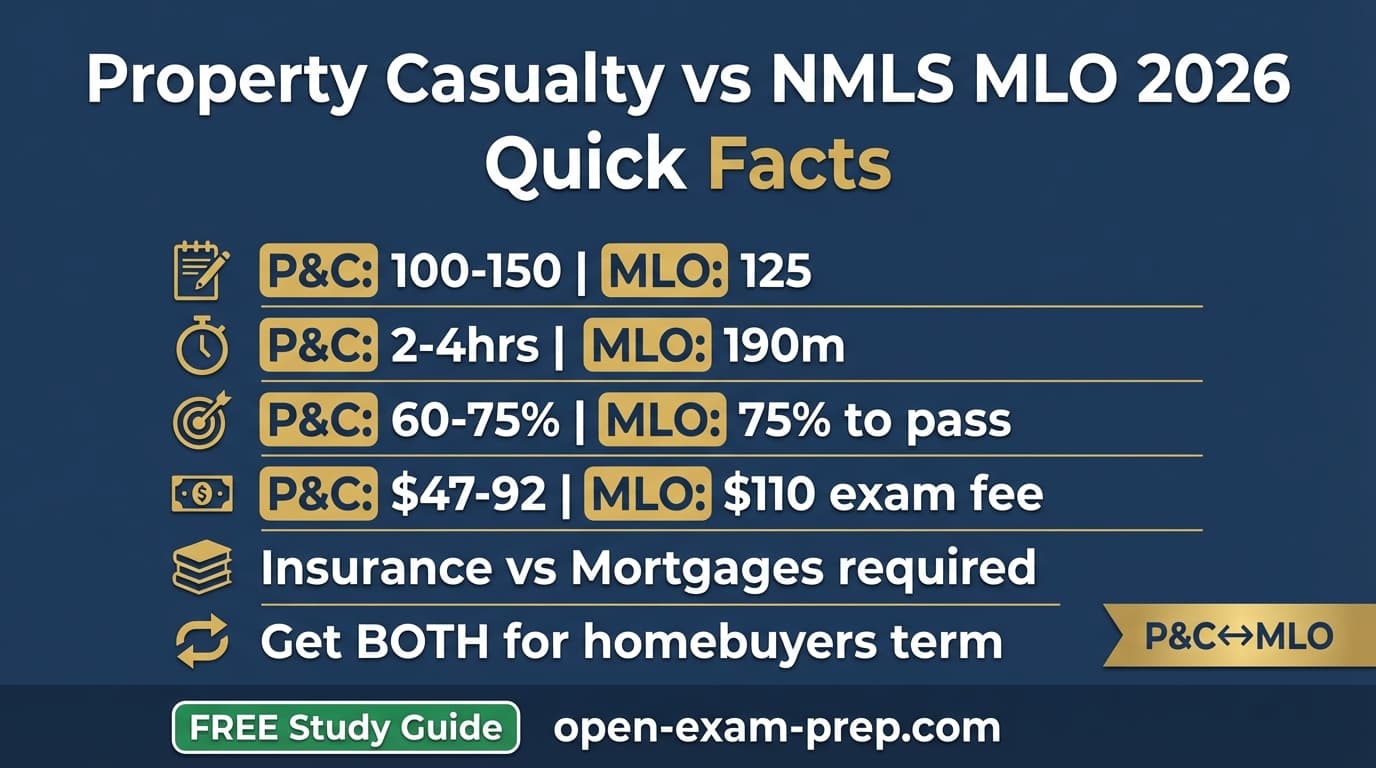
Side-by-Side Comparison
| Feature | Property & Casualty | NMLS MLO |
|---|---|---|
| Full Name | Property & Casualty Insurance License Exam | NMLS SAFE Mortgage Loan Originator (MLO) License Exam |
| Exam Cost | $35 - $184 (varies by state) | ~$110 (NMLS exam fee) |
| Passing Score | 70% (most states) | 75% (nationally standardized) |
| Questions | 100 - 150 (varies by state) | 125 (115 scored + 10 unscored pilot questions) |
| Time Limit | 2 - 3 hours (varies by state) | 190 minutes (3 hours 10 minutes) |
| Study Time | 35 - 60 hours over 2 - 4 weeks | 60 - 100 hours over 3 - 6 weeks |
| Difficulty | Moderate | Moderate to Difficult |
| Prerequisites | Pre-licensing course completion (20 - 52 hours, varies by state) | 20 hours of NMLS-approved pre-licensing education (federal requirement) |
| Exam Body | State Department of Insurance (administered by PSI or Prometric) | Nationwide Multistate Licensing System (NMLS), administered by Prometric |
Key Differences
- 1P&C commission is smaller per transaction ($220-$440 on a typical homeowners policy) but renews annually with 85-90% retention; MLO commission is much larger (~$4,000-$5,000 per loan) but is entirely one-time
- 2P&C income is recession-resistant (auto and homeowners insurance are mandatory); MLO income is highly cyclical (tied to interest rates and housing volume)
- 3The P&C exam is state-regulated (varying content, 70% passing, 50-65% pass rate); the NMLS exam is federally standardized (125 questions, 75% passing, 54-56% pass rate)
- 4P&C pre-licensing is 20-52 hours at $300-$600 total cost; NMLS pre-licensing is 20 hours but total licensing costs run $500-$1,000
- 5P&C agents build a sellable book of business (valued at 1.5-2.5x annual revenue); MLOs do not accumulate a comparable sellable asset
- 6P&C agents can serve clients for decades through annual renewals and coverage reviews; MLOs interact primarily at the point of origination and occasional refinancing
- 7MLO median salary ($74,180) exceeds P&C median ($47,768), but P&C renewal income at the 5-10 year mark can match or exceed MLO cumulative earnings
- 8Both licenses are essential to the home purchase: every home sale requires insurance (lender mandate) and most require mortgage financing
What Each Exam Allows You To Do
Property & Casualty
- Sell homeowners, renters, and condo insurance
- Sell personal and commercial auto insurance
- Sell commercial property and general liability insurance
- Sell business owner's policies (BOPs) and umbrella policies
- Sell workers' compensation and professional liability insurance
- Sell surety and fidelity bonds
- Provide complete property protection for every home purchase transaction
NMLS MLO
- Originate residential mortgage loans (conventional, FHA, VA, USDA)
- Take mortgage applications and advise borrowers on loan programs
- Process loan packages and coordinate with underwriting
- Work within the real estate transaction ecosystem alongside agents, appraisers, and title companies
- Earn per-transaction commission on each loan closed
- Build referral partnerships with real estate agents and builders
Who Should Take Each Exam?
Take the Property & Casualty if you...
- →Professionals in the real estate ecosystem seeking recurring revenue
- →People who prefer building predictable, compounding income through renewals
- →Those who enjoy working with both personal and commercial clients
- →Individuals who want recession-resistant income (insurance is mandatory)
- →Anyone interested in building a sellable book of business as a retirement asset
Take the NMLS MLO if you...
- →People who want high per-transaction income ($4,000-$5,000+ per loan)
- →Those comfortable with federally regulated compliance environments
- →Individuals who enjoy complex financial analysis and problem-solving
- →People already in the real estate ecosystem (agents, title, appraisal)
- →Those who thrive in fast-paced, deadline-driven work
Which Should You Take First?
If your primary goal is immediate income, the NMLS MLO license generates larger per-transaction paychecks ($4,000-$5,000 per loan vs. $220-$440 per insurance policy). If your goal is long-term wealth building through compounding passive income, the P&C license is the stronger foundation because every policy you write renews year after year. For real estate professionals choosing between adding one of these licenses, P&C is typically the easier and faster add-on (20-52 hours pre-licensing, $300-$600 total, 50-65% pass rate) compared to NMLS (20 hours pre-licensing but $500-$1,000 total, 54-56% pass rate, more rigorous federal compliance content). The strategically optimal answer is to pursue both and build the complete "property professional stack" (RE + MLO + P&C) over 6-12 months. Start with whichever license aligns with your current position: if you are already originating loans, add P&C to capture insurance on every closing; if you are already selling insurance, add MLO to capture the larger mortgage transaction.
At a Glance: Property & Casualty vs NMLS MLO
Median Salary
$47,768
Property & Casualty
$74,180
NMLS MLO
Pass Rate
50-65%
Property & Casualty
54-56%
NMLS MLO
Study Time
35-60 hrs
Property & Casualty
60-100 hrs
NMLS MLO
Total Cost
$300-600
Property & Casualty
$500-1,000
NMLS MLO
Property & Casualty
Compounding renewal income, recession-resistant coverage, and building a sellable book of business
NMLS MLO
High per-transaction income, real estate ecosystem integration, and mortgage financing careers
Start preparing today:
Key Facts: Property & Casualty vs NMLS MLO
- 1Every home purchase requires BOTH mortgage financing (MLO) and homeowners insurance (P&C), making these two licenses essential components of the real estate transaction ecosystem.
- 2P&C agents earn smaller per-transaction commissions ($220-$440 per homeowners policy) but build compounding renewal income, while MLOs earn larger per-transaction commissions (~$4,000-$5,000 per loan) with zero residual.
- 3After 10 years of writing 20 homeowners policies per year, a P&C agent's renewal book generates approximately $40,000-$46,000 in annual passive income, while the MLO must continuously originate new loans to earn.
- 4The "property professional stack" (Real Estate + MLO + P&C licenses) captures $9,200-$13,800+ per home transaction with compounding insurance renewals, representing the complete home purchase revenue opportunity.
- 5P&C insurance is mandatory and recession-resistant (auto by law, homeowners by lender); MLO income dropped 40-60% for many loan officers during the 2022-2023 rate spike.
- 6The P&C license costs $300-$600 and requires 20-52 hours of pre-licensing, making it significantly cheaper and comparable in time to the MLO license ($500-$1,000, 20 hours pre-licensing).
- 7Insurance sales agent job growth (4%, 47,000 openings/year) outpaces loan officer growth (2%, 20,300 openings/year), with the insurance industry's 50% retirement wave by 2028 creating additional structural opportunity.
- 8A P&C book of business is a sellable retirement asset valued at 1.5-2.5x annual revenue; MLO income generates no comparable transferable asset.
Why This Comparison Matters
$9,200-$13,800+
Property Professional Stack
Holding RE + MLO + P&C licenses captures the full home transaction: sale commission, mortgage fee, and insurance premium from every deal.
$80K-$100K
P&C Passive Renewal Income
Writing 20 homeowners policies per year with auto bundling builds a passive renewal book worth $80K-$100K annually by year 10.
85-90%
Recession-Proof Retention
P&C policies renew at 85-90% because auto and homeowners insurance are legally mandated. MLO income dropped 40-60% during the 2022-2023 rate spike.
The P&C insurance license and NMLS MLO license are both essential to America's most common financial transaction: buying a home. Every purchase requires a mortgage officer to fund the loan and an insurance agent to secure the homeowners policy before closing. Together with a real estate license, these credentials form the "property professional stack" — capturing $9,200-$13,800+ per home sale across all three revenue streams.
The core economic tension is recurring vs. one-time income. MLOs earn large per-transaction checks (~$4,000-$5,000 per loan) but start every year at zero. P&C agents earn smaller commissions ($220-$440 per policy) but build a compounding renewal book that grows annually with 85-90% retention. Forward-thinking professionals are increasingly pursuing both licenses to combine the MLO's cash flow spikes with the P&C agent's recession-resistant passive income and sellable book of business.
What Each Exam Covers
Property & Casualty Exam Topics
Pass Rate: 50 - 65% (varies by state; source: state insurance department data)
NMLS MLO Exam Topics
Pass Rate: 54 - 56% first-time pass rate (source: NMLS annual reports)
Salary & Income Comparison
Property & Casualty Insurance Agent
$47,768
Median Annual Salary
Range: $31,530 - $95,000+
ZipRecruiter, 2024; BLS Insurance Sales Agents median $60,370
P&C agents with large commercial books or agency ownership earn $150,000-$300,000+. Agency owners with 1,000+ policies and commercial accounts can earn $300,000-$500,000+ through combined production and profit sharing. The P&C book of business is a major sellable asset at retirement.
Mortgage Loan Officer
$74,180
Median Annual Salary
Range: $35,000 - $150,000+
BLS, May 2024
Top-producing MLOs earn $200,000-$500,000+ in favorable rate environments. However, income is highly volatile: the 2022-2023 rate spike caused 40-60% income drops for many MLOs, and thousands left the industry.
| Commission Detail | Property & Casualty | NMLS MLO |
|---|---|---|
| First-Year Commission | 10 - 20% of annual premium | ~1% of loan amount (0.5 - 1.5%, varies by employer) |
| Renewal Commission | 10 - 15% of premium on annual renewals (85-90% retention rate) | None - mortgage origination is strictly a one-time transaction fee |
| Income Model | P&C insurance operates on a compounding renewal model. Each new policy earns 10-20% of the annual premium upfront, then 10-15% every year on renewal. Because P&C coverage is mandatory (auto by law, homeowners by lender requirement, business liability by contractual obligation), clients renew at 85-90% rates. A homeowners policy at $2,200/year generates approximately $330 in first-year commission and $220-$330 annually thereafter, indefinitely. After 5 years of writing 100 policies per year, the renewal book alone can generate $80,000-$120,000 in annual income. This compounding, predictable income is the defining advantage of P&C over transaction-based careers like mortgage origination. | MLO compensation is per-loan: approximately 1% of the loan amount, paid at closing. On a $400,000 mortgage, the MLO earns approximately $4,000. Some lenders pay a base salary ($40,000-$60,000) plus reduced commission (0.25-0.5%), while independent brokerages offer higher commission (1-1.5%) with no salary. The average MLO closes 3-5 loans per month. There is no residual income whatsoever: once the loan closes, all income from that transaction is complete. If the borrower refinances with another lender in 3 years, the original MLO earns nothing. This one-time model creates higher peak income but no compounding base. |
MLOs earn a median of $74,180 (BLS, May 2024), significantly above the P&C agent median of $47,768 (ZipRecruiter, 2024). However, MLO income is highly cyclical — swinging from $100K-$130K during the 2020-2021 refi boom to an estimated $50K-$70K during the 2022-2023 rate spike — while P&C income remains stable year over year.
The time-horizon math shifts the advantage. In years 1-3 the MLO out-earns the P&C agent, but by years 8-10 a disciplined P&C agent with 500+ active policies can match or exceed MLO total compensation through compounding renewals alone. Elite MLOs reach $200K-$500K+ in strong markets; elite P&C agency owners reach $150K-$500K+ with a higher income floor. Dual-licensed professionals capturing both commissions per transaction can realistically earn $100K-$250K+ while building a sellable insurance book.
Total Cost to Get Licensed
| Expense | Property & Casualty | NMLS MLO |
|---|---|---|
| Pre-Licensing Education | $150 - $500 (20-52 hour state-approved course) | $200 - $500 (20-hour NMLS-approved pre-licensing education) |
| Exam Fee | $35 - $184 (varies by state) | ~$110 (NMLS national exam fee) |
| License Fee | $15 - $200 (state application and license fee) | $100 - $300 (state-specific MLO license application + NMLS processing) |
| Background Check | $50 - $100 (fingerprinting and background check) | $50 - $100 (FBI criminal background check + credit report review) |
| Total Investment | $300 - $600 (most candidates spend $350-$450) | $500 - $1,000 (most candidates spend $600-$800; additional surety bond may be required) |
A Day in the Life
Property & Casualty Professional
A Property & Casualty insurance agent starts the morning processing four homeowners policy applications received from a real estate agent partner whose buyers are closing this week. At 10:00 AM, the agent calls two existing clients whose auto policies are up for renewal, reviewing coverage levels and shopping rates across three carriers to ensure competitive pricing. After lunch, the agent meets with a commercial client, a restaurant owner, to review their business owner's policy, liquor liability, and workers' compensation coverage ahead of annual renewal. At 3:00 PM, the agent quotes a homeowners and auto bundle for a new referral from a mortgage loan officer, then spends the late afternoon running a comparative rating for a small contractor needing commercial general liability and commercial auto coverage for three vehicles. The day ends with pipeline review: 15 active policies in processing, 8 renewals due next month.
NMLS MLO Professional
A Mortgage Loan Officer begins the day checking overnight rate movements and reviewing the day's pipeline: two loans in underwriting, one conditional approval awaiting documentation, and two new pre-approval requests. At 9:00 AM, the MLO calls a first-time homebuyer to walk through the pre-approval process, gathering income, asset, and credit information. At 10:30 AM, the MLO reviews conditions from an underwriter on a loan in process and coordinates with the borrower to obtain a missing pay stub and bank statement. After lunch, the MLO attends a real estate agent's office meeting to present current market rates and loan programs, maintaining the referral relationship. The afternoon includes locking a rate for a borrower under contract, preparing a Loan Estimate for a new application, and following up with a title company on a scheduled closing for Friday. The day ends with 3 new leads from online applications requiring follow-up calls.
Career Paths & Progression
Property & Casualty Career Path
0-2 years
Personal Lines Agent (Auto & Home)
$30K-$45K
2-5 years
Multi-Line Agent (Personal + Small Commercial)
$50K-$95K
5-10 years
Commercial Lines Specialist / Producer
$95K-$200K
10+ years
Agency Owner / Franchise Principal
$200K-$500K+
NMLS MLO Career Path
0-2 years
Junior Loan Officer (Bank or Brokerage)
$35K-$60K
2-5 years
Independent Producing MLO
$75K-$150K
5-10 years
Senior MLO / Specialty Lender (Jumbo, Commercial)
$150K-$300K
10+ years
Branch Manager / Brokerage Owner
$200K-$500K+
P&C agents progress from personal lines to commercial lines, where single accounts generate $5,000-$50,000+ in annual premium, and ultimately to agency ownership with a sellable book valued at 1.5-2.5x annual revenue. MLOs advance from individual production to branch management or brokerage ownership, often specializing in jumbo, FHA/VA, or commercial lending. Dual-licensed professionals can capture both the mortgage fee and insurance premium from every closing while building a compounding P&C renewal base.
Start preparing today:
Should You Get Both a P&C Insurance License and an NMLS MLO License?
Benefits
- +Capture both the mortgage commission (~$4,000-$5,000) and insurance commission ($220-$440 + annual renewals) from every home purchase transaction, increasing per-deal revenue by 5-10%
- +P&C renewal income provides a financial safety net during mortgage market downturns (rising rates, low housing inventory), creating counter-cyclical income stability
- +Building a P&C book creates a sellable retirement asset (1.5-2.5x annual revenue) that MLO origination alone cannot generate
- +Offering both mortgage and insurance creates a differentiated "one-stop" homebuyer experience that generates more real estate agent referrals and client loyalty
- +The complete "property professional stack" (RE + MLO + P&C) captures $9,200-$13,800+ per home transaction with compounding insurance renewals for decades
Considerations
- !Managing both practices requires disciplined time management: mortgage origination is deadline-intensive (rate locks, closing dates), while insurance requires consistent servicing and renewal management
- !Compliance obligations span two different regulatory frameworks: federal CFPB/NMLS oversight for mortgage and state Department of Insurance oversight for P&C, each with separate continuing education requirements
- !Some employers may restrict outside licensing activities: verify that your mortgage company permits insurance sales (or vice versa) before investing in the second license
The Verdict: The P&C + MLO dual license is an underappreciated combination that addresses the fundamental weakness of each career path. MLOs gain the compounding renewal income and sellable book that mortgage origination cannot provide. P&C agents gain the larger per-transaction income that insurance premiums alone cannot match. The combination is particularly powerful for professionals already embedded in the real estate ecosystem, where referral relationships with agents and builders create a natural pipeline for both services. The total investment of $800-$1,600 and 5-10 weeks of combined study time is modest relative to the lifelong income enhancement. Any professional serving homebuyers who holds only one of these licenses is leaving significant money and career resilience on the table.
Job Outlook & Industry Trends
4% (2024-2034, BLS for insurance sales agents), approximately 47,000 openings/year
Property & Casualty Job Growth (2024-2034)
2% (2024-2034, BLS for loan officers), approximately 20,300 openings/year
NMLS MLO Job Growth (2024-2034)
Insurance sales agent growth is projected at 4% (2024-2034) with 47,000 annual openings, boosted by a retirement wave that will see nearly 50% of the insurance workforce retire by 2028. Loan officer growth lags at 2% with 20,300 annual openings, reflecting mortgage industry sensitivity to rate cycles. Dual-licensed professionals hedge against the structural risks of either career alone.
Study Strategy & Tips
P&C Foundation
P&C pre-licensing course and core concepts
- Complete state-approved P&C pre-licensing course (20-52 hours)
- Master homeowners policy forms (HO-1 through HO-8) and named vs. open perils
- Learn the coinsurance formula and ACV vs. RCV valuation methods
- Study auto insurance coverage parts (A through D) and commercial liability basics
P&C Exam
Practice exams and pass the P&C exam
- Take 3-5 full-length timed practice exams
- Review state-specific insurance regulations and ethics content
- Target weak areas identified in practice exams
- Schedule and pass the P&C exam
NMLS Foundation
NMLS pre-licensing and federal law mastery
- Complete 20-hour NMLS-approved pre-licensing education
- Master federal laws: TILA, RESPA, ECOA, HMDA, FCRA
- Study Loan Estimate and Closing Disclosure timing and tolerance rules
- Learn loan product differences: Conventional, FHA, VA, USDA
NMLS Exam
Practice exams and pass the NMLS exam
- Complete 5+ full-length timed practice exams (54-56% pass rate demands extra prep)
- Focus on scenario-based ethics and prohibited practices questions
- Review uniform state content and licensing procedures
- Schedule and pass the NMLS SAFE exam
Total Duration: 5-10 weeks for both licenses (part-time study)
Property & Casualty Study Tips
- 1Master homeowners policy forms (HO-1 through HO-8) thoroughly. Know the difference between named-peril policies (HO-1, HO-2, HO-4, HO-6) and open-peril policies (HO-3, HO-5). HO-3 is the most common policy form and is heavily tested.
- 2Learn the coinsurance formula and practice calculations: (insurance carried / insurance required) x loss = recovery. When coverage is below the required coinsurance percentage (typically 80%), the insured bears a penalty on partial losses. This is the most tested calculation on the exam.
- 3Understand auto insurance coverage parts: Part A (Liability), Part B (Medical Payments), Part C (Uninsured/Underinsured Motorist), Part D (Physical Damage - Comprehensive and Collision). Know the difference between split limits and combined single limits.
- 4Study Commercial General Liability (CGL) policy structure: occurrence vs. claims-made triggers, the classifications of coverage (premises/operations, products/completed operations, personal/advertising injury), and key exclusions.
- 5Focus on valuation methods: Actual Cash Value (ACV = replacement cost minus depreciation) vs. Replacement Cost Value (RCV). Know when each applies and how to calculate ACV when given replacement cost and depreciation figures.
NMLS MLO Study Tips
- 1Prioritize federal law mastery: TILA (APR disclosure, right of rescission, Regulation Z), RESPA (kickback prohibitions, escrow rules, Regulation X), ECOA (prohibited discrimination bases, adverse action notices), HMDA (data reporting requirements), and FCRA (consumer credit rights). This section is 23-25% of the exam and the most commonly failed.
- 2Study the Loan Estimate (LE) and Closing Disclosure (CD) in granular detail: the 3-business-day application rule for LE delivery, tolerance categories for fee changes (zero tolerance, 10% tolerance, unlimited), and the 3-business-day pre-closing rule for CD delivery.
- 3Master loan product differences: Conventional (conforming limits, PMI rules), FHA (3.5% minimum down, MIP structure), VA (no down payment, funding fee, eligibility), and USDA (geographic eligibility, income limits). Know the qualifying ratios for each program.
- 4Learn prohibited practices thoroughly: steering (directing borrowers to loans not in their interest), loan flipping, equity stripping, redlining, and blockbusting. Scenario-based ethics questions are a significant exam component at 15-17%.
- 5Complete at least 5 full-length practice exams before test day. The 54-56% first-time pass rate means preparation intensity matters. Time yourself to stay within the 190-minute limit.
Ready to Start Studying?
Free practice questions, study guides, and AI tutoring for the matching exam resources.
Frequently Asked Questions
QCan a mortgage loan officer also sell homeowners insurance?
Yes, a mortgage loan officer can sell homeowners insurance (and all P&C products) if they hold a valid Property & Casualty insurance license in addition to their MLO license. There is no federal or state prohibition against holding both licenses. However, there are important compliance considerations. Under RESPA (Real Estate Settlement Procedures Act), the MLO cannot require the borrower to purchase insurance from them as a condition of the mortgage. The insurance sale must be a separate, voluntary transaction with clear disclosure. The Consumer Financial Protection Bureau (CFPB) also prohibits loan officers from receiving compensation tied to loan terms, so insurance commission must be entirely separate from mortgage compensation. In practice, most dual-licensed MLOs introduce the insurance conversation after loan approval: "Your loan is approved. Before we close, you will need homeowners insurance. I am also a licensed P&C agent and can provide a quote, or you are welcome to shop on your own." This approach is compliant, natural, and convenient for the borrower. Many borrowers appreciate the convenience, especially first-time homebuyers who may not have existing insurance relationships.
QWhat is the "property professional stack" and is it worth pursuing?
The "property professional stack" refers to holding three licenses that collectively cover the entire home purchase transaction: a Real Estate license, an NMLS Mortgage Loan Originator license, and a Property & Casualty insurance license. With all three, a single professional can represent the buyer in the home purchase (RE commission: $5,000-$8,400), originate the mortgage (MLO commission: $4,000-$5,000), and secure the homeowners insurance required for closing (P&C commission: $220-$440 + annual renewals). The combined per-transaction revenue of $9,200-$13,800+ significantly exceeds what any single license generates. More importantly, the P&C renewals compound over time, creating passive income from every past transaction. Is it worth pursuing? The investment is approximately $1,200-$2,800 total and 14-26 weeks of combined study time for all three licenses. In practice, few professionals actively work all three roles simultaneously due to time constraints, but holding the licenses creates optionality. Many focus on two roles actively (e.g., RE + insurance, or MLO + insurance) while maintaining the third license for opportunistic use. For professionals committed to the real estate ecosystem as a long-term career, building toward the full stack over 1-2 years is a strategically sound investment.
QHow does income stability compare between P&C insurance and mortgage origination?
Income stability is the most significant practical difference between these two career paths, and it overwhelmingly favors P&C insurance. Mortgage origination income is among the most volatile in financial services. It is directly driven by interest rates (which the MLO cannot control), housing inventory (which varies by market and season), and general economic conditions. When the Federal Reserve raised rates aggressively in 2022-2023, mortgage application volume dropped by 40-60% nationally. Refinancing volume plummeted over 70%. Thousands of loan officers were laid off or voluntarily left the industry. Those who remained saw income drops of 40-60% compared to the 2020-2021 boom years. P&C insurance income operates on a fundamentally different model. Because auto insurance is legally required, homeowners insurance is lender-mandated, and business liability insurance is contractually required, P&C policies renew regardless of economic conditions. Retention rates average 85-90%. An established P&C agent with 500 active policies generating $100,000 in annual renewal income receives that income during recessions, housing crashes, rate spikes, and pandemics. The P&C agent never starts a year at zero income. The MLO always starts the year at zero and must rebuild through new originations. For professionals seeking income predictability and long-term financial security, P&C insurance provides a fundamentally more stable foundation.
QWhich exam is harder, the P&C insurance exam or the NMLS SAFE exam?
The NMLS SAFE exam is generally considered slightly more difficult, based on both pass rates and candidate feedback. The NMLS first-time pass rate is 54-56% compared to 50-65% for the P&C exam. The NMLS requires a higher passing score (75% vs. 70% for most P&C exams). The NMLS exam is heavily weighted toward federal regulatory compliance (TILA, RESPA, ECOA, HMDA, FCRA), which requires analytical application of regulations to specific lending scenarios rather than straightforward recall. Many candidates struggle with the scenario-based compliance questions that require judgment about what a loan officer should or should not do in a given situation. The P&C exam tests broader product knowledge (homeowners forms, auto coverages, commercial liability, workers' compensation, bonds) and includes calculation-based questions (coinsurance formula, actual cash value) that trip up math-averse candidates. However, the P&C content is generally more intuitive than federal mortgage law, especially for candidates with real estate or property experience. Study time reflects the difficulty difference: most candidates need 35-60 hours for P&C versus 60-100 hours for NMLS. If pursuing both, taking the P&C exam first builds confidence and momentum for the more challenging NMLS exam.
QHow much can a dual-licensed P&C/MLO professional earn per home transaction?
A dual-licensed professional captures both the mortgage origination commission and the insurance commission from each home purchase. On a $400,000 home purchase with a $400,000 mortgage: the MLO commission is approximately $4,000 (at 1% of loan amount). The homeowners insurance commission is approximately $330 (15% of a $2,200 annual premium). If the agent also bundles auto insurance ($1,800 premium at 12% commission = $216), the total first-year per-transaction revenue is approximately $4,546. The insurance renewals then generate approximately $440-$550 per household per year, every year, for as long as the client maintains coverage. Over 10 years, a single household's insurance generates $4,400-$5,500 in cumulative renewal income, on top of the original $4,330 in mortgage and first-year insurance commission. Across 20 transactions per year, the dual-licensed professional earns approximately $86,600 in first-year mortgage commissions ($4,000 x 20 + insurance new business) plus a growing renewal book. By year five, the renewal book adds approximately $26,000-$33,000 annually. By year ten, renewals add approximately $46,000-$55,000. The total year-ten income combining active mortgage production and insurance renewals can realistically reach $130,000-$150,000, with the insurance side providing increasing stability as the renewal book grows.
QWhat continuing education is required for both licenses?
Maintaining both a P&C insurance license and an NMLS MLO license requires compliance with two separate continuing education (CE) frameworks. The NMLS MLO license requires **8 hours of annual CE**, specifically: 3 hours of federal law and regulations, 2 hours of ethics (including fraud prevention, consumer protection, and fair lending), 2 hours of nontraditional mortgage lending, and 1 hour of elective content. This CE must be completed through NMLS-approved providers by December 31 each year. Failure to complete results in the inability to renew the license. The P&C insurance license typically requires **24 hours of CE every two years** (biennially), though requirements vary by state. Many states mandate specific topics such as ethics, flood insurance, and workers' compensation updates. Some states accept fully online CE, while others require a portion in classroom settings. The combined CE obligation is approximately **32 hours over a two-year cycle** (16 hours annually for NMLS + 12 hours annually prorated for P&C). While this is a meaningful time investment, most CE courses are available online and can be completed at your own pace. Many professionals schedule CE during slower business periods (typically January-February or late summer). The cost of maintaining both licenses, including CE fees, renewal fees, and NMLS annual filing, is approximately $500-$800 per year, a modest investment relative to the dual-license income advantage.
10 free AI interactions per day
Free exam resources
Start Studying the Exact Exam
Use the comparison to choose a path, then move into the matching practice questions, study guide, and flashcards.
Third-party resources · We may earn a commission from purchases.

Property and Casualty Insurance License Exam Study Guide: Property Casualty Insurance Book and Practice Test Questions [3rd Edition]
By Tpb Publishing
$34.99 · 
 Flashcards on Mometrix
 Prep course on Achievable
 Take courses on Udemy
Third-party resources · We may earn a commission from purchases.

NMLS Study Guide 2026-2027 - 5 Full-Length Practice Tests, SAFE MLO Exam Prep Secrets Book for the Mortgage Loan Originator Exam: [4th Edition]
By Bowling, Matthew
$39.99 ·
 MLO pre-licensing on Aceable MortgageTake courses on UdemyFlashcards on Mometrix
Related Exam Comparisons
Stay Updated
Get free exam tips and study guides delivered to your inbox.