Introducing Managing Safely
Not publishedof exam
Assessing Risks
Not publishedof exam
Controlling Risks
Not publishedof exam
Understanding Responsibilities
Not publishedof exam
Understanding Hazards
Not publishedof exam
Investigating Incidents
Not publishedof exam
Measuring Performance
Not publishedof exam
Quick Facts
- Course
- IOSH Managing Safely
- Modules
- 7 modules
- Duration
- Three days equivalent
- Assessment
- Paper plus project
- Project pass
- 23 of 38
- Project time
- Two hours maximum
- Project hazards
- Four hazards required
- Risk matrix
- 5x5, max 25
- Paper format
- Not published by IOSH
- Certificate
- Does not expire
- Refresher
- One day, three-year window
- Audience
- Managers and supervisors
Why Manage Safely
- Moral case
- Nobody harmed by work
- Legal case
- Criminal duties, civil claims
- Financial case
- Accidents drain money
- Responsibility
- Duty to act
- Accountability
- Cannot be delegated
- Delegation
- Tasks pass down only
- Insured costs
- Claims, damaged plant
- Uninsured costs
- Lost time, investigation, overtime
- Cost iceberg
- Uninsured costs hidden below
Five Risk Steps
Identify Assess Control Record Review
Hazard vs Risk
Hazard
- Potential to cause harm
- Property of the thing
- No numbers needed
Risk
- Likelihood times consequence
- Rated out of 25
- Changes with controls
Source vs chance
Project Row Builder
- Choosing a hazard→Pick significant, not trivial
- Describing the hazard→Name the harm source
- Listing who is harmed→Quantify each group
- Rating current risk→Likelihood times consequence
- Adding further controls→Mix hard and soft
- Rating residual risk→Lower the likelihood
- Assigning an action→Job title plus date
Risk Assessment Steps
- Step 1
- Identify the hazards
- Step 2
- Assess the risks
- Step 3
- Control the risks
- Step 4
- Record your findings
- Step 5
- Review the controls
- Record trigger
- Five or more employees
- Suitable and sufficient
- Proportionate, covers significant hazards
- Review trigger
- Incident or significant change
- Vulnerable groups
- Young, new, expectant, lone
Project Marks Add Up
1 + 9x4 + 1 = 38
5x5 Risk Matrix
- Likelihood
- Rate 1 to 5
- Consequence
- Rate 1 to 5
- Risk rating
- Likelihood times consequence
- Scale
- Rating out of 25IOSH
- Examiner tolerance
- Within plus or minus oneProject
- Rating 15-16
- Urgent action expectedIOSH
- Residual rating
- Must be lower
- Consequence 5
- Foreseeable death
Project Marking Scheme
- Top of form
- 1 mark
- Each hazard row
- 9 marks available
- Four hazard rows
- 36 marks total
- Bottom of form
- 1 mark
- Total marks
- 38 marks
- Pass mark
- 23 of 38
- Not a hazard
- Lose all nine marks
- Time guide
- Two hours maximum
ERIC PD Hierarchy
Eliminate Reduce Isolate Control PPE Discipline
Safe System vs Permit
Safe system
- Defined working method
- Every routine task
- From the risk assessment
Permit
- Written authorisation
- High-risk jobs only
- Signed off, time limited
Method vs authorisation
Control Picker
- Hazard can be removed→Eliminate(Best option)
- Safer substitute exists→Reduce(Substitution)
- Keep people away→Isolate(Guard or barrier)
- Change how work runs→Control(Safe system)
- Residual risk still remains→PPE(Last resort)
- Controls being ignored→Discipline(Monitor, enforce)
ERIC PD Hierarchy
- Eliminate
- Remove the hazard1
- Reduce
- Substitute safer option2
- Isolate
- Enclosures, barriers, guarding3
- Control
- Safe systems, training, rotation4
- PPE
- Last resort protection5
- Discipline
- Monitor and enforce6
- Collective first
- Protects everyone automatically
- Personal last
- Needs individual compliance
Collective vs Personal
Collective
- Protects everyone at risk
- Works without user action
- Guard rail
Personal
- Protects one person
- Needs correct use
- Harness and lanyard
Automatic vs dependent
Control Toolkit
- Reasonably practicable
- Risk versus time, money
- Gross disproportion
- Sacrifice far outweighs risk
- Safe system of work
- Defined method from assessment
- Permit to work
- Written high-risk authorisation
- Permit examples
- Hot work, confined spaces
- Competence
- Skills, knowledge, experience, training
- Supervision
- Cover while still learning
- PPE rules
- Suitable, maintained, free of charge
HSG65 Plan Do Check Act
Plan Do Check Act
Criminal vs Civil Law
Criminal
- State prosecutes breach
- Fines and imprisonment
- HSE or council
Civil
- Injured person sues
- Compensation for loss
- Negligence claim
Punish vs compensate
Law and Duties
- HSWA 1974
- Main UK safety act
- Section 2
- Employer duties to employees
- Section 7
- Employee care and co-operation
- Section 8
- No interference or misuse
- Written policy
- Five or more employees
- MHSWR 1999
- Assessment and arrangements duties
- Criminal law
- Punishment, fines, imprisonment
- Civil law
- Negligence, compensation claims
- Three knowledge tests
- Common, industry, expert
Improvement vs Prohibition
Improvement
- Breach must be fixed
- Stated compliance period
- Appeal suspends notice
Prohibition
- Stops dangerous activity
- Serious injury risk
- Appeal does not suspend
Fix it vs stop it
Enforcement and Systems
- Improvement notice
- Fix breach within period
- Prohibition notice
- Stop dangerous activity
- Appeal window
- 21 days to tribunal
- Appeal effect
- Improvement suspended, prohibition stands
- HSE inspectors
- Factories, construction, agriculture, hospitals
- Local authority
- Shops, offices, warehouses, hospitality
- HSG65
- Plan, Do, Check, Act
- ISO 45001
- OSH management system standard
Manual Handling TILE
Task Individual Load Environment
EAV vs ELV
Action value
- Triggers required action
- Noise 80 and 85
- Vibration 2.5
Limit value
- Must not be exceeded
- Noise 87 dB(A)
- Vibration 5.0
Act vs never exceed
Height Equipment Picker
- Job can be done below→Avoid work at height(First choice)
- Safe existing place available→Guarded platform(Prevent falls)
- Work needs a platform→Tower or MEWP(Collective)
- Low risk, 30 minutes→Ladder(Short duration)
- Fall cannot be prevented→Net or airbag(Minimise consequence)
- Only personal protection possible→Harness and lanyard(Needs correct use)
Six Hazard Categories
- Physical
- Noise, vibration, radiation
- Chemical
- Dusts, fumes, solvents
- Biological
- Bacteria, viruses, mould
- Mechanical
- Machinery, moving parts
- Environmental
- Wet floors, lighting, temperature
- Organisational
- Workload, shifts, stress
Six Stress Standards
Demands Control Support Relationships Role Change
Exposure Values
- Noise lower value
- 80 dB(A) daily
- Noise upper value
- 85 dB(A) daily
- Noise limit value
- 87 dB(A) daily
- Peak values
- 135, 137, 140 dB(C)
- Hand-arm EAV
- 2.5 m/s2 A(8)
- Hand-arm ELV
- 5.0 m/s2 A(8)
- COSHH duty
- Prevent or adequately control
- Asbestos duty
- Find, record, manage, plan
Height, Handling, Fire
- Height hierarchy
- Avoid, prevent, minimise
- Ladder use
- Low risk, short duration
- Short duration
- Maximum 30 minutes
- Ladder angle
- One out, four up
- TILE
- Task, Individual, Load, Environment
- Handling duty
- Avoid, assess, reduce
- Fire triangle
- Fuel, oxygen, heat
- Class A fire
- Wood, paper, textiles
- Class F fire
- Cooking oils and fats
Extinguishers and Electricity
- Water
- Red, Class A only
- Foam
- Cream, solids and liquids
- Dry powder
- Blue, liquids and electrical
- CO2
- Black, electrical and liquids
- Wet chemical
- Yellow, cooking oils only
- Site voltage
- 110V centre tapped earth
- Voltage to earth
- Maximum 55 volts
- Safest tools
- Battery powered equipment
Stress Management Standards
- Demands
- Workload, patterns, environment
- Control
- Say over the work
- Support
- Encouragement, sponsorship, resources
- Relationships
- Conflict and unacceptable behaviour
- Role
- Clear, non-conflicting duties
- Change
- Managed and communicated well
Investigation Four Steps
Gather Analyse Identify Plan
Immediate vs Root Cause
Immediate
- Agent of harm
- Visible at the scene
- Missing guard
Root
- Management system failing
- No maintenance plan
- Fixes many events
Trigger vs system
RIDDOR Picker
- Worker killed at work→Notify without delay(Report follows)
- Specified injury occurs→Report within 10 days
- Absent over seven days→Report within 15 days
- Absent four to seven days→Record only(Not reportable)
- Written disease diagnosis→Report the disease
- Listed dangerous occurrence→Report within 10 days
Incident Definitions
- Accident
- Event causing injury, harm
- Incident
- Accident or near miss
- Near miss
- No harm, clear potential
- Undesired circumstance
- Conditions with harm potential
- Immediate cause
- Obvious agent of harm
- Underlying cause
- Workplace failure behind it
- Root cause
- Management system failing
- No-blame rule
- Find causes, not culprits
RIDDOR Reporting
- Death at work
- Notify without delay
- Specified injuries
- Report within 10 days
- Dangerous occurrences
- Report within 10 days
- Over-seven-day injury
- Report within 15 days
- Over-three-day injury
- Record, do not report
- Occupational disease
- Report on written diagnosis
- Responsible person
- Usually the employer
- Record contents
- Date, place, people, description
Active vs Reactive
Active
- Before harm occurs
- Inspections and training
- Leading indicators
Reactive
- After harm occurs
- Injuries and absence
- Lagging indicators
Prevent vs count
Monitoring Picker
- Check conditions today→Inspection(Frontline)
- Test the whole system→Audit(Evidence based)
- Need independent challenge→External auditor
- Need low cost check→Internal auditor
- Measure effort invested→Leading indicator(Active)
- Measure outcomes suffered→Lagging indicator(Reactive)
Performance Indicators
- Active monitoring
- Checks before harm occurs
- Reactive monitoring
- Counts what went wrong
- Leading indicator
- Training done, actions closed
- Lagging indicator
- Injury and absence rates
- Inspection
- Frontline conditions on day
- Audit
- Systematic system examination
- Internal auditor
- Knows operation, less independent
- External auditor
- Independent, brings outside comparison
- Benchmarking
- Compare against similar organisations
Inspection vs Audit
Inspection
- Conditions on the day
- Frontline walk round
- Quick and frequent
Audit
- Whole management system
- Documents, interviews, observation
- Periodic and deep
Snapshot vs system
Audit Evidence and Rates
- Document evidence
- Policies, records, assessments
- Interview evidence
- What people actually say
- Observation evidence
- What actually happens
- Good KPI
- Specific, measurable, owned, timed
- Incidence rate
- Injuries per 100,000 workers
- Rate purpose
- Compare sites, sectors, years
- Falling injury count
- May mean suppressed reporting
- Ill health lag
- Long latency hides exposure
Common Traps
Hazard vs risk
Hazard is the source ≠ Risk is the chance
Accountability vs task
Tasks can be delegated ≠ Accountability stays with you
Reduce vs isolate
Reduce substitutes safer option ≠ Isolate separates people physically
Practicable vs reasonably practicable
Practicable means technically possible ≠ Reasonably practicable weighs cost
Notice types
Improvement fixes a breach ≠ Prohibition stops the work
Report vs record
Over seven days reportable ≠ Over three days recorded
EAV vs ELV
Action value triggers control ≠ Limit value must never be exceeded
Inspection vs audit
Inspection checks conditions today ≠ Audit tests the system
Cause depth
Immediate cause is visible ≠ Root cause is managerial
Residual rating direction
Likelihood usually falls ≠ Consequence usually stays same
PPE placement
PPE is last resort ≠ Never the first control
Fewer injuries claim
Low counts may hide underreporting ≠ Ill health lags years
Last Minute
- 1.Seven modules, three days equivalent
- 2.Project pass mark: 23 of 38
- 3.Project needs four significant hazards
- 4.Risk rating = likelihood x consequence
- 5.5x5 matrix maximum is 25
- 6.Residual rating must be lower
- 7.ERIC PD: PPE near bottom
- 8.Collective protection before personal protection
- 9.Record findings at five employees
- 10.Noise action values 80 and 85
- 11.Noise limit value is 87
- 12.Vibration EAV 2.5, ELV 5.0
- 13.Ladders: low risk, 30 minutes
- 14.Specified injuries: report 10 days
- 15.Over seven days: report 15 days
- 16.Improvement fixes; prohibition stops work
- 17.Active monitoring happens before harm
- 18.Audit tests system; inspection checks conditions
- 19.Immediate cause visible; root cause managerial
- 20.Certificate never expires; refresher recommended
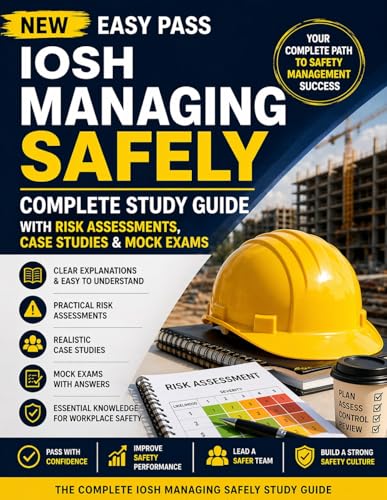
 Buy on Amazon
Explore More IOSH Safety Courses
Continue into nearby exams from the same family. Each card keeps practice questions, study guides, flashcards, videos, and articles in one place.