PMP Certification Exam Overview
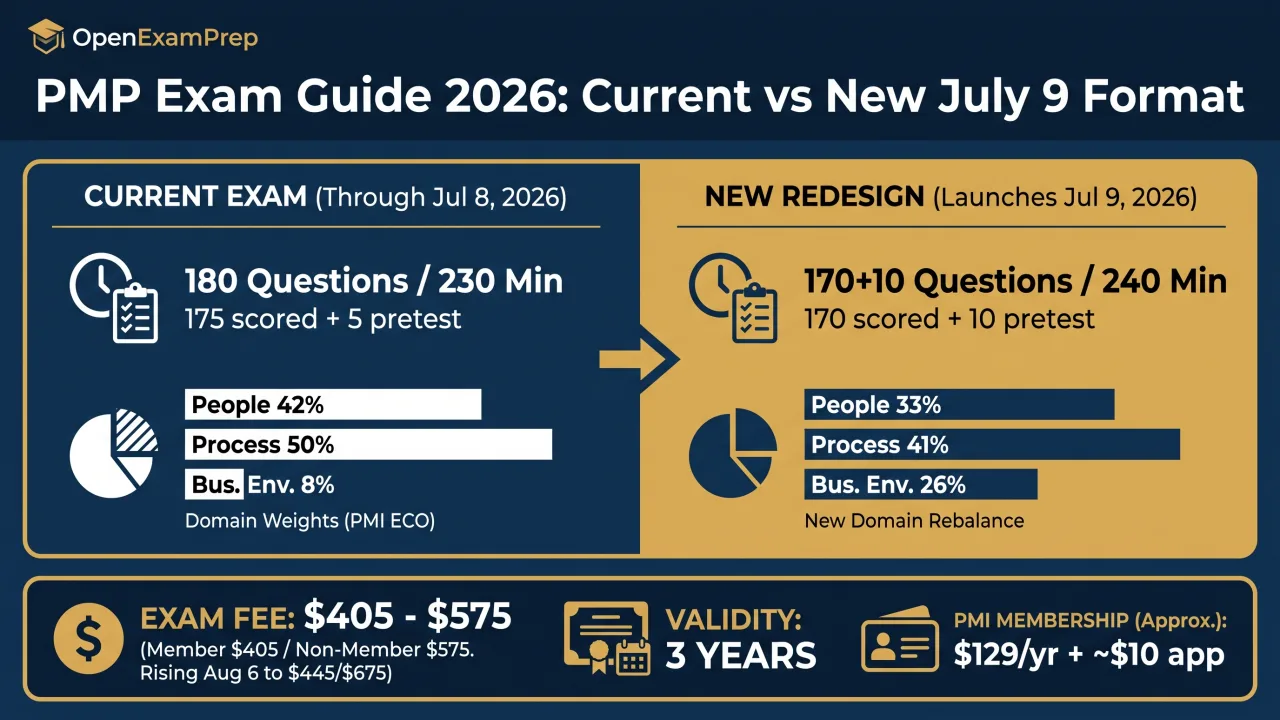
The Project Management Professional (PMP) certification is administered by the Project Management Institute (PMI) and is the most recognized project management credential worldwide. In 2026 there are effectively two PMP exams: the current version you can take through July 8, 2026, and a redesigned version that launches July 9, 2026, built on the new Examination Content Outline and the PMBOK Guide 8th Edition. Which one you sit depends only on your exam date, so the first decision is whether to test before or after the switch.
Current vs New PMP Exam at a Glance
| Feature | Current (through Jul 8, 2026) | New (from Jul 9, 2026) |
|---|---|---|
| Questions | 180 total (175 scored + 5 pretest) | 180 total (170 scored + 10 pretest) |
| Time limit | 230 minutes | 240 minutes |
| People domain | 42% | 33% |
| Process domain | 50% | 41% |
| Business Environment | 8% | 26% |
| Reference guide | PMBOK Guide 7th Edition | PMBOK Guide 8th Edition |
| Agile/hybrid weight | ~50% | ~60% |
| Question types | Multiple choice, multiple response, matching, hotspot | Adds case-study sets and graphic/interpretation items |
The biggest content shift is Business Environment jumping from 8% to 26%, while People and Process both shrink. If you test after July 9, expect more questions on value delivery, compliance, organizational strategy, and external factors such as AI and sustainability. PMI does not publish an official pass rate for either version, so ignore any blog quoting a fixed percentage.
Start FREE PMP Exam Prep
Fees and Eligibility (2026)
| Item | Cost (US) |
|---|---|
| Exam fee, PMI member | $405 (rises to $445 on Aug 6, 2026) |
| Exam fee, non-member | $575 (rises to $675 on Aug 6, 2026) |
| PMI annual membership | ~$129/year plus a ~$10 application fee |
| Validity | 3 years (60 PDUs to renew) |
Because membership is roughly $139 all-in and cuts the exam fee by about $170, almost every candidate should join PMI first, then register. If you are testing after August 6, 2026, the non-member premium grows to $230, making membership an even clearer choice.
To be eligible you need 35 contact hours of project management education (or a current CAPM certification) plus documented experience on one of two tracks:
- Four-year degree: 36 months leading projects.
- High school diploma or associate degree: 60 months leading projects.
PMI widened the qualifying experience window from 8 years to 10 years, so older project work now counts toward the experience requirement. The 35 contact hours are satisfied automatically if you already hold an active CAPM.
Exam Content Outline (ECO)
The PMP exam is organized into three performance domains. The task lists below describe the current outline; the July 9 redesign keeps the same three domains but rebalances the weights toward Business Environment.
People (42% current / 33% new)
- Manage conflict
- Lead a team
- Support team performance
- Empower team members
- Ensure team training
- Build a team
- Address impediments
Process (50% current / 41% new)
- Execute project with urgency
- Manage communications
- Assess and manage risks
- Engage stakeholders
- Plan and manage budget/resources
- Plan and manage schedule
- Plan and manage quality
- Plan and manage scope
- Integrate project planning activities
- Manage project changes
- Plan and manage procurement
- Manage project artifacts
- Determine methodology (Agile, Predictive, Hybrid)
Business Environment (8% current / 26% new)
- Plan and manage compliance
- Evaluate and deliver project benefits
- Support organizational change
- Evaluate external business environment
Free Practice Questions
Key Exam Topics for 2026
Agile and Hybrid Approaches
The current exam is roughly half Agile/hybrid; the new exam pushes that to about 60%:
- Scrum framework
- Kanban boards
- Sprint planning and retrospectives
- Servant leadership
- Adaptive and hybrid life cycles
Predictive (Waterfall) Approaches
Traditional project management still appears throughout both versions:
- Work Breakdown Structure (WBS)
- Critical Path Method (CPM)
- Earned Value Management (EVM)
- Change control processes
- Procurement management
PMBOK Guide: 7th vs 8th Edition
The current exam references PMBOK 7 (12 principles, 8 performance domains, tailoring). The July 9 exam references PMBOK 8, which sharpens the focus on value delivery, stakeholder and business outcomes, and managing in changing environments. You do not memorize the PMBOK, but the edition signals where the question writers are looking.
Study Timeline
| Week | Focus | Hours |
|---|---|---|
| Week 1-2 | People domain + Agile basics | 20-25 |
| Week 3-5 | Process domain (largest) | 35-40 |
| Week 6 | Business Environment + Review | 15-20 |
| Week 7-8 | Practice exams + weak areas | 25-30 |
Total: 100-120 hours recommended. If you are sitting the July 9 version, shift more of Week 6 into Business Environment, since it now carries roughly a quarter of all scored questions.
Tips for Success
- Pick your version first - Decide whether you test before or after July 9, then study to that outline.
- Weight your effort by domain - Business Environment matters far more on the new exam.
- Understand "why" - PMI tests situational judgment, not memorization.
- Practice case-study sets - The new exam groups several questions around one scenario.
- Know EVM formulas - CPI, SPI, EAC, ETC, VAC still appear on both versions.
How To Read The Blueprint Without Overstudying
Do not read the PMP outline like a table of contents. Read it like a risk map. Each domain tells you what the exam writer is allowed to test, but the action verbs tell you how the topic may appear. A verb such as identify usually points to recognition. A verb such as apply, analyze, evaluate, calculate, determine, or recommend means the question can require judgment, sequencing, or multi-step reasoning.
Use four passes through the outline. First, mark topics you already use at work. Second, mark topics you recognize but cannot explain without notes. Third, mark topics that have unfamiliar vocabulary. Fourth, mark topics that combine two skills, such as a rule plus a calculation or a policy plus a scenario. The fourth group deserves the most practice because it is where candidates often feel prepared while still missing points.
Route your weekly study around these high-friction buckets:
- stakeholder intent
- methodology fit (predictive, agile, hybrid)
- risk and change response
- servant-leadership or governance judgment
The goal is not to give every line of the outline equal time. The goal is to convert weak, testable behaviors into repeatable decisions. If a topic is easy in isolation but difficult inside a mixed set, it belongs in your active rotation until it stays stable under time pressure.
Scenario Strategy For Hard Questions
Most candidates miss hard PMP questions for one of three reasons: they answer the first familiar phrase, they ignore a limiting condition, or they spend too long trying to make every answer choice perfect. A better method is to treat each stakeholder scenario as a short professional decision.
Start by naming the task in plain English. Ask: what is the exam actually asking me to decide? Then identify the controlling facts. Separate facts that change the answer from facts that merely describe the setting. Next, predict the principle before looking at the options. Even a rough prediction reduces the chance that an attractive distractor pulls you away from the rule, process, or judgment being tested.
When two answer choices remain, compare them against the exact role you are playing in the prompt. Are you the project manager, a servant leader, a sponsor's representative, or a coach? Exam writers often make the second-best option sound reasonable for the wrong role. If the question asks for the next action, prefer the answer that preserves stakeholder engagement, documentation, or process control before jumping to a final conclusion. On the new exam's case-study sets, read the full scenario once before answering any item, because later questions often reuse facts established earlier.
Practice Routing And Score Repair
Use practice questions as diagnostic data, not as a score-chasing game. After each timed block, tag every miss with one primary cause: content gap, vocabulary gap, careless reading, calculation setup, scenario judgment, or pacing. If you tag everything as content, your remediation will be too broad. If you tag every miss carefully, your next study block becomes obvious.
A strong remediation cycle has three steps. First, reread only the smallest source section that explains the miss. Second, write a one-sentence rule in your own words. Third, answer two or three nearby questions without notes. If you can only answer the original question after seeing the explanation, you have recognized the answer rather than repaired the skill.
Use mixed sets earlier than feels comfortable. Topic-by-topic drills build confidence, but the real exam rarely announces which rule is being tested. A mixed set forces you to identify the domain before solving. That recognition skill is part of readiness. Start with short mixed sets, then grow into longer timed blocks as your accuracy stabilizes.
You can pair this article with the free practice path here: PMP practice questions and PMP study guide. Keep your official outline beside you for final scope control, and confirm which version of the exam your practice set targets.
Final Two-Week Readiness Plan
Two weeks before exam day, stop measuring progress by pages completed. Measure it by repeatable performance. Your target is not one lucky high score; it is several timed blocks where the same weak area no longer appears in the miss log.
During the first week, run alternating blocks: one targeted weak-area set, one mixed timed set, one review block, and one short recall session. The recall session should be closed-book. Write definitions, formulas, procedures, rule triggers, or decision steps from memory, then check them against the official outline and your notes.
During the final week, reduce new material. Keep daily contact with the hardest topics, but shift toward confidence, pacing, and clean execution. Rework missed questions from your log, especially the ones you missed twice. Review administrative requirements, testing location rules, remote-proctor rules if applicable, identification, permitted materials, and break policy. Those logistics are not content knowledge, but they can still disrupt performance if you handle them late.
Common Traps To Avoid
The first trap is passive rereading. Rereading feels productive because the material becomes familiar, but familiarity does not prove you can choose correctly under pressure. Convert reading into retrieval: close the source, explain the rule, then apply it.
The second trap is treating every miss as equal. A careless one-off miss needs a prevention habit. A repeated domain miss needs a study block. A pacing miss needs timed drills. A vocabulary miss needs flashcards or a glossary. Different misses require different repairs.
The third trap is studying the wrong outline. If you register after July 9, 2026, do not lean on PMBOK 7-era materials that under-weight Business Environment. Confirm your prep matches your exam date.
The fourth trap is ignoring why the right answer is right. For each reviewed item, write why the correct answer wins and why the best distractor fails. That second sentence is where durable learning happens.
When You Are Ready
You are ready for the PMP exam when you can explain all three domains without reading the outline, complete timed sets without rushing the final questions, and identify your miss patterns before checking the score report. You should also be able to say what you will do if the first ten questions feel harder than expected. The answer should be simple: slow down, return to the task, identify controlling facts, eliminate role-inconsistent options, and keep moving.
Passing is usually less about finding a secret resource and more about building a reliable loop: official source, focused study, timed practice, miss analysis, and targeted repair. Keep that loop tight, and every practice session has a job.
Begin FREE PMP Exam Prep Now - everything you need is 100% FREE.

 Buy on Amazon
 Take courses on Udemy
 Prep course on Brain Sensei
 PMP course on Alison