Ohio Real Estate Salesperson Exam Overview
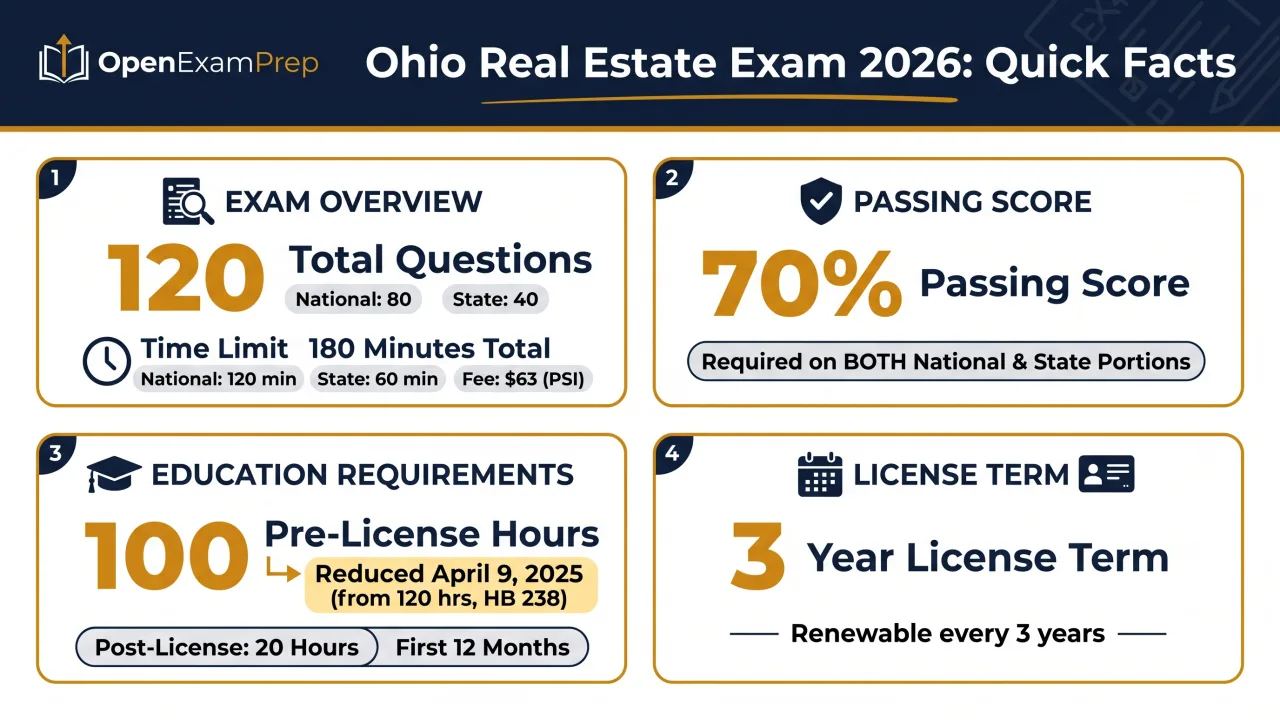
The Ohio Real Estate Salesperson Exam is administered by PSI Services LLC on behalf of the Ohio Division of Real Estate and Professional Licensing (ODRE). Ohio reduced its pre-licensing education requirement from 120 to 100 hours effective April 9, 2025, under House Bill 238, making entry faster while still demanding strong foundational knowledge.
Passing this exam qualifies you to work as a real estate salesperson in Ohio—the 7th-largest state by population, with major markets including Columbus, Cleveland, and Cincinnati. According to the U.S. Bureau of Labor Statistics (May 2024 OEWS, SOC 41-9022), real estate sales agents in Ohio earn a median annual wage of $46,240, with the national median at $56,320.
Exam Format at a Glance
| Component | Details |
|---|---|
| Total Questions | 120 multiple-choice (80 national + 40 state) |
| Time Limit | 180 minutes (120 min national + 60 min state) |
| Passing Score | 70% on each portion (salesperson) |
| Exam Fee | $63 (paid to PSI) |
| Application Fee | $81 (paid to ODRE) |
| Pre-licensing Education | 100 hours (effective April 9, 2025) |
| Post-license Education | 20 hours within first 12 months |
| License Term | 3 years |
| CE Requirement | 30 hours per 3-year cycle (12 hours in 4 core courses) |
| Testing Vendor | PSI Services LLC |
| Delivery | In-person at Ohio testing centers or remote online proctoring |
BLS Wage Data for Ohio Real Estate Agents
The U.S. Bureau of Labor Statistics (OEWS, May 2024) reports the following annual wages for real estate sales agents (SOC 41-9022):
| Area | 10th Percentile | Median (50%) | 90th Percentile |
|---|---|---|---|
| United States | $32,970 | $56,320 | $123,590 |
| Ohio (statewide) | $29,990 | $46,240 | $96,840 |
| Cincinnati, OH-KY-IN | $31,110 | $48,540 | $154,720 |
| Cleveland, OH | $30,060 | $44,320 | $114,130 |
| Columbus, OH | $29,990 | $41,970 | $63,400 |
Income is almost entirely commission-based, so earnings vary widely by market, effort, and brokerage.
Why Get Licensed in Ohio?
- Large population — Over 11.8 million residents (7th-largest state)
- Three major metros — Columbus, Cleveland, and Cincinnati each offer distinct markets
- Affordable housing — Strong buyer demand with relatively affordable entry costs
- 3-year license term — Longer renewal cycle than most states
- Remote proctoring — Take the exam from home or at one of seven Ohio testing centers (Akron, Cambridge, Cincinnati, Cleveland, Columbus, Toledo, Troy)
Start Your FREE Ohio Real Estate Exam Prep
Ready to begin studying? Our comprehensive, completely free Ohio Real Estate exam prep covers everything you need to pass.
Official Exam Content Outline
The PSI Candidate Information Bulletin publishes the official content outline. The exam is split into a national portion (80 questions, 120 minutes) and a state portion (40 questions, 60 minutes). A small number of unscored experimental questions (5-10) may appear; they do not count against your time or score.
National Portion (80 Questions, 120 Minutes)
| Topic | Approx. Questions | Weight |
|---|---|---|
| Contracts | 15 | 19% |
| Agency | 10 | 13% |
| Practice of Real Estate | 10 | 12% |
| Property Ownership | 8 | 10% |
| Financing | 8 | 10% |
| Market Analysis & Valuation | 6 | 8% |
| Property Disclosures | 6 | 7% |
| Real Estate Calculations | 6 | 7% |
| Transfer of Title | 5 | 6% |
| Land Use Controls | 4 | 5% |
| Property Management | 2 | 3% |
State Portion (40 Questions, 60 Minutes)
| Topic | Questions | Weight |
|---|---|---|
| License Law & Rules of the Ohio Real Estate Commission | 16 | 40% |
| Brokerage Relationships (Agency Law) | 14 | 35% |
| Licensing Requirements | 6 | 15% |
| State Governance of the Real Estate Profession | 4 | 10% |
The state portion is dominated by License Law (40%) and Brokerage Relationships (35%), so prioritize those areas in your Ohio-specific study.
Pre-Licensing Education Requirements (100 Hours)
Effective April 9, 2025, Ohio reduced pre-licensing education from 120 to 100 hours under House Bill 238. The four required courses are:
| Course | Hours | Notes |
|---|---|---|
| Real Estate Principles & Practices | 40 | No change |
| Ohio Real Estate Law (incl. civil rights, housing discrimination, desegregation) | 40 | No change |
| Real Estate Finance | 10 | Reduced from 20 hours |
| Real Estate Appraisal | 10 | Reduced from 20 hours |
| Total | 100 | Effective April 9, 2025 |
Courses must be completed at an Ohio-approved provider. Pre-licensure courses are valid for 10 years preceding your application. You must be at least 18 years old, have a high school diploma or equivalent (if born after 1950), and pass BCI/FBI criminal background checks through Webcheck.
Ohio License Process Step by Step
- Complete 100 hours of ODRE-approved pre-licensing education and keep completion certificates
- Obtain a sponsoring broker — Ohio requires broker sponsorship before license activation
- Submit Salesperson Examination Application with $81 fee to the Ohio Division of Real Estate
- Complete BCI & FBI fingerprinting through a Webcheck user
- Receive Candidate Information Bulletin from PSI after ODRE processes your application
- Schedule and pass both national (80 Q, 120 min) and state (40 Q, 60 min) portions at 70%
- Activate your license under your sponsoring broker
- Complete 20 hours of post-license education within first 12 months
Fee Table
| Item | Cost | Paid To |
|---|---|---|
| Pre-licensing course (100 hours) | $400-$700 | Approved education provider |
| Salesperson application | $81 | Ohio Division of Real Estate |
| Exam fee (both portions) | $63 | PSI Services |
| Fingerprinting (BCI & FBI) | ~$40 | Webcheck provider |
| Post-license course (20 hours) | $150-$300 | Approved education provider |
| Total to first license | $584-$884 |
Post-License and Continuing Education
Post-License (first 12 months): Ohio requires 20 hours of post-licensing education within 12 months of license issuance, including 10 hours on law and civil rights. Submit proof by emailing attendance certificates to postcert@com.ohio.gov. Failure to complete it results in license suspension.
Continuing Education (every 3 years): 30 hours per 3-year cycle, including 12 hours across 4 mandatory core courses (Core Law, Civil Rights, Canon of Ethics, and one elective area). Up to 15 hours may be computer-based electives. Up to 10 excess hours may roll over to the next cycle as electives only.
Retake Rules
There is no published limit on retake attempts, but you must:
- Pay the $63 exam fee for each attempt
- Wait at least 24-48 hours before rescheduling
- Retake the failed portion by the date indicated on your initial Candidate Information Bulletin label
- Pre-license education is valid for 10 years, so passing within that window is recommended
Key Topics Covered on the Exam
1. License Law & Rules (40% of State Portion)
Regulatory Authority:
- Ohio Division of Real Estate and Professional Licensing
- Ohio Real Estate Commission
- Rule-making powers
- Disciplinary procedures
- License law enforcement
License Requirements:
- 18 years old minimum
- High school diploma (if born after 1950)
- 100 hours pre-license education (post-April 2025)
- Pass both exam portions at 70%
- BCI/FBI background check through Webcheck
License Types:
- Salesperson license
- Broker license (requires 2 of last 5 years as active salesperson, 20 transactions)
- Foreign real estate dealer
- Real estate appraiser (separate license path)
- Management-level license
2. Brokerage Relationships / Agency Law (35% of State Portion)
Agency Relationships:
- Seller agency
- Buyer agency
- Dual agency
- Agency disclosure requirements
- In-company transactions
Fiduciary Duties:
- Obedience
- Loyalty
- Disclosure
- Confidentiality
- Accounting
- Reasonable care and diligence
Agency Disclosure Form:
- Consumer Guide to Agency Relationships required at first contact
- Written acknowledgment
- Timing requirements
- Documentation standards
Dual Agency:
- Written consent required
- Limited representation
- Both parties informed
- Confidentiality limitations
3. Contracts & Disclosures (National + State)
Ohio Residential Property Disclosure:
- Ohio Residential Property Disclosure Form
- Material defects across multiple categories (water, structural, plumbing, electrical, HVAC, roof)
- Lead-based paint disclosure (federal, for pre-1978 homes)
- Underground mine subsidence disclosure (Ohio-specific)
- Sex offender notification
- HOA disclosure
Purchase Contracts:
- Offer and acceptance
- Essential terms
- Contingencies
- Earnest money provisions
- Closing timeline
Trust Accounts:
- Escrow requirements
- Deposit timeline
- Interest-bearing accounts
- Disbursement rules
- Record keeping (3 years)
4. Property Law & Fair Housing
Ohio Civil Rights:
- Ohio Civil Rights Commission
- Protected classes under Ohio law
- State enforcement
- Fair housing violations
- Penalties and remedies
Types of Ownership:
- Fee simple absolute
- Life estates
- Tenancy in common
- Joint tenancy
- Survivorship tenancy (Ohio-recognized co-ownership with right of survivorship)
Property Taxes:
- County auditor assessment
- Tax rates and levies
- Homestead exemption
- Tax liens
- Payment schedules
Environmental Issues:
- Lead-based paint
- Underground storage tanks
- Mine subsidence (Ohio-specific)
- Wetlands
- Flood zones
Study Timeline for Success
| Week | Focus Area | Hours |
|---|---|---|
| Week 1-2 | National: property ownership, transfer, land use | 15-18 |
| Week 2-3 | National: contracts, agency, practice | 18-22 |
| Week 3-4 | National: financing, valuation, disclosures, math | 15-18 |
| Week 4-5 | State: license law, rules, governance | 18-22 |
| Week 5-6 | State: brokerage relationships, agency law | 14-18 |
| Week 6-7 | Practice exams and weak-area review | 18-22 |
Total recommended study time: 100-120 hours (beyond your 100-hour pre-licensing coursework)
Free Practice Questions Available
Test your knowledge with hundreds of free practice questions designed specifically for the Ohio Real Estate exam.
Ohio-Specific Exam Tips
1. Master the Property Disclosure Form
Ohio's comprehensive Residential Property Disclosure Form:
- Detailed questionnaire format covering known material defects
- Specific items including water intrusion, structural damage, plumbing, electrical, HVAC, roof, and environmental conditions
- Lead-based paint disclosure is separate (federal requirement for pre-1978 homes)
- Underground mine subsidence disclosure is Ohio-specific
- Exemptions apply (transfers by court order, estate, foreclosure, etc.)
2. Understand Survivorship Tenancy
Ohio recognizes survivorship tenancy (tenancy in common with right of survivorship):
- Similar to joint tenancy but with distinct legal requirements
- Right of survivorship means property passes to surviving owners on death
- Specific language must appear in the deed
- Common in Ohio deed drafting
3. Prioritize License Law and Agency for the State Portion
The state portion is 75% License Law (16 Q) and Brokerage Relationships (14 Q):
- Know the Ohio Real Estate Commission's rule-making and disciplinary powers
- Master agency disclosure requirements (Consumer Guide to Agency Relationships)
- Understand fiduciary duties: obedience, loyalty, disclosure, confidentiality, accounting, reasonable care
- Know dual agency rules and written consent requirements
4. Key Numbers to Remember
| Topic | Ohio Requirement |
|---|---|
| Passing score | 70% each portion |
| Pre-licensing | 100 hours (April 2025) |
| Post-license | 20 hours (first 12 months) |
| License term | 3 years |
| CE requirement | 30 hours/3 years (12 core) |
| Exam questions | 120 (80 national + 40 state) |
| Exam time | 180 min (120 national + 60 state) |
| Exam fee | $63 |
| Application fee | $81 |
Common Mistakes to Avoid
- Studying with outdated 120-hour figures — Ohio reduced to 100 hours in April 2025; verify your materials are current
- Missing post-license deadline — 20 hours must be done within 12 months, no extensions
- Underestimating the state portion — License Law and Agency are 75% of the state score
- Failing one portion — You must pass BOTH national and state at 70%; a fail on one means retaking only that portion
- Skipping property disclosure details — Ohio's comprehensive form is heavily tested
- Not pacing the exam — 180 minutes for 120 questions means 1.5 minutes per question average
After Passing Your Exam
- Complete fingerprinting (if not already done)
- Submit license application to the Ohio Division of Real Estate (if not already submitted)
- Confirm broker sponsorship before activation
- Complete 20-hour post-license education within first 12 months
- Track your 3-year renewal date and plan 30 hours of CE
- Begin your real estate career in Ohio
2026 Ohio Updates
For 2026, be aware of:
- The 100-hour pre-licensing requirement (reduced from 120 in April 2025) is now in full effect
- Updated PSI content outlines may shift question distributions slightly — always check the latest Candidate Information Bulletin
- Remote online proctoring remains available alongside in-person testing
- Disclosure form revisions and fair housing training updates may apply
- Verify all administrative details against the current PSI CIB before scheduling
Start Your Ohio Real Estate Career Today
The Ohio Real Estate Salesperson license opens doors to diverse markets across the Buckeye State. With Columbus leading growth and strong markets in Cleveland and Cincinnati, Ohio offers excellent opportunities for new agents. With proper preparation, you can pass both exam sections on your first attempt.
Our free study materials include:
- Complete topic coverage
- Practice questions with explanations
- Property disclosure guide
- Survivorship tenancy specifics
- AI-powered study assistance
Don't pay for expensive prep courses when everything you need is available FREE.
How to Use This Ohio Guide Without Wasting Study Time
Treat the facts above as your control sheet, not as a one-time read. The most common mistake candidates make is reading a licensing overview, feeling familiar with the vocabulary, and then taking mixed practice questions before they can explain why each answer is right or wrong. For the Ohio real estate exam, build your prep around three passes: first learn the licensing workflow, then master the national real estate concepts, and finally drill the Ohio-specific rules until they feel separate from generic national law.
Start by copying the eligibility, education, sponsoring broker, application, fingerprint or background-check, testing vendor, passing score, and renewal facts from this article into one page. Leave a blank column next to each item titled "proof." In that proof column, write where the requirement appears in your course, candidate bulletin, state agency page, or school materials. This exercise is not busywork. It forces you to separate official licensing requirements from school marketing language, and it prevents exam-day confusion when a question asks what happens before licensure versus what happens after a license is issued.
When you study national topics, organize them by transaction stage. Property ownership, estates, encumbrances, land use, valuation, finance, agency, contracts, transfer, closing, and math are not isolated chapters in real practice. They appear in sequence as a client moves from representation to offer, financing, inspection, title, closing, and post-closing duties. If you can place a rule in the transaction timeline, you are less likely to confuse similar terms such as lien versus encumbrance, option versus right of first refusal, void versus voidable, or material fact versus ordinary sales puffery.
Ohio Licensing Workflow to Verify Before You Schedule
Before you schedule the exam, verify every step in the Ohio licensing workflow against the current state agency or testing vendor instructions. Use the article above for orientation, then confirm the current version of the candidate handbook, application portal, education certificate process, identification rules, and score-report policy. State real estate programs change forms and portal steps more often than they change core property law, so do not rely on an old school handout for the last administrative details.
A practical workflow looks like this. First, finish the required pre-license education and keep your completion documentation where you can find it. Second, confirm whether your exam authorization is automatic or requires a separate application step. Third, check whether the testing vendor requires a legal name match with your government ID. Fourth, decide whether you are testing both portions in one sitting or retesting a failed portion. Fifth, confirm what happens after passing: license application, broker sponsorship, background review, fee payment, and any post-license or continuing education deadlines.
That order matters because candidates often prepare for the content but lose days to process errors. A mismatched name, expired authorization, missing education certificate, or misunderstanding about broker sponsorship can delay a license even after a passing score. Add a calendar reminder for every expiration date mentioned in your candidate materials. If your passed score, education certificate, or application window expires, you may have to repeat work that was already finished.
Split Your Prep Between National Concepts and Ohio Rules
Most real estate exams reward candidates who can move back and forth between national principles and state-specific administration. Your national prep should answer questions such as: What kind of ownership interest exists? Which party owes which fiduciary duty? What makes a contract enforceable? How is title transferred? What financing rule applies? What calculation is needed? Your Ohio prep should answer a different set of questions: Who regulates the license? What must be disclosed? What conduct can trigger discipline? What forms or notices are required? What deadlines, fees, or renewal duties apply?
Do not blend those two tracks too early. Spend part of each study session on national concepts and part on Ohio rules, but review mistakes in separate lists. A missed agency question because you forgot obedience, loyalty, disclosure, confidentiality, accounting, and reasonable care is different from a missed state-law question because you confused the regulator, renewal period, or required disclosure. Separate error logs make your next study block much more precise.
For math, keep a compact formula page and practice under time. Real estate math is often more predictable than legal scenario questions, but it punishes sloppy reading. Circle what the question is asking for before calculating: commission amount, broker split, property tax, proration, loan-to-value, interest, area, or capitalization. Then write the units next to the answer. Many wrong choices are built from a correct formula applied to the wrong time period, percentage, or party.
Exam-Day Strategy for Ohio Candidates
On test day, read each question as if one word was placed there to change the answer. Words such as except, first, best, most likely, must, may, before, after, seller, buyer, broker, salesperson, and licensee are common traps. If a question gives a long fact pattern, identify the legal issue before looking at the answers. If you read the answers first, a familiar phrase can pull you toward a rule that does not match the facts.
Use a three-pass timing system. On the first pass, answer questions you can resolve confidently. On the second pass, return to marked questions that require calculation, close reading, or comparison between two plausible answers. On the final pass, make sure no item is blank and revisit only the questions where you have a specific reason to change an answer. Changing answers because of anxiety usually hurts more than it helps; changing an answer because you found a missed word in the stem is different.
If your exam has separate national and state portions, mentally reset between them. A state portion may test rules that override your general instincts from national law. A national portion may ask broad principles without using Ohio terminology. Treat each portion as its own scoring event and keep your pace aligned to the number of questions and time allowed for that section.
What to Do If Your Practice Scores Stall
If your practice scores stay below passing, stop taking full-length exams for a few days and audit your misses. Label each wrong answer as vocabulary, rule, application, math, state-specific detail, or reading error. Vocabulary misses need flashcards. Rule misses need a short outline. Application misses need scenario practice. Math misses need repeated setup drills. Reading errors need slower question review, not more content.
A strong final week is not about seeing the most questions. It is about seeing your weak patterns until they stop repeating. Rework every missed question without looking at the explanation, then write one sentence explaining why the correct answer is better than the tempting wrong answer. That sentence is where learning happens. If you cannot write it, return to the underlying rule before moving on.
For free next steps, use the OpenExamPrep Ohio study path here: Ohio real estate study guide. Then route weak areas into timed practice sets: real estate practice questions. Use the score report or your practice log to decide what to study next, not your comfort level with the topic.


 Buy on Amazon
 Pre-licensing on AceableAgent
 Flashcards on Mometrix
 Pre-licensing on Colibri
 Take courses on Udemy