The Short Answer
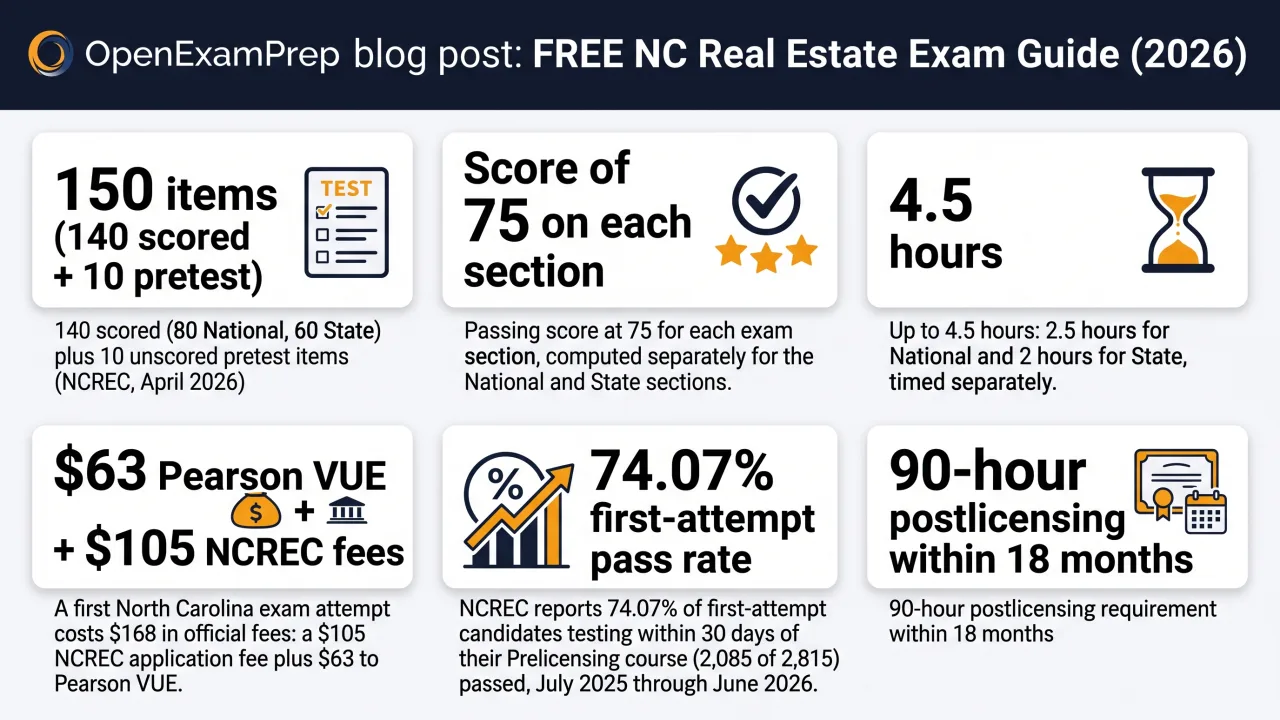
The North Carolina real estate broker exam is a two-part Pearson VUE test given for the North Carolina Real Estate Commission (NCREC). It has 150 multiple-choice items: 140 scored (80 National + 60 State) and 10 unscored pretest items (5 in each section). You get up to 4.5 hours (2.5 for National, 2 for State) and need a score of 75 on each section, computed separately. Official fees for a first attempt are $168: $105 to NCREC plus $63 to Pearson VUE. In NCREC's report for July 2025 through June 2026, 74.07% of first-time candidates passed both sections.
North Carolina is a broker-only state, so there is no salesperson exam. Everyone takes this same test and starts as a provisional broker.
Every number below was checked on October 2, 2026 against NCREC's April 2026 booklet Real Estate Licensing in North Carolina (the same PDF Pearson VUE posts as its candidate handbook), NCREC's FAQs and rules, and NCREC's pass-rate report. This is an independent study guide by OpenExamPrep. It is not affiliated with NCREC or Pearson VUE.
NC Real Estate Exam at a Glance (2026)
| Item | 2026 fact | Source |
|---|---|---|
| Exam vendor | Pearson VUE (since March 1, 2024) | NCREC March 2024 eBulletin |
| Total items | 150 = 140 scored + 10 pretest | NCREC booklet, p. 18 |
| National section | 80 scored + 5 pretest; 2.5 hours | NCREC booklet, pp. 17 and 27 |
| State section | 60 scored + 5 pretest; 2 hours | NCREC booklet, pp. 17 and 27 |
| Passing score | 75 on each section, computed separately | NCREC Licensing FAQ 28 |
| NCREC application fee | $105, nonrefundable, paid for every attempt | 21 NCAC 58A .0302 |
| Pearson VUE exam fee | $63 for both sections; $53 for one section | NCREC booklet, p. 19 |
| Eligibility window | 180 days from the Notice of Exam Eligibility; no extensions | NCREC booklet, p. 19 |
| Retake wait | At least 10 calendar days after a failed or missed exam | NCREC Prelicensing FAQ 19 |
| Prelicensing | 75-hour NC Broker Prelicensing Course, completed within 3 years before you apply | NCREC booklet, p. 6 |
| First license | Inactive provisional broker license | NCREC booklet, p. 30 |
| Renewal | $50 per year, online, May 15 to June 30 | NCREC License Renewal FAQ |
What "75 to Pass" Really Means
NCREC says the passing score "is 75 and is computed separately for each exam section." It does not publish a number of correct answers. Some prep sites convert this to 60 of 80 and 45 of 60, others to 57 of 80. None of those conversions comes from NCREC or Pearson VUE, so do not plan around a raw cut score.
What the official wording does tell you:
- Each section stands alone. A strong National score cannot rescue a weak State score.
- Pretest items are hidden. The 5 pretest items in each section appear at random and look like scored items, so treat every question as if it counts.
- Blank answers are wrong. The booklet says an unanswered item is scored as incorrect. Make an educated guess before time runs out.
- Build a margin. Aim for 80% or higher on timed, North Carolina-specific practice before you schedule. That is our study recommendation, not an official cut score.
The Official Content Outline: Where the Points Are
NCREC publishes the number of scored items in every category. Use those counts to divide your study time.
National section (80 scored items, developed by Pearson)
| Category | Scored items | Share of section |
|---|---|---|
| Contracts & Agency | 16 | 20.0% |
| Real Estate Practice | 14 | 17.5% |
| Valuation | 11 | 13.8% |
| Real Property | 9 | 11.3% |
| Ownership | 8 | 10.0% |
| Property Disclosures | 8 | 10.0% |
| Financing | 7 | 8.8% |
| Real Estate Math | 7 | 8.8% |
State section (60 scored items, developed by NCREC)
| Category | Scored items | Share of section |
|---|---|---|
| Agency | 16 | 26.7% |
| Brokerage Practice | 12 | 20.0% |
| Other NC Laws | 11 | 18.3% |
| Contracts/Closing | 7 | 11.7% |
| Supervision/Compensation | 4 | 6.7% |
| Taxes/Insurance | 4 | 6.7% |
| Licensure | 3 | 5.0% |
| Landlord/Tenant | 3 | 5.0% |
Two takeaways. First, Agency and Brokerage Practice are 28 of the 60 State items (47%). North Carolina agency disclosure, dual and designated agency, and trust-money rules deserve far more time than licensing trivia, which is only 3 items. Second, math is only 7 scored National items, but calculations also appear inside valuation, financing, and closing questions. NCREC points to its Broker Prelicensing Course Syllabus for the detailed subtopics in each category.
Pacing works out to about 1.8 minutes per item in both sections: 85 items in 150 minutes for National and 65 items in 120 minutes for State.
How Hard Is It? The 2025-26 Pass Rates
NCREC's Education Provider License Examination Performance Record counts first-time candidates who take and pass the full exam within 30 days of finishing a Prelicensing course. For July 1, 2025 through June 30, 2026, the statewide total was 2,085 passes out of 2,815 candidates (74.07%).
The same report splits results by how the Prelicensing course was delivered:
| Course delivery | Tested | Passed | Pass rate |
|---|---|---|---|
| Blended | 104 | 87 | 83.65% |
| Synchronous (live online) | 988 | 790 | 79.96% |
| In-person | 537 | 421 | 78.40% |
| Distance (self-paced online) | 1,186 | 787 | 66.36% |
| All methods | 2,815 | 2,085 | 74.07% |
The report does not prove that self-paced courses cause lower scores, because students choose their own format. It is still a clear warning: if you study alone online, add structure, timed practice, and a firm test date. Results also vary widely between schools, so check the provider table in the same NCREC report before you pay tuition. NCREC does not recommend any school.
One more data point matters if you already hold a license elsewhere: NCREC says out-of-state licensees who take only the State section have an average pass rate below 50%.
What a North Carolina License Costs in 2026
| Cost | Amount | Notes |
|---|---|---|
| 75-hour Broker Prelicensing Course | Set by each provider | Compare formats and provider pass rates |
| Criminal record report (CriminalRecordCheck.com) | Likely under $50 if you lived only in NC for the past 7 years | More for other states, countries, or extra names |
| NCREC license application | $105 | Nonrefundable; paid again for every attempt |
| Pearson VUE exam, both sections | $63 | Paid to Pearson when you schedule |
| Pearson VUE exam, one section | $53 | For a single-section retake |
| Annual license renewal | $50 | Effective April 1, 2026 |
| Postlicensing (three 30-hour courses) | Set by each provider | Required within 18 months of licensure |
A first attempt costs $168 in official fees plus your background report and tuition. If you pass National but fail State, the retake adds $158 ($105 + $53). Failing both sections adds another $168. A no-show, a late arrival, or missing ID forfeits both fees, so book a date you can keep.
From Course to License: The Step-by-Step Path
- Finish the 75-hour NC Broker Prelicensing Course and pass its end-of-course exam. The course must be completed within 3 years before you apply. Providers offer it in person, live online (synchronous), or self-paced online.
- Order your criminal record report from CriminalRecordCheck.com through the NCREC application portal. The report must be prepared within 6 months before you apply and must include a federal check.
- Submit the online NCREC application and pay $105 by credit card. The portal will not take payment until your provider reports your course completion and your background report is attached.
- Receive your Notice of Exam Eligibility by email. NCREC's pages quote turnaround times between 2 and 7 days. The notice opens a 180-day window that cannot be extended.
- Schedule with Pearson VUE starting one business day after the notice, online or at 800-745-2627. Walk-ins are not allowed. NCREC says most candidates get a seat within 7 calendar days, and you may test at any physical Pearson VUE center, including centers in other states.
- Take both sections at one appointment. First-time candidates cannot choose to take only one section.
- Get licensed. With no character issues, NCREC emails your license number and mails your certificate, usually within 7 to 10 business days of your exam. If there is a character issue, allow at least 45 days.
- Activate your license. Your first license is an inactive provisional broker license. You and a Broker-in-Charge (BIC) must file the License Activation/Affiliation form (REC 2.08) before you do any brokerage work.
Failing a Section: Retake Rules
- Retake only what you failed. Once you pass one section, you may retake just the other one.
- Wait 10 calendar days. NCREC does not allow a retake for at least 10 calendar days after a failed or missed exam.
- Refile and repay. Every attempt requires refiling your application in the NCREC portal, a new $105 application fee, and a new Pearson VUE fee.
- Watch the 180-day clock. Both sections must be passed in the same 180-day eligibility period, and you need at least 10 eligibility days left after your last test date to schedule again.
- An expired window means starting over. If the period ends with a section still unpassed, you lose credit for the section you passed and must reapply with a new criminal record report and pass both sections.
There is no limit on attempts, but each one costs money and calendar time. Study your weak categories before you book again.
High-Yield North Carolina Rules for the State Section
These rules come straight from NCREC's rules and the North Carolina General Statutes. They are tested often and are easy to confuse with generic national material.
| Topic | North Carolina rule | Citation |
|---|---|---|
| Working with Real Estate Agents (WWREA) | In sales transactions, give and review the brochure at first substantial contact with a prospective buyer or seller | 21 NCAC 58A .0104(c) |
| WWREA by phone or online | Send the brochure no later than 3 days after first substantial contact | 21 NCAC 58A .0104(c) |
| Buyer agency | Must be in writing no later than when any party makes an offer; an agreement that binds the buyer for a time period or limits working with other agents must be written from the start | 21 NCAC 58A .0104(a) |
| Listing agreements | Must be in writing and signed when formed | 21 NCAC 58A .0104(a) |
| Dual agency | Requires the written authority of each party | 21 NCAC 58A .0104(d) |
| Trust money | Deposit within 3 banking days of receipt | 21 NCAC 58A .0116(a) |
| Provisional brokers and trust money | Deliver trust money upon receipt to the supervising broker | 21 NCAC 58A .0116(b)(1) |
| Earnest money paid by check on a pending offer | Deposit within 3 days after acceptance | 21 NCAC 58A .0116(b)(3) |
| Earnest money to the closing attorney | May be transferred no more than 10 days before settlement | 21 NCAC 58A .0116(e) |
| Disputed deposits | Hold until a written release or court order, or deposit with the Clerk of Superior Court | 21 NCAC 58A .0116(d) |
| Excise tax | $1 per $500 (or fraction) of the consideration, paid by the transferor | G.S. 105-228.30 |
| NC Fair Housing Act | Race, color, religion, sex, national origin, handicapping condition, and familial status | G.S. 41A-4 |
| Address or employment change | Notify NCREC within 10 days | NCREC booklet, p. 30 |
Due Diligence: North Carolina's Signature Contract Concept
The NC REALTORS and NC Bar Association Offer to Purchase and Contract (Standard Form 2-T) gives the buyer a negotiated due diligence period to investigate the property and the deal.
- Due diligence fee: paid by the buyer directly to the seller. It is generally nonrefundable. NCREC explains that the buyer gets it back only in limited cases, such as the seller's material breach, the seller's failure to meet its contract obligations, or a property that is destroyed or materially damaged before closing.
- Earnest money: a separate deposit held by the escrow agent. If the buyer terminates during the due diligence period, the earnest money is refunded but the due diligence fee is not.
- Termination: during the due diligence period, the buyer may terminate for any reason or no reason by giving written notice.
- July 1, 2026 form update: the fee is still due on the Effective Date, but the buyer is not in breach until the end of the next banking day. The seller must then give written notice (Form 355-T) before terminating for nonpayment, and may limit physical access to the property while the fee is unpaid.
The exam tests these concepts through the Prelicensing syllabus. Focus on who receives which money and when, not on paragraph numbers that change with each form revision.
A 6-Week Study Plan Weighted by the Outline
| Week | Focus | Scored items covered |
|---|---|---|
| 1 | NC agency: WWREA, seller, buyer, dual, and designated agency; agency agreements | 16 State |
| 2 | Licensure, BIC supervision, compensation, brokerage practice, trust money, advertising | 19 State |
| 3 | National Contracts & Agency and Real Estate Practice, including fair housing | 30 National |
| 4 | Valuation, Real Property, Ownership, Property Disclosures, Financing | 43 National |
| 5 | NC contracts and closing (Form 2-T, due diligence), taxes, landlord/tenant, other NC laws; daily math sets | 25 State + 7 National |
| 6 | Two timed mock exams per section; review every miss and retest weak categories | Pacing and margin |
Plan on roughly 10 to 15 hours of review per week on top of your course, and more if your practice scores sit below 80%. Try to book the exam within about a month of finishing the course, while the material is fresh. When you review a miss, label it as vocabulary, rule, application, math, NC-specific detail, or reading error, and keep a separate error log for each section. A missed National contract question and a missed NC trust-money question need different fixes.
Pearson VUE sells general real estate practice tests for $19.95 and tells NC candidates to choose the Sales practice exam. It does not offer a State-section practice test, so you need NC-specific questions from another source.
Exam-Day Rules That Trip People Up
- Arrive 30 minutes early. Late arrivals may be turned away and lose their fees.
- Bring one valid, unexpired, government-issued photo ID with a signature. The name must match your application. Pearson accepts a middle initial in place of a full middle name, but not other variations.
- Bring a calculator. It is recommended but not provided. Use a handheld battery or solar financial calculator without alphabetic keys.
- Breaks are allowed, but the clock runs. A break between sections is not deducted from either section.
- The tutorial is free time. The on-screen tutorial does not count against exam time.
- Reschedule early. Changes are free at least 2 business days before your appointment.
- Expect a strict room. Phones, watches, bags, notes, and your own scratch paper stay out; the test center gives you materials for notes.
After You Pass: Provisional Broker, Postlicensing, CE, and Renewal
- Provisional broker status. You must be supervised by a BIC to be on active status. You remove provisional status by completing Post 301 (Broker Relationships and Responsibilities), Post 302 (Contracts and Closing), and Post 303 (NC Law, Rules, and Legal Concepts), 30 hours each, within 18 months of initial licensure. If you miss the deadline, your license goes inactive until you finish. Postlicensing courses do not count as CE.
- Continuing education. Each license year (July 1 to June 30), active brokers need 8 hours by June 10: a 4-hour Update course plus a 4-hour elective. Provisional and non-BIC brokers take the General Update (GENUP); BICs and BIC-eligible brokers take the BIC Update (BICUP). Update courses must be taken live, in person or synchronously online, while electives may be self-paced. You have no CE requirement in the license year you are first licensed.
- Renewal. Every NC license expires June 30. Renew online between May 15 and June 30 for $50, even if your CE is not finished; if you do not renew, the license expires.
What Changed in 2026
- New candidate booklet. NCREC's Real Estate Licensing in North Carolina (April 2026) is the current handbook, and it is the copy Pearson VUE links.
- Higher fees (effective April 1, 2026). The broker application fee is $105 and the annual renewal fee is $50 (21 NCAC 58A .0302 and .0503).
- Voluntary cancellation (April 1, 2026). New rule 21 NCAC 58A .0513 lets a broker permanently cancel a license if no complaint or disciplinary action is pending.
- Cameras on in live online classes (July 1, 2026). Students in synchronous distance learning must stay visible on camera to meet attendance requirements (21 NCAC 58H .0101).
- Form 2-T update (July 1, 2026). New due diligence fee payment and cure rules, described above.
- Latest pass rate. The 2025-26 first-attempt pass rate was 74.07%.
Already Licensed in Another State?
If you hold a current license in another state, U.S. territory, or Canadian jurisdiction that was active at some point in the past 3 years, NCREC's Option 4 lets you skip the Prelicensing course and the National section. You then choose one path:
- Pass the State section and receive an NC license equivalent to the one you hold now, or
- Skip the State section and start as a provisional broker who must complete Postlicensing, with no waiver available.
You will need an official certification of licensure issued within the 6 months before you apply. Given the sub-50% State-only pass rate, take State-section practice seriously even if you have years of experience.
Free OpenExamPrep Resources for the NC Exam
- North Carolina real estate study guide for NC-specific topics
- NC real estate practice questions with explanations
- NC real estate flashcards for deadlines, rule numbers, and terms
- NC real estate cheat sheet for last-week review
- National real estate practice questions for the 80-item National section
All of these are free. Use the AI tutor to explain a missed question or to quiz you on the State categories above.
Official Sources
- NCREC: Real Estate Licensing in North Carolina, April 2026 (Pearson VUE copy)
- NCREC Licensing FAQs
- NCREC Prelicensing FAQs
- NCREC License Exam Performance Records
- NCREC April 2026 rule changes
- NCREC continuing education bulletin, June 2026
- NCREC License Renewal FAQs
- NCREC: Due Diligence Fees, When Are They Refunded?
- Pearson VUE: North Carolina Real Estate Commission
- NC REALTORS: Summary of 2026 residential form changes


 Buy on Amazon
 Flashcards on Mometrix
 Pre-licensing on AceableAgent
 Pre-licensing on Colibri
 Take courses on Udemy