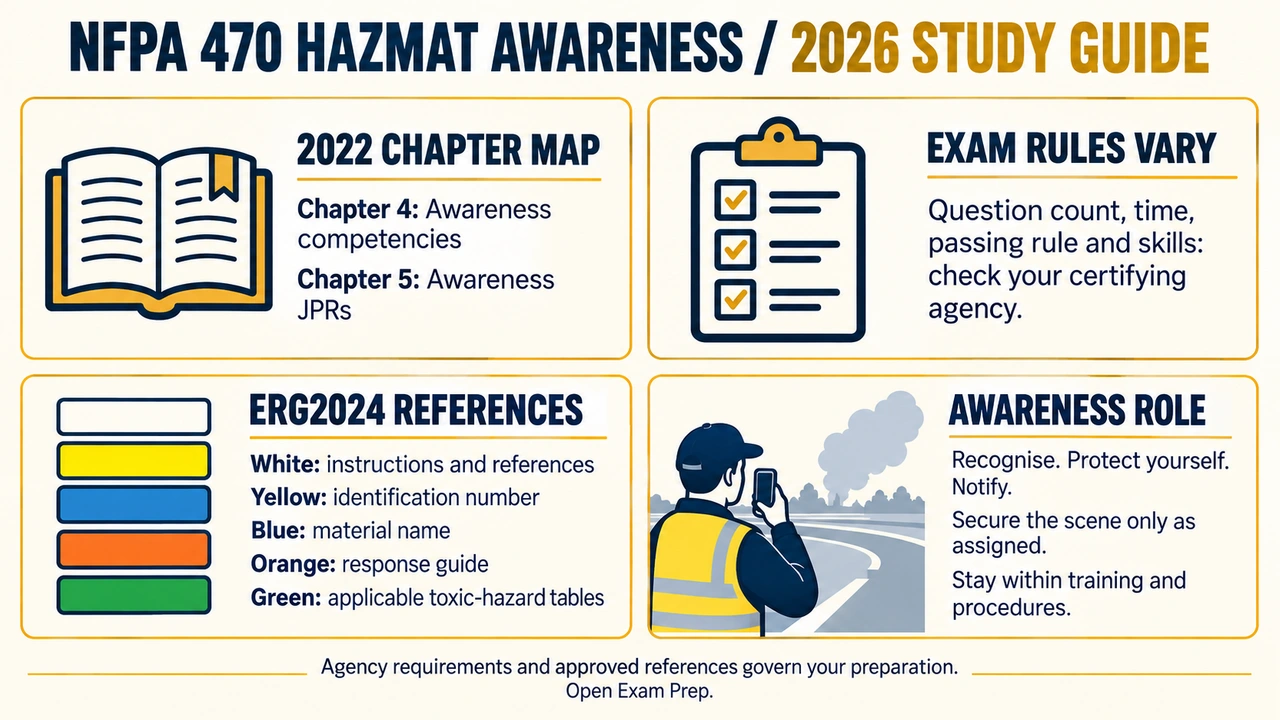
Start with your certifying agency, then study the standard
NFPA 470 Hazmat Awareness does not have one universal national exam format. Your state or regional certifying agency sets the test arrangements. NFPA publishes the responder standard; Pro Board and IFSAC accredit eligible certifying agencies. A question count advertised by one academy is not automatically your examination.
For 2026 preparation, first obtain your agency's current candidate handbook, adopted standard edition, approved course material and skills sheets. Then practise the awareness-level decisions: recognise a possible hazardous-materials incident, protect yourself, use available reference information without approaching the hazard, make notifications and carry out assigned non-intervention scene-security duties.
This guide concerns emergency-response awareness certification. A commercial driver's CDL hazardous-materials endorsement is a different examination and pathway. Truck-driver candidates should use our CDL Hazmat Endorsement guide.
Why a generic 50-question snapshot can mislead
Two official examples show why the provider name belongs beside every exam statistic:
| Named certification program | Published awareness examination information | What to check separately |
|---|---|---|
| Missouri Division of Fire Safety | 50 multiple-choice questions, one hour, 70% minimum; an awareness practical skill examination is also required | Current approved curriculum, eligibility, scheduling and practical requirements |
| California State Fire Training, Fire Fighter 1B, May 2026 overview | The awareness cognitive section has 25 questions in 30 minutes; the separate Operations/PPE/Product Control section also has 25 questions in 30 minutes | Your current Fire Fighter 1B candidate instructions and combined skills requirements |
California's numbers describe sections of its Fire Fighter 1B system, not a separate nationwide NFPA awareness examination. Missouri's 70% figure means 35 correct answers out of 50 for that published written format; it does not eliminate the practical assessment. Neither example establishes a universal fee or training-hour requirement.
Before booking, confirm identification, age or other entry rules, permitted references, testing accommodation procedures, retakes, fees and the exact credential awarded. Course completion, passing a written test, certification and employer authorisation to perform a task are separate events. Ask the agency about renewal; do not assume every accredited certificate has identical lifetime validity.
Read the 2022 chapter map correctly
The NFPA 470 publisher page identifies the 2022 edition as current in the source checked for this guide. It consolidates the former NFPA 472, 473 and 1072 documents. Your agency still determines which edition it has adopted.
The 2022 edition retains separate competency and professional-qualification streams:
| Responder level | Competencies chapter | Professional qualifications/JPR chapter |
|---|---|---|
| Awareness | 4 | 5 |
| Operations | 6 | 7 |
| Operations with mission-specific responsibilities | 8 | 9 |
| Technician | 10 | 11 |
For awareness JPR preparation, Chapter 5 covers recognition and identification, initiating protective actions, and notification. The Texas curriculum effective January 2025 and Indiana curriculum dated September 2025 explicitly reference these Chapter 5 requirements. Do not call Chapter 4 the awareness JPR chapter or mistake a committee proposal for the published standard.
Use those three awareness functions to organise revision. You need to explain both the information you can obtain and the limits on what you may do with it. No common national topic percentages are established by the sources used here; the sections below are study groups, not an official weighted blueprint.
Awareness scope: recognition does not authorise intervention
OSHA 29 CFR 1910.120(q)(6)(i) describes awareness personnel who initiate the response sequence by notifying the proper authorities and take no further action beyond that notification. Its competencies include recognising hazards, identifying substances if possible, understanding the employer's emergency plan and recognising the need for additional resources.
NFPA-based awareness skills also address personal protection and isolating or securing an area under the applicable plan. Read these requirements together with your training, employer's procedures and incident command. They do not grant general permission to conduct an evacuation, enter a contaminated area or improvise a containment operation.
An exam option that has you approach a leaking tank, perform product control or undertake decontamination solely because you hold awareness training exceeds that preparation. Operations personnel have additional defensive-response competencies; technicians have additional release-control competencies. Mission-specific assignments require their own training and capabilities.
Avoid memorising a table that assigns one uniform, chemical suit or zone to every training level. PPE and zones depend on the actual hazards, assessment and assignment. Structural firefighting clothing does not provide universal chemical protection, and SCBA alone does not make an otherwise unqualified entry safe.
For employees covered by OSHA paragraph (q), the refresher rule also matters: paragraph (q)(8) requires sufficient annual refresher training or demonstration of competency at least yearly. The employer must document the training or competency and, for a competency statement, the demonstration method. This workplace obligation is distinct from a certifying agency's renewal rules.
Recognise hazards without moving closer to collect a clue
Study occupancy and location, containers, markings, placards, labels, documents and information from responsible personnel. These are complementary indicators, not a universally ranked seven-step approach route. Never approach to obtain a better smell, touch an unknown substance or treat absence of an odour as proof of safety.
The 2024 Emergency Response Guidebook, or ERG, lists nine transport hazard classes. Read the class or division number and symbols together; colour alone does not identify a substance or all its hazards.
| Class | Recognition knowledge to practise |
|---|---|
| 1: Explosives | Division numbers distinguish mass-explosion, projection and other explosive hazards; do not treat all divisions as identical |
| 2: Gases | 2.1 flammable, 2.2 non-flammable/non-toxic, 2.3 toxic gases; a non-flammable gas can still create serious hazards |
| 3: Flammable liquids | Recognise the flame/Class 3 marking and consult the specific material information; do not infer an exact flash point from colour |
| 4: Flammable solids and related hazards | Distinguish 4.1, spontaneously combustible 4.2, and dangerous-when-wet 4.3 |
| 5: Oxidisers and organic peroxides | Separate 5.1 oxidising substances from 5.2 organic peroxides |
| 6: Toxic and infectious substances | Distinguish 6.1 toxicity from 6.2 infectious hazards |
| 7: Radioactive materials | Recognise the radiation marking and obtain specialist information; distance and shielding decisions are hazard-specific |
| 8: Corrosives | Recognise corrosive hazards to people and materials; an acid/base nickname is not a full assessment |
| 9: Miscellaneous hazardous materials | Learn the class marking without assuming it means a minor or harmless substance |
Subsidiary hazards, package quantities and regulatory exceptions can affect markings. A four-digit UN/NA number is an identification reference; the class number is a hazard classification. They are not interchangeable.
NFPA 704 and workplace labels answer different questions
The NFPA 704 diamond communicates emergency hazards: blue for acute health, red for flammability, yellow for instability and white for special hazards. The numeric ratings run from 0 to 4, with 4 the more severe rating. Read the ratings separately: blue 0 describes the lowest acute-health hazard, while the red number still governs flammability. A low rating in one quadrant does not cancel a high rating in another.
Recognise the standard special-hazard symbols: OX for oxidiser, W with a slash for unusual water reactivity, and SA for simple asphyxiant gases. These are hazard warnings, not stand-alone instructions authorising an awareness responder to select an extinguishing agent or enter the scene.
The joint NFPA/OSHA comparison card explains why an SDS hazard category number must not be copied into an NFPA diamond. OSHA/GHS categories classify particular hazards, while NFPA ratings serve emergency recognition. A category number only makes sense within its hazard class; there is no single universal 1-to-5 GHS ladder for every hazard.
Also distinguish edition from adoption. The NFPA 704 publisher page lists a 2027 edition, but that does not automatically change the NFPA 470 edition or references adopted by your certification program. Learn the basic systems, then use the references specified by the testing authority.
Container shapes are clues, not positive identification
Use the ERG rail-car and road-trailer charts as fallback recognition resources. The charts warn that designs vary and jackets can hide reinforcing rings. A silhouette cannot establish contents, internal pressure, remaining quantity or safety.
| Container family | Useful recognition association | Limit on the inference |
|---|---|---|
| MC-306/DOT-406 | Often elliptical liquid cargo tanks associated with flammable-liquid service | The chart is not proof of the actual load or pressure |
| MC-307/DOT-407 | Circular chemical cargo tanks; rings may be visible or concealed | Multiple toxic, corrosive or flammable liquids may be carried |
| MC-312/DOT-412 | Often smaller-diameter, reinforced corrosive-service tanks | Appearance does not replace an ID number or shipping paper |
| MC-331 | Rounded-head tanks associated with liquefied compressed gases | Several products and configurations share the shape |
| MC-338 | Insulated refrigerated-liquid tanks with a fittings cabinet | Insulation and appearance do not prove an incident is controlled |
| General-service and pressure rail tank cars | Fittings, housings, markings and car numbers help recognition | A protective housing alone is not a pressure classification; DOT-117 also has protected fittings |
A useful drill is to name the likely container family, then state what additional identification is needed. Do not turn an approximate design-pressure range into a reading of the pressure in a damaged tank.
Shipping papers and SDS navigation
The ERG describes road shipping papers in the cab, rail information with a crew member, aviation information with the pilot or aircraft employees, and marine documents on the bridge. Obtain information through safe communications; do not enter an unsafe vehicle to retrieve paperwork.
Practise extracting the identification number, proper shipping name, class/division, packing group where applicable and emergency telephone number. A consist helps locate cars in a train; a shipping description identifies the regulated material. Not every material has a packing group, and document names or electronic arrangements can vary by mode.
For an SDS exercise, locate identification and contact information, hazard identification, first aid, firefighting measures, accidental-release measures, physical properties, and stability/reactivity information. Reading an operational recommendation does not establish that you are trained or equipped to carry it out.
Learn the ERG lookup logic, including its exceptions
The ERG supports the initial phase of a transportation incident. It is not a universal first-30-minutes rule, a complete response plan or a substitute for material-specific technical advice. It contains advice for multiple responder capabilities; awareness training does not authorise every action printed in an orange guide.
| Section | Study task |
|---|---|
| White reference pages | Locate the instructions, placard/container charts, definitions and emergency contacts |
| Yellow index | Find the material by four-digit identification number |
| Blue index | Find the material by its listed name |
| Orange guides | Read potential hazards, public safety and the relevant emergency-response information |
| Green tables | Use the applicable initial-isolation/protective-action information and its conditions, not just the colour |
For a classroom single-material scenario, locate the material, note its guide number and any P suffix, then read the relevant orange guide. A P indicates a possible violent-polymerisation hazard. A green highlight directs you to additional guidance for toxic-inhalation or toxic-gas-producing water-reactive hazards.
For an applicable spill without fire, consult the green tables with the orange guide. Table 1 distinguishes initial isolation from downwind protective action and differentiates small/large spills and day/night conditions. Table 2 identifies toxic gases generated by specified water-reactive materials; those gases are already considered in the associated Table 1 distances. Table 3 provides additional large-spill guidance for six commonly encountered toxic-inhalation gases, accounting for container and wind conditions.
Fire does not mean ignore all green-table information. The green-table introduction directs use of the orange fire-hazard distance for isolation where fire/explosion hazards control, while retaining downwind protection for residual toxic release from Table 1. The flowchart also warns against using its ordinary single-material sequence for incidents involving more than one hazardous material. Such circumstances require the appropriate assistance and procedures.
Guide 111 is not a universal safe radius
When identification cannot be established through the available number, name, placard or container references, the ERG directs users to Guide 111 for mixed load/unidentified cargo. In that guide, the immediate precaution for a spill or leak is at least 100 metres (330 feet) in all directions. Its tank/rail-tank/highway-tank fire provision instead specifies 800 metres (one-half mile) of isolation and consideration of initial evacuation.
Compare that with Guide 115: its stated tank-fire provision uses 1,600 metres (one mile). Those are different conditions in different guides, not interchangeable answers. Memorising one distance for every spill, fire or possible BLEVE is poor preparation. In an actual incident, follow the current guide, incident command and your qualified role; do not use a study example as an independent perimeter decision.
Practise explaining why an answer uses a particular guide, incident condition, spill category and unit. If those inputs are missing, the numerical answer is not supported.
Physical properties: interpret the reference conditions
Vapour density compares equal volumes of a gas/vapour and dry air at the same temperature and pressure. A value of 2.4 is greater than 1, indicating a denser pure vapour under those reference conditions. It may collect or travel near the ground; wind, temperature, mixing, terrain and release conditions still affect the actual cloud. Do not memorise that every gas lighter than air immediately rises safely away.
Specific gravity compares a substance with water at a stated temperature. A liquid value of 0.75 indicates lower density than water. A separate floating layer is a reasonable classroom inference only when the liquid is sufficiently immiscible and does not react significantly with the water. Solubility, reaction and temperature can change the situation. Neither density number authorises approaching a spill or predicts its complete movement.
For BLEVE recognition, understand the possibility of catastrophic pressure-container failure and the associated projectile and, for ignited flammable contents, fire hazards. The ERG notes that damaged pressure tanks can fail even without an active fire. Do not depend on a particular relief-valve sound, visible deformation or a fixed one-mile rule as a reliable warning-and-distance formula.
Make a useful notification and practise the complete skill
Know the communications sequence in your employer's emergency plan. From information available without exposure, communicate location, observed markings or ID numbers, container type, fire/spill conditions, people potentially affected and the help needed. Separate observations from assumptions: an unreadable marking is unknown, not evidence that the load is harmless.
The ERG lists CHEMTREC at 1-800-424-9300 for technical assistance in the United States, Canada and the US Virgin Islands. The US National Response Center number is 1-800-424-8802; federal reporting duties depend on the applicable release and reporting rules. A technical-information call does not replace emergency dispatch, the organisation's notification procedure or a legally required report.
A seven-day review cycle you can adapt
This is an editorial revision plan, not mandatory course hours or a promise of readiness:
| Day | Practice outcome |
|---|---|
| 1 | Confirm the agency handbook, edition, written/skills requirements and awareness role |
| 2 | Explain the nine transport classes, markings and limits of colour-only identification |
| 3 | Interpret NFPA 704 separately from SDS/GHS categories and practise finding document information |
| 4 | Compare container families; identify the additional evidence needed before naming a material |
| 5 | Work ERG lookup scenarios, including green highlights, unknown cargo, fire and unit distinctions |
| 6 | Use the agency's actual time/count conditions for written practice and rehearse the approved skills sheets |
| 7 | Review reasoning errors, reference navigation and notification; verify exam-day instructions |
Use our Hazmat Awareness practice questions, study resources, flashcards and cheat sheet for additional revision, cross-checking the agency's current requirements and primary references when details differ. A practice score is feedback on those questions, not certification or proof of field competence.
Primary references to keep beside your notes
- NFPA 470 current-edition and development information
- Texas NFPA 470 curriculum, effective January 2025
- Indiana awareness curriculum, September 2025
- Missouri hazardous-materials certification requirements
- PHMSA ERG2024 accessible PDF and publication details
- OSHA 1910.120, especially paragraphs (q)(6) and (q)(8)
- NFPA/OSHA hazard-label comparison

 2 Job Wiki
 Free CE

 Buy on Amazon