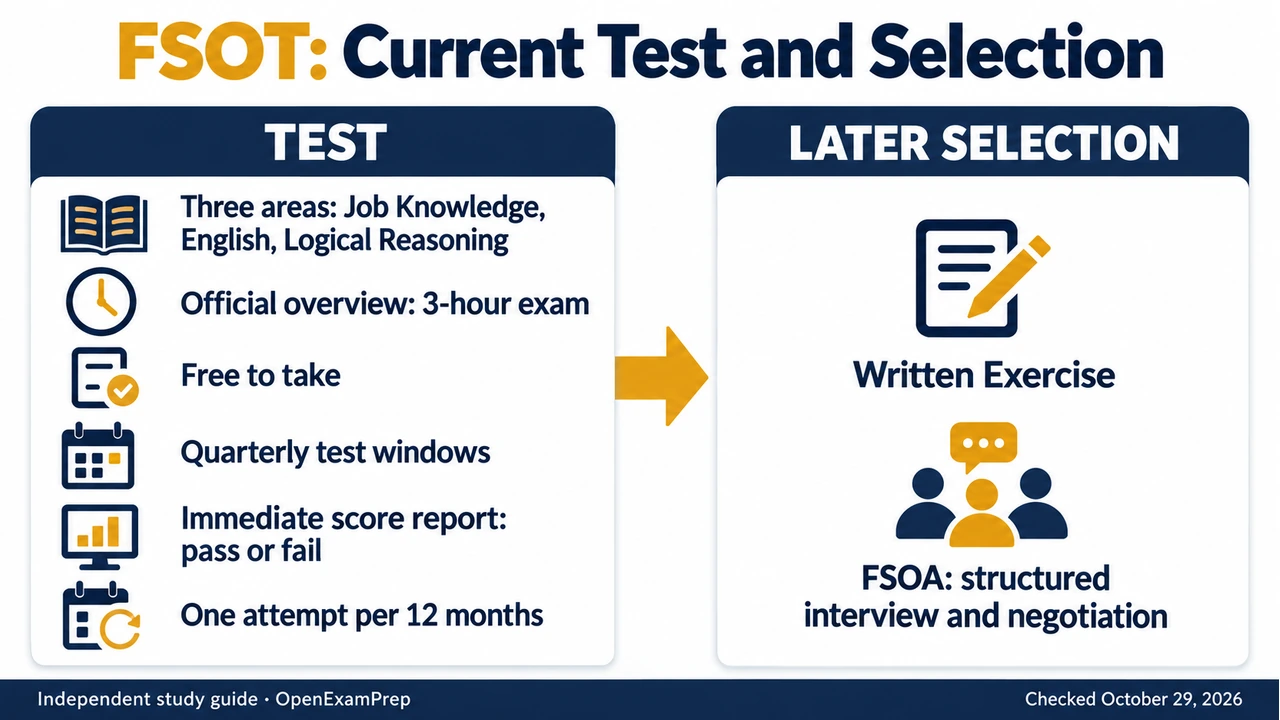
The Foreign Service Officer Test (FSOT) currently covers Job Knowledge, English Usage and Comprehension, and Logical Reasoning. The State Department describes it as a free, three-hour exam offered quarterly. Pearson's current instructions say your score report shows pass or fail. Those are the starting facts for planning a 2026 attempt, according to the State Department candidate kit, its selection-process page, and Pearson's FSOT page.
A major source of confusion is the official practice test: its three sets contain 125 questions with 115 minutes of suggested self-timing. That is useful preparation guidance, but the current live-exam overview does not separately publish an item total or explain the difference between those practice timings and its three-hour description. Keep both figures in their proper context.
This guide, checked October 29, 2026, helps you choose a testing window, understand the revised selection process, and build a practical study routine. Start with the official simulation, then use FSOT practice questions and the FSOT study guide to work on specific weaknesses. None of these practice results predicts appointment to the Foreign Service.
What changed, and which older advice should you retire?
The State Department's modernization announcement identifies October 18-25, 2025 as the first revamped testing window. It confirms a new logic-and-reasoning section, the retirement of Situational Judgment, and removal of the personal narrative essay requirement. It also describes revisions to Job Knowledge and English questions.
Do not interpret the removal of personal narratives as the removal of writing from the entire hiring process. The current official practice instructions separately describe a later Written Exercise (WE) and an FSOA consisting of a structured interview and a negotiation exercise. The page was updated October 27, 2026; that timestamp establishes when the page was updated, not when every policy first took effect.
| Advice you may encounter | How to use current guidance |
|---|---|
| Study the old Situational Judgment section | Prioritize Logical Reasoning for the current three-part test. |
| Every candidate automatically proceeds to holistic QEP review | That description belongs to the June 2022 model; current score reports show pass or fail. |
| There is no writing anywhere in selection | Prepare for the FSOT first, while recognizing that a separate Written Exercise follows later. |
| Take the test in February, June or October only | Use the current quarterly schedule and the exact published dates below. |
| Budget about two hours including check-in | The current candidate kit describes a three-hour exam; verify the appointment details separately. |
Older official documents can also be stale. The Information Guide PDF hosted under a 2023 directory contains a 2016 copyright and an older test structure. Its own notice directs readers to the current State Department website when information conflicts. A recent-looking file path is not evidence of a recent policy.
Use the official practice format without inventing exam weights
The State Department says its online simulation previews the new test's length and questions. The linked form gives the following directions, which we checked directly. This table describes the official practice simulation, not a separately confirmed live-exam blueprint.
| Official practice section | Practice questions | Self-timing instruction | Average pace, calculated |
|---|---|---|---|
| Job Knowledge | 50 | 35 minutes | 42 seconds per question |
| English Understanding and Comprehension | 45 | 35 minutes | About 47 seconds per question |
| Logical Reasoning | 30 | 45 minutes | 90 seconds per question |
| Total | 125 | 115 minutes | Sections must be paced separately |
The instructions page calls the English section English Usage and Comprehension, while the form uses Understanding and Comprehension. Both refer to English skills and reading comprehension. Follow the labels and directions presented in your actual appointment.
The arithmetic is straightforward: 50 + 45 + 30 = 125 questions, and 35 + 35 + 45 = 115 minutes. However, dividing the practice question counts by 125 does not establish official scoring weights. The current overview does not publish those weights. Nor does it support an alternate 40/35/40-minute schedule.
For planning, keep the three-hour live-exam overview separate from the practice timer. The sources reviewed do not explain the difference, so do not assign the remaining time to tutorials, breaks or another assessment. Use your Pearson confirmation and on-screen instructions for the actual appointment.
For a practice session, set a separate timer for each part and record where you ran out of time. The English and logic practice directions say there is no penalty for guessing. Use that instruction in the simulation; read the live test's own directions rather than assuming every practice navigation feature will be identical.
Pass/fail results and the stages after the FSOT
Pearson's current page explicitly distinguishes an account status reading "scores are under review" from the score report itself. The immediate report indicates whether you passed or failed. Candidates can retrieve it through View score reports in their Pearson account. Do not interpret a processing label as the final result.
The public sources reviewed do not supply a current numeric cutoff. That is different from saying no passing standard exists. An old article describing the 2022 move away from a pass/fail gateway cannot override today's operational score-report instructions.
The current State Department instructions describe this progression:
- FSOT: the initial knowledge and reasoning test.
- Written Exercise: a later assessment stage, separate from the initial multiple-choice preparation discussed here.
- FSOA: a structured interview and a negotiation exercise.
- Background, medical and suitability clearances: required before placement on the hiring register.
- Rank-ordered register: offers depend on hiring needs by career track.
Use the invitation for your own candidacy to confirm the next stage's scheduling and requirements. Do not substitute an older Case Management Exercise/Group Exercise checklist for current instructions. Passing one stage is not a job offer. The candidate kit gives 12-18 months from FSOT to first assignment as a typical timeline, not a guaranteed completion period or the time needed to prepare for this exam.
Choose a realistic window and check eligibility first
The State Department's published schedule lists these windows as of October 29, 2026:
| Testing window | Registration opens | Registration closes | Testing dates |
|---|---|---|---|
| October 2026 | September 10, 2026 | October 30, 2026 | October 10-31, 2026 |
| Early 2027 | December 31, 2026 | January 28, 2027 | January 30-February 6, 2027 |
Published dates do not guarantee an available appointment. Check the live table and Pearson availability before arranging travel or taking leave. The State table gives the January 2027 closing date correctly; Pearson's February 2027 listing currently displays a January 2026 year error. Use the coherent State window and confirm your booking.
Quarterly availability does not mean you can test every quarter: Pearson permits only one FSOT attempt within a 12-month period. The application is valid only for the selected window. Treat registration and preparation as separate decisions, especially if you are considering the final days of the current October window.
Pearson lists these standard eligibility conditions:
- U.S. citizenship when submitting the registration package.
- Age 20-59 at registration.
- Age at least 21 and not yet 60 at appointment.
- Willingness to accept assignments based on service needs.
The State Department's current careers FAQ says no specific degree or prior foreign-language proficiency is required. Avoid confusing registration age with appointment age or assuming a particular degree is mandatory. If your circumstances involve an exception, get guidance from the Department before relying on general eligibility summaries.
Fees, cancellation and delivery
The State Department lists the FSOT as free. Do not automatically apply an old blanket $72 fee/48-hour cancellation rule to every current appointment. Pearson's current OnVUE instructions permit cancellation or rescheduling up to the appointment time at no cost. Read the terms for your selected delivery method; the sources reviewed do not establish a universal current test-center no-show charge.
You can use a Pearson testing center or OnVUE remote delivery, subject to available appointments and requirements. For OnVUE, Pearson asks candidates to run the system test using the intended computer and location, log in 30 minutes before the appointment, and present acceptable identification matching the registration name. Its online instructions prohibit calculators, notes and writing materials in the testing room. Practice mental arithmetic, but follow the actual accommodations and appointment instructions that apply to you.
Pick a career track for the work, not an imagined easier score
Choose among the five generalist tracks before applying. Pearson says a submitted application cannot be changed; do not plan to switch tracks after submitting it. The official career descriptions explain the work, while the questions below are our decision prompts.
| Track | Official work emphasis | A question to ask yourself |
|---|---|---|
| Consular | Serving U.S. citizens abroad and facilitating lawful travel | Do I want direct public-facing decisions and citizen assistance? |
| Economic | U.S. prosperity and international economic cooperation | Do I enjoy explaining how economic developments affect national interests? |
| Management | Embassy staffing, logistics, property and budgets | Do I want responsibility for the systems that keep a mission operating? |
| Political | Political analysis and advocacy for U.S. policy | Do I enjoy interpreting events and presenting a defensible assessment? |
| Public Diplomacy | Connecting with foreign audiences | Do I want to explain policy and build understanding through communication? |
These are career choices, not five separate FSOT syllabuses. The current sources do not publish track-specific pass scores that would justify choosing a supposedly easier route. Read the work descriptions and choose a track you can explain sincerely.
Study the skills behind your missed answers
Job Knowledge: turn broad reading into specific recall
The official content list includes U.S. government, history and society; world history and geography; economics; and mathematics/statistics. Use it to organize a notebook instead of collecting unrelated trivia. After a missed question, write the underlying rule, one example and the mistaken idea that attracted you to another option.
For government, distinguish an institution's power from the threshold needed to exercise it. For example, Article II, Section 2 makes the treaty-consent threshold two-thirds of senators present, not a fixed number in every vote. This distinction connects civics knowledge with careful numerical reading.
For economics, define the measure before calculating. The Bureau of Economic Analysis defines net exports as exports minus imports. With hypothetical exports of 80 units and imports of 100 units, net exports are -20 units. A negative balance is not the same thing as negative total production. The quiz below uses a different example so you can test the method rather than memorize the answer.
For geography and history, explain relationships: where a place is, what event occurred, and why it mattered. For mathematics, practice percentages, averages and tables with units written beside the numbers. If a quantity rises from 80 to 100, the increase is 20 divided by the original 80, or 25%, not 20%.
English: explain the edit, then defend the reading answer
Treat editing and comprehension as distinct tasks. In an editing question, first find the subject and its verb, then inspect modifiers, punctuation and parallel structure. An extra phrase between subject and verb does not change the subject's number.
Compare "After reviewing the report, the analyst corrected the totals" with "After reviewing the report, the totals were corrected." The second version leaves the reviewer unstated as the main-clause subject. Naming the person who performed the action makes the relationship clear. This is the principle behind Purdue OWL's dangling-modifier guidance.
For reading comprehension, identify the sentence that supports your answer. A plausible statement about diplomacy can still be wrong if the passage does not support it. Label each error as grammar, vocabulary, passage evidence or rushing; the remedy should match the error.
Logical Reasoning: use the stated facts, not workplace intuition
The official practice directions use hypothetical work scenarios and warn against adding outside assumptions. Identify the conclusion, underline its supporting premises, and ask what connection the author needs.
Suppose every office that adopted a new scheduling system reduced waiting times. An office reduced waiting times, so an analyst concludes it adopted the system. That conclusion does not follow: another change could have produced the result. The argument treats an outcome as proof of one particular cause or sufficient condition.
For each answer choice, ask whether it answers the exact task: a supported inference, an assumption, a justified conclusion or a flaw. Reject an option because of a specific mismatch, not because it sounds less diplomatic. Use FSOT flashcards for terms you repeatedly confuse, then return to fresh arguments to check whether you can apply them.
An adaptable 12-week preparation plan
This is an editorial example, not an official minimum or a claim about how long most candidates need. At eight hours per week, it totals 96 hours. Adjust the allocation using your diagnostic results and the time you actually have before an eligible window.
| Weeks | Focus | Evidence that the work is helping |
|---|---|---|
| 1-2 | Take the official simulation; classify mistakes; review all three areas | You can separate knowledge gaps from reading, reasoning and timing errors. |
| 3-6 | Work through weak topics in the study guide; alternate English and logic drills | You can explain why the correct choice works and why each distractor fails. |
| 7-10 | Add timed section practice using the official simulation's directions | Accuracy remains stable when working within the practice time budget. |
| 11-12 | Review recurring errors and check booking, ID and technical requirements | Your remaining weaknesses are specific enough to target in short sessions. |
One possible eight-hour week is three hours of Job Knowledge, two of English, two of Logical Reasoning and one of error-log review. This is a starting allocation, not an exam-weight calculation. Move time toward persistent weaknesses rather than assuming Job Knowledge always deserves a fixed percentage.
An effective error log has four columns: topic, reason missed, correction, next check. If you knew a definition but misread a qualifier, rereading the entire chapter may be less useful than another careful-reading exercise. If you guessed correctly, still check the reasoning. A repeat score on memorized questions is weaker evidence than explaining a fresh example.
Use the FSOT cheat sheet as a revision aid and the practice bank for additional drills. Our resource inventory is separate from the official test's item count. For live rules, always return to the State Department and Pearson links above. OpenExamPrep is independent preparation, not an official exam administrator or a promise of selection.

 1 Job Wiki

 Buy on Amazon
 Flashcards on Mometrix