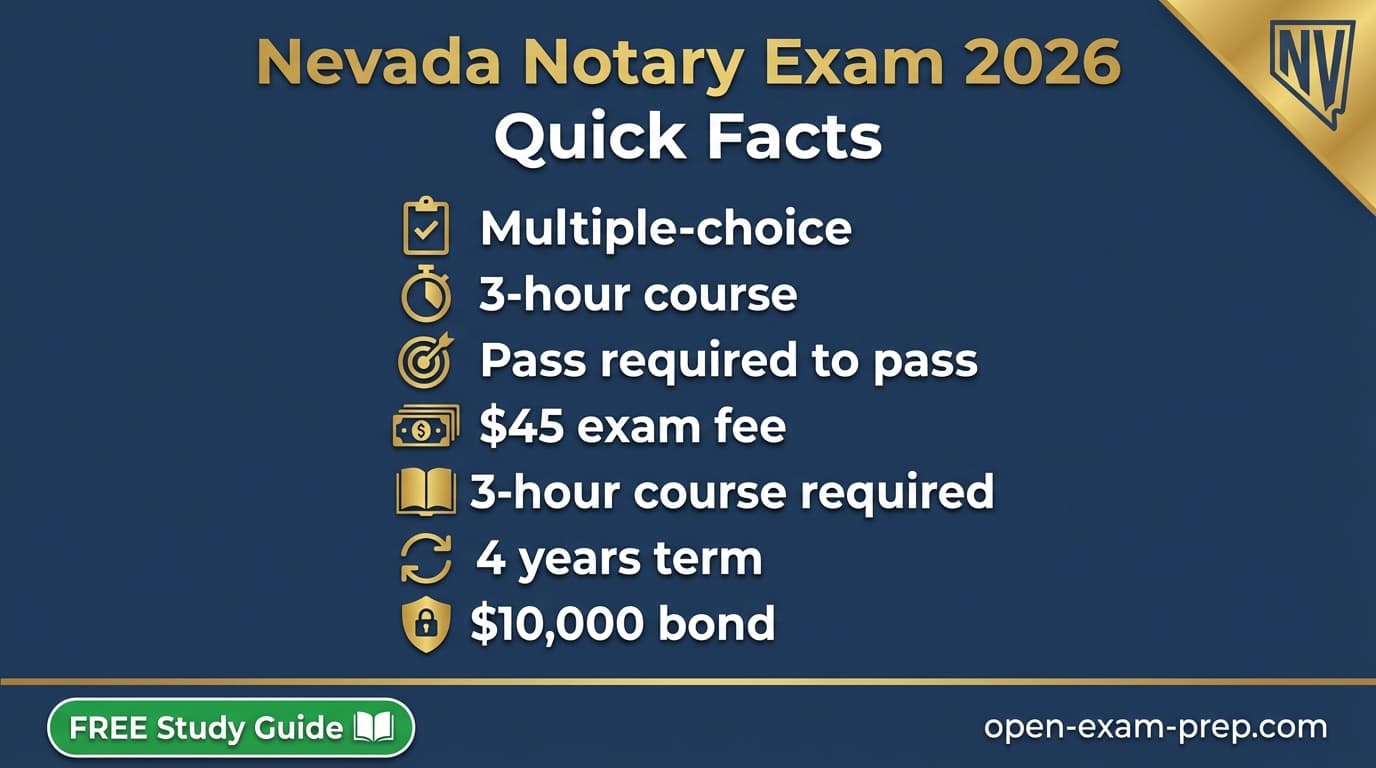
Nevada Notary Public Exam Overview
The Nevada Notary Public Exam is administered by the Nevada Secretary of State as part of the mandatory 3-hour training course. All new and renewing notaries in Nevada must complete the training through the Secretary of State's own official training website and score at least 80% on the exam to receive their commission. Training completed through any other provider does not satisfy Nevada's requirement (NRS 240.018).
Nevada also requires a $10,000 surety bond, a $35 application fee filed through the state's SilverFlume business portal, and mandatory electronic notary (eNotary) training if you want to perform electronic or remote online notarizations.
Exam Format at a Glance
| Component | Details |
|---|---|
| Training Course | 3 hours (mandatory, official SOS site only) |
| Exam Format | Multiple-choice, taken online immediately after training |
| Passing Score | 80% |
| Retake Wait | 24 hours after a failed attempt (no limit on retakes) |
| Training + Exam Fee | $45 |
| Application Fee | $35 (paid through SilverFlume) |
| Commission Term | 4 years (course + exam repeat at every renewal) |
| Surety Bond | $10,000 required |
| Typical Processing Time | About 4-6 weeks after a complete application |
Why Become a Nevada Notary?
- Growing market — Las Vegas and Reno have high demand
- Real estate hub — High volume of property transactions supports notary signing agent work
- eNotary capability — Perform electronic notarizations
- Remote Online Notarization — Nevada has allowed RON since December 2018
- Income opportunity — No state-set maximum fees
- Border state flexibility — Serve clients from neighboring states
Start Your FREE Nevada Notary Exam Prep
Ready to begin studying? Our comprehensive resources cover everything you need to pass the Nevada notary exam. The National Notary Association is also an excellent resource for notary education and supplies.
View All Notary Exam Prep Resources
Nevada Training and Exam Requirements
Mandatory 3-Hour Training Course
All Nevada notary applicants must:
- Create an account and enroll in the Secretary of State's own official training course — third-party "notary prep" providers do not satisfy this requirement
- Complete 3 hours of instruction covering notary duties and Nevada law
- Pass the examination at the end of the course with a score of 80% or higher
- Pay $45 for the training and exam, processed through the SilverFlume portal
If You Fail: You must wait at least 24 hours before retaking the exam. There is no cap on the number of retakes.
eNotary Additional Training
If you want to perform electronic notarizations or Remote Online Notarization (RON), you must:
- Hold an active traditional Nevada notary commission first
- Complete the eNotary training course (separate from traditional training)
- Pass the eNotary examination
- Register on a Secretary of State-approved RON platform if you plan to notarize remotely
Key Topics Covered on the Exam
1. Notary Fundamentals (25%)
Commission Requirements:
- Must be 18 years or older
- Nevada resident OR resident of adjoining state (California, Oregon, Idaho, Utah, or Arizona) with regular Nevada employment/business
- Complete mandatory 3-hour training course through the official SOS site
- Pass the state examination with a score of 80% or higher
- Obtain $10,000 surety bond
- Pay $35 application fee via SilverFlume
Background Check Note: NRS 240.030 gives the Secretary of State authority to require fingerprints for a criminal-history check, but as of 2026 that step has not been implemented for standard applicants — don't expect a fingerprinting appointment as part of the current process.
Oath of Office:
- Take and subscribe to the oath in Section 2 of Article 15 of the Nevada Constitution
- File the oath together with your bond with the county clerk where you reside (or, for adjoining-state residents, the county where you work)
2. Types of Notarial Acts (30%)
Acknowledgments:
- Signer acknowledges signing voluntarily
- Most common notarial act
- Used for deeds, powers of attorney, contracts
- Signer must appear before you in person
Jurats (Oaths/Affirmations):
- Signer swears content is true
- Must sign in notary's presence
- Notary administers oath or affirmation
- Common for affidavits
Copy Certification:
- Certify true copies of certain documents in your possession
- Cannot certify a birth certificate, death certificate, marriage certificate, or divorce decree (NRS 240.075)
- Cannot certify any other publicly recordable document — refer the signer to the issuing agency instead
Signature Witnessing:
- Witness the signing of a document
- No oath required
- Signer signs in notary's presence
3. Identification Requirements (20%)
Acceptable Forms of ID:
| Acceptable ID | Requirements |
|---|---|
| Nevada Driver License/ID | Current or recently expired |
| US Passport | Current or recently expired |
| Other State ID | Current, government-issued with photo |
| US Military ID | Current |
| Foreign Passport | Current (with proper verification) |
Credible Witnesses:
- Used when signer lacks acceptable ID
- Must personally know the signer
- Must present acceptable ID to notary
Personal Knowledge:
- Notary personally knows the signer
- Document basis in journal
4. Nevada-Specific Laws (15%)
Nevada Revised Statutes (NRS):
- NRS Chapter 240 — Notaries Public and Commissioned Abstracters
- NRS 240.030 — Application, oath, bond, and fee requirements
- NRS 240.040 — Notary stamp/seal format requirements
- NRS 240.075 — Prohibition on certifying vital records
- NRS 240.181-240.206 — Electronic Notary Public Authorization Act (RON)
- Know key statutory requirements
Prohibited Acts:
- Cannot notarize your own signature
- Cannot notarize if you have financial interest
- Cannot certify vital records
- Cannot provide legal advice
- Cannot notarize incomplete documents
5. Journal and Record Keeping (10%)
Journal Requirements (NRS 240.120): Nevada requires notaries to maintain a journal including:
- Date and time of notarial act
- Type of notarial act performed
- Type of document
- Signer's name and signature
- Type of ID presented
- Fee charged (if any)
Electronic Journal (for eNotary, NRS 240.201):
- Required for all electronic notarial acts
- Must specify if act was via audio-video communication
- Maintain under sole control with password protection
- Cannot include audio-video recording of RON in journal
Retention:
- Keep journal for 7 years after termination of registration
- Provide for lawful inspection and copying
Seal/Stamp Requirements
Your Nevada notary stamp (NRS 240.040) must include:
- Your name exactly as on your commission
- "Notary Public, State of Nevada"
- Commission expiration date
- Your certificate of appointment number
Format:
- Rectangular only — no larger than 1 inch by 2.5 inches
- Ink stamp in indelible, photographically reproducible ink
- An embossed seal is not required and has not been legally sufficient on its own since 1965 — an embosser may only be used as a decorative addition alongside the required ink stamp, never as a substitute for it
Fee Schedule
Nevada does not set maximum notary fees by state law:
| Requirement | Details |
|---|---|
| Maximum fee per act | No state limit |
| Fee disclosure | Must be provided to signer |
| Travel fees | Set by notary |
| eNotary surcharge | Determined by notary |
Important: While there's no maximum, fees should be reasonable and disclosed before performing the notarization.
Study Timeline for Success
| Week | Focus Area | Hours |
|---|---|---|
| Week 1 | Complete mandatory 3-hour training | 3 |
| Week 1-2 | Review NRS Chapter 240 | 3-4 |
| Week 2 | Notarial acts deep dive | 3-4 |
| Week 2-3 | Identification and journal requirements | 3-4 |
| Week 3 | Practice questions and review | 3-4 |
Total recommended study time: 15-20 hours (including required course)
Nevada-Specific Exam Tips
1. Complete the Official Training First
The state-mandated course covers exactly what's on the exam:
- $45 paid to Secretary of State
- Available online through the SOS training site only
- Exam immediately follows training; you need 80% to pass
2. Know NRS Chapter 240
Key sections to study:
- NRS 240.030 — Application, oath, bond, and fee requirements
- NRS 240.033 — Bond execution and reinstatement
- NRS 240.040 — Notary stamp/seal format
- NRS 240.075 — Vital-records copy-certification ban
- NRS 240.120 — Paper journal contents and 7-year retention
- NRS 240.181-240.206 — Electronic Notary Public Authorization Act (RON)
- NRS 240.201 — Electronic journal duties
3. Understand eNotary vs. Traditional
Know the differences:
- Traditional requires separate seal and journal
- eNotary requires digital certificate and electronic seal
- Both require completing their respective training courses
4. Key Numbers to Remember
| Topic | Nevada Requirement |
|---|---|
| Training course | 3 hours |
| Passing score | 80% |
| Bond amount | $10,000 |
| Commission term | 4 years |
| Application fee | $35 |
| Training + exam fee | $45 |
| Journal retention | 7 years |
| Seal shape | Rectangular, max 1" x 2.5" |
Common Mistakes to Avoid
- Skipping the mandatory training — 3-hour course is required
- Taking a third-party "notary prep" course instead of the official SOS training site — it will not satisfy the requirement
- Not obtaining bond first — Must have before filing application
- Ignoring journal requirements — Mandatory in Nevada
- Confusing traditional and eNotary — Different requirements
- Using a circular seal — Nevada requires a rectangular stamp, max 1" x 2.5"
- Forgetting the wait period — 24 hours between exam retakes
After Passing Your Exam
- Obtain $10,000 surety bond from an approved provider
- Create a SilverFlume account and submit your application with the Secretary of State ($35 fee)
- Submit training certificate with application
- Take oath of office per Nevada Constitution
- File oath and bond with the county clerk in your county of residence
- Purchase notary seal meeting state requirements (rectangular, max 1" x 2.5")
- Purchase journal — Required before performing acts
- Wait about 4-6 weeks for your certificate of appointment
- Begin your notary practice — Commission valid 4 years
Remote Online Notarization (RON) in Nevada
Nevada has authorized Remote Online Notarization since December 14, 2018, under NRS 240.181-240.206:
RON Requirements
- Be a registered eNotary in Nevada
- Use an approved RON platform from the Secretary of State's Electronic Notary Solution Provider list (examples include DocuSign, Notarize, SIGNiX, and ProNotary)
- Verify signer identity via credential analysis and knowledge-based authentication
- Record the session — Audio-visual recording required
- Retain records — Keep for 7 years
RON Location
- Notary must be in Nevada (or authorized location)
- Signer can be anywhere in the world
- Real-time audio-video communication required
Beyond the Exam: Notary Signing Agent (NSA) Work
Once commissioned, many Nevada notaries add loan-signing work for the state's high volume of real estate closings. This isn't a separate license, but it typically involves:
- Purchasing errors & omissions (E&O) insurance beyond your surety bond
- Completing a signing-agent training program (not a state requirement, but expected by title companies)
- Registering on signing marketplaces such as Snapdocs, NotaryRotary, or 123Notary
Total Cost to Become a Nevada Notary
| Item | Cost |
|---|---|
| Training + Exam Fee | $45 |
| Application Fee | $35 |
| Surety Bond (4 years) | $35-$55 |
| Notary Seal | $25-$50 |
| Notary Journal | $15-$30 |
| Total Estimated | $155-$215 |
Start Your Nevada Notary Career Today
Nevada's mandatory training and exam ensure all notaries understand state requirements. With proper preparation through the official course, you can pass the exam and begin serving Nevada's growing population.
Our resources include:
- Complete topic coverage
- Practice questions with explanations
- Nevada law specifics (NRS Chapter 240)
- Study guides and summaries
- AI-powered study assistance
Final Verification Step
Before you act on this guide, compare your plan with the current state agency and testing vendor instructions. Use the guide for strategy and explanation, then use official materials for the final administrative details. That habit protects you from outdated forms, expired authorizations, wrong identification assumptions, and avoidable scheduling delays.

 Free CE
 Buy on Amazon
 Notary training on Notary.net
 Take courses on Udemy