Louisiana Real Estate License Overview
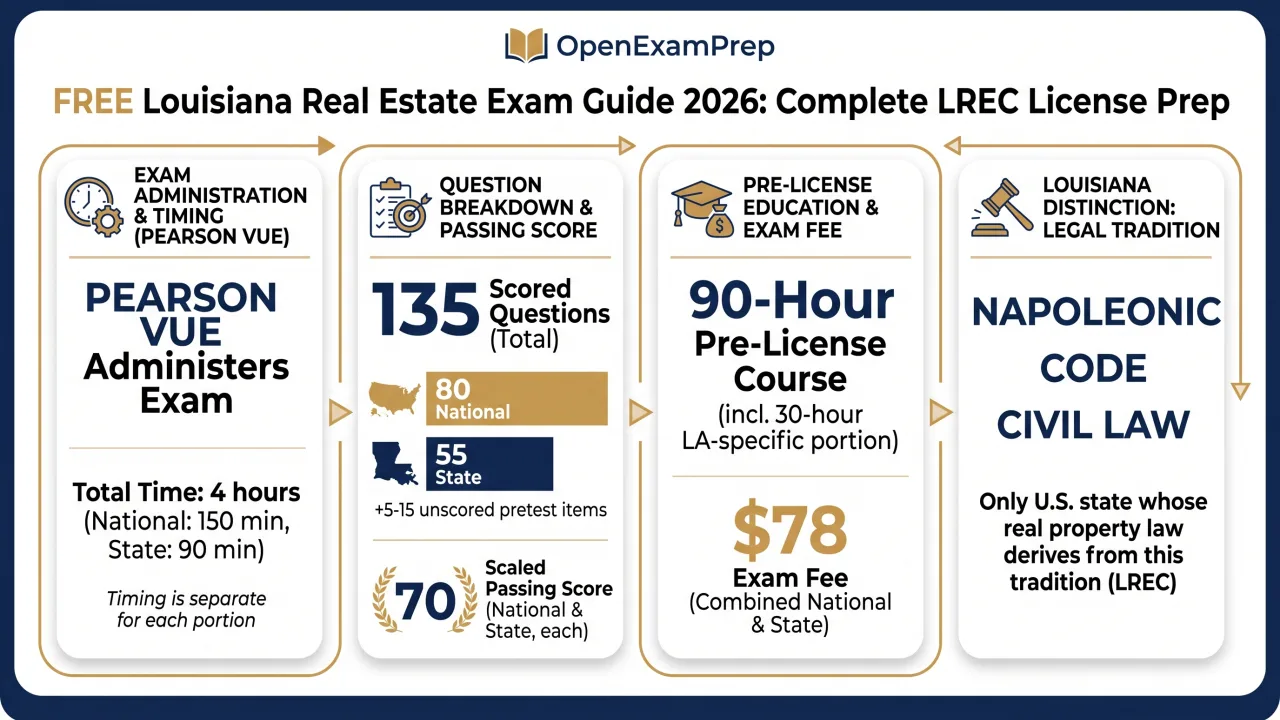
Louisiana is the only U.S. state whose property law descends from the Napoleonic Code (the French Civil Code tradition), which is why the Louisiana real estate exam tests terminology and concepts you will not see in any other state - immovable property, usufruct, servitudes, and the authentic act. The Louisiana Real Estate Commission (LREC) sets every licensing rule, and the salesperson exam is delivered by Pearson VUE (the current vendor; earlier years used PSI). This guide reflects the current LREC requirements and the Pearson VUE candidate handbook (content outlines effective April 1, 2025) so you study the right numbers the first time.
Louisiana Real Estate Exam Quick Facts
| Feature | Details |
|---|---|
| License Earned | Real Estate Salesperson (first license) |
| Exam Administrator | Pearson VUE for the LREC |
| Scored Questions | 135 (80 national + 55 state) |
| Pretest Questions | 10-15 unscored, mixed in (combined exam) |
| Time Limit | National 150 minutes + State 90 minutes (separately timed) |
| Passing Score | Scaled 70 on each portion (salesperson) |
| Exam Fee | $78 first attempt; $93 per retake (combined exam) |
| Results | Pass/fail on screen; official score in your Pearson VUE profile |
| Authorization Window | 1 year from LREC approval, unlimited attempts |
| Retake Rule | Retake only the failed portion within the 1-year window |
Heads up: the passing score is a scaled 70, not 70% raw. Pearson VUE converts your raw score to a 0-100 scale, so the exact number of correct questions needed can vary by exam form. Older study sites that list "70% = 56 of 80 national and 40 of 55 state" are describing the historical raw equivalents, not the official scaled score.
Requirements Before Taking the Exam
Basic Eligibility
| Requirement | Details |
|---|---|
| Age | 18 years or older |
| Education | High school diploma or GED |
| Pre-License Education | 90 hours of LREC-approved coursework |
| Background Check | Fingerprint-based state and federal check through LREC's approved vendor |
| Broker Sponsorship | Required to activate the license (not to sit for the exam) |
| E&O Insurance | Required before an active license is issued |
Pre-License Course Content (90 Hours)
The 90-hour pre-license course must cover real estate principles and practices plus a mandatory 30-hour Louisiana-specific portion. Per the LREC, no substitution is allowed for the 30-hour block, which covers:
- The Louisiana Real Estate License Law
- Commission Rules and Regulations
- Louisiana Law of Agency
- Louisiana Civil Law pertaining to real estate
Application Process
- Complete the 90-hour pre-license course at an LREC-certified school
- Submit the Initial Salesperson License Application (Part A) to the LREC with the $90 fee
- Pass the Pearson VUE exam after LREC emails your Authorization to Test
- Complete the fingerprint-based background check through the LREC-approved vendor
- Submit Application Part B with broker sponsorship and proof of E&O insurance
- Receive your license (active or inactive status)
The $90 LREC application fee breaks down as a $45 initial license fee, $10 Research and Education Fund fee, $10 Recovery Fund fee, and $25 application processing fee.
Louisiana Exam Format
The salesperson exam has two separately timed portions delivered by Pearson VUE. You must reach a scaled 70 on each.
Content and Scoring Breakdown
| Portion | Scored Questions | Pretest | Time | Passing Score |
|---|---|---|---|---|
| National | 80 | 5 | 150 minutes | Scaled 70 |
| State | 55 | 5-10 | 90 minutes | Scaled 70 |
| Total (combined) | 135 | 10-15 | 240 minutes | Scaled 70 on each |
You can take both portions in one combined sitting ($78) or schedule them separately ($39 each). The combined exam gives you the discounted first attempt; retakes are $93 for the combined exam or $39 per single portion. Answer every question - pretest items look identical to scored ones and cannot be identified.
National Portion Content Outline (80 Questions)
The Pearson VUE national outline (effective April 1, 2025) distributes the 80 scored questions across eight topic areas:
| Topic Area | Scored Items |
|---|---|
| Real Estate Contracts and Agency | 16 |
| Real Property Characteristics, Legal Descriptions, and Property Use | 11 |
| Property Value and Appraisal | 11 |
| Real Estate Practice | 10 |
| Forms of Ownership, Transfer, and Recording of Title | 9 |
| Property Disclosures and Environmental Issues | 9 |
| Financing and Settlement | 7 |
| Real Estate Math Calculations | 7 |
Contracts and agency is the single largest topic, so prioritize it. Math (7 items) is its own section and is mostly application and analysis, not recall.
State Portion Content Outline (55 Questions)
The Louisiana state outline (effective September 1, 2021) distributes 55 scored questions across five areas:
| Topic Area | Scored Items |
|---|---|
| Statutory Requirements Governing Activities of Licensees | 13-15 |
| Louisiana Civil Law System | 13-15 |
| Louisiana Law of Agency | 13-15 |
| Licensing Requirements | 7-9 |
| Duties, Overview, and Powers of the Real Estate Commission | 4-6 |
Nearly 40 of the 55 state questions come from three civil-law-heavy areas - statutory requirements, the civil law system, and Louisiana agency. Mastering civil-law terminology is the highest-leverage study move you can make.
Louisiana's Unique Civil Law System
Why Louisiana Is Different
Louisiana is the only U.S. state with a legal system derived from the Napoleonic Code (French Civil Code of 1804). The other 49 states follow English common law. Louisiana's civil law tradition creates unique terminology, procedures, and concepts that every Louisiana real estate professional must understand - and that the state portion tests directly.
Napoleonic Code Terminology Comparison
| Common Law (49 States) | Louisiana Civil Law |
|---|---|
| Real property | Immovable property |
| Personal property | Movable property |
| Deed | Act of Sale |
| Life estate | Usufruct |
| Joint tenancy | Ownership in indivision |
| Easement | Servitude |
| Lease | Lease (bail) |
| Mortgage | Mortgage (hypothec) |
The Authentic Act
In Louisiana, the Authentic Act is the highest form of legal document for real estate transfers. It must be:
- Executed before a Louisiana notary public
- Signed in the presence of two competent witnesses
- Signed by all parties, witnesses, and the notary
- With names typed or printed beneath signatures
Louisiana notaries have significantly more authority than notaries in common-law states and can prepare legal documents, not just witness signatures. This is heavily tested.
Usufruct
Usufruct is a civil-law right that lets a person (the usufructuary) use and enjoy property owned by another and collect its income, without destroying or disposing of the property. It is commonly used in estate planning - for example, a surviving spouse may receive a usufruct over the family home while naked ownership passes to the children.
Forced Heirship
Louisiana's forced heirship laws require a portion of an estate to pass to protected heirs:
| Rule | Application |
|---|---|
| Protected heirs | Children under 24, or children of any age with a mental or physical infirmity |
| Forced portion | 25% with one forced heir; 50% with two or more |
| Disposable portion | The remainder, freely distributable |
| Cannot disinherit | Protected heirs must receive their forced portion |
Community Property
Louisiana is one of nine community property states. Property acquired during marriage is community property (owned equally by the spouses); property owned before marriage, and gifts or inheritances received during marriage, are separate property. Both spouses must consent to sell or encumber community immovable property.
Louisiana Agency Relationships
The state portion tests Louisiana agency law (13-15 items). Know these relationship types and the disclosure rules:
| Agency Type | Description |
|---|---|
| Designated Agency | Broker designates an agent to represent one party |
| Dual Agency | One agent represents both parties; written disclosure required |
| Buyer Agency | Agent represents the buyer's interests |
| Sub-agency | Cooperating agent represents the seller through the listing broker |
Louisiana requires written disclosure of agency relationships before providing services that require a license.
Louisiana Exam Pass Rate
The Louisiana real estate exam has an estimated first-time pass rate of roughly 55-65%, placing it among the more challenging state exams. Pass rates are estimates compiled by industry providers; the LREC and Pearson VUE do not publish an official pass rate.
| Factor | Impact on Difficulty |
|---|---|
| Two separately timed sections | Must pass both independently |
| Civil law content | Unique terminology and concepts no other state uses |
| 135 scored questions | More than most states, plus pretest items |
| 55 state questions | Heavy weight on Louisiana-specific law |
Study Strategy
Recommended Study Time
| Approach | Hours | Timeline |
|---|---|---|
| Intensive | 60-80 | 3-4 weeks |
| Standard | 80-100 | 4-6 weeks |
| Part-time | 100-120 | 6-8 weeks |
These hours are in addition to the required 90-hour pre-license course.
Study Priority by Section
National portion (80 questions): Lead with Contracts and Agency (16 items), then Real Property Characteristics, Property Value and Appraisal, and Real Estate Practice. These four areas account for 48 of the 80 national questions.
State portion (55 questions): Lead with the Civil Law System, Statutory Requirements, and Louisiana Law of Agency. These three areas account for roughly 40 of the 55 state questions. Learn the civil-law vocabulary cold.
Key Math Facts to Memorize
Pearson VUE does not provide these at the test center - memorize them:
- 43,560 square feet per acre
- 5,280 feet per mile
- A handheld calculator and an on-screen calculator are provided
For proration questions, the exam tells you whether to use a 360- or 365-day year and whether the day of closing belongs to the buyer or seller.
Commission:
Prorations:
Capitalization Rate:
Common Mistakes to Avoid
1. Using Common Law Terminology
The state portion tests Louisiana-specific terms. Know the civil-law equivalents - say "immovable property," not "real property"; "Act of Sale," not "deed"; "usufruct," not "life estate"; "servitude," not "easement."
2. Underestimating Civil Law Content
Roughly 40 of 55 state questions come from civil-law-heavy areas. Focus on the authentic act, forced heirship, community property, and usufruct.
3. Treating the Passing Score as 70% Raw
The score is a scaled 70, not 70% of questions correct. The raw number needed varies by form, so aim comfortably above the historical raw equivalents (about 56 of 80 national and 40 of 55 state).
4. Weak Math Skills
Math is its own 7-item national section, mostly application and analysis. Practice commission, proration, area, and investment calculations until they are automatic.
Exam Day Tips
Before the Exam
- Get good rest the night before
- Eat a balanced meal
- Arrive 30 minutes early at the Pearson VUE test center
- Bring one current, government-issued, photo-bearing ID with a signature (the name must exactly match your registration)
Pearson VUE Testing Centers in Louisiana
Pearson VUE operates Professional Centers in Baton Rouge, Baton Rouge (East), Metairie, New Orleans, and Shreveport, plus additional sites in Alexandria, Lafayette, Lake Charles, Bossier City, Addis, and Natchitoches. Confirm your exact location when scheduling.
During the Exam
- Read every question completely
- Watch for Louisiana civil-law terminology versus common-law terms
- Flag difficult questions and return later
- Pace yourself: about 1.9 minutes per national question and 1.6 minutes per state question
- Answer every question - pretest items cannot be identified and skipping hurts if you run out of time
Retake Policy
| Scenario | Policy |
|---|---|
| Fail one portion | Retake only the failed portion |
| Retake fee | $93 combined, or $39 per single portion |
| Authorization | Valid 1 year with unlimited attempts; no new LREC authorization needed |
After Passing
Immediate Steps
- Receive results on screen at the test center
- Complete post-license education - 45 hours within 180 days of initial licensure
- Submit Application Part B with broker sponsorship and E&O insurance proof
- Activate your license through the MyLREC Portal
Post-License Education
| Requirement | Detail |
|---|---|
| 45-hour post-license course | Within 180 days of initial license issuance |
| Subjects | Laws, rules and regulations changes, finance, handling of funds |
| CE overlap | Post-license hours may satisfy 8 of the 12 annual CE hours, but not the 4-hour mandatory topic |
Missing the 180-day deadline is a violation of LREC rules, so schedule the post-license course early.
Continuing Education
| Requirement | Detail |
|---|---|
| Annual CE | 12 hours every year (4 mandatory + 8 elective) |
| 2026 Mandatory topic | "Transparency, Technology, and Trust" (salespersons and brokers) |
| 2026 Broker Mandatory | "Broker Leadership & Compliance" |
| Deadline | December 31 each year |
License Renewal Timeline
| Period | Dates | Fee Impact |
|---|---|---|
| Timely renewal | August 1 - September 30 | Standard renewal fee |
| First delinquent | October 1 - November 15 | +$50 delinquent fee |
| Second delinquent | November 16 - December 31 | +$50 inactive / +$200 active |
| Expiration | After December 31 | License expires |
All licensees must renew by December 31 to maintain status. Current licensees do not need a new fingerprint background check to renew.
Louisiana Real Estate Career Outlook
Salary (BLS Data)
Real estate income is commission-based and varies widely. According to the U.S. Bureau of Labor Statistics (May 2024 data):
| Metric | Wage |
|---|---|
| Median annual wage, real estate sales agents | $56,320 |
| Median annual wage, real estate brokers | $72,280 |
| Projected job growth, 2024-2034 | 3% (about as fast as average) |
| Annual openings | About 46,300 |
First-year agents typically earn less while building a pipeline. Top producers earn well above the median, but income follows production, not tenure.
Hot Louisiana Markets (2026)
- New Orleans - Tourism, historic properties, diverse neighborhoods
- Baton Rouge - State capital, LSU, growing suburban areas
- Lafayette - Cajun culture, oil and gas hub
- Shreveport / Bossier City - Affordable, gaming industry
- Lake Charles - Industrial growth, casino development
- Northshore - Suburban growth, commuter communities
Louisiana Market Factors
- Energy sector - Oil and gas affect commercial and residential demand
- Cultural tourism - French Quarter, plantation homes, festivals
- Waterfront and flood zones - A major factor for property insurance
- Historic preservation - Tax credits and restrictions on historic properties
Reciprocity Agreements
Louisiana offers reciprocal licensing with nine states:
| State |
|---|
| Alabama |
| Arkansas |
| Colorado |
| Georgia |
| Iowa |
| Mississippi |
| New Mexico |
| Oklahoma |
| Pennsylvania |
Reciprocal applicants submit a certified license history, the reciprocal application, background check, and E&O insurance. Non-resident licensees who obtained a Louisiana license through reciprocity and maintain residency in the reciprocal state are not required to complete annual CE.
Total Costs to Get Licensed
| Item | Cost |
|---|---|
| Pre-license education (90 hours) | $250-$500 |
| LREC application fee (Part A) | $90 |
| Pearson VUE exam fee (combined, first attempt) | $78 |
| Background check (LREC-approved vendor) | ~$61 |
| E&O insurance (LREC group policy, prorated) | from ~$35 (annual premium $136 + $7 fee) |
| Total estimated | ~$515-$775 |
E&O insurance through the LREC group policy carries an annual premium of $136 plus a $7 LREC transaction fee, prorated based on your issue date. You may also use an independent insurer.
Resources
- LREC - lrec.gov - Official licensing information and pre-licensing checklist
- Pearson VUE - pearsonvue.com/us/en/la/realestate.html - Exam scheduling and candidate handbook
- Candidate Handbook - Pearson VUE LA Real Estate Handbook (PDF) - Content outlines and exam rules
- BLS - Real Estate Brokers and Sales Agents - Wage and outlook data
- OpenExamPrep - Free study materials and practice questions

 Free CE
 Buy on Amazon
 Pre-licensing on Colibri
 Flashcards on Mometrix
 Pre-licensing on AceableAgent