Louisiana Notary Public Exam Overview
The Louisiana Notary Public Exam is administered by the Louisiana Secretary of State (SOS) and is, by the numbers, the hardest notary exam in the United States. The reason is structural: Louisiana is the only U.S. state built on a civil law tradition (rooted in French and Spanish law and the Napoleonic Code) instead of common law. That gives Louisiana notaries quasi-judicial, attorney-like authority - they draft and execute legal instruments that, in the other 49 states, only a licensed attorney can prepare.
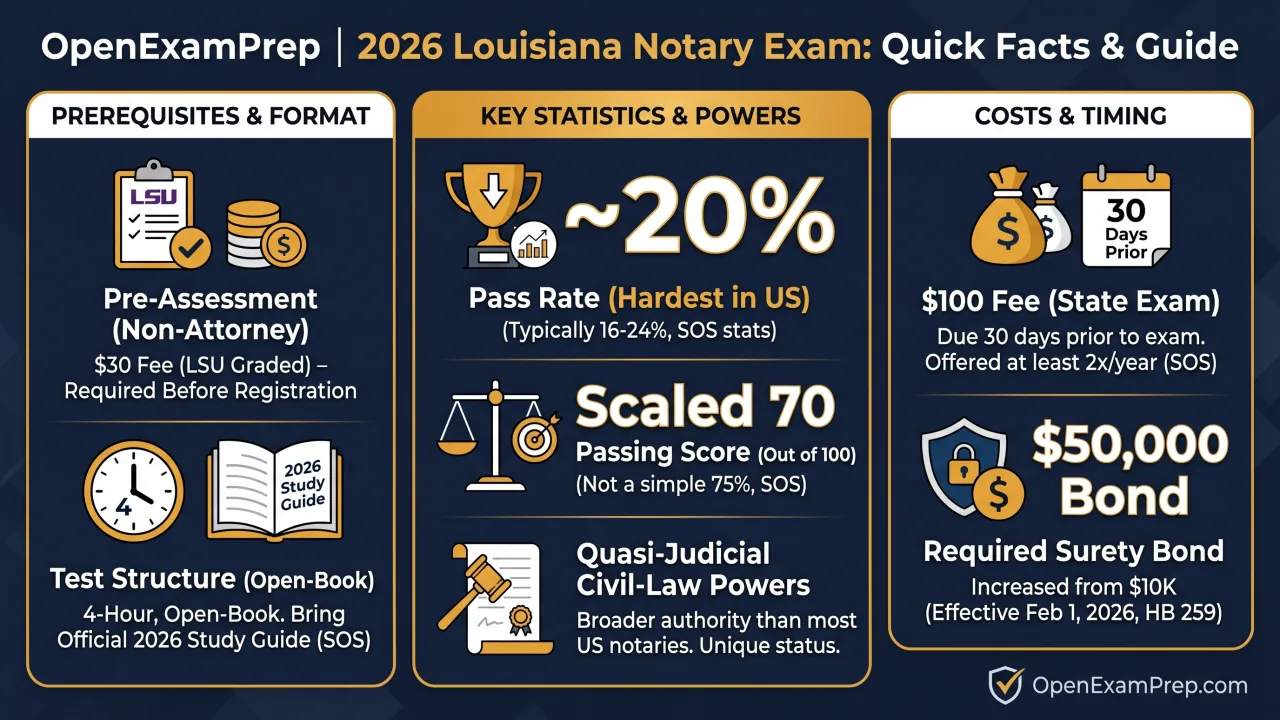
Because the office carries that much power, the exam is unusually demanding. Across published SOS results from 2018 through 2024, the statewide pass rate has typically sat between 16% and 24%, most often around 17-21%. On the September 14, 2024 administration, only 145 of 681 candidates passed (21%). Plan for this to be a genuine law exam, not a 20-minute online quiz.
Exam Format at a Glance (2026)
| Component | Detail |
|---|---|
| Administered by | Louisiana Secretary of State (graded by LSU) |
| Delivery | Computer-based, in person at approved sites |
| Time limit | 4-hour single sitting |
| Question types | General-knowledge items + scenario-based application items |
| Passing score | Scaled score of 70 (out of 100) |
| Open book? | Yes - bring the official 2026 study guide (annotated/tabbed) |
| Exam fee | $100 (register 30 days before exam date) |
| Frequency | Offered not less than twice per year (commonly spring + fall) |
| Typical pass rate | ~16-24% (most often 17-21%) |
| Commission term | For life (bond renewed every 5 years) |
| Surety bond | $50,000 (increased from $10,000 effective Feb 1, 2026) |
Two facts surprise almost every first-timer. First, the exam is open book: you may bring the official 2026 SOS study guide into the testing room, and you may highlight it and add permanent tabs (self-adhesive, max 2 inches, one per page). Loose inserts, Post-its, sheet protectors, and outside reference materials are prohibited. Second, the exam is not scored as a simple 75% pass line - you need a scaled score of 70 of 100, and the questions are heavily scenario-based, so knowing the page where an answer lives matters more than rote memorization.
Why the Louisiana Notary Commission Is Worth It
- Lifetime commission - once commissioned, you hold the office for life (subject to bond renewal and good standing).
- Quasi-judicial powers - draft and pass authentic acts, sales, donations, mortgages, and notarial testaments.
- High earning potential - you can perform closings and prepare instruments that require an attorney elsewhere.
- Statewide jurisdiction - a Louisiana notary may act throughout the state, not just the home parish.
- Scarcity - the ~20% pass rate keeps the credential genuinely valuable.
Start Your FREE Louisiana Notary Exam Prep
Ready to begin? Our completely free Louisiana Notary prep covers the civil-law fundamentals, authentic acts, sales, donations, mortgages, matrimonial regimes, and successions that the exam tests. Pair it with the official SOS study guide (required for the open-book exam) for the strongest result.
Start FREE Louisiana Notary Study Guide | Free LA Notary Practice Questions
Eligibility: Who Can Sit the Louisiana Notary Exam
To qualify (per the Louisiana Secretary of State), a non-attorney applicant must:
- Be 18 years of age or older
- Be a resident citizen or alien of Louisiana
- Be registered to vote in the parish where you seek the commission
- Be able to read, write, and speak English
- Hold a high school diploma, approved home-study diploma, or GED
- Not have been convicted of a felony (or have been pardoned, with full restoration of rights)
Louisiana attorneys are exempt from the exam - they may be commissioned without sitting it. Everyone else must pass the statewide standardized exam.
The Step Most Candidates Miss: The $30 Pre-Assessment
Before you can register for the state exam, non-attorney applicants must complete the Notary Exam Pre-Assessment (required by Act 610 of 2014). Key points:
- Fee: $30, graded by LSU (allow ~7 days for grading and transmission to the SOS).
- It is a diagnostic, not a pass/fail gate - there is no minimum score required to move on to the state exam.
- Pre-assessment scores never expire, so completing it early costs you nothing.
Many first-time candidates do not realize this is a separate, mandatory step and lose an entire exam cycle waiting on it. Do it first.
What the Exam Actually Tests (Topic Areas)
The exam is built entirely from The Louisiana Notary Public Examination Official Study Guide 2026 - Fundamentals of Louisiana Notarial Law and Practice. Expect heavy weighting on the following.
1. Fundamental Documents and Civil-Law Foundations
- Structure of the Louisiana Civil Code and how civil law differs from common law
- Authentic acts: signed by the parties before a notary and two competent witnesses, self-proving, entitled to full faith and credit
- Acts under private signature and their duly acknowledged conversion
- Obligations, contracts, capacity, and consent
- Required certificate elements: venue, date, parties, notarial wording, signature, seal, and notary ID/commission information
2. Sales (Acts of Sale)
- Elements of a valid sale: thing, price, and consent
- Cash sales vs. credit/bond-for-deed arrangements
- Property descriptions, encumbrances, and warranty
- Recordation and the public-records doctrine
3. Donations
- Donations inter vivos (form requirements; generally an authentic act) vs. donations mortis causa (made by testament)
- Manual gifts of corporeal movables
- Reduction and the rights of forced heirs
4. Mortgages and Security Devices
- Conventional, legal, and judicial mortgages
- The act of mortgage and the paraph (marking the note for identification)
- Ranking, recordation, and cancellation
5. Matrimonial Regimes
- The community property default and separate property
- Matrimonial agreements (prenuptial/postnuptial) and required form
- Management of community assets and the spouse's authority
6. Successions
- Testate vs. intestate succession and the order of heirs
- Forced heirship, the legitime, and usufruct (Louisiana-specific concepts)
- Notarial testaments (a will form unique to Louisiana law)
- Affidavits of death, domicile, and heirship; small successions; judgment of possession
7. Notarial Acts, Ethics, and Recordkeeping
- Acknowledgments, jurats, oaths/affirmations, and certified copies
- Personal appearance, identification, and capacity screening
- Prohibited acts: giving legal advice when not an attorney, acting with a personal interest, notarizing blank documents
- Fee limits and required recordkeeping
Study Timeline for Success
Most successful candidates report 120-150+ hours of focused study over roughly 3-4 months. The open-book format does not make this easier - it means you must know the material well enough to find and apply the right rule in seconds.
| Phase | Focus Area | Hours |
|---|---|---|
| Weeks 1-3 | Civil-law foundations + authentic acts | 30-35 |
| Weeks 4-6 | Sales, donations, and mortgages | 25-30 |
| Weeks 7-9 | Matrimonial regimes + successions | 30-35 |
| Weeks 10-11 | Notarial acts, certificates, ethics, fees | 15-20 |
| Weeks 12-14 | Timed scenario practice + full review | 25-30 |
Total recommended study time: 125-150 hours. Critically, tab and index your official study guide as you go - your tabs are your single most valuable tool on exam day.
Free Practice Questions Available
Test yourself with scenario-based practice questions written for the Louisiana civil-law exam, with full explanations and free AI tutoring (10 free AI questions per day).
Louisiana-Specific Exam Tips
1. Treat the Open-Book Guide as a System
The official 2026 study guide is your reference on exam day. Build a clean tab system by topic (sales, donations, mortgages, successions, matrimonial regimes), add a personal index of high-frequency rules, and practice locating answers fast. Candidates who simply read the guide once and rely on memory consistently fail.
2. Master Authentic Acts vs. Acts Under Private Signature
This distinction underlies dozens of questions. An authentic act is executed before a notary and two witnesses and is self-proving. An act under private signature is signed privately and may be duly acknowledged to gain near-authentic effect. Know exactly which instruments require the authentic form.
3. Drill Successions and Forced Heirship
Louisiana successions carry concepts no other state tests: forced heirship, the legitime, usufruct, and the notarial testament. These are heavily weighted and trip up candidates from common-law backgrounds.
4. Key Numbers to Remember
| Topic | Louisiana 2026 Requirement |
|---|---|
| Passing score | Scaled 70 of 100 |
| Time limit | 4 hours |
| Exam fee | $100 |
| Pre-assessment fee | $30 (LSU-graded) |
| Typical pass rate | ~16-24% |
| Commission term | For life |
| Surety bond | $50,000 (effective Feb 1, 2026) |
| Bond renewal | Every 5 years |
| Witnesses for an authentic act | 2 |
Common Mistakes to Avoid
- Skipping the $30 pre-assessment - it is a mandatory, separate step; missing it costs an exam cycle.
- Thinking "open book" means "easy" - without a fast tab/index system you will run out of time.
- Underestimating successions and matrimonial regimes - the most Louisiana-specific, heavily weighted topics.
- Confusing authentic acts with acts under private signature - a foundational distinction.
- Studying from out-of-state notary materials - they teach common-law concepts that are wrong for Louisiana.
- Insufficient study time - plan 125-150 hours, not a weekend.
After You Pass: The Commissioning Process and Costs
Passing the exam is one step. The full path, with current fees:
- Submit the Application to Qualify to the SOS ($35).
- Complete the Notary Exam Pre-Assessment ($30, LSU-graded).
- Register and pay for the state exam ($100, 30 days before the exam date).
- Pass the state exam (scaled 70).
- File your commission documents with the SOS: notarized Oath of Office, Official Signature Page, the $50,000 surety bond, and the commission fee ($35).
- File a duplicate Oath of Office with your parish clerk of court (typically within one month).
- Order your notary seal and journal, and begin practicing statewide.
Budget roughly $300-$1,500 total depending on study materials, the bond premium, and whether you take an optional prep course.
2026 Updates You Must Know
- Surety bond increased to $50,000 (from $10,000), effective February 1, 2026 (HB 259) - this is the single biggest 2026 change.
- 2026 official study guide is the only approved reference; the exam is written from it and it is the book you may bring into the room.
- Remote Online Notarization (RON) continues to expand in Louisiana - check the SOS for current registration rules if you intend to offer remote notarizations.
- Exam registration closes 30 days before each exam date, and the exam is offered at least twice per year.
Start Your Louisiana Notary Career Today
The Louisiana notary commission grants the most extensive notarial powers in the nation. With disciplined preparation, you can clear the toughest notary exam in the country and begin a rewarding, lifelong practice.
Begin FREE Louisiana Notary Study Guide | Free LA Notary Practice Questions
Our free study materials include:
- Civil-law foundations and authentic acts
- Sales, donations, mortgages, and matrimonial regimes
- Successions, forced heirship, and notarial testaments
- Scenario-based practice questions with explanations
- Free AI study assistance (10 questions/day)
How to Turn This Louisiana Notary Guide Into a Passing Study Plan
A notary exam or appointment review is not just a vocabulary test. It measures whether you can protect the signer, the document, the public record, and your own commission when the facts are messy. Read the rules above once for orientation, then convert them into a procedure checklist you can apply to acknowledgments, jurats, oaths or affirmations, copy certifications if allowed, and any remote or electronic notarization rules that apply in Louisiana.
Your first checklist should follow the order of a real appointment. Confirm that the requested act is one you are authorized to perform. Confirm personal appearance under the rules that apply to the act. Identify the signer using the acceptable evidence described in your Louisiana materials. Screen for willingness, awareness, and basic communication. Complete the notarial certificate with the correct venue, date, signer name, notarial wording, signature, seal, and commission information. Record the act in your journal if required, or keep a careful voluntary record when allowed and appropriate.
That sequence is important because many exam questions describe a signer who appears at the wrong time, presents weak identification, asks for legal advice, wants a blank document notarized, or asks the notary to choose the certificate. In those scenarios, memorizing definitions is not enough. You need to know the next lawful step. Usually the safest exam answer is the one that preserves impartiality, requires proper identification and personal appearance, refuses unauthorized practice of law, and follows the certificate requirements exactly.
Louisiana Commission Workflow and Documents to Verify
Before relying on any checklist, verify the current Louisiana commissioning process with the Secretary of State, commissioning authority, approved education provider, or official handbook named in your materials. Administrative steps can change even when the core notary duties stay the same. Confirm the current application form, training or exam requirement, bond requirement if any, oath filing, seal requirements, commission term, renewal timing, and whether remote online notarization has separate registration rules.
Keep a small commissioning file with your application confirmation, education certificate, exam result if applicable, bond or insurance documents, oath filing receipt, commission certificate, stamp order, and journal purchase record. If you plan to offer loan signing or mobile notary services, keep those business records separate from your official notary records. Your commission duties come first; marketing, travel fees, and signing-agent assignments never expand what state law allows you to notarize.
When you review fees, separate maximum notarial fees from optional charges such as travel or business service fees. If the article above lists a fee cap, treat it as a rule to verify and apply carefully. Fee questions often test whether the candidate can distinguish a notarization fee from a separate travel agreement, whether the fee must be disclosed in advance, and whether remote online notarization has a different fee structure.
Procedure Drills That Build Exam Readiness
The fastest way to improve is to practice short appointment scenarios. Write five columns on a page: requested act, signer identity evidence, document condition, certificate wording, and notary action. Then create examples. A signer wants an acknowledgment but has not signed yet. A signer wants a jurat but refuses an oath. A signer brings an expired ID. A spouse asks you to notarize for an absent signer. A customer asks whether a power of attorney is legally sufficient. A remote signer passes credential analysis but cannot communicate clearly. For each scenario, write what you would do and why.
Focus especially on the difference between acknowledgments and jurats. In an acknowledgment, the signer acknowledges signing willingly; the document may have been signed before appearing if state law and the certificate allow it. In a jurat, the signer swears or affirms the truth of the document and usually signs in the notary's presence. Exam questions often hide the correct answer in those verbs. If the certificate says subscribed and sworn, think oath or affirmation. If it says acknowledged before me, think acknowledgment and voluntary execution.
Also drill refusal rules. A notary should refuse when the signer is not properly identified, does not personally appear as required, appears unwilling or unaware, asks the notary to perform an unauthorized act, presents a document with blanks that cannot be completed, or asks for legal advice. A refusal should be calm, specific, and tied to the rule. On the exam, avoid answers that make the notary a document adviser, immigration consultant, attorney, or party to the transaction.
Recordkeeping, Seal, and Certificate Traps
Recordkeeping questions are easy points if you learn the pattern. The journal entry, when required or recommended, should document the date and time, type of act, document description, signer identity method, fee, and any signature or thumbprint requirement that applies. Do not invent information after the fact. Do not share journal details casually. Do not let an employer take control of official records unless your state rules clearly allow a specific arrangement.
Seal questions usually test completeness and control. Keep your stamp secure, use the exact name and commission information required, and never let another person use your seal. If a stamp is lost, stolen, damaged, or replaced after a name or commission change, follow the reporting and replacement process in your Louisiana rules. If a certificate has an error, correct it only in the manner allowed by your commissioning authority; do not backdate or attach a loose certificate unless the facts and state rules support that action.
Certificate wording is another common trap. A notary may identify the type of notarial act requested, but should not choose the legal effect of a certificate for a signer. If the document lacks a certificate, the signer or document recipient may need to choose or provide the wording. Your role is to complete the notarial act correctly, not to decide which form gives the document legal effect.
If You Miss Questions in Practice
Use missed questions as a routing tool. If you miss identification questions, reread acceptable ID, credible witness, and personal knowledge rules. If you miss jurat questions, drill oath language and signature timing. If you miss fee questions, build a small chart of allowed fees and when they apply. If you miss remote notarization questions, separate traditional personal appearance from remote appearance, credential analysis, audio-video session rules, electronic journal requirements, and technology-provider rules.
Then practice with mixed sets instead of rereading the whole guide. The goal is to recognize the lawful Louisiana action under pressure - which form an instrument requires, how forced heirship limits a donation, or whether a sale was validly passed. Start here: Louisiana notary study guide and use Louisiana notary practice questions for short, scenario-based review. When your explanations become precise, your score usually follows.


 Buy on Amazon
 Louisiana notary training