Illinois Real Estate Broker Exam Overview
The Illinois Real Estate Broker Exam is administered by PSI Services LLC on behalf of the Illinois Department of Financial and Professional Regulation (IDFPR), Division of Real Estate. Illinois is unusual: it has no "salesperson" license. The entry-level credential is called the Broker license, and the supervisory tier is the Managing Broker. To practice you must pass a two-part PSI exam covering both national real estate principles and Illinois-specific law.
Passing qualifies you to work as a real estate broker in Illinois under a sponsoring managing broker. Illinois is home to about 12.6 million residents and the Chicago metro, one of the nation's largest and most active housing markets.
Heads up for 2026: IDFPR's state-specific Broker and Managing Broker content outlines were updated effective June 24, 2026 (per the PSI Candidate Information Booklet). Confirm you are studying the current outline before you test.
Exam Format at a Glance
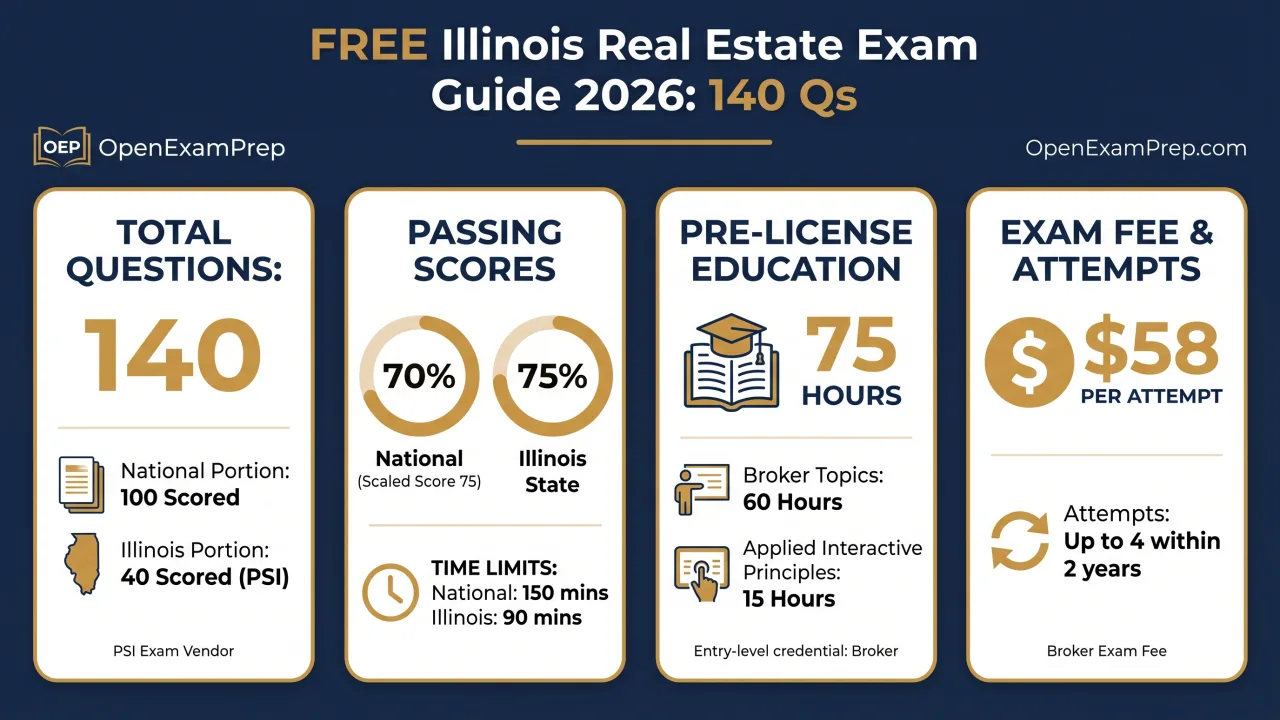
The two portions are scored separately, and the passing standard is not the same for each. This is the single most misreported fact about the Illinois exam.
| Portion | Questions | Time | Passing Score |
|---|---|---|---|
| National | 100 scored | 150 minutes | 70% (reported as a scaled score of 75) |
| State (Illinois) | 40 scored | 90 minutes | 75% |
| Total | 140 scored | 240 minutes (4 hours) | Must pass both portions |
Key details from the official PSI Candidate Information Booklet:
- Exam fee: $58 per attempt (non-refundable, non-transferable). Each retake costs $58 again.
- 5-10 unscored experimental questions may be added to each portion; they count against your time but not your score.
- Attempts: you get up to four attempts within your 2-year eligibility period. If you exhaust them, you must repeat the pre-license education.
- Pre-license education completion is valid for two years.
- A short tutorial (up to 15 minutes) precedes the exam and does not count against your time.
- Score and a diagnostic report are available immediately on screen and emailed.
Eligibility: 75-Hour Broker Pre-License Course
To sit for the Broker exam under the standard "Category A" path you must:
- Be at least 18 years old
- Hold a high school diploma or GED
- Complete 75 class hours of IDFPR-approved Broker pre-license education, split as:
- Broker Pre-License Topics (60 hours)
- Broker Pre-License Applied Real Estate Principles - Interactive (15 hours)
Illinois attorneys (admitted by the Illinois Supreme Court) and certain out-of-state licensees pursuing endorsement follow alternate paths, but the 75-hour course is the route most candidates use.
Why Get Licensed in Illinois?
- Chicago market - third-largest city in the US
- Large population - about 12.6 million residents
- Diverse markets - urban, suburban, and rural opportunities
- Strong economy - major corporate headquarters
- Growing suburbs - continuous development opportunities
Start Your FREE Illinois Real Estate Exam Prep
Ready to begin studying? Our comprehensive, completely free Illinois Real Estate exam prep covers everything you need to pass. Logged-out visitors get 10 free AI questions per day.
National Portion: What Is Actually Tested (and Weights)
The 100-question national portion follows PSI's Real Estate Principles and Practices outline. These are the official Broker weightings - study by them, not by guesswork:
| National Topic | Approx. Weight |
|---|---|
| Contracts | 19% |
| Agency | 13% |
| Practice of Real Estate (incl. fair housing, antitrust, advertising) | 12% |
| Property Ownership | 10% |
| Financing | 10% |
| Valuation (appraisal, CMA) | 8% |
| Property Disclosures | 7% |
| Real Estate Calculations (math) | 7% |
| Transfer of Title | 6% |
| Land Use Controls | 5% |
| Property Management | 3% |
Federal fair housing lives on the national portion (protected classes, redlining, blockbusting, steering, ADA). Illinois math is light but unforgiving - expect prorations, commission splits, LTV, transfer fees, PITI, seller's net, and capitalization rate.
State Portion: 40 Illinois Questions
The 40-question Illinois portion is built from three buckets:
| State Topic | Items |
|---|---|
| Laws and Rules Regulating Real Estate Practice | 20 |
| Licensing Requirements | 10 |
| Disclosures | 10 |
High-yield Illinois-only content includes the Real Estate License Act of 2000, designated agency (Illinois default), the Illinois Human Rights Act, the Residential Real Property Disclosure Act, handling of monies and special accounts, transfer tax stamps, the Real Estate Recovery Fund, and the Commercial Real Estate Broker Lien Act.
Illinois Human Rights Act vs Federal Fair Housing
Illinois protects more classes than the federal Fair Housing Act. Federal law covers race, color, religion, national origin, sex, familial status, and disability. Illinois adds protections such as:
| Federal (FHA) | Illinois Additional |
|---|---|
| Race | Sexual orientation |
| Color | Marital status |
| Religion | Military status |
| National origin | Order of protection status |
| Sex | Ancestry |
| Familial status | Unfavorable military discharge |
| Disability | Arrest record / source of income |
Enforcement runs through the Illinois Department of Human Rights (IDHR).
Study Timeline for Success
| Week | Focus Area | Hours |
|---|---|---|
| Week 1-2 | National property, ownership, land use | 15-18 |
| Week 2-3 | National agency, contracts, financing | 18-22 |
| Week 3-4 | National valuation, transfer, math | 18-22 |
| Week 4-5 | Illinois licensing law, disclosures, agency | 15-18 |
| Week 5-6 | Full-length practice exams and review | 15-18 |
Recommended study time: 80-100 hours of focused review on top of the required 75-hour pre-license course.
Free Practice Questions Available
Test your knowledge with free practice questions written for the Illinois Broker exam - both national principles and Illinois-specific rules.
Illinois-Specific Exam Tips
1. Memorize the split passing standard
The most common factual error candidates carry into test day is "75% on both." The national portion passes at 70% (reported as a scaled score of 75); the Illinois portion passes at 75%. You must clear each portion - a great national score will not rescue a failed state score.
2. Master designated agency
Illinois defaults to designated agency: the sponsoring/managing broker names individual licensees to represent each side, which avoids automatic dual agency at the firm level. Know when written consent for dual agency is required and the managing broker's supervisory role.
3. Know the Illinois Human Rights Act
Broader than federal law, enforced by IDHR, and heavily weighted on the state portion. Be able to list which protected classes are Illinois-only.
4. Key numbers to remember
| Topic | Illinois Requirement |
|---|---|
| National passing score | 70% (scaled 75) |
| State passing score | 75% |
| Pre-licensing | 75 hours (60 topics + 15 applied) |
| Exam fee | $58 per attempt |
| Attempts in eligibility window | 4 (over 2 years) |
| License renewal | every 2 years, by April 30 (even years) |
| First-renewal post-license education | 45 hours |
| Ongoing CE | 12 hours per cycle |
| Exam questions | 140 (100 national + 40 state) |
Common Mistakes to Avoid
- Believing it is 75% on both - the national portion passes at 70% (scaled 75); only the state portion needs 75%
- Confusing agency types - designated agency is the Illinois default
- Forgetting both portions must pass - 100 national + 40 state, scored separately
- Underestimating the Human Rights Act - broader than federal, state-portion heavy
- Skipping disclosure law - the Residential Real Property Disclosure Act is tested
- Neglecting math - only about 7% of the national portion, but easy points if drilled
After Passing Your Exam
- Apply for the license through IDFPR (your sponsoring managing broker confirms sponsorship)
- Pay the application fee and complete any required fingerprint/background check (live scan, roughly $50-70)
- Activate under a sponsoring managing broker before you can practice
- First renewal: complete 45 hours of post-license education (three 15-hour courses, including Sexual Harassment Prevention training)
- Ongoing renewals: 12 hours of CE per cycle (a 6-hour Core course that includes Fair Housing, plus 6 hours of electives), renewing every two years by April 30 of even years
- Upgrade to Managing Broker when ready - see below
Upgrading to Managing Broker
To supervise other brokers and run an office you need the Managing Broker license. The common path requires you to:
- Be at least 20 years old
- Hold an active Illinois broker license with at least 2 of the past 3 years active
- Complete 45 class hours of Managing Broker pre-license education (30 topics + 15 applied management/supervision interactive)
- Pass the PSI Managing Broker exam (state portion: 50 items, 90 minutes, 75% to pass; $58 fee)
Illinois attorneys with the required broker experience also qualify under an alternate category.
2026 Illinois Updates
For 2026, be aware of:
- Updated state content outlines effective June 24, 2026 for Broker and Managing Broker
- Fair Housing training now embedded in the 6-hour CE Core course
- Sexual Harassment Prevention training required within post-license and CE elective hours
- Standard remote-proctored (Atlas) testing in addition to test centers
Start Your Illinois Real Estate Career Today
The Illinois Broker license opens one of the nation's most dynamic markets. With Chicago and its suburbs, opportunity is everywhere. With the right plan - and a clear understanding that the national portion passes at 70% while the state portion needs 75% - you can pass both portions on your first attempt.
Our free study materials include:
- Complete national and Illinois topic coverage
- Practice questions with explanations
- Designated agency and disclosure-law walkthroughs
- Illinois Human Rights Act guide
- AI-powered study assistance (10 free questions per day)
You do not need an expensive prep course when the practice you need is FREE.
How to Use This Illinois Guide Without Wasting Study Time
Treat the facts above as your control sheet, not as a one-time read. The most common mistake candidates make is reading a licensing overview, feeling familiar with the vocabulary, and then taking mixed practice questions before they can explain why each answer is right or wrong. For the Illinois real estate exam, build your prep around three passes: first learn the licensing workflow, then master the national real estate concepts, and finally drill the Illinois-specific rules until they feel separate from generic national law.
Start by copying the eligibility, education, sponsoring broker, application, fingerprint or background-check, testing vendor, passing score, and renewal facts from this article into one page. Leave a blank column next to each item titled "proof." In that proof column, write where the requirement appears in your course, candidate bulletin, state agency page, or school materials. This exercise is not busywork. It forces you to separate official licensing requirements from school marketing language, and it prevents exam-day confusion when a question asks what happens before licensure versus what happens after a license is issued.
When you study national topics, organize them by transaction stage. Property ownership, estates, encumbrances, land use, valuation, finance, agency, contracts, transfer, closing, and math are not isolated chapters in real practice. They appear in sequence as a client moves from representation to offer, financing, inspection, title, closing, and post-closing duties. If you can place a rule in the transaction timeline, you are less likely to confuse similar terms such as lien versus encumbrance, option versus right of first refusal, void versus voidable, or material fact versus ordinary sales puffery.
Illinois Licensing Workflow to Verify Before You Schedule
Before you schedule the exam, verify every step in the Illinois licensing workflow against the current state agency or testing vendor instructions. Use the article above for orientation, then confirm the current version of the candidate handbook, application portal, education certificate process, identification rules, and score-report policy. State real estate programs change forms and portal steps more often than they change core property law, so do not rely on an old school handout for the last administrative details.
A practical workflow looks like this. First, finish the required pre-license education and keep your completion documentation where you can find it. Second, confirm whether your exam authorization is automatic or requires a separate application step. Third, check whether the testing vendor requires a legal name match with your government ID. Fourth, decide whether you are testing both portions in one sitting or retesting a failed portion. Fifth, confirm what happens after passing: license application, broker sponsorship, background review, fee payment, and any post-license or continuing education deadlines.
That order matters because candidates often prepare for the content but lose days to process errors. A mismatched name, expired authorization, missing education certificate, or misunderstanding about broker sponsorship can delay a license even after a passing score. Add a calendar reminder for every expiration date mentioned in your candidate materials. If your passed score, education certificate, or application window expires, you may have to repeat work that was already finished.
Split Your Prep Between National Concepts and Illinois Rules
Most real estate exams reward candidates who can move back and forth between national principles and state-specific administration. Your national prep should answer questions such as: What kind of ownership interest exists? Which party owes which fiduciary duty? What makes a contract enforceable? How is title transferred? What financing rule applies? What calculation is needed? Your Illinois prep should answer a different set of questions: Who regulates the license? What must be disclosed? What conduct can trigger discipline? What forms or notices are required? What deadlines, fees, or renewal duties apply?
Do not blend those two tracks too early. Spend part of each study session on national concepts and part on Illinois rules, but review mistakes in separate lists. A missed agency question because you forgot obedience, loyalty, disclosure, confidentiality, accounting, and reasonable care is different from a missed state-law question because you confused the regulator, renewal period, or required disclosure. Separate error logs make your next study block much more precise.
For math, keep a compact formula page and practice under time. Real estate math is often more predictable than legal scenario questions, but it punishes sloppy reading. Circle what the question is asking for before calculating: commission amount, broker split, property tax, proration, loan-to-value, interest, area, or capitalization. Then write the units next to the answer. Many wrong choices are built from a correct formula applied to the wrong time period, percentage, or party.
Exam-Day Strategy for Illinois Candidates
On test day, read each question as if one word was placed there to change the answer. Words such as except, first, best, most likely, must, may, before, after, seller, buyer, broker, salesperson, and licensee are common traps. If a question gives a long fact pattern, identify the legal issue before looking at the answers. If you read the answers first, a familiar phrase can pull you toward a rule that does not match the facts.
Use a three-pass timing system. On the first pass, answer questions you can resolve confidently. On the second pass, return to marked questions that require calculation, close reading, or comparison between two plausible answers. On the final pass, make sure no item is blank and revisit only the questions where you have a specific reason to change an answer. Changing answers because of anxiety usually hurts more than it helps; changing an answer because you found a missed word in the stem is different.
If your exam has separate national and state portions, mentally reset between them. A state portion may test rules that override your general instincts from national law. A national portion may ask broad principles without using Illinois terminology. Treat each portion as its own scoring event and keep your pace aligned to the number of questions and time allowed for that section.
What to Do If Your Practice Scores Stall
If your practice scores stay below passing, stop taking full-length exams for a few days and audit your misses. Label each wrong answer as vocabulary, rule, application, math, state-specific detail, or reading error. Vocabulary misses need flashcards. Rule misses need a short outline. Application misses need scenario practice. Math misses need repeated setup drills. Reading errors need slower question review, not more content.
A strong final week is not about seeing the most questions. It is about seeing your weak patterns until they stop repeating. Rework every missed question without looking at the explanation, then write one sentence explaining why the correct answer is better than the tempting wrong answer. That sentence is where learning happens. If you cannot write it, return to the underlying rule before moving on.
For free next steps, use the OpenExamPrep Illinois study path here: Illinois real estate study guide. Then route weak areas into timed practice sets: real estate practice questions. Use the score report or your practice log to decide what to study next, not your comfort level with the topic.


 Buy on Amazon
 Pre-licensing on AceableAgent
 Flashcards on Mometrix
 Pre-licensing on Colibri
 Take courses on Udemy