Last updated: June 30, 2026. Aligned to the NHA ExCPT test plan (effective for exams scheduled on or after July 9, 2025) and the current NHA candidate handbook.
ExCPT Fast Answer
If you want the shortest path to passing the ExCPT (Exam for the Certification of Pharmacy Technicians), focus on this:
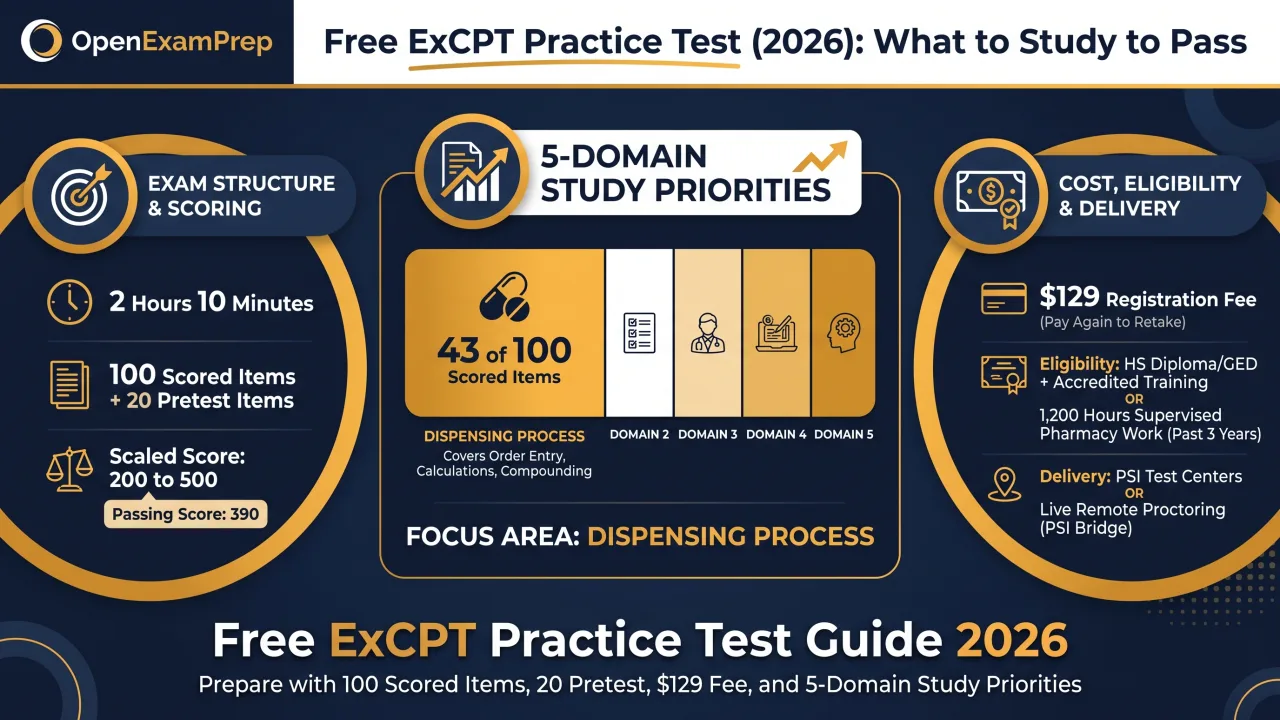
- Format: 100 scored items + 20 unscored pretest items (120 total, all multiple-choice)
- Exam time: 2 hours, 10 minutes, one continuous session
- Passing score: scaled score of 390 (scale runs 200-500)
- Exam fee: $129 to register through NHA (a retake requires paying the fee again)
- Delivery: PSI test center or NHA live remote proctoring (PSI Bridge) from home
- Credential earned: Certified Pharmacy Technician (CPhT)
Who Can Sit for the ExCPT
NHA requires one of these eligibility paths before you can schedule the exam:
- A high school diploma, GED, or recognized equivalent (or be within 60 days of finishing one), and
- Either: completion of an accredited or state-recognized pharmacy technician training program, or at least 1,200 hours of supervised pharmacy-related work experience completed within any one of the past three years.
Unlike some other NHA exams, ExCPT has no provisional-certification option — you must fully meet eligibility before you test, not after.
Updated Domain Blueprint (ExCPT)
The current NHA test plan (2023 job-task analysis, live since July 9, 2025) allocates the 100 scored items like this:
| Domain | Scored Items | % of Exam |
|---|---|---|
| 1) Role, Responsibilities & General Duties | 15 | 15% |
| 2) Laws (Laws/Regulations 9 + Controlled Substances 6) | 15 | 15% |
| 3) Drugs and Drug Therapy (Classification 8 + Frequently Prescribed Meds 5) | 13 | 13% |
| 4) Dispensing Process (Order Intake/Entry 13 + Preparing/Dispensing 13 + Calculations 7 + Compounding/Unit Dose/Repackaging 10) | 43 | 43% |
| 5) Medication/Patient Safety and Quality Assurance | 14 | 14% |
| Total scored | 100 | 100% |
Most misses come from Domain 4 (dispensing) + safety/law detail traps, because those domains combine a rule with a calculation or workflow step instead of testing a fact in isolation.
What to Study First
Best sequence for faster score gains:
- Dispensing workflow, order entry, and calculations (largest domain by far)
- Pharmacy law, HIPAA, and controlled-substance handling
- Drug classification and high-frequency/top-200 medications
- Patient safety and look-alike/sound-alike (LASA) error prevention
- Mixed timed drills that combine all five domains
Free vs Paid Prep: How to Choose
Free path (best if disciplined)
- Free domain notes + free ExCPT question banks
- Build your own error log and a one-page calculation/formula sheet
- Run timed mocks every 3-4 days
Paid path (best if you need structure)
- NHA's own study guide/practice products, built to the same blueprint
- Structured lesson order, progress analytics, and accountability
- Useful for candidates who need strict pacing or have failed once already
Free can work just as well if you actually follow timed practice and remediation loops — the blueprint above is public, so there's no hidden content a paid product can show you that you can't study from official sources.
2-Week Sprint (for experienced techs)
Week 1
- Domain 4 (dispensing/calculations) heavy + law refresh
- 60-80 questions/day
Week 2
- Mixed timed mocks + weak-area cleanup
- 80-120 questions/day
Use this only if you already have strong pharmacy floor experience — most first-time candidates without floor time need the 4-week plan below.
4-Week Plan (most candidates)
Week 1
- Laws + role/duties + federal frameworks (HIPAA, controlled substances)
Week 2
- Drug classes, top-200 meds, interactions, storage rules
Week 3
- Dispensing process: order entry, SIG codes, third-party billing/adjudication, calculations
Week 4
- Safety/QA + full timed mocks + final review
Must-Know Medication/Law Topics
Meds and therapy
- Top recurring classes (cardiovascular, diabetes, anti-infectives, CNS, respiratory)
- Brand-generic pairing accuracy
- LASA (look-alike/sound-alike) risk drugs
Law and regulation
- HIPAA handling in real workflows
- Controlled-substance scheduling and handling basics
- Labeling, record retention, and documentation triggers
- Fraud/waste/abuse and reporting awareness
Dispensing and calculations
- Prescription/order intake and entry accuracy
- Third-party billing, days'-supply, and prior-authorization basics
- Compounding, unit-dose, and repackaging rules
- Dosage and concentration calculations (the single most error-prone subdomain)
Score Targets Before Exam Day
| Metric | Target |
|---|---|
| Timed mixed sets | 78-82% |
| Dispensing-only sets | 82%+ |
| Safety/law sets | 80%+ |
| Last 2 full mocks | 80%+ |
The goal is consistency under time pressure, not one lucky high score. NHA's scaled scoring weights harder items more heavily, so raw percent-correct on practice sets is a guide, not a guarantee — treat 390 scaled as the real target and use percent-correct only to track trend.
Mock Strategy That Works
- Take a full timed mock.
- Tag every miss by type: knowledge gap, process error, misread, or calculation slip.
- Repair only the top two weak categories.
- Re-test those categories within 24 hours.
This loop is faster than re-reading all content.
Common Failure Patterns
- Under-prepping dispensing workflow and calculation details.
- Memorizing definitions without scenario practice.
- Skipping timed mocks until the last week.
- Weak brand/generic medication name recognition.
- Ignoring law and controlled-substance details until the final days.
Exam-Day Checklist
- Confirm PSI logistics (test-center directions or live-remote-proctoring system check) and bring required identification.
- Do one short warm-up, not a marathon review session.
- Keep pace steady — at ~1.3 minutes/item you can't afford to stall on one scenario.
- Flag and return to hard items instead of freezing on them.
- Leave review time for calculation and law-trap questions.
After You Pass: Recertification
Passing ExCPT earns the Certified Pharmacy Technician (CPhT) credential. To keep it active, NHA requires 20 hours of continuing education every 2 years (at least 1 hour in pharmacy law and 1 hour in patient safety), plus a $55 renewal fee. Many states also layer their own board CE rules on top of NHA's, so confirm your state board's requirements alongside NHA's.
Practice CTA
Official Sources (2026)
- NHA Pharmacy Technician (CPhT / ExCPT) page
- NHA Candidate Handbook (PDF)
- NHA ExCPT Test Plan (for exams scheduled on/after July 9, 2025)
- NHA ExCPT exam update overview
- NHA eligibility requirements
- NHA continuing education / recertification requirements
Official-Source Check Before You Schedule
Treat this article as a study map, not a substitute for NHA's own candidate materials. Requirements can change by testing window, state, or delivery vendor, and changes often hit the details candidates overlook: identification rules, retake timing, calculator policy, reference materials, continuing-education language, application approvals, and exactly how domains are named. Before you pay the $129 exam fee, build a one-page source checklist: the official exam page, candidate handbook, test plan, fee page, and reschedule policy. If a prep book or older post disagrees with NHA, follow NHA — this matters most for candidates retesting after a failed attempt who may be studying from an outline from before the July 2025 blueprint update.
How to Read the Blueprint Without Overstudying
Don't read the ExCPT outline like a table of contents — read it like a risk map. Each domain tells you what can be tested; the action verbs tell you how. "Identify" usually points to recognition. "Apply," "calculate," "determine," or "recommend" means the question can require judgment, sequencing, or multi-step reasoning — this is most of Domain 4.
Make four passes through the outline. First, mark topics you already use at work. Second, mark topics you recognize but can't explain without notes. Third, mark unfamiliar vocabulary. Fourth, mark topics that combine two skills, such as a law plus a calculation, or a dispensing rule plus a patient-safety scenario. That fourth group deserves the most practice — it's where candidates feel prepared but still lose points, because the real exam blends rules into scenarios rather than asking for them in isolation.
Scenario Strategy for Hard Questions
Most candidates miss hard ExCPT questions for one of three reasons: they answer on the first familiar phrase, they ignore a limiting condition in the stem, or they spend too long trying to make every answer choice perfect. A better method treats each scenario as a short workplace decision.
Name the task in plain English: what is the exam actually asking you to decide? Identify the controlling facts and separate them from details that just describe the setting (drug name, insurance type, patient age that doesn't change the rule). Predict the answer before reading the options — a rough prediction reduces the chance an attractive distractor pulls you off the correct law, dosage rule, or workflow step. When two choices remain, ask which one a real pharmacy technician — not a pharmacist or prescriber — is authorized to do next, and which one protects patient safety, documentation, and compliance first.
Practice Routing and Score Repair
Use practice questions as diagnostic data, not a score-chasing game. After each timed block, tag every miss with one primary cause: content gap, vocabulary gap, careless reading, calculation setup, scenario judgment, or pacing. Tag everything as "content" and your remediation stays too broad to fix anything fast.
A strong remediation cycle has three steps: reread only the smallest source section that explains the miss, write a one-sentence rule in your own words, then answer two or three nearby questions without notes. If you can only get the original question right after seeing the explanation, you've recognized the answer, not repaired the skill.
Final Two-Week Readiness Plan
Two weeks out, stop measuring progress by pages read and start measuring repeatable performance: several timed blocks where the same weak domain no longer shows up in the miss log.
In week one, alternate blocks: one targeted weak-domain set, one mixed timed set, one review block, and one closed-book recall session where you write calculation steps, law triggers, and dispensing-process order from memory, then check against the official outline.
In the final week, cut new material. Keep daily contact with your hardest topics, but shift toward pacing and clean execution. Rework questions you've missed twice. Confirm your PSI test-center directions or live-remote-proctoring system check, identification requirements, and break policy — logistics, not content, but they can still cost you points if you handle them at the last minute.
Common Traps to Avoid
Passive rereading. Familiarity isn't the same as being able to choose correctly under time pressure. Convert reading into retrieval: close the source, explain the rule out loud, then apply it to a practice scenario.
Treating every miss as equal. A one-off careless miss needs a prevention habit; a repeated domain miss needs a study block; a pacing miss needs timed drills; a vocabulary miss needs flashcards. Different misses need different fixes.
Delaying full-length timed practice. Longer timed sets expose fatigue and pacing problems you can't see in 10-question drills. Find those problems while there's still time to fix them.
Skipping the "why." For every reviewed item, write why the correct answer wins and why the best distractor fails. That second sentence is where the learning actually sticks.
When You're Ready
You're ready for the ExCPT when you can explain all five domains without reading the outline, finish timed sets without rushing the last 10 questions, and identify your own miss pattern before checking the score report. Passing is less about finding a secret resource and more about a tight loop: official source, focused study, timed practice, miss analysis, targeted repair. Keep that loop running and every practice session earns its place.


 Buy on Amazon
 Study resources on Achievable
 Study guide on Mometrix
 Take courses on Udemy