 View
ViewYou Passed Your NSA Training — Now What?
Congratulations. You have completed your Notary Signing Agent training, passed your exam, and you are ready to start earning $75-$200 per mobile loan signing. But before you accept your first appointment from Snapdocs, SigningOrder, or NotaryDash, you need the right supplies.
Notary Signing Agents are not regular notaries. A general notary might notarize a single document at their office. A signing agent drives to a borrower's home, sits down at their kitchen table, and guides them through a 100-200+ page loan document package — with 40-80 signature, initial, and date locations — in under an hour. Speed, organization, and professionalism are not optional. They are how you get rehired.
The good news: you do not need to spend hundreds of dollars on supplies. A complete, professional-grade signing agent kit costs less than the fee from a single appointment. Here are the five essential supplies every new NSA needs, plus exactly how to use them.
The 5 Essential Notary Signing Agent Supplies
1. YUHUEDIT Notary Journal — Best Signing Agent Journal
Your notary journal is your legal record of every notarization you perform. For signing agents, this is especially critical because a single loan signing appointment typically involves 3-6 separate notarizations — and you may do 2-4 signings per day. That adds up to thousands of journal entries per year.
Why this journal works for signing agents:
The YUHUEDIT journal holds 236 entries in a hardcover, tamper-resistant binding with numbered pages and stitched construction. This matters because many states — California being the most notable — require bound journals with tamper-evident features. Loose-leaf binders or spiral notebooks do not meet the legal standard and could expose you to liability.
What signing agents need in a journal:
- Numbered pages — proves no pages have been removed (required in CA, NY, and many other states)
- Bound construction — stitched or sewn binding, not perforated or spiral
- Enough entries — at 3-6 notarizations per signing and 2-4 signings per day, you will fill a journal faster than you think
- Portable size — you are carrying this to kitchen tables, coffee shops, and hospital rooms
- Document pocket — for storing business cards, loose acknowledgment certificates, or receipts
The YUHUEDIT journal checks every box. The built-in pen holder and elastic closure mean you will not be fumbling for a pen or worrying about the journal falling open in your bag. At $9.99, you can buy multiple journals and always have a backup ready.
Pro tip: Start a new journal entry for each signer at each appointment. If you are notarizing documents for two borrowers (husband and wife) at the same signing, that is two separate journal entries minimum — one per signer.
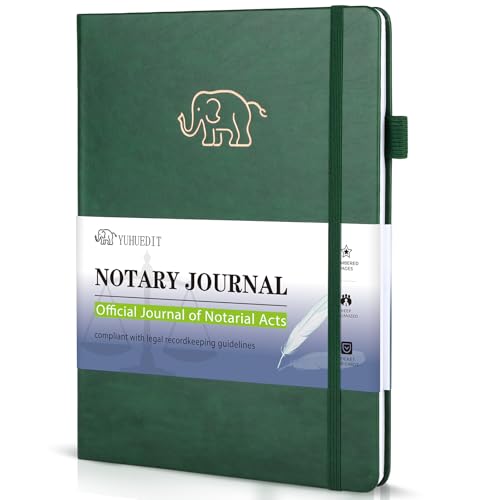
YUHUEDIT Notary Journal — Hardcover, 236 Entries, Tamper-Resistant
by YUHUEDIT
$9.99
- Meets CA Civil Code §8205 & UPA §3-203(a) requirements
- Tamper-resistant stitching with numbered pages
- Built-in pen holder, elastic closure, document pocket
2. ZILAMGOO Sign Here Tabs — Essential for Every Signing
If there is one supply that separates professional signing agents from amateurs, it is sign-here tabs. These small adhesive flags are how you pre-tab a loan package before the borrower sits down — marking every signature line, initial line, date line, and notarization location in the entire stack.
Why pre-tabbing changes everything:
A typical refinance loan package has 40-80 locations where borrowers need to sign, initial, or date. Without pre-tabbed flags, you would need to flip through every single page during the signing, searching for signature lines while the borrower watches and waits. This turns a smooth 45-minute signing into a painful 90-minute ordeal. Borrowers get frustrated. Title companies get complaints. You stop getting assignments.
With pre-tabbed flags, the signing flows like this: "Sign here... initial here... date here... next tab... sign here..." The borrower moves through the stack efficiently, and you maintain control of the appointment. Professional signing agents can complete a standard refinance package in 30-45 minutes using pre-tabbed documents.
How to use color-coded tabs:
The ZILAMGOO set includes 500 tabs in four colors. Here is the standard color-coding system used by experienced signing agents:
| Color | Tab Label | Use For |
|---|---|---|
| Red | Sign Here | Full signature locations |
| Yellow | Initial Here | Initial-only locations |
| Green | Sign & Date | Combined signature + date locations |
| Blue | Notarize | Pages requiring your notary seal |
500 tabs sounds like a lot, but at 40-80 tabs per signing, this pack covers roughly 6-12 appointments. At $6.99, that is less than $1 per signing in tab costs.
Pre-tabbing workflow:
- Receive the loan package (PDF or printed) from the signing service
- Print and review all documents — identify every signature, initial, and date line
- Place the appropriate colored tab at each location, extending from the right edge of the page
- Stack the documents in signing order (typically: Note first, then Deed of Trust, then remaining documents)
- Arrive at the appointment with a pre-tabbed, organized package ready to go

ZILAMGOO Sign Here Stickers & Tabs — 500 Pieces
by ZILAMGOO
$6.99
- 500 tabs: Sign Here, Initial Here, Sign & Date, Notarize
- Color-coded in red, yellow, green, blue
- Durable PET material — waterproof and tear-resistant
3. Loan Documents Cheat Sheet — Know What You Are Notarizing
Here is something no one tells you before your first signing: borrowers will ask you what the documents mean. You cannot provide legal advice — that is strictly prohibited — but you can describe the general purpose of each document. The problem is that a loan package contains 30-50 different documents, and as a new signing agent, you may not recognize half of them.
The ESA Notary Academy Loan Documents Cheat Sheet gives you a visual reference for every document you will encounter in a typical mortgage closing. It shows you what each document looks like and provides a plain-English description of its purpose.
Key documents you need to recognize:
- Closing Disclosure (CD) — the 5-page document showing all loan terms, costs, and cash to close
- Promissory Note — the borrower's legal promise to repay the loan
- Deed of Trust / Mortgage — gives the lender a security interest in the property
- Notice of Right to Cancel — for refinances, gives borrowers 3 business days to back out
- Compliance Agreement — borrower agrees to fix any errors in the documents
- Signature/Name Affidavit — confirms the borrower's legal name and any name variations
- Tax and Insurance Authorization — allows the lender to set up escrow
New signing agents often struggle with the first 3-5 signings simply because they are unfamiliar with the documents. A cheat sheet eliminates that learning curve. You can glance at it during your pre-tabbing session or keep it in your bag as a quick reference.
Important: You are a notary, not an attorney. When borrowers ask questions about the terms of their loan, the correct response is always: "I am not authorized to explain the legal or financial terms. I recommend contacting your lender or a real estate attorney for specific questions about your loan." The cheat sheet helps you identify documents and describe their general purpose — nothing more.

Loan Documents Cheat Sheet — ESA Notary Academy
by ESA Notary Academy
$13.99
- Visual descriptions of every loan document
- Quick reference for signing appointments
- By ESA Notary Academy — trusted training provider
4. Notary Bag with Lock & Fingerprint Kit — Secure Document Transport
Loan packages contain some of the most sensitive personal information a person has: Social Security numbers, bank account details, income verification, tax returns, and employment records. When you transport these documents from the signing appointment to the drop-off location (or shipping center), you are legally and ethically responsible for keeping them secure.
Why a locking bag matters:
Signing services and title companies require secure document transport. If documents are lost, stolen, or damaged, you face potential liability and will almost certainly lose your accounts with that signing service. A locking document bag protects you in multiple scenarios:
- In your car — documents stay secure if your car is broken into or if you make a stop between the signing and drop-off
- During shipping — a locked bag adds a layer of protection when you drop documents at FedEx or UPS
- At the signing — a professional bag makes a better impression than a grocery store plastic bag or loose folder
The Junkin kit includes a waterproof bag with a combination lock plus two fingerprint ink pads. The fingerprint pads are required in some states (California requires thumbprints in the notary journal for certain documents) and useful to have in others.
Bag organization tip: Use a system inside your bag. Keep blank acknowledgment certificates, jurat certificates, and loose forms in one section. Keep the signed loan package in another. Keep your journal, pens, and tabs in a third. When you can find everything without digging, your signings run faster and look more professional.

Notary Bag, Lock & Fingerprint Ink Pad Kit (4-Pack)
by Junkin
$13.99
- Waterproof locking bag with combination lock
- Includes 2 fingerprint ink pads
- Protects confidential loan documents during transport
5. ExcelMark Notary Embosser — Professional Raised Seal
An embosser creates a raised impression (often called a "raised seal" or "crimp seal") on paper. Unlike an ink stamp, the embossed impression is three-dimensional — you can feel it with your fingers. This serves two important purposes for signing agents:
- State compliance — many states require or recommend a raised seal in addition to (or instead of) an ink stamp for notarized documents
- Tamper evidence — an embossed impression cannot be photocopied. If someone tries to forge a notarized document by copying your ink stamp, the lack of a raised seal is immediately detectable
The ExcelMark embosser is custom-made for your specific state's requirements. When you order, you provide your name, commission number, commission expiration date, and state — and the embosser is manufactured to meet your state's exact specifications.
States that require or commonly expect an embosser for loan signings:
While requirements vary, the following states either legally require a raised seal or have title company expectations that strongly favor one: California, New York, Florida, Texas, Illinois, Pennsylvania, Ohio, Georgia, North Carolina, and many others. Even in states where only an ink stamp is required, having both demonstrates professionalism and provides an additional layer of document security.
How to use an embosser at a loan signing:
- Complete the notarization with your ink stamp first
- Place the embosser over the ink stamp impression and squeeze firmly
- Verify the raised impression is clear and legible
- The embossed seal should overlap slightly with your ink stamp but not obscure the text
At $24.99, the embosser is the most expensive item on this list — and also the one that makes the strongest impression (literally) on title companies reviewing your completed documents.

ExcelMark Notary Embosser — All 50 States
by ExcelMark
$24.99
- Custom-made for your state requirements
- Clear crisp impression with minimal effort
- Required by most states for loan document notarization
What to Bring to Your First Loan Signing
Use this checklist before every signing appointment. Print it and keep it in your notary bag until it becomes second nature:
Documents & Tools:
- Printed and pre-tabbed loan package (all pages, in signing order)
- Notary journal with pen
- Notary stamp/seal (with backup ink pad)
- Notary embosser
- Sign-here tabs (bring extras — you always need more)
- Blue ink pens (bring 3-4)
- Black ink pens (bring 2)
- Loan document cheat sheet
- Loose acknowledgment certificates (your state's current version)
- Loose jurat certificates (your state's current version)
Transport & Security:
- Locking document bag
- Return shipping labels (if provided by signing service)
- Prepaid shipping envelope or FedEx/UPS supplies
- Fingerprint ink pad (required in some states)
Technology:
- Fully charged phone (for GPS navigation and signing service app)
- Car charger for phone
- Scanning app (CamScanner, Adobe Scan, or similar) — some signing services require scan-backs
- Portable phone charger (backup)
Professional Extras:
- Business cards
- A bottle of water for the borrower (small touch, big impression)
- Breath mints (you are sitting across a table from someone for 45 minutes)
- Hand sanitizer
How to Organize Your Signing Agent Bag
Experienced signing agents develop a system that lets them find anything in their bag within seconds. Here is a proven organization method:
Main compartment — loan packages: Keep the current signing's documents here, pre-tabbed and in order. If you have back-to-back signings, use separate folders or large binder clips labeled with each borrower's last name and appointment time.
Front pocket — high-frequency items: Pens, sign-here tabs, business cards, breath mints, hand sanitizer. These are things you reach for constantly — they should be instantly accessible.
Interior pocket — notary tools: Notary stamp, embosser, backup ink pad, fingerprint pad, loose certificates. Group these together so your notarization supplies are always in one place.
Zippered section — journal and cheat sheet: Your journal and loan document cheat sheet stay here. The journal should be easy to pull out and open flat on any surface.
Side pocket — technology: Phone charger, car charger, backup battery. Keep cords organized so they do not tangle with your documents.
The golden rule of bag organization: If you cannot find any item in your bag within 5 seconds, reorganize. Fumbling through your bag during a signing looks unprofessional and wastes everyone's time.
What Title Companies and Signing Services Expect
When you accept an assignment from Snapdocs, SigningOrder, NotaryDash, or a direct title company, they expect a professional operation. Here is what "professional" means in the signing agent world:
Before the appointment:
- Confirm the appointment within 30 minutes of receiving the assignment
- Download and review the loan package as soon as it is available
- Pre-tab all signature, initial, and date locations
- Contact the borrower to confirm the appointment time and location
- Arrive 5-10 minutes early (never late)
During the appointment:
- Dress professionally (business casual minimum — no shorts, flip-flops, or graphic tees)
- Explain the signing process briefly before starting
- Guide the borrower through each document efficiently
- Use your cheat sheet discreetly if needed
- Never rush, but keep the signing moving
- Complete the notary journal for every notarization
After the appointment:
- Scan-back signed documents within 30-60 minutes if required
- Ship original documents the same day (or next morning for evening signings)
- Confirm drop-off or shipping with the signing service
- Invoice promptly through the signing service's platform
The math that matters: A signing agent who earns a reputation for professionalism, speed, and reliability gets more assignments. At $100-$150 per signing and 2-3 signings per day, that is $200-$450 in daily revenue. The $70 you spend on quality supplies is the investment that makes that revenue possible.
Common Mistakes New Signing Agents Make
Learn from others' mistakes so you do not repeat them:
1. Not pre-tabbing the loan package. This is the number one mistake. Showing up to a signing without pre-tabbed documents is like a surgeon showing up without prepped instruments. Tab everything before you leave your house.
2. Bringing only one pen. Pens die. Pens roll under furniture. Borrowers accidentally pocket them. Bring at least 3-4 blue pens and 2 black pens to every signing.
3. Not bringing loose certificates. Sometimes a loan package requires additional notarizations that were not included in the original documents. Having loose acknowledgment and jurat certificates means you can handle this on the spot instead of rescheduling.
4. Using an expired or nearly expired stamp. Check your stamp and commission expiration dates monthly. If your commission expires between the signing date and the loan's recording date, the notarization may be challenged. Most signing services will not assign you work if your commission expires within 30-60 days.
5. Forgetting to complete the journal. In the rush to keep the signing moving, some new agents skip journal entries or fill them in later from memory. Complete your journal at the time of notarization — it is your legal record and protection.
6. Not confirming the signer's identity. Every signer's identity must be verified with acceptable identification before any notarization. Check the ID name against the name on the documents, verify the ID is current (not expired), and record the ID details in your journal.
Total Kit Cost Breakdown
Here is what the complete signing agent supply kit costs:
| Supply | Price | Signings to Break Even |
|---|---|---|
| YUHUEDIT Notary Journal | $9.99 | — |
| ZILAMGOO Sign Here Tabs (500 pcs) | $6.99 | — |
| ESA Loan Documents Cheat Sheet | $13.99 | — |
| Junkin Notary Bag + Lock + Fingerprint Kit | $13.99 | — |
| ExcelMark Notary Embosser | $24.99 | — |
| Total | $69.95 | 1 signing |
At $69.95 total, this entire kit costs less than the fee from a single loan signing appointment. Most signing agents charge $75-$200 per signing depending on the document package and location. Your supplies pay for themselves before you finish your first appointment.
Free Notary Signing Agent Study Resources
Pair your new supplies with solid preparation:
- Free Notary Signing Agent Study Guide — Complete coverage of loan documents, notarial procedures, and signing best practices
- Free NSA Practice Questions — Test your knowledge with realistic signing scenarios
- AI Study Assistant — 10 free questions per day — ask about specific loan documents, state requirements, or signing procedures
- Notary Flashcards — Quick review of key terms and document types
The AI study assistant is especially useful for signing agents. Ask questions like "What is the difference between an acknowledgment and a jurat?" or "What should I do if the borrower's name on their ID does not match the loan documents?" and get instant, detailed answers.
Final Verdict
The five supplies in this guide are not luxuries — they are the baseline tools every professional Notary Signing Agent needs. The journal protects you legally. The tabs make you efficient. The cheat sheet builds your confidence. The bag keeps documents secure. The embosser proves your professionalism.
At $69.95 for the complete kit, you are investing less than one signing fee to equip yourself for a career that can generate $50,000-$100,000+ per year in signing fees. The signing agents who succeed are the ones who show up prepared, organized, and professional from day one.
Order your supplies, pre-tab your first loan package, and start accepting assignments. Your career as a Notary Signing Agent starts now.
Start your preparation today with our free Notary Signing Agent study guide and practice questions.
As an Amazon Associate, OpenExamPrep earns from qualifying purchases. All recommendations are based on editorial review.

 Free CE
 Signing agent training on Notary.net