TEAS vs CNA
TEAS and CNA serve different purposes in the nursing pathway, and many aspiring nurses complete both. The TEAS is an admission test for nursing programs - it measures academic readiness in reading, math, science, and English. The CNA credential is a professional certification that allows you to work immediately in patient care. Strategic nursing students get CNA certification first to earn money and gain experience, then take the TEAS for nursing school admission with clinical experience that strengthens their application.
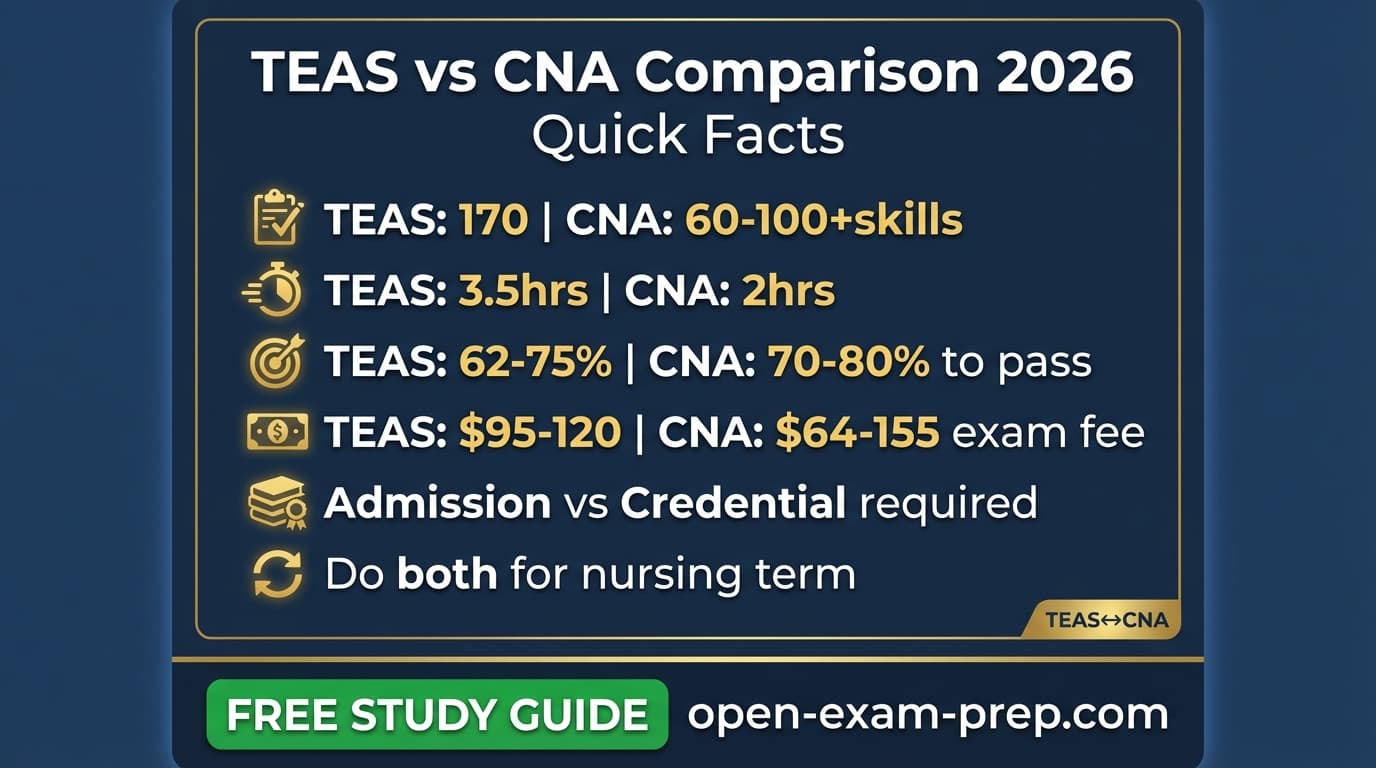
Side-by-Side Comparison
| Feature | TEAS | CNA |
|---|---|---|
| Full Name | Test of Essential Academic Skills | Certified Nursing Assistant |
| Exam Cost | $95-$120 | $64-$155 (varies by state) |
| Passing Score | 62-75% (varies by program) | Varies by state (typically 70-80%) |
| Questions | 170 questions | 60-100 written + skills demonstration |
| Time Limit | 209 minutes (3 hours 29 minutes) | 90 minutes written + 30 minutes skills |
| Study Time | 20-40 hours | 75-120 hours training program |
| Difficulty | Moderate | Moderate |
| Prerequisites | None (high school knowledge assumed) | State-approved CNA training program |
| Exam Body | ATI (Assessment Technologies Institute) | State Nursing Board |
Key Differences
- 1TEAS is an admission test; CNA is a professional credential
- 2TEAS measures academic readiness; CNA tests clinical skills
- 3TEAS alone doesn't allow you to work; CNA leads to immediate employment
- 4TEAS costs $95-$120 one-time; CNA involves training program costs too
- 5TEAS scores are used for school ranking; CNA is pass/fail certification
- 6TEAS tests reading, math, science; CNA tests patient care skills
What Each Exam Allows You To Do
TEAS
- Apply to nursing programs (RN, LPN)
- Apply to allied health programs
- Demonstrate academic readiness
- Meet program admission requirements
CNA
- Work as nursing assistant immediately
- Gain patient care experience
- Earn while preparing for nursing school
- Strengthen nursing program applications
Who Should Take Each Exam?
Take the TEAS if you...
- →Aspiring nurses applying to programs
- →Allied health program applicants
- →Those pursuing healthcare education
- →High school graduates entering nursing
Take the CNA if you...
- →Those wanting immediate healthcare employment
- →Nursing school applicants building experience
- →Career changers testing healthcare interest
- →Those earning while learning
Which Should You Take First?
Most successful nursing students get CNA first for several reasons: 1) Immediate employment in healthcare while pursuing education, 2) Patient care experience strengthens nursing school applications, 3) Clinical exposure confirms nursing is the right career choice, 4) Some nursing programs give admission preference to CNAs. After working as a CNA, take the TEAS for nursing program admission. This sequence gives you income, experience, and competitive advantage.
Frequently Asked Questions
QDo I need TEAS if I'm already a CNA?
Yes, if you want to become an RN or LPN. Being a CNA is a great foundation, but nursing programs still require TEAS scores for admission. Your CNA experience strengthens your application but doesn't replace the academic assessment. Some programs may give admission preference to CNAs with strong TEAS scores since you've already demonstrated commitment to patient care and understand the clinical environment.
QCan I skip CNA and go straight to nursing school with TEAS?
Yes, CNA is not required for nursing school admission. You can take TEAS directly out of high school or while completing prerequisites. However, having CNA experience is highly recommended: it provides patient care skills before clinicals, income while in school, and a backup credential if nursing doesn't work out. Many nursing programs value CNA experience in admissions decisions.
QWhich test is harder - TEAS or CNA exam?
They test completely different things. TEAS is harder academically - it requires knowledge of biology, chemistry, anatomy, algebra, and strong reading comprehension. Many students need 20-40 hours of study. The CNA exam tests practical patient care skills from your training program. If you completed CNA training, the exam validates what you learned. TEAS requires broader academic preparation beyond any specific course.
QHow does working as a CNA help nursing school applications?
CNA experience demonstrates several things to admissions committees: 1) You understand what healthcare work actually involves (reducing dropout risk), 2) You can handle the physical and emotional demands of patient care, 3) You've shown initiative by getting credentialed, 4) You have professional references from healthcare settings. Combined with strong TEAS scores and prerequisites, CNA experience creates a compelling application that shows both academic readiness and practical commitment.
10 free AI interactions per day
Free exam resources
Start Studying the Exact Exam
Use the comparison to choose a path, then move into the matching practice questions, study guide, and flashcards.
Third-party resources · We may earn a commission from purchases.

ATI TEAS 7th Edition 2025-2026 Study Guide: Practice Exams and Review Book for the TEAS Test Prep: [Includes Detailed Answer Explanations]
By Morrison, Lydia
$29.99 · 
 Flashcards on Mometrix
 Practice exams on ExamEdge
 Take courses on Udemy
Third-party resources · We may earn a commission from purchases.

CNA Ultimate Study Guide 2025 - 2026: Your Comprehensive Study Companion with Strategies and Practice Tests to Ace the Certified Nursing Assistant Exam
By Powers, Daniel
$23.99 ·
Take courses on UdemyOnline course on MometrixPractice exams on ExamEdgeRelated Exam Comparisons
Stay Updated
Get free exam tips and study guides delivered to your inbox.