PTCE vs CNA
PTCE (pharmacy tech) and CNA (nursing assistant) are both entry-level healthcare credentials, but the work environments and daily tasks are fundamentally different. Pharmacy technicians work behind the counter with medications, computers, and inventory - minimal patient interaction in retail settings, more in hospital pharmacy. CNAs provide hands-on patient care - bathing, feeding, mobility assistance, vital signs monitoring - with extensive patient interaction and physical demands. Both lead to healthcare careers but serve different personality types and work preferences.
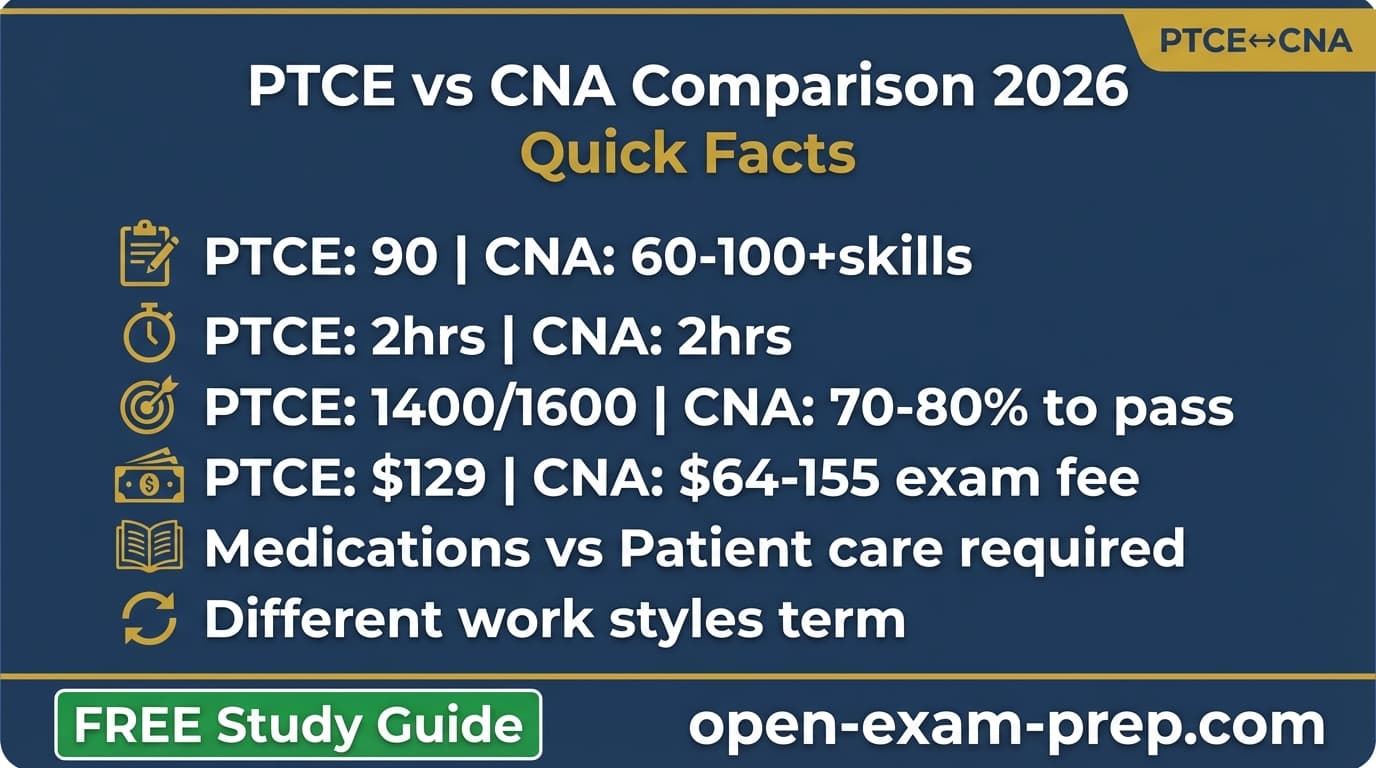
Side-by-Side Comparison
| Feature | PTCE | CNA |
|---|---|---|
| Full Name | Pharmacy Technician Certification Exam | Certified Nursing Assistant |
| Exam Cost | $129 | $64-$155 (varies by state) |
| Passing Score | 1400/1600 (scaled score) | Varies by state (typically 70-80%) |
| Questions | 90 (80 scored + 10 unscored) | 60-100 written + skills demonstration |
| Time Limit | 2 hours | 90 minutes written + 30 minutes skills |
| Study Time | 40-80 hours | 75-120 hours training program |
| Difficulty | Moderate | Moderate |
| Prerequisites | PTCB-recognized education OR 500 hours experience | State-approved CNA training program |
| Exam Body | PTCB (Pharmacy Technician Certification Board) | State Nursing Board |
Key Differences
- 1Pharmacy techs work with medications; CNAs work with patients directly
- 2PTCE is one national exam; CNA varies by state
- 3Pharmacy techs have minimal patient contact (retail); CNAs have constant contact
- 4Pharmacy work is less physical; CNA work involves lifting and mobility assistance
- 5PTCE costs $129; CNA costs $64-$155 by state
- 6Pharmacy tech leads to pharmacy career; CNA leads to nursing career
What Each Exam Allows You To Do
PTCE
- Work as Certified Pharmacy Technician
- Fill prescriptions under pharmacist supervision
- Prepare IV medications (hospital)
- Manage pharmacy inventory
CNA
- Provide direct patient care
- Assist with activities of daily living
- Monitor vital signs
- Work in nursing homes, hospitals, home health
Who Should Take Each Exam?
Take the PTCE if you...
- →Those entering pharmacy careers
- →Detail-oriented individuals
- →Those preferring predictable schedules
- →Healthcare career without patient lifting
Take the CNA if you...
- →Those who enjoy direct patient interaction
- →Aspiring nurses wanting experience
- →Compassionate caregivers
- →Those comfortable with physical demands
Which Should You Take First?
Choose based on your work style preferences, not just career goals. If you prefer working with medications, computers, and systems with predictable tasks and limited patient interaction, PTCE/pharmacy tech fits better. If you're drawn to direct patient care, forming relationships with patients, and don't mind the physical demands of helping with mobility and personal care, CNA is your path. Both are solid healthcare entry points with different day-to-day experiences.
Frequently Asked Questions
QWhich pays more - pharmacy technician or CNA?
Pharmacy technicians earn slightly more on average. Pharmacy techs earn $38,000-$47,000 annually ($18-$22/hour), with hospital pharmacy positions paying higher than retail. CNAs earn $35,000-$42,000 annually ($17-$20/hour). However, both have similar advancement potential - pharmacy techs can specialize in compounding or become pharmacy managers, while CNAs often pursue LPN/RN licensure for significantly higher pay ($50,000-$80,000+).
QWhich job has better work-life balance?
Pharmacy technician work tends to be more predictable, especially in retail settings with scheduled shifts and limited weekend/holiday requirements at some locations. Hospital pharmacy techs work varied schedules like CNAs. CNAs often work 8-12 hour shifts including nights, weekends, and holidays, particularly in nursing homes and hospitals. Home health CNA positions can offer more flexibility. Overall, retail pharmacy offers the most predictable schedule.
QCan I do both pharmacy tech and CNA work?
Yes, holding both certifications is possible and some healthcare workers do maintain both. However, it's uncommon because the jobs are quite different and typically lead to different career paths. Having both might be useful if you're undecided about your direction or want maximum job flexibility. Most people choose the path that matches their personality and commit to that career track.
QWhich certification is faster to get?
Both can be obtained in similar timeframes. CNA training programs are typically 4-8 weeks (75-120 hours mandatory), and you test immediately after. PTCE requires either completing a PTCB-recognized program (4-6 months typically) OR having 500 hours of pharmacy work experience. If you can get pharmacy experience through employment, PTCE might be faster. If starting from scratch with no healthcare background, CNA is often the quicker path to certification.
10 free AI interactions per day
Free exam resources
Start Studying the Exact Exam
Use the comparison to choose a path, then move into the matching practice questions, study guide, and flashcards.
Third-party resources · We may earn a commission from purchases.

PTCB Exam Study Guide 2025-2026: 4 Full-Length Practice Tests and Pharmacy Technician Certification (PTCE) Prep: [8th Edition]
By Downs, Jeremy
$46.78 · 
 Prep course on Achievable
 Practice exams on ExamEdge
 Online course on Mometrix
Third-party resources · We may earn a commission from purchases.

CNA Study Guide 2025-2026: Complete Review + 560 Questions and Detailed Answer Explanations for the Certified Nursing Assistant Exam (8 Full-Length Exams)
By CNA Test Prep Team, Newstone
$19.99 ·
Practice exams on ExamEdge Take courses on UdemyStudy guide on Mometrix
Related Exam Comparisons
Stay Updated
Get free exam tips and study guides delivered to your inbox.