CNA vs CDA
CNA and CDA both involve caring for vulnerable populations, but at opposite ends of the age spectrum. CNAs care for elderly, ill, and disabled adults in healthcare settings. CDAs care for infants, toddlers, and preschoolers (ages 0-5) in educational settings. Both require state or nationally recognized credentials, involve direct caregiving, and offer pathways to further credentials in their respective fields. The choice depends on whether you're drawn to healthcare/nursing or early childhood education.
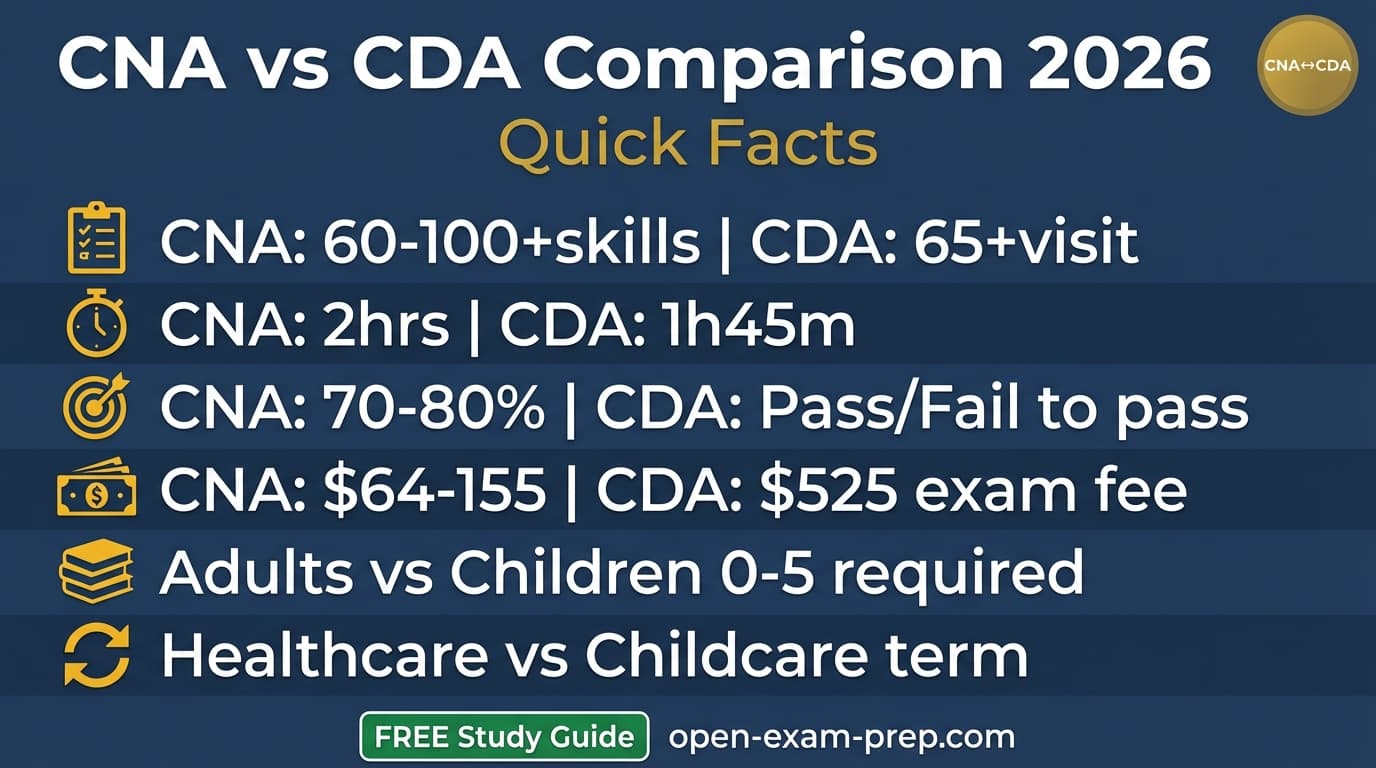
Side-by-Side Comparison
| Feature | CNA | CDA |
|---|---|---|
| Full Name | Certified Nursing Assistant | Child Development Associate |
| Exam Cost | $64-$155 (varies by state) | $525 (online application) |
| Passing Score | Varies by state (typically 70-80%) | Pass/Fail (competency-based) |
| Questions | 60-100 written + skills demonstration | 65 multiple-choice + verification visit |
| Time Limit | 90 minutes written + 30 minutes skills | 1 hour 45 minutes (exam) |
| Study Time | 75-120 hours training program | 120 hours professional education |
| Difficulty | Moderate | Moderate |
| Prerequisites | State-approved CNA training program (75-120 hours) | 480 hours work experience + 120 hours training + portfolio |
| Exam Body | State Nursing Board | Council for Professional Recognition |
Key Differences
- 1CNA cares for sick/elderly adults; CDA works with young children ages 0-5
- 2CNA is healthcare/nursing pathway; CDA is early childhood education pathway
- 3CNA exam includes skills demonstration; CDA includes verification visit
- 4CNA costs $64-$155; CDA costs $525
- 5CNA training is 75-120 hours; CDA requires 120 hours + 480 hours experience
- 6CNA leads to LPN/RN; CDA leads to preschool teacher/director roles
What Each Exam Allows You To Do
CNA
- Provide basic patient care
- Assist with activities of daily living
- Monitor and record vital signs
- Work in nursing homes, hospitals, home health
CDA
- Work as lead teacher in childcare
- Meet Head Start teacher requirements
- Work in licensed childcare centers
- Qualify for higher pay in early childhood
Who Should Take Each Exam?
Take the CNA if you...
- →Entry into healthcare careers
- →Those pursuing nursing school
- →Caregiving-oriented individuals
- →Quick path to healthcare employment
Take the CDA if you...
- →Early childhood educators
- →Childcare workers seeking advancement
- →Head Start program employment
- →Those passionate about young children
Which Should You Take First?
Choose based on the population you want to serve and your career direction. If you're drawn to healthcare, medical settings, and eventually nursing school, CNA is your path - it provides clinical experience that strengthens nursing applications. If you love working with young children and see yourself in early childhood education, CDA opens doors to Head Start programs, childcare centers, and eventually preschool administration. These are fundamentally different career paths that rarely intersect.
Frequently Asked Questions
QWhich pays more - CNA or CDA?
CNAs typically earn slightly more, averaging $17-$20/hour ($36,000-$42,000/year) compared to CDA holders at $15-$18/hour ($31,000-$37,000/year). However, both have advancement potential. CNAs can become LPNs ($50,000+) or RNs ($75,000+) with additional schooling. CDA holders can become preschool teachers ($38,000+) or childcare center directors ($45,000-$65,000+) with experience and education. Hospital CNAs and CDAs at well-funded programs can exceed these averages.
QWhich credential is faster to obtain?
CNA is faster if you focus solely on the credential. CNA training programs are 4-8 weeks (75-120 hours), and you can test immediately after completion. The CDA requires 120 hours of professional education PLUS 480 hours of work experience with children, plus assembling a professional portfolio before applying. However, many people earn experience while working in childcare, so the CDA timeline depends on your starting point.
QCan I work with children as a CNA?
CNAs primarily work with adult patients. Pediatric CNA positions exist in children's hospitals, but they're less common and usually require experience. If your passion is working with children, CDA is the appropriate credential for childcare and early education settings. If you want to work with sick children specifically, consider the CNA path followed by pediatric nursing specialization through LPN/RN education.
QWhich has better job security - CNA or CDA?
Both have strong job security due to ongoing demand, but for different reasons. CNA demand is driven by aging population - nursing homes and home health agencies consistently need staff. CDA demand is driven by working parents needing childcare - licensed childcare centers require credentialed teachers. CNA positions are available in more settings (nursing homes, hospitals, home health, hospice), while CDA positions are concentrated in childcare centers and Head Start programs.
10 free AI interactions per day
Free exam resources
Start Studying the Exact Exam
Use the comparison to choose a path, then move into the matching practice questions, study guide, and flashcards.
Third-party resources · We may earn a commission from purchases.

CNA Study Guide 2025-2026: Complete Review + 560 Questions and Detailed Answer Explanations for the Certified Nursing Assistant Exam (8 Full-Length Exams)
By CNA Test Prep Team, Newstone
$19.99 · 
 Practice exams on ExamEdge
 Take courses on Udemy
 Study guide on Mometrix
Related Exam Comparisons
Stay Updated
Get free exam tips and study guides delivered to your inbox.