Vermont Notary Public Exam Overview
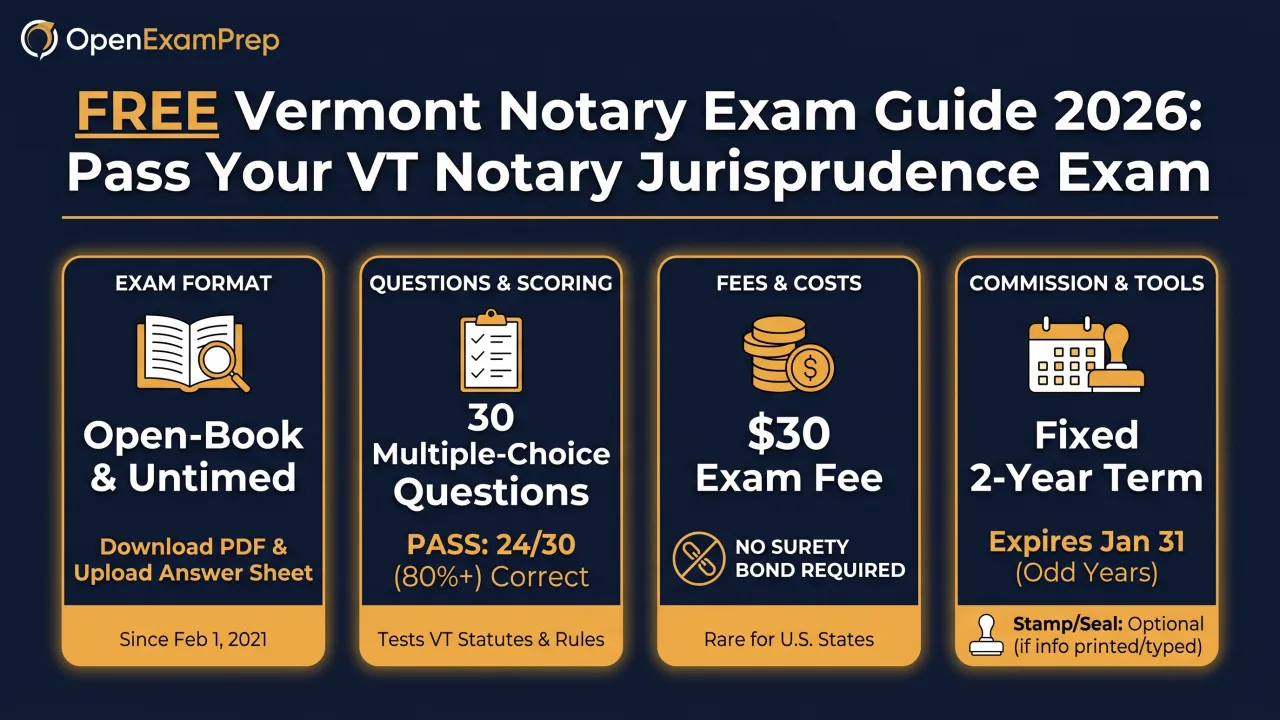
The Vermont State Jurisprudence Exam is required for all first-time notary public applicants in Vermont. This exam requirement has been in effect since February 1, 2021. The exam tests your knowledge of Vermont's notarial statutes and administrative rules with 30 multiple-choice questions, and you can miss up to six and still pass.
The good news? The Vermont Notary Exam is an open-book, take-home exam — you download the official PDF from the Office of Professional Regulation (OPR), complete it using your notes and Vermont's notarial statutes, and upload the answer sheet as part of your online application. There is no proctor and no fixed time limit.
Exam Format at a Glance
| Component | Details |
|---|---|
| Total Questions | 30 multiple-choice |
| Time Limit | None — untimed, self-paced take-home exam |
| Passing Score | No more than 6 wrong (at least 24/30, 80%+) |
| Exam Format | Open-book, take-home PDF (download, complete, upload answer sheet) |
| Application Fee | $30 |
| Commission Term | 2 years (fixed biennial term) |
| Surety Bond | Not required |
Why Become a Vermont Notary?
- No bond required - One of few states without a bond requirement
- Open-book exam - Reference materials allowed during test
- No stamp required - Seal/stamp is optional in Vermont
- Remote notarization - Vermont allows Remote Online Notarization (RON)
- Reasonable fees - No statutory fee caps, set your own rates
Start Your Vermont Notary Exam Prep
Ready to begin studying? Understanding Vermont's notarial laws is key to passing the Jurisprudence Exam. The National Notary Association is also an excellent resource for notary education and supplies.
View All Notary Exam Prep Resources
Key Topics Covered on the Exam
1. Notary Commission Requirements (20%)
Eligibility Requirements:
- Must be at least 18 years old
- Must be a U.S. citizen or permanent legal resident
- Must be a resident of Vermont OR have a place of employment or practice in Vermont
- Not disqualified under Section 5342 of Chapter 103, Title 26
Application Process:
- Create account on Office of Professional Regulation's Online Services Platform
- Complete online notary application
- Download and complete the VT State Jurisprudence Exam (30 questions, open-book)
- Upload completed exam answer sheet — if you miss more than 6 questions, you must retake the exam
- Pay $30 non-refundable application fee
2. Types of Notarial Acts (25%)
Acknowledgments:
- Signer acknowledges signing the document
- Signer must appear before the notary
- Most common notarial act
Jurats (Verification on Oath or Affirmation):
- Signer swears or affirms content is true
- Must sign in notary's presence
- Notary administers oath/affirmation
Oaths and Affirmations:
- Verbal pledge of truthfulness
- Oath - religious invocation
- Affirmation - non-religious pledge
Witnessing Signatures:
- Notary witnesses the signing
- Signer signs in notary's presence
Copy Certification:
- Certifying copies of certain documents
- Cannot certify vital records (birth, death, marriage)
3. Identification Requirements (20%)
Acceptable Forms of ID:
- Current state-issued driver's license or ID card
- Current U.S. passport
- Current foreign passport with USCIS stamp
- Current U.S. military ID
Personal Knowledge:
- Notary personally knows the signer
- Should be reserved for well-known individuals
Credible Witnesses:
- One or two credible witnesses who know the signer
- Witnesses must present satisfactory ID to notary
4. Vermont-Specific Laws (20%)
26 V.S.A. Chapter 103 - Notaries Public:
- Know the key sections of Vermont notary statutes
- Understand prohibited acts
- Commission requirements and terms
Prohibited Acts:
- Cannot notarize your own signature
- Cannot notarize when you have a financial interest
- Cannot notarize for immediate family members in certain situations
- Cannot certify vital records
- Cannot provide legal advice
- Cannot notarize incomplete documents
Disqualification Provisions (Section 5342):
- Understand what disqualifies someone from being a notary
5. Notarial Certificates and Records (15%)
Certificate Requirements:
Every notarial certificate must include:
- Type of notarial act performed
- Date of notarial act
- State and county/jurisdiction
- Notary's signature
- Notary's printed/typed name
- Notary's commission number
- Notary's title ("Notary Public")
- Commission expiration date
Seal/Stamp (Optional in Vermont):
If NOT using a stamp:
- Must clearly print or type ALL required information on certificate
If using a stamp, it must contain:
- Notary's name (as on commission)
- "Notary Public"
- "Vermont"
- Commission number
- Must NOT include VT State Seal/coat-of-arms
Journal (Recommended but not required):
- Not legally required for any notarization in Vermont, including Remote Online Notarization
- Strongly recommended for protection
- For RON specifically, what IS mandatory is a retained audio-visual recording of the notarial act (not a paper journal) — see the RON section below
Study Timeline for Success
| Week | Focus Area | Hours |
|---|---|---|
| Week 1 | Vermont notary statutes (26 V.S.A. Chapter 103) | 3-4 |
| Week 1 | Types of notarial acts | 2-3 |
| Week 2 | Identification requirements | 2-3 |
| Week 2 | Prohibited acts and disqualification | 2-3 |
| Week 2 | Notarial certificates and procedures | 2-3 |
| Week 2 | Practice with open-book format | 2-3 |
Total recommended study time: 14-19 hours
Vermont Notary Exam Tips
1. Use the Open-Book Format Wisely
Since Vermont's exam is open-book:
- Prepare your reference materials - Have Vermont statutes organized and accessible
- Know where to find information - Don't waste time searching during the exam
- Don't rely solely on references - Understand concepts to answer efficiently
- Tab important sections - Mark frequently referenced laws
2. Focus on Vermont-Specific Rules
Key Vermont differences from other states:
- No bond required - Vermont doesn't require a surety bond
- No stamp required - Seal is optional if you print/type all info
- Two-year commission term - Fixed biennial period ending January 31 of odd years
- No statutory fee maximum - Set reasonable fees
3. Know the Commission Cycle
Vermont's unique commission system:
- All commissions expire January 31 of odd-numbered years (e.g., 2025, 2027)
- This is a fixed term, not rolling 2 years from your commission date
- Plan your application timing accordingly
4. Understand Exemptions
Certain professionals are exempt from the exam and continuing education:
- Vermont-licensed attorneys (still must apply and pay the $30 fee)
- Judiciary-related employees such as judges, Superior Court clerks, probate registers, and county clerks (also exempt from the fee — they only answer basic eligibility questions and submit a signed oath)
Town clerks, assistant town clerks, Town Clerk staff, and Justices of the Peace have the application fee waived but must still complete the exam and continuing education.
Law enforcement-related employees (certified officers, sheriffs' staff, and employees of the Department of Public Safety, Motor Vehicles, Corrections, Fish and Wildlife, Liquor Control, Children and Families, the Defender General, the Attorney General, and State's Attorneys) don't need any notary commission at all to perform notarial acts within the scope of their official duties — the broadest exemption in Vermont law. They only need a commission if they want to notarize outside their job duties.
Common Mistakes to Avoid
- Not preparing references - Organize materials before the exam
- Guessing instead of looking it up - The exam is untimed and open-book; missing more than 6 of the 30 questions means a full retake
- Ignoring Vermont-specific rules - Focus on VT statutes, not general notary knowledge
- Not understanding commission terms - Know the biennial cycle
- Confusing optional vs. required elements - Stamp is optional; certificate info is required
After Passing Your Exam
- Complete your application if not already done
- Pay the $30 application fee (non-refundable)
- Wait for processing (3-5 business days typically)
- Receive your commission via the online portal
- Purchase notary stamp (optional but recommended)
- Purchase journal (optional but recommended)
- Begin your notary practice - Commission valid until January 31 of next odd year
Renewal Requirements
Important: Renewal requirements differ from initial application:
- Continuing Education Required - 1 hour of approved CE course
- No re-examination - CE course replaces exam for renewals
- Timely renewal - Apply before January 31 expiration
Vermont Notary Fees
| Service | Maximum Fee |
|---|---|
| Any notarial act | No statutory maximum |
| Travel fees | Set by notary |
Vermont does not set statutory maximum fees for notarial services. Notaries may charge reasonable fees but must:
- Disclose fees upfront
- Maintain transparency
- Charge fairly
Remote Online Notarization (RON) in Vermont
Vermont allows Remote Online Notarization under permanent administrative rules (Code of Vermont Rules 04-030-015) adopted by the Secretary of State, effective February 26, 2025 — these replaced the earlier temporary emergency rules:
- Special endorsement required: A standard notary commission does not cover RON or electronic records. You must apply for the electronic/remote notary special endorsement through OPR.
- Additional fee: $30 for the special endorsement
- Eligibility: Must already hold a current Vermont notary commission in good standing
- Notary location: The notary must be physically located in Vermont when performing the act; the signer may be located anywhere
- Identity verification: Personal knowledge, a credible witness, or two-factor remote identity proofing (credential analysis plus a dynamic knowledge-based authentication quiz)
- Technology: Must use live, two-way audio-video communication technology that meets OPR's standards and can produce a recording
- Records: Must retain an audio-visual recording of each remote notarial act for at least 7 years (the 2025 permanent rule shortened this from the 10-year default set out in the underlying statute)
- Renewal: The special endorsement renews every 2 years alongside the notary commission and requires 1 additional hour of continuing education on electronic/remote notarial acts
Total Cost to Become a Vermont Notary
| Item | Cost |
|---|---|
| Application Fee | $30 |
| Surety Bond | $0 (not required) |
| Notary Stamp (optional) | $20-$50 |
| Journal (optional) | $15-$30 |
| Total Estimated | $30-$110 |
Vermont is one of the most affordable states to become a notary!
Start Your Vermont Notary Career Today
The Vermont Jurisprudence Exam is manageable with proper preparation. Take advantage of the open-book format by organizing your reference materials and understanding Vermont's notarial statutes.
How to Turn This Vermont Notary Guide Into a Passing Study Plan
A notary exam or appointment review is not just a vocabulary test. It measures whether you can protect the signer, the document, the public record, and your own commission when the facts are messy. Read the rules above once for orientation, then convert them into a procedure checklist you can apply to acknowledgments, jurats, oaths or affirmations, copy certifications if allowed, and any remote or electronic notarization rules that apply in Vermont.
Your first checklist should follow the order of a real appointment. Confirm that the requested act is one you are authorized to perform. Confirm personal appearance under the rules that apply to the act. Identify the signer using the acceptable evidence described in your Vermont materials. Screen for willingness, awareness, and basic communication. Complete the notarial certificate with the correct venue, date, signer name, notarial wording, signature, seal, and commission information. Record the act in your journal if required, or keep a careful voluntary record when allowed and appropriate.
That sequence is important because many exam questions describe a signer who appears at the wrong time, presents weak identification, asks for legal advice, wants a blank document notarized, or asks the notary to choose the certificate. In those scenarios, memorizing definitions is not enough. You need to know the next lawful step. Usually the safest exam answer is the one that preserves impartiality, requires proper identification and personal appearance, refuses unauthorized practice of law, and follows the certificate requirements exactly.
Vermont Commission Workflow and Documents to Verify
Before relying on any checklist, verify the current Vermont commissioning process with the Secretary of State, commissioning authority, approved education provider, or official handbook named in your materials. Administrative steps can change even when the core notary duties stay the same. Confirm the current application form, training or exam requirement, bond requirement if any, oath filing, seal requirements, commission term, renewal timing, and whether remote online notarization has separate registration rules.
Keep a small commissioning file with your application confirmation, education certificate, exam result if applicable, bond or insurance documents, oath filing receipt, commission certificate, stamp order, and journal purchase record. If you plan to offer loan signing or mobile notary services, keep those business records separate from your official notary records. Your commission duties come first; marketing, travel fees, and signing-agent assignments never expand what state law allows you to notarize.
When you review fees, separate maximum notarial fees from optional charges such as travel or business service fees. If the article above lists a fee cap, treat it as a rule to verify and apply carefully. Fee questions often test whether the candidate can distinguish a notarization fee from a separate travel agreement, whether the fee must be disclosed in advance, and whether remote online notarization has a different fee structure.
Procedure Drills That Build Exam Readiness
The fastest way to improve is to practice short appointment scenarios. Write five columns on a page: requested act, signer identity evidence, document condition, certificate wording, and notary action. Then create examples. A signer wants an acknowledgment but has not signed yet. A signer wants a jurat but refuses an oath. A signer brings an expired ID. A spouse asks you to notarize for an absent signer. A customer asks whether a power of attorney is legally sufficient. A remote signer passes credential analysis but cannot communicate clearly. For each scenario, write what you would do and why.
Focus especially on the difference between acknowledgments and jurats. In an acknowledgment, the signer acknowledges signing willingly; the document may have been signed before appearing if state law and the certificate allow it. In a jurat, the signer swears or affirms the truth of the document and usually signs in the notary's presence. Exam questions often hide the correct answer in those verbs. If the certificate says subscribed and sworn, think oath or affirmation. If it says acknowledged before me, think acknowledgment and voluntary execution.
Also drill refusal rules. A notary should refuse when the signer is not properly identified, does not personally appear as required, appears unwilling or unaware, asks the notary to perform an unauthorized act, presents a document with blanks that cannot be completed, or asks for legal advice. A refusal should be calm, specific, and tied to the rule. On the exam, avoid answers that make the notary a document adviser, immigration consultant, attorney, or party to the transaction.
Recordkeeping, Seal, and Certificate Traps
Recordkeeping questions are easy points if you learn the pattern. The journal entry, when required or recommended, should document the date and time, type of act, document description, signer identity method, fee, and any signature or thumbprint requirement that applies. Do not invent information after the fact. Do not share journal details casually. Do not let an employer take control of official records unless your state rules clearly allow a specific arrangement.
Seal questions usually test completeness and control. Keep your stamp secure, use the exact name and commission information required, and never let another person use your seal. If a stamp is lost, stolen, damaged, or replaced after a name or commission change, follow the reporting and replacement process in your Vermont rules. If a certificate has an error, correct it only in the manner allowed by your commissioning authority; do not backdate or attach a loose certificate unless the facts and state rules support that action.
Certificate wording is another common trap. A notary may identify the type of notarial act requested, but should not choose the legal effect of a certificate for a signer. If the document lacks a certificate, the signer or document recipient may need to choose or provide the wording. Your role is to complete the notarial act correctly, not to decide which form gives the document legal effect.
If You Miss Questions in Practice
Use missed questions as a routing tool. If you miss identification questions, reread acceptable ID, credible witness, and personal knowledge rules. If you miss jurat questions, drill oath language and signature timing. If you miss fee questions, build a small chart of allowed fees and when they apply. If you miss remote notarization questions, separate traditional personal appearance from remote appearance, credential analysis, audio-video session rules, electronic journal requirements, and technology-provider rules.
Then practice with mixed sets instead of rereading the whole guide. The goal is to recognize the lawful notary action under pressure. Start here: Vermont notary study guide and use notary practice questions for short, scenario-based review. When your explanations become precise, your score usually follows.

 Free CE
 Buy on Amazon
 Notary training on Notary.net
 Take courses on Udemy