How to Become a Notary Public in Minnesota
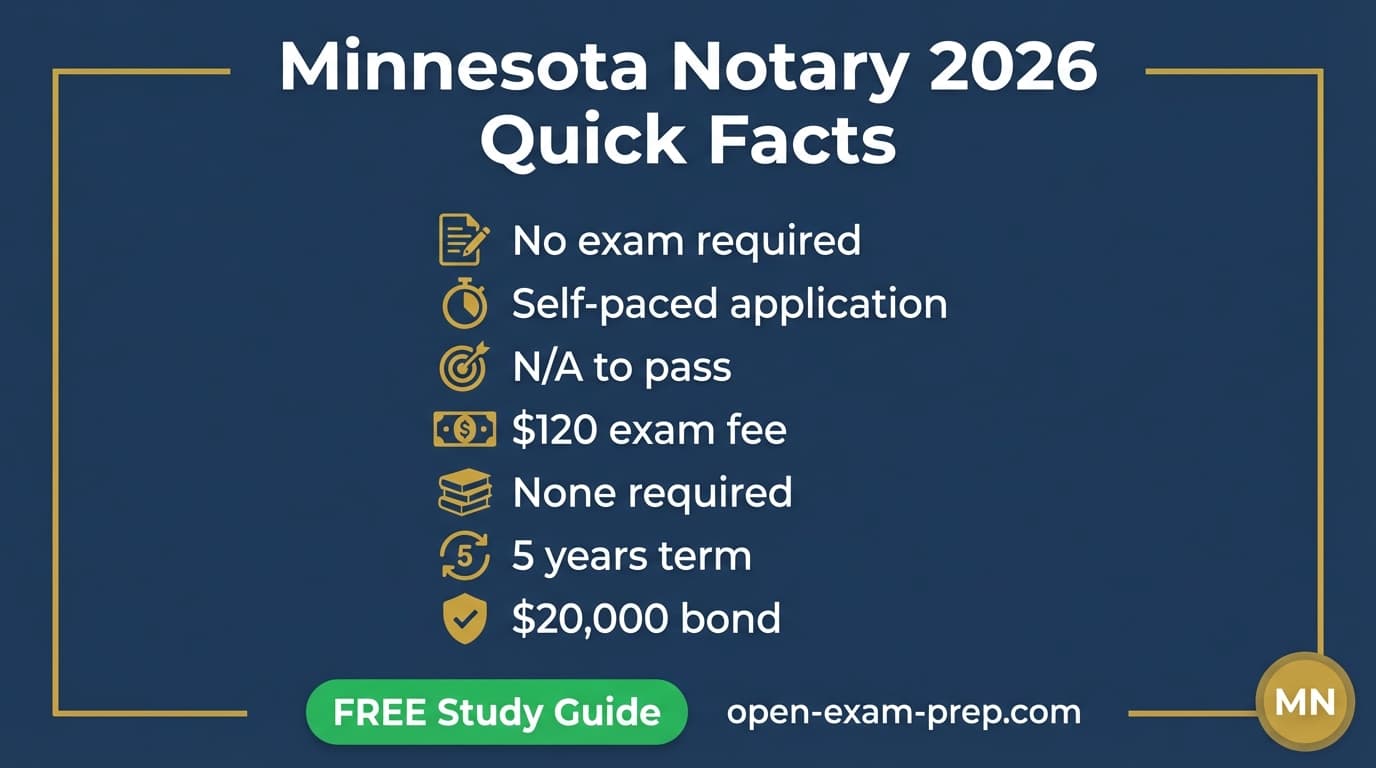
Minnesota does not require an exam to become a notary public. The state has a straightforward application process through the Minnesota Secretary of State. Minnesota adopted the Revised Uniform Law on Notarial Acts (RULONA) in 2018, modernizing notary laws and authorizing Remote Online Notarization.
Minnesota Notary Requirements at a Glance
| Requirement | Details |
|---|---|
| Minimum Age | 18 years |
| Residency | Minnesota resident OR regularly employed in Minnesota |
| Exam Required | No |
| Education Required | No (recommended to study notary laws) |
| Surety Bond | $20,000 required |
| Commission Term | 5 years |
| Application Fee | $120 (includes bond filing) |
Why Become a Minnesota Notary?
- No exam required - Simple application process
- 5-year commission - Reasonable commission term
- RON authorized - Remote Online Notarization available since 2019
- RULONA state - Modern, standardized notary laws
- Growing demand - Strong need in Twin Cities metropolitan area
- Reasonable fees - Competitive notary fee structure
Explore More Notary Resources
Looking for notary study materials or guides for other states? Check out our comprehensive resources. For additional education and supplies, visit the National Notary Association.
View All Notary Exam Prep Resources
Step-by-Step: How to Become a Minnesota Notary
Step 1: Meet Eligibility Requirements
To become a Minnesota notary public, you must:
- Be at least 18 years old
- Be a resident of Minnesota OR be regularly employed in Minnesota
- Be able to read and write English
- Not have had a notary commission revoked during the past 10 years
- Not have been convicted of a crime involving fraud, dishonesty, or deceit
Step 2: Complete a Notary Application
Apply online through the Minnesota Secretary of State:
- Visit the Minnesota Secretary of State Business Services website
- Select "Notary Public" services
- Complete the Notary Public Application
- Answer all eligibility questions truthfully
Required Information:
- Full legal name
- Social Security Number
- Date of birth
- Home address (Minnesota)
- Business/employer address (if applicable)
- Contact information
Step 3: Obtain Your Surety Bond
Minnesota requires a surety bond as part of the application:
Bond Requirements:
- Amount: $20,000
- Term: Must cover your 5-year commission
- Filing: Bond must be filed with the Secretary of State
Where to Purchase:
- Minnesota Secretary of State offers bond through the application process
- Or purchase from private surety bond companies
- Cost: Approximately $75-$150 for 5-year term
Step 4: Pay the Application Fee
- Application Fee: $120 (when using SOS bond service)
- This includes the bond filing fee
- If purchasing bond separately, fees may vary
- Payment can be made online
Step 5: Take the Oath of Office
As part of the application, you will:
- Sign the oath of office electronically
- Affirm that you will faithfully perform notary duties
- This is completed during the online application process
Step 6: Receive Your Commission
After your application is processed:
- Processing typically takes 5-10 business days
- You will receive your commission certificate via mail or email
- Your commission information is available in the online database
Step 7: Purchase Notary Supplies
After receiving your commission, purchase required supplies:
Official Notary Stamp (Required):
- Rubber ink stamp (embossers alone not acceptable)
- Must be rectangular
- Cost: $20-$50
Required Stamp Information:
- Your name exactly as commissioned
- "Notary Public"
- "Minnesota"
- Commission expiration date
Notary Journal (Required):
- Minnesota requires a chronological journal
- Must record all notarial acts
- Cost: $15-$40
Minnesota Notary Fees
| Service | Maximum Fee |
|---|---|
| Acknowledgment | $5.00 per signature |
| Jurat | $5.00 per signature |
| Certified Copy | $5.00 per document |
| Administering oath | $5.00 |
| Travel fees | Reasonable amount by agreement |
Important Notes:
- Minnesota sets maximum fees that notaries cannot exceed
- Notaries may charge less than the maximum
- Travel fees are negotiable and not subject to the $5 cap
- RON fees follow the same structure
Minnesota-Specific Requirements
Seal/Stamp Requirements
Your Minnesota notary stamp must meet specific requirements:
Format:
- Rubber ink stamp REQUIRED
- Embosser may be used as backup but cannot be sole seal
Shape:
- Must be rectangular
Required Information:
- Your exact name as commissioned
- "Notary Public"
- "Minnesota"
- Commission expiration date
Ink Color:
- Black or blue ink recommended
Journal Requirements (Mandatory)
Minnesota requires all notaries to maintain a chronological journal:
Required Journal Entries:
- Date and time of notarization
- Type of notarial act performed
- Type or title of document
- Name and address of each principal
- Evidence of identity presented
- Fee charged (if any)
Journal Format:
- Bound paper journal with numbered pages, OR
- Secure electronic journal
Retention:
- Must retain journals for at least 10 years after last entry
- Must provide journal to Secretary of State upon demand
Identification Requirements
Minnesota requires notaries to identify signers using:
- Personal knowledge, OR
- Satisfactory evidence of identity
Acceptable Forms of ID:
- Valid driver's license or state ID
- Valid passport
- Government-issued photo identification
- Credible witness identification (with specific requirements)
Remote Online Notarization (RON) in Minnesota
Minnesota authorizes Remote Online Notarization (RON) under Minnesota Statutes Chapter 358, effective August 1, 2019.
Becoming a Minnesota Remote Notary
To perform RON in Minnesota:
- Hold a valid Minnesota notary commission in good standing
- Register as a Remote Notary with the Secretary of State
- Complete RON-specific training (recommended)
- Select an approved technology platform
- Comply with all technology and security requirements
RON Registration
- Additional registration with Secretary of State required
- May need to provide additional information about technology platform
- Registration fee may apply
RON Technology Requirements
- Computer with webcam and microphone
- Stable high-speed internet connection
- Approved remote notarization platform
- Identity verification technology (knowledge-based authentication, credential analysis)
- Tamper-evident technology
- Audio-visual recording capability
RON Training Requirements
While Minnesota doesn't mandate specific training, RON notaries should understand:
- Minnesota RON laws and regulations
- Technology platform operations
- Identity verification procedures
- Electronic record-keeping
- Security and fraud prevention
Types of RON Permitted
Minnesota allows remote online notarization for:
- Acknowledgments
- Jurats
- Oaths and affirmations
- Verifications on oath or affirmation
- Most standard notarial acts
RON Recording Requirements
- Must record entire RON session (audio and video)
- Must retain recordings for at least 10 years
- Recordings must be stored securely and be retrievable
Total Cost to Become a Minnesota Notary
| Item | Cost |
|---|---|
| Application Fee (with bond) | $120 |
| Notary Stamp | $20-$50 |
| Journal | $15-$40 |
| Total Estimated | $155-$210 |
For RON (additional):
| Item | Cost |
|---|---|
| RON Registration | Varies |
| RON Training (recommended) | $50-$100 |
| Technology Platform | $20-$50/month |
| RON Additional Total | $50-$150+ first year |
Timeline: How Long Does It Take?
| Step | Estimated Time |
|---|---|
| Complete application and pay fee | 1 day |
| State processing | 5-10 business days |
| Receive commission | 3-5 days after processing |
| Order supplies | 3-5 days |
| Total | 2-3 weeks |
Renewing Your Minnesota Commission
Minnesota notary commissions are valid for 5 years.
Renewal Process:
- Apply for renewal before your commission expires
- Submit renewal application through Secretary of State
- Pay the $120 application fee
- Obtain new surety bond coverage
- Complete new oath of office
Important Notes:
- If your commission expires, you cannot notarize until renewed
- Apply 30-60 days before expiration recommended
- Update your stamp with new expiration date
Special Considerations
RULONA State
Minnesota adopted the Revised Uniform Law on Notarial Acts (RULONA):
- Provides standardized notary practices
- Clear guidance on acceptable notarial acts
- Modernized framework for electronic notarization
Journal Surrender
Minnesota notaries must surrender their journal:
- Upon resignation from commission
- Upon revocation of commission
- Upon request by Secretary of State
- Within 30 days of commission expiration if not renewed
Non-Attorney Applicants
Minnesota allows non-attorneys to become notaries:
- Same requirements as other applicants
- Cannot provide legal advice
- Cannot prepare legal documents (unless separately qualified)
Name or Address Changes
If your information changes during your commission:
- Notify the Secretary of State within 30 days
- Submit a change notification form
- May need to obtain new seal with updated information
Commission Verification
Your commission can be verified:
- Through the Secretary of State online database
- Commission number and expiration date are public record
- Useful for document recipients to verify your authority
Start Your Minnesota Notary Career Today
Minnesota offers a straightforward path to becoming a notary public with no exam requirement. As a RULONA state, Minnesota provides clear, modern guidance for notary practices. With RON authorized since 2019, Minnesota notaries have expanded opportunities to serve clients both in-person and remotely throughout the state and beyond.

 Free CE
 Buy on Amazon
 Notary training on Notary.net
 Take courses on Udemy