Keeping Buildings Running --- and People Safe
Every hospital, office tower, factory, power plant, school, and apartment complex depends on boiler systems for heating, hot water, and industrial processes. The stationary engineer or boiler operator is the licensed professional who keeps these critical systems running safely. A boiler failure is not an inconvenience --- it is a catastrophe. Boiler explosions have killed hundreds of workers throughout history, which is precisely why states require licensed operators and rigorous examinations.
According to the Bureau of Labor Statistics, the median annual wage for stationary engineers and boiler operators was $75,190 in May 2024. The lowest 10% earned less than $47,310, while the highest 10% earned more than $121,200. This is a solidly middle-class to upper-middle-class career that does not require a four-year college degree --- most operators enter through on-the-job training, apprenticeships, or technical programs.
Employment is steady. The BLS reports that employment of stationary engineers and boiler operators is projected to grow 2% from 2024 to 2034, with approximately 3,800 annual openings projected over the decade. While growth is slower than average, the openings are driven by retirements --- the workforce is aging, creating reliable replacement demand for newly licensed operators. The profession offers strong job security because buildings always need heat, and boilers always need trained operators.
There is no single national boiler operator license --- licensing is set state by state, and in many places city by city. A dozen-plus states and jurisdictions license boiler operators or stationary engineers by examination, with tests covering boiler types and components, combustion, safety devices, water treatment, ASME codes, pressure vessel operation, and state-specific regulations. The picture is uneven: some states (such as New York) license only at the city level --- the NYC Department of Buildings, not the state --- a few (such as Alaska) issue a voluntary certificate rather than a mandate, and many states have no operator license at all and defer to employers, insurers, or local ordinances. This guide covers the 16 jurisdictions where OpenExamPrep offers free practice tests, plus the exam format, detailed content breakdowns, 10 sample questions with answers, a study plan, and a comparison of free vs. paid resources.
Start Your FREE Boiler Operator Practice Test
Select your state below and start practicing with free questions tailored to your state's boiler operation laws and regulations.
No signup. No credit card. Instant access to 1,600+ questions.
Boiler Operator Exam Format at a Glance
| Feature | Detail |
|---|---|
| Full name | Boiler Operator / Stationary Engineer License Examination (title and class vary by state) |
| Prerequisite | Age 18+, on-the-job experience (typically 1-4 years depending on license class), technical training |
| Administered by | State boiler divisions, labor departments, or third-party testing providers |
| Format | Written or computer-based, multiple-choice, closed-book (some states allow open-book code references) |
| Questions | 50-100 questions depending on state and license class |
| Time limit | 2-4 hours depending on state and license class |
| Passing score | 70% in most states |
| Cost | $25-$100 exam fee (varies by state and license class) |
| Required for | Operating high-pressure or low-pressure boilers and pressure vessels |
| License classes | Most states have multiple classes (1st through 4th class, or similar tiers) based on boiler size and pressure |
Key point: Most states have a tiered licensing system. Higher license classes authorize you to operate larger, higher-pressure boiler systems and typically require more experience and a more difficult exam. Start with the lowest class and work your way up as you gain experience.
Free Boiler Operator Practice Tests by State
Select your jurisdiction below. The "Licenses & classes" column reflects current regulator structures verified for 2026 --- note that Alaska's certificate is voluntary, New York's license is issued by New York City (not the state), and Iowa licenses boiler inspectors rather than operators at the state level.
| State / jurisdiction | Practice Test | Regulatory Authority (2026) | Licenses & classes |
|---|---|---|---|
| Alaska | AK Boiler Operator Practice | AK Dept. of Labor & Workforce Development, Mechanical Inspection | Boiler Operator certificate (Class 1-4) --- voluntary, issued only when an employer requires it |
| Arkansas | AR Boiler Operator Practice | AR Dept. of Labor & Licensing, Boiler Inspection Division | Boiler Operator license (low- and high-pressure), written exam |
| Connecticut | CT Boiler Operator Practice | CT Dept. of Consumer Protection | Operating Stationary Engineer (OE-2) license, exam-based |
| District of Columbia | DC Boiler Operator Practice | DC Dept. of Licensing & Consumer Protection (DLCP), Board of Industrial Trades | Steam & Operating Engineer licenses |
| Iowa | IA Boiler Operator Practice | Iowa DIAL, Boiler & Pressure Vessel Program | Commissions boiler inspectors; operator rules left to municipalities (no statewide operator license) |
| Massachusetts | MA Boiler Operator Practice | MA Dept. of Fire Services, Boiler & Pressure Vessel Program | Engineer license (1st-4th class) plus 1st/2nd Class Fireman |
| Maryland | MD Boiler Operator Practice | MD Dept. of Labor, Board of Stationary Engineers | Stationary Engineer license, Grades 1-5, state exam (70% pass) |
| Maine | ME Boiler Operator Practice | ME Office of Professional & Occupational Regulation, Board of Boilers & Pressure Vessels | Stationary Steam Engineer license, 1st-4th class |
| Michigan | MI Boiler Operator Practice | MI LARA, Bureau of Construction Codes (Boiler Division) | Boiler Operator (low/high pressure) + Stationary Engineer, PSI exam |
| Minnesota | MN Boiler Operator Practice | MN Dept. of Labor & Industry | Boiler/Special Engineer license, multiple classes (Special to Chief) |
| Montana | MT Boiler Operator Practice | MT Dept. of Labor & Industry, Boiler Operator Program | Boiler (Operating) Engineer license, multiple classes |
| New Jersey | NJ Boiler Operator Practice | NJ Dept. of Labor & Workforce Development, Bureau of Boiler & Pressure Vessels | Black Seal (operator) plus Gold/Red/Blue Seal engineer grades |
| New Mexico | NM Boiler Operator Practice | NM Regulation & Licensing Dept., Construction Industries Division | Boiler Operator certificate of competency (e.g., BO1), exam (~$65) |
| New York | NY Boiler Operator Practice | New York City Dept. of Buildings (no statewide license) | High-Pressure Boiler Operating Engineer license (NYC; Buffalo etc. separate) |
| Ohio | OH Boiler Operator Practice | OH Dept. of Commerce, Division of Industrial Compliance | Stationary (Steam) Engineer license; Low/High-Pressure Operator classes |
| Oklahoma | OK Boiler Operator Practice | OK Dept. of Labor, Boiler & Pressure Vessel Safety | Boiler Operator license / certificate of competency, exam-based |
Not on the list? States such as Washington, Pennsylvania, and Illinois license operators only in major cities (Seattle/Tacoma, Philadelphia/Pittsburgh, Chicago), and Oregon licenses through its Building Codes Division. If your state is not shown, confirm requirements with your city or your state labor/boiler division before scheduling an exam.
Exam Content Breakdown: What the Boiler Operator Exam Tests
Domain 1: Boiler Types, Components, and Construction (20-25% of most exams)
This domain tests your knowledge of the physical systems you will operate.
-
Fire-tube vs. water-tube boilers --- In a fire-tube boiler, hot combustion gases pass through tubes surrounded by water (e.g., Scotch marine boiler). In a water-tube boiler, water flows through tubes surrounded by hot gases (e.g., Babcock & Wilcox). Water-tube boilers operate at higher pressures and are more common in large industrial and power generation applications. Know the design differences, advantages, and limitations of each type.
-
High-pressure vs. low-pressure boilers --- The ASME Boiler and Pressure Vessel Code defines a high-pressure boiler as one operating above 15 psi steam pressure or 160 psi / 250 degrees F water temperature. Low-pressure boilers operate at or below these thresholds. License classes are typically tied to boiler pressure and size. Know the ASME pressure classifications and which license class authorizes which equipment.
-
Key boiler components --- The steam drum, mud drum, tubes (generating, superheater, economizer), headers, water walls, refractory, insulation, casing, and setting. Know the function of each component and how they work together to generate steam.
-
Boiler fittings and accessories --- Safety valves, water gauge glasses, pressure gauges, blowdown valves, feedwater regulators, steam traps, check valves, and stop valves. Know the required fittings specified by the ASME code and the function of each.
-
Pressure vessels and unfired vessels --- In addition to boilers, stationary engineers may operate pressure vessels (compressed air tanks, heat exchangers, deaerators, expansion tanks) and other unfired pressure vessels. Know the ASME classifications and operating parameters.
Domain 2: Combustion and Fuel Systems (15-20% of most exams)
-
Combustion fundamentals --- Combustion requires fuel, oxygen, and heat (the fire triangle). Complete combustion produces CO2 and H2O. Incomplete combustion produces CO (carbon monoxide) --- toxic and dangerous. Know the chemistry of combustion and the conditions required for efficient, safe burning.
-
Fuel types --- Natural gas, fuel oil (grades No. 1 lightest through No. 6 heaviest --- No. 6 must be preheated to flow), coal, biomass, and waste fuels. Know the properties of each fuel: heat value (BTU content), handling requirements, storage, and combustion characteristics. Natural gas is the most common boiler fuel in the U.S. due to availability and clean burning. Higher-class exams often test fuel-oil viscosity, atomization, and heater settings.
-
Burner types and operation --- Atmospheric burners, power burners, combination gas/oil burners, and pulverized coal burners. Know the components (nozzle, electrode, scanner, damper, air-fuel ratio controller) and the proper startup, operation, and shutdown sequences.
-
Draft systems --- Natural draft (stack effect), forced draft (fan pushes air into firebox), induced draft (fan pulls gases through), and balanced draft. Know how draft affects combustion efficiency and flame stability.
-
Combustion efficiency and emissions --- Flue gas analysis (O2, CO2, CO levels), stack temperature, and excess air calculation. Know how to optimize combustion for efficiency while minimizing emissions (NOx, SOx, particulates). Environmental regulations (EPA, state agencies) set emission limits that operators must meet.
Domain 3: Water Treatment and Chemistry (15-20% of most exams)
-
Why water treatment matters --- Untreated water causes scale buildup (reducing heat transfer and efficiency), corrosion (weakening metal, causing leaks and failures), and carryover (water droplets in steam damaging turbines and equipment). Proper water treatment is essential for safe, efficient boiler operation.
-
Feedwater treatment --- Softening (removing calcium and magnesium), deaeration (removing dissolved oxygen), chemical treatment (oxygen scavengers, phosphates, polymers), and pH control (maintaining alkalinity). Know the treatment methods and their purposes.
-
Blowdown procedures --- Surface blowdown removes dissolved solids from the water surface. Bottom blowdown removes sludge and sediment from the mud drum. Know when to blow down, how much water to remove, and the safety precautions (never blow down on low water).
-
Testing and monitoring --- Conductivity, pH, alkalinity, hardness, dissolved oxygen, and sulfite/phosphate levels. Know the target ranges for each parameter and how to test them. Water testing frequency depends on boiler pressure and size.
-
Condensate return --- Returning condensate to the boiler saves energy and treated water. Know the condensate system components (steam traps, receivers, pumps) and common problems (flash steam, contamination, corrosion).
Domain 4: Safety Devices and Emergency Procedures (20-25% of most exams)
This is the most critical domain --- your primary job is to operate boilers safely.
-
Safety valves --- The safety valve is the most important boiler safety device. It opens automatically when pressure exceeds the set point, preventing catastrophic overpressure. Know the types (pop safety, modulating), set pressures, testing frequency, and maintenance requirements. ASME requires every boiler to have at least one safety valve.
-
Low-water fuel cutoff --- This device shuts off fuel to the burner when the water level drops below a safe minimum. Low water is the number one cause of boiler explosions because exposed heating surfaces overheat and fail. Know the types (float, probe), testing procedures (daily blowdown test), and maintenance requirements.
-
Flame safety controls --- The flame safeguard system monitors the burner flame and shuts off fuel if flame failure is detected, preventing unburned fuel accumulation that could cause an explosion. Know the components (flame scanner, programmer, fuel valves) and the safety shutdown sequence.
-
Operating controls vs. limit controls --- Operating controls maintain normal conditions (pressuretrol, aquastat, modulating controls). Limit controls activate when conditions exceed safe parameters (high-pressure limit, high-temperature limit, low-water cutoff). Limit controls override operating controls and shut down the boiler.
-
Emergency procedures --- Know what to do during low water, overpressure, flame failure, fuel leak, tube failure, and power failure. The correct response varies by emergency, but the general principle is: protect human life first, then protect equipment.
-
Boiler inspections --- ASME and the National Board of Boiler and Pressure Vessel Inspectors require periodic inspections (internal and external). Know the inspection schedule, who can perform inspections (commissioned inspectors), and common deficiencies that fail inspection.
Domain 5: ASME Codes, Regulations, and Professional Standards (10-15% of most exams)
-
ASME Boiler and Pressure Vessel Code (BPVC) --- The ASME code establishes design, construction, inspection, and testing standards for boilers and pressure vessels. Sections I (Power Boilers), IV (Heating Boilers), and VI (Recommended Rules for the Care and Operation of Heating Boilers) are most relevant to operators.
-
National Board and jurisdictional requirements --- The National Board of Boiler and Pressure Vessel Inspectors sets standards for in-service inspection. Individual states adopt and enforce these standards through their boiler inspection programs.
-
State-specific regulations --- Each state has its own boiler law specifying licensing requirements, inspection schedules, operating standards, and penalties for violations. Know your state's specific statutes.
-
Operator responsibilities and record-keeping --- Maintain the boiler logbook (pressure readings, water tests, maintenance performed, inspections). Document all safety device tests. Report any incidents to the proper authority.
-
Electrical and steam-theory basics --- Higher-class exams (and the WA, MA, and NJ-style tests) often add motor controls, single- vs three-phase power, transformer/delta voltages, steam tables, and the difference between sensible heat, latent heat, and total heat. Do not overlook these supporting topics.
Boiler Operator License Classes Explained
Most licensing jurisdictions use a tiered class system. The exact names differ by state, but the structure is consistent: lower classes operate smaller, lower-pressure equipment, and each higher class authorizes larger systems and requires more documented experience.
| Tier (typical) | Common names | Authorizes | Typical experience |
|---|---|---|---|
| Entry / lowest | Fireman, Special, 4th or 5th Class, Low-Pressure Operator | Low-pressure heating boilers (15 psi steam or less) | A few hundred to ~1,000 hours, or a training course |
| Mid | 3rd / 2nd Class, High-Pressure Operator, Blue/Red Seal (NJ) | High-pressure boilers up to a defined size or horsepower | 1-2 years under a licensed operator |
| Highest | 1st Class / Chief Engineer, Gold Seal (NJ), Grade 1 (MD) | Any boiler size, supervisory authority over a plant | 3+ years and a comprehensive exam |
How to use this: start with the lowest class your employer or facility requires, pass it, then bank the experience hours needed to step up. Verify the exact class names, horsepower limits, and experience hours with your own jurisdiction --- they are set by state or city law, not nationally.
10 Boiler Operator Sample Questions with Answers
Question 1
What is the most common cause of boiler explosions?
- A) Overfiring the burner
- B) Low water condition
- C) Excessive scale buildup
- D) Fuel leak
Answer: B --- Low water is the number one cause of boiler explosions. When the water level drops below the top of the heating surfaces, those surfaces overheat rapidly because they are no longer cooled by water contact. The overheated metal weakens and can rupture under pressure, causing a catastrophic explosion. This is why the low-water fuel cutoff is one of the most important safety devices on any boiler and must be tested regularly.
Question 2
Under the ASME code, a high-pressure steam boiler operates at pressures exceeding:
- A) 5 psi
- B) 15 psi
- C) 30 psi
- D) 150 psi
Answer: B --- The ASME Boiler and Pressure Vessel Code defines a high-pressure steam boiler as one operating above 15 psi steam pressure. A low-pressure steam boiler operates at or below 15 psi. For hot water boilers, the threshold is 160 psi or 250 degrees Fahrenheit. These classifications determine which ASME code section applies and which license class is required to operate the equipment.
Question 3
You arrive for your shift and notice the water level in the gauge glass is below the visible range. What should you do FIRST?
- A) Immediately add feedwater to raise the level
- B) Shut down the boiler following emergency low-water procedures
- C) Blow down the gauge glass to verify the reading
- D) Increase the firing rate to generate more steam and raise pressure
Answer: B --- If the water level is not visible in the gauge glass, you must assume a dangerously low water condition and shut down the boiler immediately. Do NOT add feedwater to a hot, dry boiler --- introducing cold water to overheated metal can cause thermal shock and catastrophic failure. Shut off fuel, close the steam stop valve, and allow the boiler to cool before investigating. This is the correct emergency response for a low-water condition.
Question 4
What is the primary function of a safety valve on a boiler?
- A) To regulate normal operating pressure
- B) To prevent pressure from exceeding the maximum allowable working pressure (MAWP) by automatically releasing steam
- C) To drain condensate from steam lines
- D) To control the feedwater flow rate
Answer: B --- The safety valve is the last line of defense against catastrophic overpressure. It is set to open automatically when pressure exceeds the maximum allowable working pressure (MAWP) of the boiler, releasing steam to prevent the pressure from rising to dangerous levels. Safety valves must never be adjusted, blocked, gagged, or tampered with. ASME requires every boiler to have at least one safety valve, and it must be tested regularly.
Question 5
In a fire-tube boiler, the hot combustion gases pass through:
- A) The water space surrounding the tubes
- B) The tubes, which are surrounded by water
- C) The superheater section only
- D) The economizer
Answer: B --- In a fire-tube boiler, hot combustion gases flow through the inside of the tubes, and water surrounds the outside of the tubes. Heat transfers from the gases through the tube walls into the water. Fire-tube boilers are common in lower-pressure applications (up to about 250 psi) and smaller facilities. Water-tube boilers are the opposite: water flows inside the tubes and hot gases surround the outside.
Question 6
What is the purpose of blowdown on a boiler?
- A) To increase steam pressure
- B) To remove dissolved solids, sludge, and sediment that accumulate in the boiler water
- C) To test the safety valve
- D) To increase the firing rate
Answer: B --- Blowdown removes concentrated dissolved solids from the boiler water (surface blowdown) and sludge/sediment from the bottom of the boiler (bottom blowdown). As water evaporates into steam, dissolved minerals remain behind and concentrate in the boiler water. Without regular blowdown, these minerals cause scale buildup (reducing efficiency and heat transfer) and can cause carryover (water in the steam). Blowdown also allows you to test the low-water fuel cutoff.
Question 7
Incomplete combustion in a boiler produces which dangerous gas?
- A) Carbon dioxide (CO2)
- B) Carbon monoxide (CO)
- C) Nitrogen (N2)
- D) Oxygen (O2)
Answer: B --- Incomplete combustion occurs when there is insufficient oxygen, improper air-fuel mixing, or the flame temperature is too low. The result is carbon monoxide (CO) --- a colorless, odorless, toxic gas. CO is dangerous to personnel and also represents wasted fuel (energy that was not fully released). Proper combustion produces CO2 and water vapor. Flue gas analysis should show minimal CO levels. Any significant CO in the flue gas indicates a combustion problem that must be corrected.
Question 8
The low-water fuel cutoff should be tested by:
- A) Removing it from the boiler annually
- B) Blowing down the float chamber daily to verify it shuts off the burner
- C) Visually inspecting it monthly
- D) It is a sealed device that requires no testing
Answer: B --- The low-water fuel cutoff must be tested regularly --- most manufacturers and codes recommend daily testing during the heating season. The standard test procedure is to open the blowdown valve on the float chamber, which lowers the water level inside the device. The cutoff should shut off the burner before the water level drops to a dangerous point. If the burner does not shut off, the device is malfunctioning and the boiler must be taken out of service until the cutoff is repaired.
Question 9
What causes scale formation inside a boiler?
- A) Excess dissolved oxygen in the feedwater
- B) Minerals (primarily calcium and magnesium) in hard water that precipitate out and deposit on heating surfaces
- C) Too much chemical treatment
- D) Operating at low pressure
Answer: B --- Scale is caused by hard water minerals --- primarily calcium carbonate and magnesium silicate --- that precipitate out of solution as water is heated and deposit on boiler tubes and heating surfaces. Scale acts as an insulator, reducing heat transfer efficiency and causing localized overheating that can weaken tube metal and lead to failure. Preventing scale requires proper feedwater treatment (softening) and regular blowdown to control dissolved solids.
Question 10
A flame scanner detects flame failure during boiler operation. What should the flame safeguard system do?
- A) Attempt to relight the burner immediately
- B) Sound an alarm but continue fuel flow
- C) Shut off fuel to the burner immediately to prevent unburned fuel accumulation
- D) Increase the draft to reignite the flame
Answer: C --- When the flame scanner detects flame failure (loss of flame), the flame safeguard system must immediately shut off fuel supply to the burner. If unburned fuel continues to flow into a hot firebox without a flame, the fuel can accumulate and ignite explosively when exposed to a heat source --- a "furnace explosion" or "delayed ignition." The system enters a safety lockout condition. The operator must investigate the cause, purge the firebox of unburned fuel, and manually restart following proper light-off procedures.
Study Plan: How to Pass the Boiler Operator Exam
Week 1-2: Foundation --- Boiler Types, Components, and Safety Devices
- Study the differences between fire-tube and water-tube boilers
- Learn ASME pressure classifications: high-pressure vs. low-pressure thresholds
- Master key boiler fittings: safety valves, gauge glasses, blowdown valves, check valves, stop valves
- Study the low-water fuel cutoff --- testing, maintenance, and emergency procedures
- Learn flame safeguard system operation and safety shutdown sequence
- Take 20 practice questions daily on OpenExamPrep
Week 3-4: Deep Dive --- Combustion, Water Treatment, and Operations
- Study combustion fundamentals: fire triangle, complete vs. incomplete combustion, CO vs. CO2
- Learn fuel types: natural gas, fuel oil, coal --- properties, handling, BTU values
- Master water treatment: softening, deaeration, chemical treatment, blowdown procedures
- Study condensate return systems and steam traps
- Learn flue gas analysis: O2, CO2, CO levels and their significance
- Increase to 35 practice questions daily
Week 5-6: Practice Exams and Final Review
- Take 2-3 full-length practice exams simulating actual test conditions
- Review every missed question and trace it to the specific ASME code section or state regulation
- Focus on safety devices and emergency procedures --- the most heavily tested and most critical topics
- Re-study low-water fuel cutoff, safety valves, and flame failure response
- Review water treatment chemistry and boiler inspection requirements
- Schedule your exam for the end of Week 6
Free vs. Paid Boiler Operator Exam Prep Resources
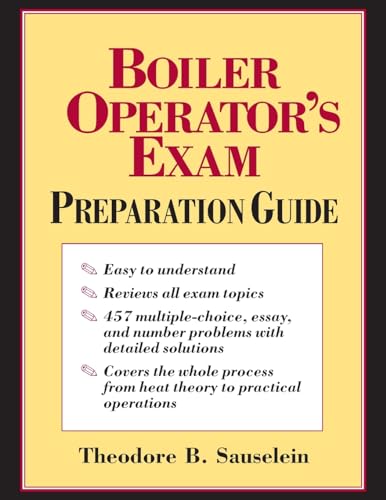
| Feature | OpenExamPrep (FREE) | Boiler Operator's Exam Prep Guide ($40-$65) | NAPE/IUOE Training ($500-$2,000) | State-Sponsored Programs (varies) |
|---|---|---|---|---|
| Price | $0 | $40-65 | $500-2,000 | $0-500 |
| Question count | 1,600+ | 200-400 | Varies | Varies |
| State-specific | 16 jurisdictions | General | Union-specific | Yes |
| AI tutor | Yes, built-in | No | No | No |
| Explanations | Detailed for every Q | Yes | Instructor-led | Varies |
| Updated for 2026 | Yes | Varies | Yes | Yes |
| Signup required | No | No (book purchase) | Yes (union membership) | Varies |
| Hands-on training | No (written exam only) | No | Yes | Yes |
Note: Boiler operation is a hands-on profession. Written exam prep (like OpenExamPrep) complements but does not replace the operational experience required for licensure. Many states require documented hours of on-the-job experience before you can sit for the exam.
Career Outlook and Salary
Boiler operation offers stable, well-paying careers with clear advancement paths:
| License Level | Typical Salary | Equipment Authorized |
|---|---|---|
| Low-pressure operator (entry-level) | $47,000-$60,000 | Heating boilers up to 15 psi steam |
| High-pressure operator | $55,000-$80,000 | Power boilers above 15 psi |
| Chief engineer / 1st class | $75,000-$100,000 | All boiler sizes, supervisory authority |
| Facility/plant manager | $85,000-$121,000+ | Full facility operations management |
| HVAC/building engineer | $55,000-$85,000 | Boilers, chillers, HVAC systems |
The BLS median wage of $75,190 places boiler operators well above the national median for all occupations ($49,500 in May 2024). The top 10% earn over $121,200 --- achievable with a first-class license and experience in large industrial or municipal facilities. The top-paying sector is local government, where stationary engineers earn a median of about $103,880; hospitals pay around $78,540. Other key employers include schools and municipal buildings, manufacturing, commercial real estate, and power generation.
Job security is strong. While the BLS projects modest 2% growth from 2024 to 2034, the 3,800 annual openings are driven largely by retirements in an aging workforce. Many facilities report difficulty finding qualified, licensed operators --- a shortage that benefits job seekers with current licenses.
 Buy on Amazon