California Bar Exam Overview
The California Bar Exam is a 2-day, in-person licensing exam administered twice a year (February and July) by the State Bar of California. It is widely regarded as one of the most difficult bar exams in the United States, and the pass numbers bear that out: the February 2026 administration had a 30.8% overall pass rate, while the July 2025 administration came in at 54.8% overall (69.7% for first-time takers). California has not adopted the Uniform Bar Examination (UBE) — it writes its own essays and Performance Test and uses the NCBE Multistate Bar Examination (MBE) for the multiple-choice section.
The July 2026 California Bar Exam is scheduled for Tuesday, July 28 and Wednesday, July 29, 2026, with results released November 6, 2026.
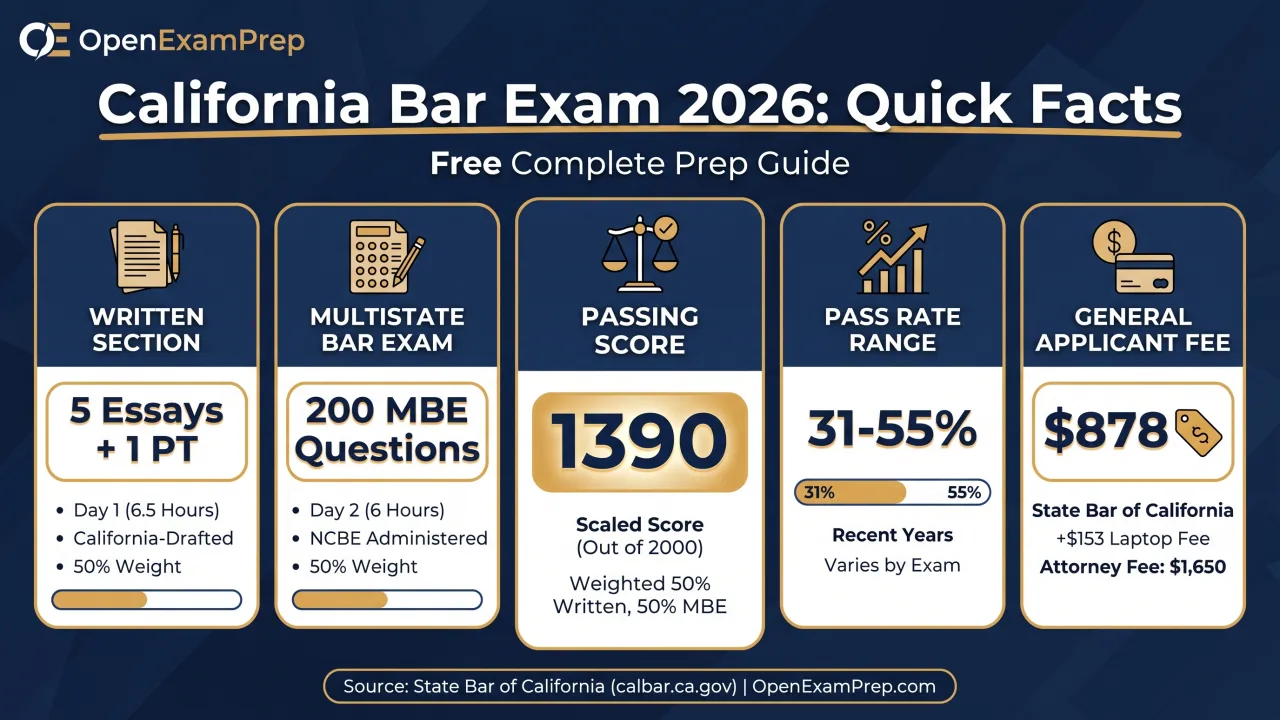
Exam Format At A Glance
| Component | Details |
|---|---|
| Duration | 2 days, in person |
| Day 1 - Written | 5 one-hour essays + 1 90-minute Performance Test |
| Day 1 sessions | Morning: 3 essays (3 hours); Afternoon: 2 essays + PT (3.5 hours) |
| Day 2 - MBE | 200 multiple-choice questions (NCBE MBE) |
| Day 2 sessions | Morning: 100 questions (3 hours); Afternoon: 100 questions (3 hours) |
| Passing score | 1390 / 2000 scaled |
| Weighting | 50% MBE, 50% written |
| Exam fee | $878 (general applicant); $1,650 (attorney applicant) + $153 laptop fee |
| Offered | February and July |
| UBE status | Not a UBE state |
Start FREE California Bar Exam Prep
Day 1: Essays And Performance Test
Day 1 is the written section, delivered on personal laptops through ExamSoft's Examplify software (handwriting is also permitted). It has two sessions.
Morning session (3 hours): Essays 1, 2, and 3. You manage your own pacing across the three essays.
Afternoon session (3.5 hours): Essays 4 and 5, plus one 90-minute Performance Test (PT). You allocate time within the session — most candidates write the two essays first (roughly 1 hour each) and reserve 90 minutes for the PT, but the order is up to you. Day 1 typically ends around 5:30 p.m.
The Five Essays
Each essay is designed to take about one hour. Essay fact patterns are complex and often cross subjects (for example, Contracts combined with Remedies, or Evidence combined with Constitutional Law). Graders expect:
- IRAC structure — Issue, Rule, Application, Conclusion for each issue
- Thorough issue-spotting — graders reward identifying all issues, even sub-issues
- California distinctions — when California law differs from the majority or MBE rule, state both and apply California's
- A conclusion — commit to an answer even when uncertain
Written responses are graded on a 40-100 scale, then statistically scaled.
The Performance Test
The Performance Test is a 90-minute closed-library assignment that mimics a realistic lawyering task. You receive a "file" (facts, documents, transcripts) and a "library" (cases, statutes, rules) and must complete a task — typically drafting a memo, brief, client letter, or opinion. The PT tests reading comprehension of legal authorities, issue identification, application of law to the file's facts, and professional writing organization.
The PT is weighted as 200 raw points (equivalent to two essays) within the written section. Many candidates underprepare for the PT because it feels "easy," but it is a major slice of Day 1 and worth practicing weekly from week three of bar prep.
Day 1 Time Management
| Session | Time | Components |
|---|---|---|
| Morning | 3 hours | Essays 1, 2, 3 (~1 hour each) |
| Afternoon | 3.5 hours | Essays 4, 5 (~1 hour each) + PT (90 min) |
A practical pacing rule: spend the first 5 minutes of each essay outlining issues before writing. For the PT, spend 15-20 minutes reading and organizing before drafting.
Free Practice Questions
Day 2: MBE (200 Questions)
Day 2 is the NCBE Multistate Bar Examination (MBE) — 200 multiple-choice questions in two 3-hour sessions of 100 questions each. Answers are marked on Scantron sheets with No. 2 pencils (not on the laptop). You cannot return to the first 100 questions during the afternoon session.
MBE Subjects (7)
The MBE tests seven foundational areas:
- Civil Procedure — Federal Rules of Civil Procedure, jurisdiction, pleading, discovery
- Constitutional Law — Individual rights, separation of powers, federalism
- Contracts — Formation, performance, breach, remedies, UCC Article 2
- Criminal Law & Procedure — Substantive crimes, defenses, Fourth/Fifth/Sixth Amendment
- Evidence — Relevance, hearsay, privileges, authentication, Federal Rules of Evidence
- Real Property — Estates, future interests, landlord-tenant, mortgages
- Torts — Intentional torts, negligence, strict liability, products liability
MBE Strategy
- Answer every question — there is no penalty for guessing
- Read the call of the question first — know what you are being asked before reading the fact pattern
- Eliminate two distractors quickly — most items have two clearly wrong answers
- Pick the "best" answer — several options may be partially correct; choose the most complete and accurate
- Pace at 1.8 minutes per question — flag items that run long and return if time allows
- Do not change answers blindly — only switch if you find a reasoning error
The MBE is the single most reliable predictor of passing. Target 65% or higher raw accuracy on timed practice sets before exam day.
Subjects Tested On California Essays
The written section may test any of 13 subjects — the seven MBE subjects plus six California-relevant areas:
- Business Associations
- Civil Procedure
- Community Property
- Constitutional Law
- Contracts
- Criminal Law and Procedure
- Evidence
- Professional Responsibility
- Real Property
- Remedies
- Torts
- Trusts
- Wills and Succession
California-Specific Emphasis
Several subjects deserve special attention because California law diverges from the majority rule tested on the MBE:
- Community Property — California is a community property state. Essays test characterization (separate vs. community), transmutation, commingling and tracing, division on divorce, and disposition at death. This subject appears frequently and is a California favorite.
- Professional Responsibility — Tests both the ABA Model Rules and the California Rules of Professional Conduct. Appears on almost every administration, often embedded inside another essay. Also tested separately via the MPRE.
- California Evidence — Distinctions from the Federal Rules of Evidence, including privileges, the secondary evidence rule, and expert testimony standards.
- California Civil Procedure — State court procedures and differences from federal rules.
- Wills & Trusts — California Probate Code, intestate succession, trust administration.
- Business Associations — Corporations, partnerships, and LLCs under California law.
- Remedies — Legal and equitable remedies; often combined with Contracts or Torts.
Scoring And The 1390 Passing Score
The total scaled score is calculated as:
Total = (MBE scaled score x 0.50) + (Written scaled score x 0.50)
- Passing score: 1390 out of 2000 scaled points (equivalent to 139 on a 200-point scale)
- Lowered from 1440 in October 2020
- Written section raw maximum: 700 points (5 essays x 100 points + 1 PT x 200 points)
- Second-read band: If your first-read total falls between 1350 and 1390, your answers get a second reading by different graders. A score of 1390 or higher after the second read passes; below 1390 fails. Scores of 1390 or higher on the first read pass; scores below 1350 on the first read fail without a second read.
The 50/50 weighting means a strong MBE can offset a weaker written performance (and vice versa), but you must clear 1390 on the combined scale.
Pass Rates: What The Numbers Actually Say
California's overall pass rate swings significantly between February and July administrations because February sittings have a much higher share of repeat takers, who pass at lower rates.
| Administration | Overall | First-Time Takers | Repeat Takers |
|---|---|---|---|
| February 2026 | 30.8% | 43.9% | 23.1% |
| July 2025 | 54.8% | 69.7% | 12.4% |
| July 2024 | 53.8% | ~66% | ~24% |
| February 2024 | ~35% | ~45% | lower |
First-time takers consistently pass at far higher rates than repeaters — in July 2025, 69.7% vs. 12.4%. This is the most important takeaway for a first-time candidate: the exam is very passable on the first attempt with serious preparation, while repeating is statistically much harder.
The February 2025 Anomaly
The February 2025 administration had an unusual 63.6% overall pass rate. That sitting used Kaplan-developed multiple-choice questions and remote delivery, which suffered major technology failures. The California Supreme Court intervened, set a one-time raw passing score of 534 for that administration only, and ordered the State Bar to return to the NCBE MBE and in-person testing starting July 2025. The 1390 scaled passing score was restored from July 2025 onward. If you see the February 2025 number cited as evidence the exam is getting easier, that reading is incorrect — it was a remedial response to a failed administration.
Fees And Deadlines (July 2026)
Exam Application Fees
| Fee | Amount |
|---|---|
| General (non-attorney) applicant | $878 |
| Attorney applicant | $1,650 |
| Laptop fee | $153 |
| First late filing window | +$50 |
| Final late filing window | +$250 |
A one-time fee waiver is available through July 2026 for applicants who withdrew before or were unsuccessful on the February 2025 exam.
July 2026 Filing Deadlines
| Date | Detail |
|---|---|
| March 1, 2026 | Application opens |
| April 1, 2026 | Timely filing deadline |
| April 2 - April 30 | $50 late filing window |
| May 1 - June 1 | $250 late filing window (final) |
| June 1, 2026 | Final filing deadline |
| June 30, 2026 | ExamSoft registration opens; admittance tickets available |
| July 24, 2026 | Mandatory mock exam deadline |
| July 28-29, 2026 | Exam |
| November 6, 2026 | Results released |
Other Admission Costs
Beyond the exam fee, expect separate charges for registration with the State Bar, the moral character determination, and a Supreme Court enrollment fee at admission. Budget for the full admission pipeline, not just the exam application.
MPRE Requirement
California requires a separate Multistate Professional Responsibility Examination (MPRE) score of 86 or higher — among the higher minimums in the U.S.
| Component | Details |
|---|---|
| Passing score | 86 (scaled) |
| Questions | 60 multiple-choice (50 scored) |
| Time | 2 hours |
| Offered | 3 times per year (March, August, November) |
| Expiry | No time limit — the score does not expire |
Designate California to receive your score on your NCBE MPRE application, and add your NCBE number to your State Bar account so the result is matched to your file.
Moral Character Determination
Before you can be admitted, you must receive a positive moral character determination from the State Bar. Key points:
- Processing time: typically 6-8 months (longer if there are issues)
- Validity: a positive determination is valid for 36 months
- Apply early: submit no later than the start of your last year of law school
- Duty to update: report any changes (criminal, financial, disciplinary) within 30 days
- Definition: honesty, fairness, candor, trustworthiness, respect for the law and judicial process
Do not leave this until after you pass the exam — the determination can take longer than the bar exam cycle itself.
The 2028 NextGen UBE Transition
California is not a UBE state today, but that is likely to change. In April-May 2026, the Committee of Bar Examiners and the Board of Trustees recommended adopting NCBE's NextGen Uniform Bar Exam beginning July 2028, with a possible California-specific component added soon after. The NCBE will retire the standalone MBE after February 2028, forcing a change. The California Supreme Court must still approve the adoption.
What this means for 2026 and 2027 candidates: you will sit the current 2-day, 5-essay + PT + 200-MBE format. The NextGen UBE (1.5 days, 120 MCQ + 3 PTs + 6 integrated item sets, computer-based) would not arrive until July 2028 at the earliest. Prepare for the existing format.
Study Plan And Strategy
Most successful candidates study 8-10 weeks full-time (roughly 400-500 hours). If you are working, plan closer to 20 weeks part-time.
| Phase | Weeks | Focus |
|---|---|---|
| Foundation | 1-4 | Learn all 7 MBE subjects; start daily MBE practice |
| California subjects | 5-6 | Community Property, CA distinctions, Wills & Trusts, Business Associations |
| Essays & PT | 7-8 | Write 2-3 full essays per week under timed conditions; weekly PT from week 3 |
| MBE drilling | 9-10 | Timed mixed sets of 50-100; target 65%+ raw |
| Final review | 11-12 | Mixed practice, weak-area repair, full simulated exam days |
Essay Strategy
- Use IRAC for every issue
- Spot all issues — graders reward thoroughness
- State the rule even if you cannot recall exact wording
- Apply facts to law — this is where most points are earned
- Note California distinctions when they exist
- Reach a conclusion for every issue
Performance Test Strategy
- Spend the first 15-20 minutes reading the file and library before writing
- Outline the task using the rule statements in the library
- Match facts from the file to each rule element
- Write in the format the task requires (memo, brief, letter)
- Manage the 90 minutes strictly — the PT is weighted heavily
MBE Strategy
- Practice daily from day one — MBE accuracy is the best predictor of passing
- Use mixed sets early so you learn to identify the tested subject
- Review every miss: write why the correct answer wins and why the best distractor fails
- Target 65% or higher raw accuracy before exam day
- Simulate full 100-question sessions to build stamina
Common Mistakes To Avoid
- Ignoring the Performance Test. The PT is worth two essays. Practice it weekly.
- Studying only MBE subjects. California essays test Community Property, Wills, Trusts, Remedies, and Business Associations — none of which are on the MBE.
- Skipping California distinctions. Essays reward stating the majority rule and the California difference.
- Delaying timed practice. Topic-by-topic drilling builds confidence, but the exam mixes subjects. Start mixed timed sets early.
- Underestimating repeat-taker difficulty. If you do not pass, your repeat attempt is statistically much harder — invest fully the first time.
- Leaving moral character late. It can take 6-8 months. Apply early.
- Passive rereading. Convert reading into retrieval: close the outline, explain the rule, then apply it.
Free Practice Path
Pair this guide with the free OpenExamPrep resources:
- California Bar Exam practice questions — timed MCQ drills
- California Bar Exam study guide — full subject outline
Everything on OpenExamPrep is 100% free, including AI-powered practice and study planning.
Official Sources
- State Bar of California — California Bar Examination: calbar.ca.gov/admissions/examinations/california-bar-examination
- July 2026 California Bar Exam page: calbar.ca.gov/admissions/examinations/california-bar-examination/july-2026-california-bar-exam
- Scope of the California Bar Examination: calbar.ca.gov/admissions/examinations/california-bar-examination/scope-california-bar-examination
- MPRE requirement: calbar.ca.gov/admissions/examinations/multistate-professional-responsibility-examination
- Moral Character: calbar.ca.gov/admissions/moral-character
- February 2026 results: calbar.ca.gov/news/state-bar-announces-february-2026-bar-exam-results
- NextGen UBE recommendation: calbar.ca.gov/news/board-recommends-nextgen-uniform-bar-exam-2028-and-added-california-component-soon-after
Always confirm deadlines, fees, and rules against the current calbar.ca.gov pages before you schedule — requirements can change by administration.

 5 Job Wiki
 Free CE
 Buy on Amazon