How to Become a Notary Public in West Virginia
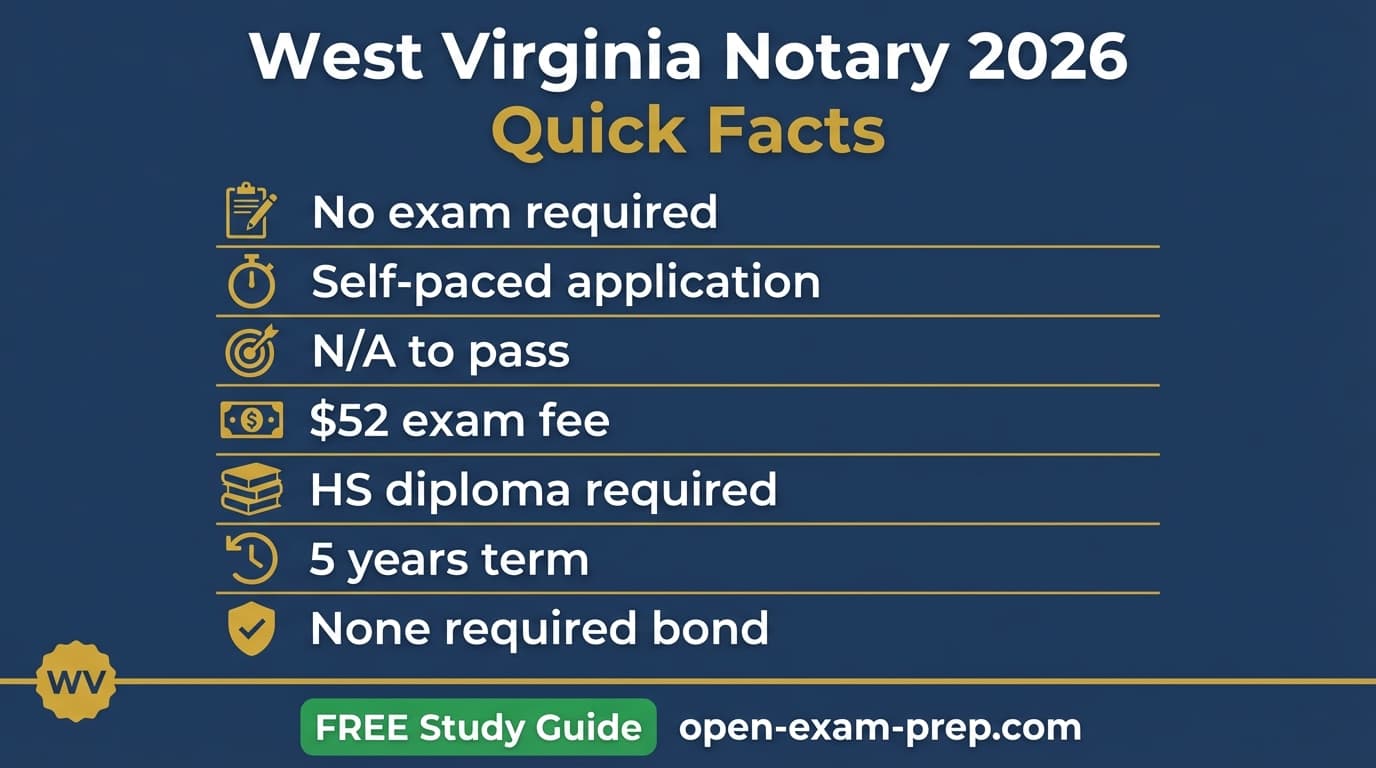
West Virginia is one of the most notary-friendly states in the country. You do not need to pass an exam, complete a course, or obtain a surety bond to become a notary public. You simply need to meet the eligibility requirements, review the Notary Handbook, and apply through the Secretary of State.
West Virginia Notary Requirements at a Glance
| Requirement | Details |
|---|---|
| Minimum Age | 18 years |
| Residency | WV resident OR employed/practicing in WV |
| Exam Required | No |
| Education Required | High school diploma or equivalent (for first-time applicants since 2018) |
| Surety Bond | Not required (eliminated June 3, 2018) |
| Commission Term | 5 years |
| Application Fee | $52 |
Why Become a West Virginia Notary?
- No exam required - Simply review the Notary Handbook
- No bond required - Bond requirement eliminated in 2018
- Long commission term - 5 years (longer than most states)
- RON authorized - Remote Online Notarization available since 2021
- Affordable - One of the lowest total costs to become a notary
Explore More Notary Resources
Looking for notary study materials or guides for other states? Check out our comprehensive resources. The National Notary Association is also an excellent resource for notary education and supplies.
View All Notary Exam Prep Resources
Step-by-Step: How to Become a West Virginia Notary
Step 1: Meet Eligibility Requirements
To become a West Virginia notary public, you must:
- Be at least 18 years old
- Be a citizen or permanent legal resident of the United States
- Be a resident of West Virginia OR have a place of employment or practice in West Virginia
- Be able to read and write English
- Have a high school diploma or equivalent (GED) - required for applicants not commissioned before January 1, 2018
- Have no disqualifying criminal convictions or prior commission revocation for cause
Non-Resident Note: Non-residents may be commissioned if they have a regular place of employment or practice in West Virginia.
Step 2: Review the West Virginia Notary Handbook
Before applying, you must:
- Download the West Virginia Notary Handbook from the Secretary of State website
- Review all notary duties, responsibilities, and procedures
- Familiarize yourself with WV notary laws and proper notarization procedures
- On the application, you will affirm that you have reviewed the handbook
Important: While there is no formal exam, understanding your duties is critical to avoiding liability.
Step 3: Complete the Online Application
West Virginia processes notary applications online:
- Visit the Secretary of State's website (sos.wv.gov)
- Access the Notary Public Application portal
- Complete all required fields accurately
- Pay the $52 non-refundable filing fee
- Affirm that you have reviewed the Notary Handbook
- Submit your application electronically
Processing Time: Applications are typically processed within 1-2 weeks.
Step 4: Receive Your Commission
Once approved:
- You will receive your notary commission certificate
- Your commission is effective immediately upon issuance
- Commission is valid for 5 years
- Keep your certificate in a safe place
Step 5: Purchase Required Notary Supplies
After receiving your commission, purchase your official notary seal:
Official Notary Seal/Stamp (Required):
West Virginia requires an inked rubber stamp for all paper notarizations:
| Specification | Requirement |
|---|---|
| Format | Rectangular |
| Maximum Size | 1 inch high x 2.5 inches wide |
| Border | Must have border |
| Required Text | "Official Seal," "Notary Public," "State of West Virginia" |
| Your Name | Exactly as on commission |
| Cost | $20-$40 |
Embossing Seal (Optional):
- May be used in conjunction with the ink stamp
- Cannot substitute for the ink stamp
- Provides additional document security
Notary Journal (Recommended):
- Not legally required for traditional notarizations
- Strongly recommended by the Secretary of State
- Provides liability protection
- Cost: $15-$30
West Virginia Notary Fees
| Service | Maximum Fee |
|---|---|
| Acknowledgment | $10 per signature |
| Jurat | $10 per signature |
| Oath/Affirmation | $10 |
| Certifying document copies | $10 per page |
| Any other notarial act | $10 |
| Travel fees | Negotiable (agree in advance) |
Important Notes:
- These are maximum fees - you may charge less or nothing
- Travel fees must be agreed upon before travel
- Record fees in your journal if you keep one
West Virginia-Specific Requirements
Seal Requirements
Your notary seal must:
- Be an inked rubber stamp (embosser alone not acceptable)
- Be rectangular with maximum 1" x 2.5" dimensions
- Include border
- State "Official Seal"
- State "Notary Public"
- State "State of West Virginia"
- Include your exact name as on your commission
Seal Security
- Keep your seal secure at all times
- Never allow others to use your seal
- Report loss or theft to the Secretary of State within 30 days
- Destroy old seals when you receive a new commission or your seal is replaced
Journal Best Practices
If you keep a notary journal (recommended), record:
- Date and time of notarization
- Type of notarial act performed
- Description of document
- Signer's name and address
- Method of identification used
- Signer's signature (if practical)
- Fees charged
- Any relevant notes
Prohibited Acts
West Virginia notaries may NOT:
- Notarize their own signature
- Notarize when they have a direct financial interest in the transaction
- Provide legal advice or prepare legal documents
- Notarize incomplete documents
- Notarize without the signer present (except for RON)
- Use an expired seal or commission
- Charge more than maximum statutory fees
Remote Online Notarization (RON) in West Virginia
West Virginia authorized RON effective June 17, 2021 under Senate Bill 469.
Becoming a WV Remote Online Notary
To perform electronic notarization or RON:
- First obtain a traditional WV notary commission
- Submit the E-Notarization Authorization form to the Secretary of State (no additional fee)
- Select an approved RON platform from the SOS-approved list (e.g., DocVerify, Notarize)
- Complete platform-specific training as required
- Begin performing RON notarizations
RON Requirements
| Requirement | Details |
|---|---|
| Notary Location | Must be physically in West Virginia |
| Signer Location | Can be anywhere |
| Technology | SOS-approved RON platform required |
| Identity Verification | Credential analysis + KBA (or personal knowledge) |
| Communication | Live, two-way audio-video |
| Recording | Mandatory A/V recording of entire session |
| Record Retention | 5 years minimum |
Certificate Requirements for RON
Your RON certificate must include:
- Statement that the act was performed remotely
- Language: "This notarial act involved the use of communication technology"
Remote Ink Notarization (RIN)
West Virginia also permits Remote Ink Notarization:
- Signer signs paper document on camera
- Signer mails document to notary
- Notary completes notarization with ink stamp
- A/V recording required (5-year retention)
Total Cost to Become a West Virginia Notary
| Item | Cost |
|---|---|
| Application Fee | $52 |
| Surety Bond | $0 (not required) |
| Notary Seal/Stamp | $20-$40 |
| Journal (optional) | $15-$30 |
| Total Estimated | $72-$122 |
Additional RON Costs
| Item | Cost |
|---|---|
| E-Notarization Authorization | $0 (no fee) |
| RON Platform Subscription | Varies ($15-$50/month or per use) |
| E&O Insurance (optional) | $20-$50/year |
Timeline: How Long Does It Take?
| Step | Estimated Time |
|---|---|
| Review Notary Handbook | 1-2 hours |
| Submit online application | Same day |
| Application processing | 1-2 weeks |
| Purchase supplies | Same day (online) |
| Total | 1-2 weeks |
Errors & Omissions Insurance
While not required, Errors & Omissions (E&O) Insurance is highly recommended:
- Protects you from liability for unintentional errors
- Typical coverage: $10,000-$25,000
- Annual cost: $20-$50
- Especially important for loan signing agents
Commission Renewal
Renewal Process:
- Apply for renewal before your commission expires
- Complete renewal application online
- Pay $52 renewal filing fee
- No continuing education required
- No exam required for renewal
- You will receive a new 5-year commission
Important: If your commission expires, you must apply as a new notary.
Changes to WV Notary Law
Recent Updates:
- June 3, 2018 - Surety bond requirement eliminated
- January 1, 2018 - High school diploma required for new applicants
- June 17, 2021 - Remote Online Notarization (RON) permanently authorized
- 2025 - Updated Notary Handbook released (September 2025 revision)
Start Your West Virginia Notary Career Today
West Virginia makes it easy and affordable to become a notary public. With no exam, no bond, and a 5-year commission term, you can start serving clients quickly.
Final Verification Step
Before you act on this guide, compare your plan with the current state agency and testing vendor instructions. Use the guide for strategy and explanation, then use official materials for the final administrative details. That habit protects you from outdated forms, expired authorizations, wrong identification assumptions, and avoidable scheduling delays.

 Free CE
 Buy on Amazon
 Notary training on Notary.net
 Take courses on Udemy