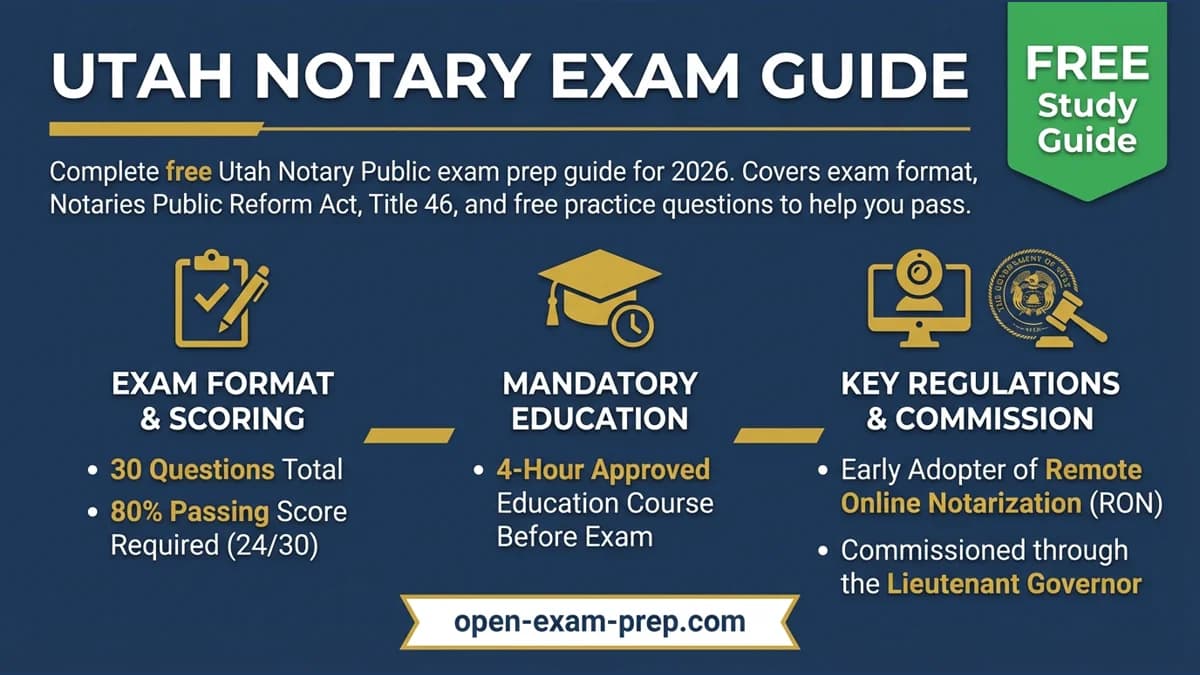
Utah Notary Public Exam Overview
The Utah Notary Public Exam is administered on behalf of the Utah Lieutenant Governor's Office. Utah was an early adopter of modern notary laws, including the Notaries Public Reform Act, which established education and examination requirements.
Passing this exam qualifies you to become a Utah Notary Public—serving over 3.4 million residents in one of the fastest-growing states in the nation, with particularly strong demand in real estate and business services.
Exam Format at a Glance
| Component | Details |
|---|---|
| Total Questions | 30 multiple-choice |
| Time Limit | 45 minutes |
| Passing Score | 80% (24 correct answers) |
| Exam Fee | Included in course |
| Education Required | 4-hour approved course |
| Commission Term | 4 years |
| Surety Bond | $10,000 required |
Why Become a Utah Notary?
- Fastest-growing state — High population growth creates demand
- Strong real estate market — Active home sales and refinances
- RON pioneer — Utah was early adopter of Remote Online Notarization
- Business-friendly — Strong corporate services demand
- Shorter exam — Only 30 questions (manageable format)
📚 Start Your FREE Utah Notary Exam Prep
Ready to begin studying? Our comprehensive, completely free Utah Notary exam prep covers everything you need to pass. The National Notary Association is also an excellent resource for notary education and supplies.
Key Topics Covered on the Exam
1. Notary Fundamentals (25%)
Commission Requirements:
- Must be 18 years or older
- Utah resident or regularly work in Utah
- Complete 4-hour approved education course
- Pass the state examination
- Obtain $10,000 surety bond
- No disqualifying criminal history
Appointment Process:
- Complete approved training course
- Pass examination
- Submit application to Lieutenant Governor
- Pay application fee ($40)
- Obtain surety bond
- Take oath of office
Lieutenant Governor Administration:
- Utah notaries commissioned through Lt. Governor's Office
- Unique among states
- Applications filed electronically
- Commission certificates issued by Lt. Governor
2. Types of Notarial Acts (30%)
Acknowledgments:
- Signer acknowledges signing voluntarily
- Most common notarial act
- Used for deeds, mortgages, powers of attorney
- Does not require oath
Jurats (Verification on Oath):
- Signer swears content is true
- Must sign in notary's presence
- Notary administers oath or affirmation
- Common for affidavits and declarations
Oaths and Affirmations:
- Administered for various purposes
- May be verbal without document
- Used for depositions, witness oaths
- Affirmation for religious objections
Copy Certifications:
- Certify copies of certain documents
- Cannot certify vital records
- Cannot certify public records
- Limited scope under Utah law
3. Utah Code Title 46 Chapter 1 (25%)
Notaries Public Reform Act:
- Modernized Utah notary practice
- Title 46, Chapter 1
- Comprehensive notary framework
- RON authorization included
Key Legal Provisions:
- Section 46-1-2 — Definitions
- Section 46-1-3 — Notary appointment
- Section 46-1-7 — Notarial acts
- Section 46-1-14 — Prohibited acts
- Section 46-1-16 — Fees
Prohibited Acts:
- Cannot notarize your own signature
- Cannot act with financial interest
- Cannot certify vital records
- Cannot provide legal advice
- Cannot use misleading advertising
4. Identification and Procedures (15%)
Satisfactory Evidence:
- Government-issued photo ID
- Valid and not expired
- Utah driver's license or ID
- U.S. passport
- Military ID
Personal Knowledge:
- Notary personally knows signer
- Based on familiarity over time
- Must be documented in journal
- Most reliable identification method
Credible Witness:
- One credible witness allowed
- Witness must personally know signer
- Witness presents acceptable ID
- Swears to signer's identity under oath
5. Journal, Seal, and Fees (5%)
Journal Requirements: Utah requires a sequential journal containing:
- Date and time of notarial act
- Type of act performed
- Document type notarized
- Signer's name and signature
- Type of identification presented
- Fees charged
Seal Requirements:
- Must include notary's name
- Words "State of Utah"
- Words "Notary Public"
- Commission expiration date
Fee Schedule:
| Service | Maximum Fee |
|---|---|
| Notarial act | $10 |
| Certificate | $10 |
| Travel | Reasonable actual cost |
Study Timeline for Success
| Week | Focus Area | Hours |
|---|---|---|
| Week 1 | Complete 4-hour education course | 4 |
| Week 1-2 | Notary fundamentals | 2-3 |
| Week 2 | Types of notarial acts | 3-4 |
| Week 2-3 | Title 46 Chapter 1 provisions | 3-4 |
| Week 3 | Identification and procedures | 2-3 |
| Week 3-4 | Journal, seal, and fees | 1-2 |
| Week 4 | Practice exams and review | 3-4 |
Total recommended study time: 18-24 hours (including required course)
🎯 Free Practice Questions Available
Test your knowledge with hundreds of free practice questions designed specifically for the Utah Notary exam.
Utah-Specific Exam Tips
1. Master Title 46 Chapter 1
Utah's notary laws are in Title 46:
- Know key section numbers
- Understand the Notaries Public Reform Act
- Memorize prohibited acts
- Know fee limitations ($10 max)
2. Understand Remote Online Notarization
Utah was a RON pioneer:
- Early adopter of RON technology
- Specific vendor requirements
- Audio-visual technology standards
- Electronic journal requirements
3. Know the Shorter Exam Format
Utah's exam is compact:
- Only 30 questions
- 45 minutes to complete
- 80% passing (24 correct)
- Focused but thorough
4. Key Numbers to Remember
| Topic | Utah Requirement |
|---|---|
| Passing score | 80% (24/30) |
| Education | 4 hours |
| Commission term | 4 years |
| Bond amount | $10,000 |
| Max fee per act | $10 |
| Application fee | $40 |
Common Mistakes to Avoid
- Skipping required course — 4-hour course is mandatory
- Ignoring Title 46 — Core of exam content
- Underestimating 30 questions — Each question matters more
- Missing 80% threshold — Higher than average
- Not understanding RON — Utah emphasis
- Rushing the short exam — Precision over speed
After Passing Your Exam
- Submit application to Lieutenant Governor's Office
- Pay $40 application fee to state
- Obtain $10,000 surety bond from approved provider
- Take oath of office before authorized official
- File commission with Lieutenant Governor
- Purchase notary seal meeting state specifications
- Purchase journal and begin your practice
2026 Utah Updates
For 2026, be aware of:
- Remote Online Notarization updates
- Electronic notarization enhancements
- Title 46 amendments
- Fee schedule reviews
Start Your Utah Notary Career Today
The Utah Notary Public commission opens doors to serving one of the nation's fastest-growing states with modern notary laws and RON authorization. With proper preparation, you can pass the shorter 30-question exam on your first attempt.
Our free study materials include:
- ✅ Complete topic coverage
- ✅ Practice questions with explanations
- ✅ Title 46 Chapter 1 specifics
- ✅ Study guides and summaries
- ✅ AI-powered study assistance
Don't pay for expensive prep courses when everything you need is available FREE.
How to Turn This Utah Notary Guide Into a Passing Study Plan
A notary exam or appointment review is not just a vocabulary test. It measures whether you can protect the signer, the document, the public record, and your own commission when the facts are messy. Read the rules above once for orientation, then convert them into a procedure checklist you can apply to acknowledgments, jurats, oaths or affirmations, copy certifications if allowed, and any remote or electronic notarization rules that apply in Utah.
Your first checklist should follow the order of a real appointment. Confirm that the requested act is one you are authorized to perform. Confirm personal appearance under the rules that apply to the act. Identify the signer using the acceptable evidence described in your Utah materials. Screen for willingness, awareness, and basic communication. Complete the notarial certificate with the correct venue, date, signer name, notarial wording, signature, seal, and commission information. Record the act in your journal if required, or keep a careful voluntary record when allowed and appropriate.
That sequence is important because many exam questions describe a signer who appears at the wrong time, presents weak identification, asks for legal advice, wants a blank document notarized, or asks the notary to choose the certificate. In those scenarios, memorizing definitions is not enough. You need to know the next lawful step. Usually the safest exam answer is the one that preserves impartiality, requires proper identification and personal appearance, refuses unauthorized practice of law, and follows the certificate requirements exactly.
Utah Commission Workflow and Documents to Verify
Before relying on any checklist, verify the current Utah commissioning process with the Secretary of State, commissioning authority, approved education provider, or official handbook named in your materials. Administrative steps can change even when the core notary duties stay the same. Confirm the current application form, training or exam requirement, bond requirement if any, oath filing, seal requirements, commission term, renewal timing, and whether remote online notarization has separate registration rules.
Keep a small commissioning file with your application confirmation, education certificate, exam result if applicable, bond or insurance documents, oath filing receipt, commission certificate, stamp order, and journal purchase record. If you plan to offer loan signing or mobile notary services, keep those business records separate from your official notary records. Your commission duties come first; marketing, travel fees, and signing-agent assignments never expand what state law allows you to notarize.
When you review fees, separate maximum notarial fees from optional charges such as travel or business service fees. If the article above lists a fee cap, treat it as a rule to verify and apply carefully. Fee questions often test whether the candidate can distinguish a notarization fee from a separate travel agreement, whether the fee must be disclosed in advance, and whether remote online notarization has a different fee structure.
Procedure Drills That Build Exam Readiness
The fastest way to improve is to practice short appointment scenarios. Write five columns on a page: requested act, signer identity evidence, document condition, certificate wording, and notary action. Then create examples. A signer wants an acknowledgment but has not signed yet. A signer wants a jurat but refuses an oath. A signer brings an expired ID. A spouse asks you to notarize for an absent signer. A customer asks whether a power of attorney is legally sufficient. A remote signer passes credential analysis but cannot communicate clearly. For each scenario, write what you would do and why.
Focus especially on the difference between acknowledgments and jurats. In an acknowledgment, the signer acknowledges signing willingly; the document may have been signed before appearing if state law and the certificate allow it. In a jurat, the signer swears or affirms the truth of the document and usually signs in the notary's presence. Exam questions often hide the correct answer in those verbs. If the certificate says subscribed and sworn, think oath or affirmation. If it says acknowledged before me, think acknowledgment and voluntary execution.
Also drill refusal rules. A notary should refuse when the signer is not properly identified, does not personally appear as required, appears unwilling or unaware, asks the notary to perform an unauthorized act, presents a document with blanks that cannot be completed, or asks for legal advice. A refusal should be calm, specific, and tied to the rule. On the exam, avoid answers that make the notary a document adviser, immigration consultant, attorney, or party to the transaction.
Recordkeeping, Seal, and Certificate Traps
Recordkeeping questions are easy points if you learn the pattern. The journal entry, when required or recommended, should document the date and time, type of act, document description, signer identity method, fee, and any signature or thumbprint requirement that applies. Do not invent information after the fact. Do not share journal details casually. Do not let an employer take control of official records unless your state rules clearly allow a specific arrangement.
Seal questions usually test completeness and control. Keep your stamp secure, use the exact name and commission information required, and never let another person use your seal. If a stamp is lost, stolen, damaged, or replaced after a name or commission change, follow the reporting and replacement process in your Utah rules. If a certificate has an error, correct it only in the manner allowed by your commissioning authority; do not backdate or attach a loose certificate unless the facts and state rules support that action.
Certificate wording is another common trap. A notary may identify the type of notarial act requested, but should not choose the legal effect of a certificate for a signer. If the document lacks a certificate, the signer or document recipient may need to choose or provide the wording. Your role is to complete the notarial act correctly, not to decide which form gives the document legal effect.
If You Miss Questions in Practice
Use missed questions as a routing tool. If you miss identification questions, reread acceptable ID, credible witness, and personal knowledge rules. If you miss jurat questions, drill oath language and signature timing. If you miss fee questions, build a small chart of allowed fees and when they apply. If you miss remote notarization questions, separate traditional personal appearance from remote appearance, credential analysis, audio-video session rules, electronic journal requirements, and technology-provider rules.
Then practice with mixed sets instead of rereading the whole guide. The goal is to recognize the lawful notary action under pressure. Start here: Utah notary study guide and use notary practice questions for short, scenario-based review. When your explanations become precise, your score usually follows.


 Buy on Amazon
 Utah notary training