Pennsylvania Life & Health Insurance License Exam Overview
The Pennsylvania Life, Accident & Health Insurance Producer Exam (PSI Series 16-03) is administered by PSI Services on behalf of the Pennsylvania Insurance Department. Pennsylvania licenses life and accident-and-health together as one combined line of authority, so a single 150-question exam covers life insurance, annuities, health insurance, and Pennsylvania Title 40 law. Philadelphia and Pittsburgh anchor a state of nearly 13 million residents with major healthcare, education, manufacturing, and financial-services employers.
Passing the 16-03 exam, clearing a fingerprint-based background check, and submitting your application through NIPR qualifies you to sell life insurance, fixed and variable annuities, health insurance, disability income, and long-term care across the Commonwealth. (Pennsylvania also offers a single-line Life (16-01) exam and a single-line Accident & Health (16-02) exam, but most producers take the combined 16-03.)
Exam Format at a Glance
| Component | Details |
|---|---|
| Exam | Life, Accident & Health -- PSI Series 16-03 |
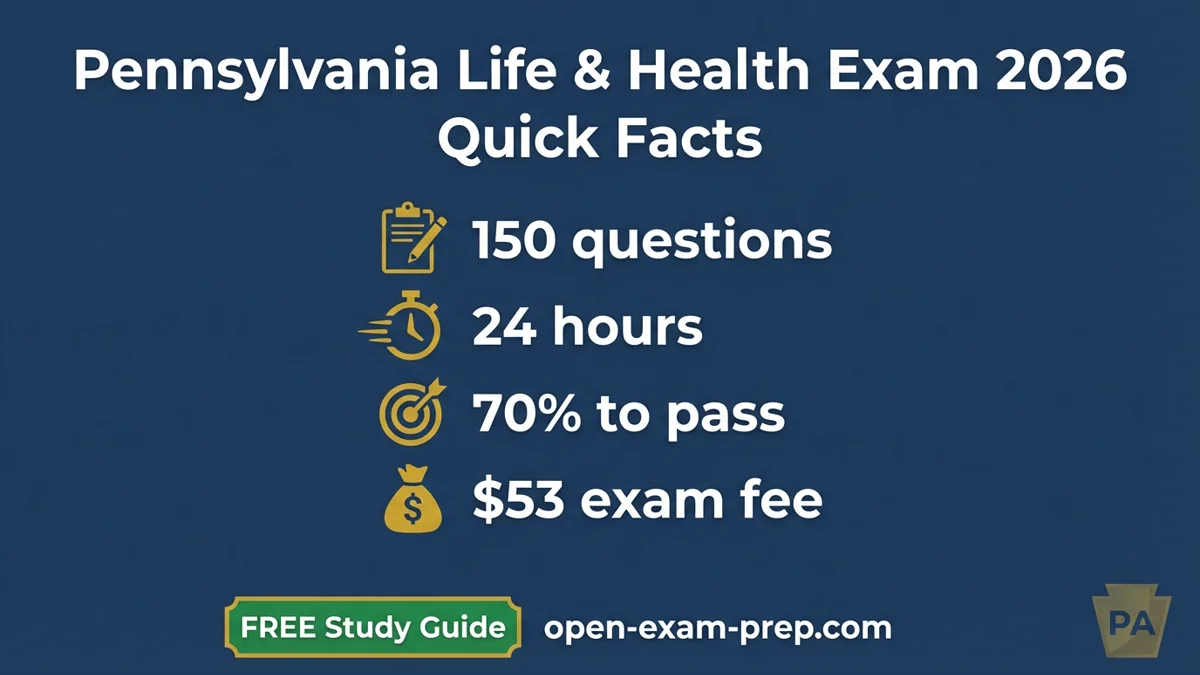
| Total Questions | 150 scored multiple-choice |
| Time Limit | 170 minutes (2 hours 50 minutes) |
| Passing Score | 70% (105 of 150 correct) |
| Testing Vendor | PSI Services |
| Delivery | PSI test center or online remote proctoring |
| Exam Fee | $53 (joint-line); $43 single-line Life or A&H |
| Pre-licensing Education | Not required (eliminated 04/29/2025) |
| Result | Pass/fail score report issued at the test center |
Why Get Licensed in Pennsylvania?
- Large population base — Nearly 13 million potential clients
- Major healthcare hub — Leading hospital systems and health insurers
- CHIP pioneer — Pennsylvania created children's health insurance
- Multi-state opportunity — Easy reciprocity with neighboring states
- Competitive compensation — Average agent salary over $65,000
📚 Start Your FREE Pennsylvania Life & Health Exam Prep
Ready to begin studying? Our comprehensive, completely free Pennsylvania Life & Health exam prep covers everything you need to pass.
Official PSI Content Outline (Series 16-03)
Unlike generic guides, Pennsylvania publishes exact weights. These are the official PSI 16-03 percentages -- study to them, not to round-number estimates. Insurance Regulation is the single largest area, so Title 40 law is not optional.
| Content Area | Weight |
|---|---|
| 1. Insurance Regulation (PA Title 40) | 21% |
| 2. General Insurance Concepts | 7% |
| 3. Life, Accident & Health Insurance Basics | 14% |
| 4. Types of Life Insurance Policies | 8% |
| 5. Life Policy Provisions, Options & Riders | 13% |
| 6. Annuities | 9% |
| 7. Individual Accident & Health Policy Provisions | 7% |
| 8. Disability Income & Related Insurance | 4% |
| 9. Medical Plans | 4% |
| 10. Group Health Insurance | 3% |
| 11. Dental Insurance | 1% |
| 12. Health Insurance for Seniors & Special Needs | 7% |
| 13. Federal Tax Considerations (Life & Health) | 2% |
Takeaway: Regulation (21%) plus the two life-policy areas (8% + 13% = 21%) make up roughly 42% of the exam. Master Pennsylvania law and life policy provisions first.
Key Topics Covered on the Exam
1. Life Insurance Fundamentals (Areas 3-5, ~35%)
Types of Life Insurance:
- Term Life (level, decreasing, renewable, convertible)
- Whole Life (ordinary, limited pay, single premium)
- Universal Life (flexible premiums, adjustable death benefit)
- Variable Life (securities-based, separate account)
Policy Provisions Under Pennsylvania Law:
| Provision | Pennsylvania Requirement |
|---|---|
| Grace Period | 31 days minimum |
| Incontestability | 2 years |
| Suicide Clause | 2 years |
| Free Look Period | 10 days (30 days for seniors 65+) |
| Reinstatement | 3 years |
| Misstatement of Age | Adjustment of benefits |
Beneficiary Designations:
- Primary and contingent beneficiaries
- Revocable vs. irrevocable designations
- Per stirpes vs. per capita distribution
- Pennsylvania inheritance and estate considerations
2. Health Insurance Fundamentals (Areas 7-12, ~26%)
Major Medical Coverage:
- Deductibles, copays, coinsurance
- Out-of-pocket maximums
- Network types (HMO, PPO, EPO, POS)
- Essential health benefits under ACA
Pennsylvania-Specific Health Topics:
- Pennie marketplace (state-based exchange)
- CHIP (Pennsylvania pioneered this program!)
- Medical Assistance (Pennsylvania Medicaid)
- Act 68 (HMO Act requirements)
Disability Income Insurance:
- Short-term vs. long-term disability
- Own occupation vs. any occupation definitions
- Elimination periods and benefit periods
- Social Security integration
Long-Term Care Insurance:
- Benefit triggers (ADLs, cognitive impairment)
- Pennsylvania Long-Term Care Partnership
- Tax-qualified policies
- Inflation protection options
3. Annuities (Area 6, ~9%)
- Fixed vs. variable annuities
- Immediate vs. deferred annuities
- Accumulation and annuitization phases
- Pennsylvania annuity suitability requirements
- Surrender charges and free withdrawal provisions
- 1035 exchanges and tax implications
4. Pennsylvania Insurance Code and Regulations (Area 1, 21% -- the largest section)
Title 40 (Insurance) Key Provisions:
- Producer licensing requirements
- Unfair Insurance Practices Act
- Unfair claims settlement practices
- Replacement regulations
- Advertising guidelines
Licensing Requirements:
- Pre-licensing education: Not required (eliminated 04/29/2025 under SB 1241; previously 24 hours)
- Minimum age: 18
- Continuing education: 24 hours every 2 years
- Ethics requirement: 3 of the 24 CE hours must be ethics
- Fingerprint-based FBI background check (IdentoGO) required for new resident producers -- not required when only adding a line to an existing resident license
Producer Responsibilities:
- Fiduciary duties to clients
- Premium handling requirements
- Record retention (5 years)
- Reporting changes within 30 days
5. Ethics and Professional Conduct (10-15%)
- Suitability and needs analysis
- Disclosure requirements
- Privacy and confidentiality (HIPAA compliance)
- Anti-rebating and anti-twisting rules
- Handling complaints and grievances
Study Timeline for Success
| Week | Focus Area | Hours |
|---|---|---|
| Week 1-2 | Life insurance products and provisions | 12-15 |
| Week 2-3 | Health insurance and ACA | 12-15 |
| Week 3-4 | Annuities and specialty products | 8-10 |
| Week 4-5 | Pennsylvania regulations (Title 40) | 8-10 |
| Week 5-6 | Practice exams and review | 12-15 |
Total recommended study time: 55-65 hours
🎯 Free Practice Questions Available
Test your knowledge with 625+ free practice questions designed specifically for the Pennsylvania Life, Accident & Health exam -- no signup required.
Pennsylvania-Specific Exam Tips
1. Know Your Pennsylvania Laws
The exam tests Pennsylvania-specific regulations:
- Title 40 — Pennsylvania Insurance Code
- Pennie — State health insurance marketplace
- Act 68 — HMO Act requirements
- CHIP — Children's health coverage (PA pioneered this!)
2. Master the Numbers
| Topic | Pennsylvania Requirement |
|---|---|
| Grace period | 31 days |
| Free look period | 10 days (30 for 65+) |
| Incontestability | 2 years |
| Suicide clause | 2 years |
| Reinstatement | 3 years |
| Exam | 150 questions / 170 minutes / 70% to pass |
| CE requirement | 24 hours/2 years (3 ethics) |
| Pre-licensing | Not required (eliminated 04/29/2025) |
| Replacement notice | Required at or before application |
3. Understand Pennie Marketplace
Pennsylvania's state-based health insurance marketplace:
- Open enrollment periods (November-January)
- Special enrollment qualifications
- Subsidy and tax credit eligibility
- Plan tier options (Bronze through Platinum)
4. Focus on Senior Protections
Pennsylvania has enhanced rules for seniors:
- Extended free look period (30 days for 65+)
- Annuity suitability requirements
- Medicare supplement regulations
- Long-term care disclosure requirements
Common Mistakes to Avoid
- Underestimating Pennsylvania regulations — State-specific laws are heavily tested
- Forgetting CHIP history — Pennsylvania pioneered children's health coverage
- Skipping health insurance — It's equal weight to life insurance
- Ignoring senior protections — PA has enhanced rules for older consumers
- Not practicing timed exams — 170 minutes for 150 questions (about 68 seconds each) requires pacing
- Cramming last minute — Spread study over 5-6 weeks
After Passing Your Exam
Apply within 180 days of passing -- PSI exam results are valid for that window.
- Complete IdentoGO fingerprinting — schedule the FBI fingerprint-based background check (about $22.60) before or alongside your application
- Apply through NIPR — submit the resident producer application via the National Insurance Producer Registry (or the PA Insurance Department); application fee is $55
- Affiliate with an insurer — a carrier must appoint you before you can write business in its name
- Maintain CE compliance — 24 hours every 2 years, including 3 ethics hours
- Renew on schedule — Pennsylvania resident producer licenses are perpetual but require ongoing CE and a biennial renewal/affirmation; lapses incur reinstatement steps
- Begin selling — you can market the lines on your license once appointed
2026 Pennsylvania Updates
For 2026, be aware of:
- Pre-licensing education eliminated — effective April 29, 2025 (Senate Bill 1241, signed October 31, 2024), the 24-hour pre-exam course is no longer required to sit for the exam
- PSI is the testing vendor — Pennsylvania moved producer testing from Prometric to PSI; older guides citing Prometric are out of date
- Pennie marketplace updates and plan-year changes
- Enhanced telehealth coverage requirements
- Updated producer appointment and replacement-disclosure guidance
Start Your Pennsylvania Insurance Career Today
The Pennsylvania Life & Health license opens doors to one of the nation's largest insurance markets. With proper preparation, you can pass the exam on your first attempt.
Our free study materials include:
- ✅ Complete topic coverage
- ✅ Practice questions with explanations
- ✅ Pennsylvania-specific regulations (Title 40)
- ✅ Study guides and summaries
- ✅ AI-powered study assistance
Don't pay for expensive prep courses when everything you need is available FREE.
How to Use This Guide Without Missing State-Specific Details
Treat this article as your working roadmap, then verify the administrative details against official sources before you schedule. Insurance licensing changes are usually small, but small changes matter on exam day: a vendor switch, new fingerprinting workflow, revised candidate handbook, or updated application checklist can delay a license even when you know the content. Start with your state insurance department, then confirm the testing vendor account, then check the National Insurance Producer Registry licensing flow if your state uses it. The NAIC state insurance department directory is a practical starting point when you need the current regulator website, and NIPR state requirements can help you verify application steps after the exam.
For the content itself, separate national insurance knowledge from Pennsylvania-specific law. National life and health questions test concepts that transfer across states: contract parties, insurable interest, beneficiary designations, policy riders, annuity phases, health policy renewability, disability income definitions, Medicare supplement basics, group health coordination, and unfair trade practices. The state section asks how those ideas are administered in Pennsylvania. When a question includes a number, deadline, appointment step, replacement notice, continuing education rule, or regulator power, slow down and decide whether it is a national default or a Pennsylvania rule.
A Practical Study Workflow for the Final Two Weeks
Use the last two weeks to convert recognition into decision speed. On day one, take a mixed diagnostic at /practice/pa-life-health and tag every missed question by reason: did you miss a definition, confuse two similar products, overlook a state rule, or run out of time? Definitions need flashcards. Similar products need comparison tables. State rules need a short checklist. Timing mistakes need practice blocks with a visible clock.
During the first week, work in focused sets. Do life insurance one day, health insurance the next, annuities after that, and Pennsylvania law at least every other session. Do not wait until the end to study regulations. Many candidates know term versus whole life but lose points on replacement, advertising, producer authority, unfair claims practices, or what must happen before a license is issued. After each set, rewrite the explanation in your own words. If you cannot explain why the wrong answer is wrong, you have not finished the question.
During the second week, switch to exam simulation. Use full mixed quizzes, then spend more time reviewing than answering. For life insurance, drill policy provisions, riders, beneficiary changes, settlement options, nonforfeiture options, and taxation at a high level. For health insurance, drill renewability, exclusions, disability definitions, long-term care, Medicare supplement rules, group versus individual contracts, and coordination of benefits. For annuities, make sure you can distinguish accumulation from annuitization, fixed from variable, immediate from deferred, and suitability from general sales preference.
Common Life and Health Traps
A common trap is answering from everyday sales language instead of policy language. "Cash value," "premium," "benefit," "owner," "insured," and "beneficiary" have precise exam meanings. Another trap is treating Medicare, Medicare Advantage, Medicare Supplement, and Medicaid as interchangeable. They are different programs or products, and exam questions often reward the candidate who notices which one is actually named.
Replacement questions deserve special attention. The exam may ask what must be disclosed, when notices are required, how existing coverage should be treated, or why twisting is prohibited. Do not memorize replacement as simply "bad." Replacement can be legitimate, but it becomes a compliance issue when comparison, disclosure, or suitability duties are ignored.
Health questions also use similar-sounding renewability terms. Noncancelable, guaranteed renewable, conditionally renewable, optionally renewable, and cancelable policies allocate power differently between insurer and insured. Build a one-page table and practice from both directions: given the term, state the rule; given the rule, name the term.
Exam-Day Checklist
Before test day, confirm your appointment time, approved identification, remote-proctoring rules if applicable, calculator policy, and reschedule deadline from the testing vendor. Use the exact legal name from your licensing and exam records. If your ID and registration do not match, content knowledge will not help at check-in.
On the exam, answer the direct question first before reading extra meaning into the facts. Insurance exams often include plausible distractors that are true statements but do not answer the question asked. Mark long calculation or scenario questions and come back after securing the easier definition and rule points. If you are stuck between two options, identify which answer is broader, which is more specific, and whether the question asks for an exception. Exceptions are where many state-law points hide.
If You Do Not Pass on the First Attempt
A failed attempt is useful data if you treat the score report correctly. Do not simply reread the same chapter. Sort weak areas into national product knowledge, Pennsylvania law, and test-taking process. For product knowledge, rebuild comparison charts. For state law, verify the current rule from official regulator materials and then practice short recall prompts. For process issues, take timed sets and force yourself to explain why each wrong answer was attractive.
Schedule the next attempt only after your weakest two categories have improved in practice. A good target is not just a passing average; it is consistency. When you can pass several mixed sets in a row without relying on memorized question wording, you are closer to exam readiness.
Best Next Step
Work through the free Pennsylvania Life and Health materials in OpenExamPrep while keeping official regulator pages open for licensing logistics. Use OpenExamPrep for practice, explanations, and routing; use the state department, candidate handbook, and NIPR for current filing requirements. That split keeps your study time focused and keeps your licensing steps grounded in official instructions.


 Buy on Amazon
 Prep course on Achievable
 Online course on Mometrix
 Take courses on Udemy