NMLS SAFE MLO Test Overview
The SAFE Mortgage Loan Originator (MLO) Test is required in all 50 states, DC, and U.S. territories to become a licensed Mortgage Loan Originator. Administered through the Nationwide Multistate Licensing System (NMLS) and developed by the Conference of State Bank Supervisors (CSBS), this exam tests knowledge of federal mortgage laws, state regulations, the mortgage origination process, and ethical lending practices.
Since April 1, 2013, almost every state uses a single combined version of the exam called the National Test Component with Uniform State Content (UST). The old stand-alone state test was folded into this one exam, so passing the National Test with UST satisfies both the national and state knowledge requirements in participating states. (A small number of jurisdictions historically required a separate state test; the National Test with UST is now the standard you will sit for in nearly every state.)
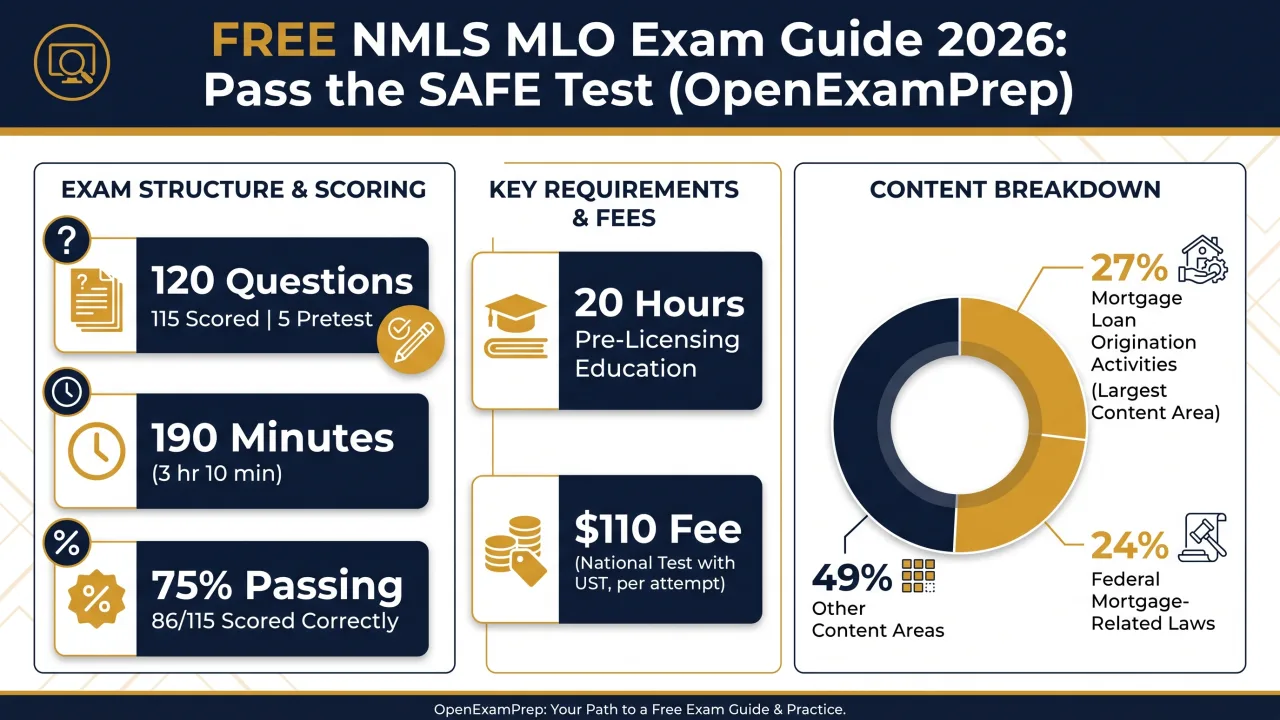
Exam Format (120 Questions / 190 Minutes / 75%)
| Component | Details |
|---|---|
| Total Questions | 120 multiple-choice |
| Scored Questions | 115 |
| Unscored (Pretest) | 5 (randomly distributed, not identified) |
| Time Limit | 190 minutes (3 hours 10 minutes) |
| Passing Score | 75% (you must answer 86 of 115 scored questions correctly) |
| Exam Fee | $110 (National Test with UST) |
| Testing | Prometric testing centers or online proctoring |
| Results | Pass/Fail score report immediately after the exam |
The 5 pretest questions are unscored and are used to evaluate items for future exams. They are mixed in randomly, so you will not know which ones they are. Your pass/fail result is based only on the 115 scored questions -- get 86 or more correct and you pass.
📚 Start FREE NMLS Exam Prep
Exam Content Breakdown (5 Content Areas)
The SAFE MLO National Test with UST covers five content areas. These weights come from the official NMLS/CSBS content outline:
| Content Area | Weight | Approx. Questions (of 115 scored) |
|---|---|---|
| Mortgage Loan Origination Activities | 27% | ~31 |
| Federal Mortgage-Related Laws | 24% | ~28 |
| General Mortgage Knowledge | 20% | ~23 |
| Ethics | 18% | ~21 |
| Uniform State Content (UST) | 11% | ~13 |
Origination Activities and Federal Laws together are 51% of the exam -- focus your study there first.
Federal Mortgage-Related Laws (24%)
This is the second-largest content area and the most rule-heavy. Know which regulation implements which law, and the key timeframes and dollar/percentage triggers.
SAFE Act (Secure and Fair Enforcement for Mortgage Licensing Act of 2008)
- Created the NMLS and the nationwide licensing/registration framework
- Requires a unique NMLS ID for every MLO; the ID must appear on loan documents
- Sets minimum standards: 20 hours pre-licensing education, testing, background checks, and surety bond
RESPA (Real Estate Settlement Procedures Act) -- Regulation X
- Prohibits kickbacks, referral fees, and unearned fees (Section 8) -- heavily tested
- Requires the Affiliated Business Arrangement (AfBA) disclosure
- Governs escrow accounts and limits the cushion a servicer may hold
- Applies to federally related mortgage loans secured by 1-4 family residential property
TILA (Truth in Lending Act) -- Regulation Z
- Requires APR and finance-charge disclosures so borrowers can compare loans
- Gives a 3-business-day right of rescission on refinances/home-equity loans on a primary residence (not on purchases)
- Regulates advertising "trigger terms" and the Ability-to-Repay/Qualified Mortgage (ATR/QM) rule
TRID (TILA-RESPA Integrated Disclosure) -- "Know Before You Owe"
- Loan Estimate (LE): delivered within 3 business days of a completed application
- Closing Disclosure (CD): received at least 3 business days before consummation
- An "application" is triggered by 6 pieces of information: name, income, Social Security number, property address, estimated property value, and loan amount
ECOA (Equal Credit Opportunity Act) -- Regulation B
- Prohibits discrimination based on race, color, religion, national origin, sex, marital status, age, receipt of public assistance, or exercising a right under the Consumer Credit Protection Act
- Requires an adverse action notice (generally within 30 days)
HMDA (Home Mortgage Disclosure Act) -- Regulation C
- Requires lenders to collect and report data on mortgage applications and originations
- Used to identify discriminatory lending patterns and serve community needs
GLBA (Gramm-Leach-Bliley Act)
- Privacy Rule: requires privacy notices and limits sharing of nonpublic personal information
- Safeguards Rule: requires protecting customer data
Fair Housing Act
- Protects against discrimination in housing (race, color, religion, sex, national origin, familial status, disability)
- Prohibits steering, blockbusting, and redlining
🎯 Free Practice Questions
Mortgage Loan Origination Activities (27%)
The largest content area covers the entire mortgage process from application to closing:
Application Process
- The 6 pieces of information that trigger an "application" under TRID
- URLA (Uniform Residential Loan Application, Form 1003)
- Required disclosures delivered at or shortly after application (LE, special information booklet)
Processing & Documentation
- Income verification (W-2s, pay stubs, tax returns, bank statements)
- Asset and reserve documentation; sourcing and seasoning of funds
- Verification of employment (VOE) and verification of deposit (VOD)
Underwriting Basics & Calculations
- Debt-to-income ratios: front-end (housing) and back-end (total debt)
- Loan-to-value (LTV) = loan amount / appraised value or sale price (lower of the two)
- Combined LTV (CLTV) for second liens; credit-score thresholds
Closing Procedures
- Closing Disclosure review and the 3-day waiting period
- Funding, disbursement, and the right of rescission (where it applies)
- Settlement agents, title, and required signatures
General Mortgage Knowledge (20%)
Loan Products
- Conventional (conforming vs. non-conforming) vs. government loans
- Fixed-rate vs. adjustable-rate mortgages (ARMs): index, margin, caps, adjustment periods
- Jumbo loans and the annual conforming loan limits
Government Loan Programs
- FHA loans: low down payment, upfront and annual MIP
- VA loans: no down payment for eligible veterans, funding fee, no monthly MI
- USDA Rural Development loans: eligible rural areas and income limits
Underwriting Guidelines
- Fannie Mae / Freddie Mac (GSE) conforming guidelines
- FHA/VA/USDA qualification requirements
- Manual vs. automated underwriting (DU / LPA)
Ethics (18%)
Ethics questions are largely federal-law-based (RESPA, TILA, ECOA, fair lending applied to scenarios).
Fair Lending & Anti-Discrimination
- Applying ECOA and the Fair Housing Act to scenarios
- Steering, redlining, and disparate treatment vs. disparate impact
Prohibited Conduct & Consumer Protection
- RESPA Section 8 kickbacks and unearned fees
- Predatory lending red flags (equity stripping, loan flipping, fee packing)
- Bait-and-switch and misrepresentation
Fraud Prevention
- Common mortgage-fraud schemes (occupancy fraud, straw buyers, inflated appraisals)
- Identity-theft red flags and Suspicious Activity Report (SAR) awareness
Uniform State Content / UST (11%)
The UST component is fully integrated into the national exam (no separate test in participating states). It covers state-level rules built on model law:
State Mortgage Regulatory Authority
- Role of state regulators and the CSBS/AARMR model state law
- Enforcement powers, examinations, and administrative actions
State Licensing Requirements
- License application, NMLS unique ID, and disclosure of administrative/criminal history
- Background check, fingerprinting, and credit report review
- Surety bond and any net-worth requirements
Standards of Conduct (State Level)
- Prohibited acts and required record-keeping
- Advertising rules and use of the NMLS ID
Prerequisites Before Testing
-
20 hours of NMLS-approved pre-licensing education (PE):
- 3 hours of Federal law and regulations
- 3 hours of Ethics (fraud, consumer protection, fair lending)
- 2 hours of Nontraditional mortgage lending
- 12 hours of Electives (which may include state-specific content)
-
Create an NMLS account and obtain a unique NMLS ID at mortgage.nationwidelicensingsystem.org
-
Submit your state license application(s) through NMLS
-
Schedule the exam through Prometric (test center or online proctoring) and pay the $110 fee
Your passed exam result is valid for licensing as long as you do not have a 5-year (or longer) gap without an active MLO license; an extended lapse can require you to retest. Check the current NMLS test expiration policy before you schedule.
After You Pass: Continuing Education (CE)
Licensed MLOs must complete 8 hours of NMLS-approved continuing education each year to renew:
- 3 hours Federal law and regulations
- 2 hours Ethics
- 2 hours Nontraditional mortgage lending
- 1 hour Elective
Some states add hour requirements on top of the federal 8. The "successive years" rule generally prevents taking the same CE course two years in a row.
Study Timeline
| Week | Focus | Hours |
|---|---|---|
| Week 1-2 | Federal Laws (SAFE, RESPA, TILA, TRID, ECOA) | 15-20 |
| Week 3 | Origination Activities + calculations | 10-15 |
| Week 4 | General Mortgage Knowledge (products, GSE, FHA/VA) | 10-15 |
| Week 5 | Ethics + Uniform State Content | 10-15 |
| Week 6 | Full-length timed practice + miss review | 15-20 |
Total: 60-85 hours recommended. The first-time pass rate hovers around 54-60%, so structured practice -- not passive reading -- is what separates passers from retakers.
Tips for Success
- Front-load Federal Laws + Origination -- together they are 51% of the exam
- Know RESPA Section 8 cold -- kickbacks and unearned fees are heavily tested
- Memorize key timeframes -- 3-day rescission, LE within 3 days, CD 3 days before closing, the 6 application items
- Drill the calculations -- LTV/CLTV, front-end and back-end DTI, ARM caps
- Test application, not recall -- NMLS writes scenario questions; predict the rule before reading options
Retake Policy
- After each of your first 3 failures: wait 30 days from the previous test date before retaking
- After 3 consecutive failures: wait 180 days (6 months) before the next attempt
- The exam taken after the 180-day wait counts as a fresh start, resetting the 30-day cycle
- No lifetime limit on total attempts; each retake costs the $110 fee
Start Your MLO Journey Today
All study materials, practice questions, and exam guides are 100% FREE.
Official-Source Check Before You Schedule
Treat this article as a study map, not a substitute for the current NMLS MLO Exam Guide 2026: Pass the SAFE Test candidate materials. For finance credentials, verify requirements with the exam sponsor, licensing system, or credential board before you lock a study calendar or cite eligibility details to an employer. Requirements can change by testing window, jurisdiction, sponsor update, or delivery vendor, and those changes often affect small details candidates overlook: identification rules, retake timing, calculator policy, reference materials, continuing-education language, application approvals, and the exact way domains are named.
Before you pay for an exam date, make a one-page source checklist. Put the official exam page, candidate handbook, content outline or blueprint, fee page, accommodation instructions, and reschedule policy in one place. Then compare your prep materials against that checklist. If a prep book, course, or old post disagrees with the sponsor, follow the sponsor. This is especially important for candidates returning after a failed attempt because they may be studying from notes built around an older outline.
How To Read The Blueprint Without Overstudying
Do not read the NMLS MLO Exam Guide 2026: Pass the SAFE Test outline like a table of contents. Read it like a risk map. Each domain tells you what the exam writer is allowed to test, but the action verbs tell you how the topic may appear. A verb such as identify usually points to recognition. A verb such as apply, analyze, evaluate, calculate, determine, or recommend means the question can require judgment, sequencing, or multi-step reasoning.
Use four passes through the outline. First, mark topics you already use at work. Second, mark topics you recognize but cannot explain without notes. Third, mark topics that have unfamiliar vocabulary. Fourth, mark topics that combine two skills, such as a rule plus a calculation or a policy plus a scenario. The fourth group deserves the most practice because it is where candidates often feel prepared while still missing points.
For NMLS MLO Exam Guide 2026: Pass the SAFE Test, route your weekly study around these high-friction buckets:
- client facts and constraints
- product structure and risk tradeoffs
- ethics, fiduciary, or conduct standards
- calculation setup before calculator work
The goal is not to give every line of the outline equal time. The goal is to convert weak, testable behaviors into repeatable decisions. If a topic is easy in isolation but difficult inside a mixed set, it belongs in your active rotation until it stays stable under time pressure.
Scenario Strategy For Hard Questions
Most candidates miss hard NMLS MLO Exam Guide 2026: Pass the SAFE Test questions for one of three reasons: they answer the first familiar phrase, they ignore a limiting condition, or they spend too long trying to make every answer choice perfect. A better method is to treat each exam scenario as a short professional decision.
Start by naming the task in plain English. Ask: what is the exam actually asking me to decide? Then identify the controlling facts. Separate facts that change the answer from facts that merely describe the setting. Next, predict the principle before looking at the options. Even a rough prediction reduces the chance that an attractive distractor pulls you away from the rule, process, or judgment being tested.
When two answer choices remain, compare them against the exact role you are playing in the prompt. Are you acting as a supervisor, adviser, technician, manager, applicant, analyst, auditor, clinician, inspector, or public-facing professional? Exam writers often make the second-best option sound reasonable for the wrong role. If the question asks for the next action, prefer the answer that preserves safety, compliance, documentation, client interest, or process control before jumping to a final conclusion.
For finance, securities, tax, and accounting candidates, the most expensive misses usually come from reading too quickly. A phrase such as discretionary authority, temporary difference, fiduciary account, private placement, tax adjustment, or client objective changes the answer even when the numbers look familiar. Build the habit of circling the controlling fact before you calculate, recommend, or choose a rule. If the prompt includes both a numerical detail and a conduct detail, decide which one controls the question before touching the answer choices. That discipline prevents a common trap: solving the math correctly while answering the wrong professional question.
Practice Routing And Score Repair
Use practice questions as diagnostic data, not as a score-chasing game. After each timed block, tag every miss with one primary cause: content gap, vocabulary gap, careless reading, calculation setup, scenario judgment, or pacing. If you tag everything as content, your remediation will be too broad. If you tag every miss carefully, your next study block becomes obvious.
A strong remediation cycle has three steps. First, reread only the smallest source section that explains the miss. Second, write a one-sentence rule in your own words. Third, answer two or three nearby questions without notes. If you can only answer the original question after seeing the explanation, you have recognized the answer rather than repaired the skill.
Use mixed sets earlier than feels comfortable. Topic-by-topic drills build confidence, but the real exam rarely announces which rule is being tested. A mixed set forces you to identify the domain before solving. That recognition skill is part of readiness. Start with short mixed sets, then grow into longer timed blocks as your accuracy stabilizes.
You can pair this article with the free practice path here: NMLS MLO Exam Guide 2026: Pass the SAFE Test practice questions and NMLS MLO Exam Guide 2026: Pass the SAFE Test study guide. If the linked resource is broader than this exact credential, use it for baseline repetition and keep your official outline beside you for final scope control.
Final Two-Week Readiness Plan
Two weeks before exam day, stop measuring progress by pages completed. Measure it by repeatable performance. Your target is not one lucky high score; it is several timed blocks where the same weak area no longer appears in the miss log.
During the first week, run alternating blocks: one targeted weak-area set, one mixed timed set, one review block, and one short recall session. The recall session should be closed-book. Write definitions, formulas, procedures, rule triggers, or decision steps from memory, then check them against the official outline and your notes.
During the final week, reduce new material. Keep daily contact with the hardest topics, but shift toward confidence, pacing, and clean execution. Rework missed questions from your log, especially the ones you missed twice. Review administrative requirements, testing location rules, remote-proctor rules if applicable, identification, permitted materials, and break policy. Those logistics are not content knowledge, but they can still disrupt performance if you handle them late.
Common Traps To Avoid
The first trap is passive rereading. Rereading feels productive because the material becomes familiar, but familiarity does not prove you can choose correctly under pressure. Convert reading into retrieval: close the source, explain the rule, then apply it.
The second trap is treating every miss as equal. A careless one-off miss needs a prevention habit. A repeated domain miss needs a study block. A pacing miss needs timed drills. A vocabulary miss needs flashcards or a glossary. Different misses require different repairs.
The third trap is delaying full-length or longer timed practice until the last few days. Longer practice exposes fatigue, sequencing problems, and weak time allocation. Find those problems while there is still time to fix them.
The fourth trap is ignoring why the right answer is right. For each reviewed item, write why the correct answer wins and why the best distractor fails. That second sentence is where durable learning happens.
When You Are Ready
You are ready for NMLS MLO Exam Guide 2026: Pass the SAFE Test when you can explain the core domains without reading the outline, complete timed sets without rushing the final questions, and identify your miss patterns before checking the score report. You should also be able to say what you will do if the first ten questions feel harder than expected. The answer should be simple: slow down, return to the task, identify controlling facts, eliminate role-inconsistent options, and keep moving.
Passing is usually less about finding a secret resource and more about building a reliable loop: official source, focused study, timed practice, miss analysis, and targeted repair. Keep that loop tight, and every practice session has a job.

 Buy on Amazon
 Online course on Mometrix
 MLO pre-licensing on Aceable Mortgage
 Take courses on Udemy