New York Real Estate Salesperson Exam Overview
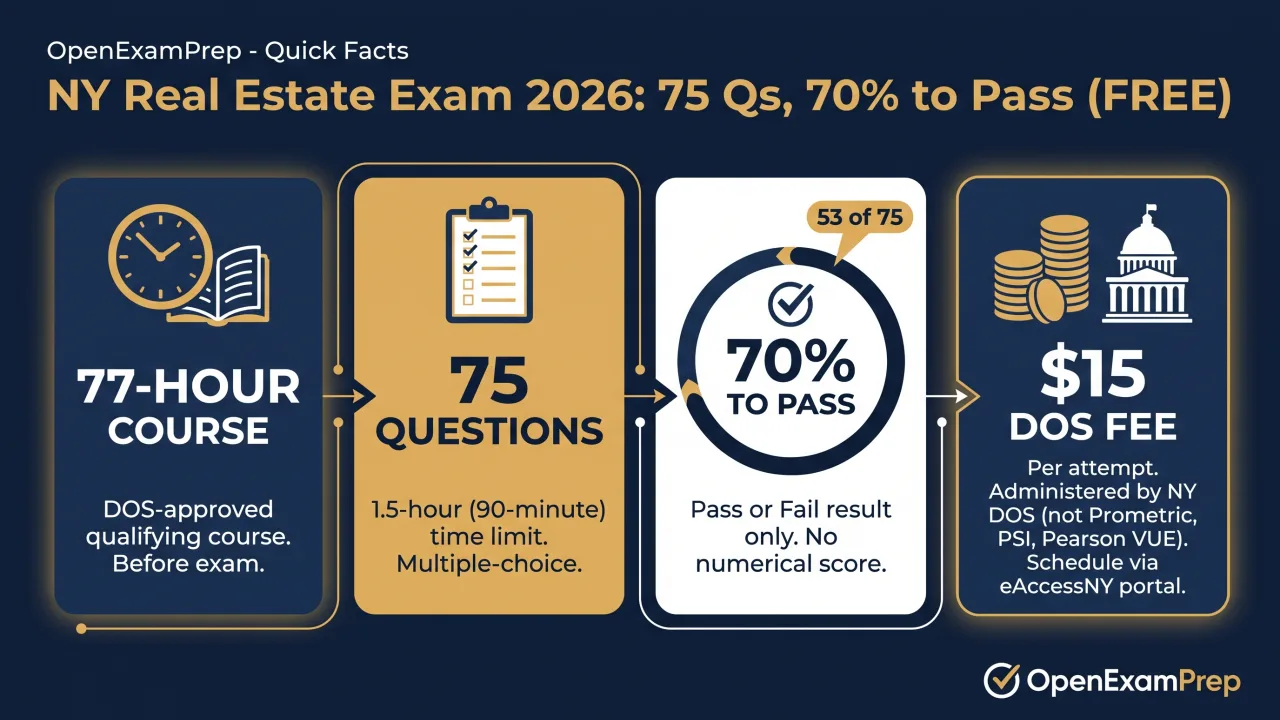
The New York Real Estate Salesperson Exam is administered directly by the New York Department of State (DOS) at state-run exam sites across New York. Unlike most states, New York does not use Prometric, PSI, or Pearson VUE for the salesperson test. You schedule and pay for the exam yourself through the DOS eAccessNY portal, and you take it on a computer at a DOS testing location.
The exam is a single computer-based test of 75 multiple-choice questions. You have 1.5 hours (90 minutes), and you must answer 70% correctly (53 of 75) to pass. There is no separate "national" and "state" section; the 75 questions blend national real estate principles (roughly 60%) with New York-specific law (roughly 40%) drawn from the 77-hour qualifying curriculum.
Passing this exam is one step toward working as a real estate salesperson in New York, home to over 19 million residents and the nation's largest metropolitan real estate market.
Exam Format at a Glance
| Component | Details |
|---|---|
| Administered by | New York Department of State (DOS) -- not Prometric/PSI/Pearson |
| Total Questions | 75 multiple-choice (one combined section) |
| Time Limit | 1.5 hours (90 minutes) |
| Passing Score | 70% (53 of 75); reported only as pass or fail |
| Exam Fee | $15 per attempt (paid via eAccessNY) |
| Scheduling | Online through the eAccessNY portal |
| Pre-licensing Education | 77-hour salesperson qualifying course |
| License Application Fee | $65 |
| License Term | 2 years |
| Continuing Education | 22.5 hours every 2 years |
How the New York Exam Is Different
- State-run, not vendor-run -- DOS administers the test itself; you book through eAccessNY, not a third party.
- Cheap to sit -- the $15 fee is one of the lowest exam fees in the country, and each retake is $15.
- Pass/fail result -- you are told only pass or fail; DOS does not release a numerical score, so you cannot see which topics you missed.
- Two-year validity -- a passing exam result is good for 2 years; if you do not apply for the license in that window, you must retest.
- Broader fair housing -- the New York State Human Rights Law protects more classes than the federal Fair Housing Act.
Start Your FREE New York Real Estate Exam Prep
Ready to begin studying? Our comprehensive, completely free New York Real Estate exam prep covers everything you need to pass.
Key Topics Covered on the Exam
The percentages below are study-weighting estimates based on the 77-hour qualifying syllabus, not an official DOS blueprint.
1. DOS & License Law
Department of State Authority:
- Article 12-A of the Real Property Law
- Licensing requirements and the eAccessNY application process
- License renewal and continuing education
- Disciplinary actions and violations
- Salesperson vs. broker requirements
License Law Fundamentals:
- Sponsoring broker requirements (you cannot work without one)
- Commission flows through the sponsoring broker
- Escrow/trust account regulations
- Record keeping requirements
- Advertising regulations (broker name disclosure)
Violations and Penalties:
- Unlicensed activity penalties
- License revocation and suspension grounds
- Fines and disciplinary actions
- Hearings and appeals process
2. Fair Housing
New York State Human Rights Law:
- Protected classes under NY law (broader than federal)
- Executive Law Section 296
- Additional protected categories such as lawful source of income
- State enforcement through the NYS Division of Human Rights
- Penalties for violations
Federal Fair Housing Act:
- Seven federally protected classes
- Prohibited practices: steering, blockbusting, redlining
- Exemptions and limitations
- HUD enforcement
Protected Classes Comparison:
| Federal Fair Housing Act | New York State adds (examples) |
|---|---|
| Race | Sexual orientation |
| Color | Gender identity or expression |
| Religion | Military status |
| National origin | Marital status |
| Sex | Age |
| Familial status | Lawful source of income |
| Disability | Status as a victim of domestic violence |
3. Contracts & Disclosures
Property Condition Disclosure Statement (PCDS) -- UPDATED 2024:
- As of March 20, 2024, the PCDS is mandatory for most one-to-four-unit residential sales.
- The old $500 credit opt-out was repealed -- sellers can no longer skip the form by giving the buyer a $500 credit.
- The form was expanded from 48 to 56 questions, adding seven flood-related disclosures (FEMA flood zones, prior flood damage, flood insurance, elevation certificate).
- Sellers must deliver the PCDS to the buyer before the buyer signs the contract of sale.
- Known defects and material facts must still be disclosed; sellers remain liable for willful failure to disclose.
Listing Agreements:
- Exclusive right to sell
- Exclusive agency
- Open listings
- Net listings (prohibited by 19 NYCRR § 175.19)
- Required provisions
Purchase Contracts:
- Offer and acceptance
- Contingencies (financing, inspection)
- Contract of sale requirements
- Mortgage commitment letters
- Attorney review (common in New York transactions)
Other Required Disclosures:
- Lead-based paint disclosure (federal, pre-1978 housing)
- New York agency disclosure form
- Smoke and carbon monoxide detector requirements
- Megan's Law notification
4. Property Law & Ownership
Types of Ownership:
- Fee simple absolute
- Life estates
- Tenancy in common
- Joint tenancy with right of survivorship
- Tenancy by the entirety (married couples)
- Cooperative ownership (very common in New York)
Real Property Taxes:
- Property tax assessment
- Tax liens and foreclosure
- STAR program exemptions
- Tax grievance procedures
Landlord-Tenant Law:
- Residential lease requirements
- Security deposit rules
- Eviction procedures
- Rent stabilization (NYC and certain localities)
- Rent control provisions
Cooperative and Condominium:
- Co-op board approval process
- Proprietary lease
- Flip tax considerations
- Common elements ownership
- Recognition agreements
Study Timeline for Success
| Week | Focus Area | Hours |
|---|---|---|
| Week 1-2 | DOS licensing and license law | 15-18 |
| Week 2-3 | Fair housing (federal and NY) | 15-18 |
| Week 3-4 | Contracts and disclosures (incl. 2024 PCDS rules) | 18-22 |
| Week 4-5 | Property law and ownership | 15-18 |
| Week 5-6 | Practice exams and review | 12-15 |
Total recommended study time: 60-80 hours of review on top of the required 77-hour qualifying course.
Free Practice Questions Available
Test your knowledge with hundreds of free practice questions written for the New York Real Estate exam, with full explanations and unlimited AI help (10 free AI questions a day).
New York-Specific Exam Tips
1. Master the State Human Rights Law
New York protects more classes than federal law:
- Know the NY-only classes (lawful source of income is heavily tested)
- Understand Executive Law Section 296
- State enforcement runs through the NYS Division of Human Rights, not HUD
- Source-of-income protection means you cannot refuse a tenant for using a housing voucher
2. Know the 2024 PCDS Rules
The Property Condition Disclosure Statement changed in 2024:
- The PCDS is now mandatory -- there is no $500 credit opt-out anymore
- The form has 56 questions, including seven new flood-disclosure questions
- It must be delivered before the buyer signs the contract
- If your study materials still say "48 questions" or "$500 credit," they are outdated
3. Know Cooperative Housing
Cooperatives are common in New York:
- The buyer purchases shares in a corporation, not real property
- Board approval is required for most transactions
- A proprietary lease governs occupancy
- Flip taxes may apply on resale
- Co-op financing uses a share loan, not a mortgage
4. Key Numbers to Remember
| Topic | New York Requirement |
|---|---|
| Questions / time | 75 questions in 90 minutes |
| Passing score | 70% (53 of 75) |
| Pre-licensing | 77 hours |
| License term | 2 years |
| CE requirement | 22.5 hours per 2 years |
| Exam fee | $15 per attempt |
| Application fee | $65 |
| PCDS | Mandatory, 56 questions (no $500 credit) |
Common Mistakes to Avoid
- Studying the old PCDS rule -- the $500 credit is gone and the form now has 56 questions
- Ignoring the State Human Rights Law -- broader than federal, heavily tested
- Confusing cooperatives with condos -- shares vs. real property
- Underestimating fair housing -- a large share of the state content
- Forgetting you need a sponsoring broker -- the license is not active until a broker sponsors you
- Pacing problems -- 90 minutes for 75 questions means about 72 seconds each
After Passing Your Exam
- Apply for the license through eAccessNY (passing result is valid 2 years)
- Pay the $65 application fee
- Have a sponsoring broker -- the license is not active until a broker sponsors you
- Complete fingerprinting/background processing as required
- Plan your 22.5 hours of CE for each 2-year renewal cycle
- Begin your real estate career in New York
2026 New York Updates
For 2026, be aware of:
- The 2024 PCDS overhaul is now fully in effect (mandatory form, 56 questions, no $500 credit)
- Continuing education includes required hours in implicit bias, cultural competency, and fair housing
- All scheduling, payment, and applications run through the eAccessNY portal
- Confirm the current exam-site list and ID rules on the DOS website before booking
Start Your New York Real Estate Career Today
The New York Real Estate Salesperson license opens doors to one of the nation's most dynamic markets, from the NYC metro area and Long Island to Upstate. With focused preparation on national principles plus New York's distinct rules, you can pass on your first attempt.
Our free study materials include:
- Complete topic coverage
- Practice questions with explanations
- State Human Rights Law specifics
- Updated PCDS and disclosure guides
- AI-powered study assistance (10 free AI questions per day)
Everything you need is available FREE.
How to Use This New York Guide Without Wasting Study Time
Treat the facts above as your control sheet, not as a one-time read. The most common mistake candidates make is reading a licensing overview, feeling familiar with the vocabulary, and then taking mixed practice questions before they can explain why each answer is right or wrong. For the New York real estate exam, build your prep around three passes: first learn the licensing workflow, then master the national real estate concepts, and finally drill the New York-specific rules until they feel separate from generic national law.
Start by copying the eligibility, education, sponsoring broker, application, fingerprint or background-check, testing vendor, passing score, and renewal facts from this article into one page. Leave a blank column next to each item titled "proof." In that proof column, write where the requirement appears in your course, candidate bulletin, state agency page, or school materials. This exercise is not busywork. It forces you to separate official licensing requirements from school marketing language, and it prevents exam-day confusion when a question asks what happens before licensure versus what happens after a license is issued.
When you study national topics, organize them by transaction stage. Property ownership, estates, encumbrances, land use, valuation, finance, agency, contracts, transfer, closing, and math are not isolated chapters in real practice. They appear in sequence as a client moves from representation to offer, financing, inspection, title, closing, and post-closing duties. If you can place a rule in the transaction timeline, you are less likely to confuse similar terms such as lien versus encumbrance, option versus right of first refusal, void versus voidable, or material fact versus ordinary sales puffery.
New York Licensing Workflow to Verify Before You Schedule
Before you schedule the exam, verify every step in the New York licensing workflow against the current state agency or testing vendor instructions. Use the article above for orientation, then confirm the current version of the candidate handbook, application portal, education certificate process, identification rules, and score-report policy. State real estate programs change forms and portal steps more often than they change core property law, so do not rely on an old school handout for the last administrative details.
A practical workflow looks like this. First, finish the required pre-license education and keep your completion documentation where you can find it. Second, confirm whether your exam authorization is automatic or requires a separate application step. Third, check whether the testing vendor requires a legal name match with your government ID. Fourth, decide whether you are testing both portions in one sitting or retesting a failed portion. Fifth, confirm what happens after passing: license application, broker sponsorship, background review, fee payment, and any post-license or continuing education deadlines.
That order matters because candidates often prepare for the content but lose days to process errors. A mismatched name, expired authorization, missing education certificate, or misunderstanding about broker sponsorship can delay a license even after a passing score. Add a calendar reminder for every expiration date mentioned in your candidate materials. If your passed score, education certificate, or application window expires, you may have to repeat work that was already finished.
Split Your Prep Between National Concepts and New York Rules
Most real estate exams reward candidates who can move back and forth between national principles and state-specific administration. Your national prep should answer questions such as: What kind of ownership interest exists? Which party owes which fiduciary duty? What makes a contract enforceable? How is title transferred? What financing rule applies? What calculation is needed? Your New York prep should answer a different set of questions: Who regulates the license? What must be disclosed? What conduct can trigger discipline? What forms or notices are required? What deadlines, fees, or renewal duties apply?
Do not blend those two tracks too early. Spend part of each study session on national concepts and part on New York rules, but review mistakes in separate lists. A missed agency question because you forgot obedience, loyalty, disclosure, confidentiality, accounting, and reasonable care is different from a missed state-law question because you confused the regulator, renewal period, or required disclosure. Separate error logs make your next study block much more precise.
For math, keep a compact formula page and practice under time. Real estate math is often more predictable than legal scenario questions, but it punishes sloppy reading. Circle what the question is asking for before calculating: commission amount, broker split, property tax, proration, loan-to-value, interest, area, or capitalization. Then write the units next to the answer. Many wrong choices are built from a correct formula applied to the wrong time period, percentage, or party.
Exam-Day Strategy for New York Candidates
On test day, read each question as if one word was placed there to change the answer. Words such as except, first, best, most likely, must, may, before, after, seller, buyer, broker, salesperson, and licensee are common traps. If a question gives a long fact pattern, identify the legal issue before looking at the answers. If you read the answers first, a familiar phrase can pull you toward a rule that does not match the facts.
Use a three-pass timing system. On the first pass, answer questions you can resolve confidently. On the second pass, return to marked questions that require calculation, close reading, or comparison between two plausible answers. On the final pass, make sure no item is blank and revisit only the questions where you have a specific reason to change an answer. Changing answers because of anxiety usually hurts more than it helps; changing an answer because you found a missed word in the stem is different.
New York combines national and state material into one 75-question section, so you cannot rely on a separate "state portion" to flag New York-specific items. A national-principle question and a New York-rule question can sit side by side. When the facts mention DOS, eAccessNY, the Human Rights Law, the PCDS, cooperatives, or rent stabilization, switch into New York mode; otherwise apply the broad national principle. Keep your pace near 72 seconds per question to finish all 75 in 90 minutes.
What to Do If Your Practice Scores Stall
If your practice scores stay below passing, stop taking full-length exams for a few days and audit your misses. Label each wrong answer as vocabulary, rule, application, math, state-specific detail, or reading error. Vocabulary misses need flashcards. Rule misses need a short outline. Application misses need scenario practice. Math misses need repeated setup drills. Reading errors need slower question review, not more content.
A strong final week is not about seeing the most questions. It is about seeing your weak patterns until they stop repeating. Rework every missed question without looking at the explanation, then write one sentence explaining why the correct answer is better than the tempting wrong answer. That sentence is where learning happens. If you cannot write it, return to the underlying rule before moving on.
For free next steps, use the OpenExamPrep New York study path here: New York real estate study guide. Then route weak areas into timed practice sets: real estate practice questions. Use the score report or your practice log to decide what to study next, not your comfort level with the topic.


 Buy on Amazon
 Flashcards on Mometrix
 Take courses on Udemy
 Pre-licensing on Colibri
 Pre-licensing on AceableAgent