How to Become a Notary Public in Maryland
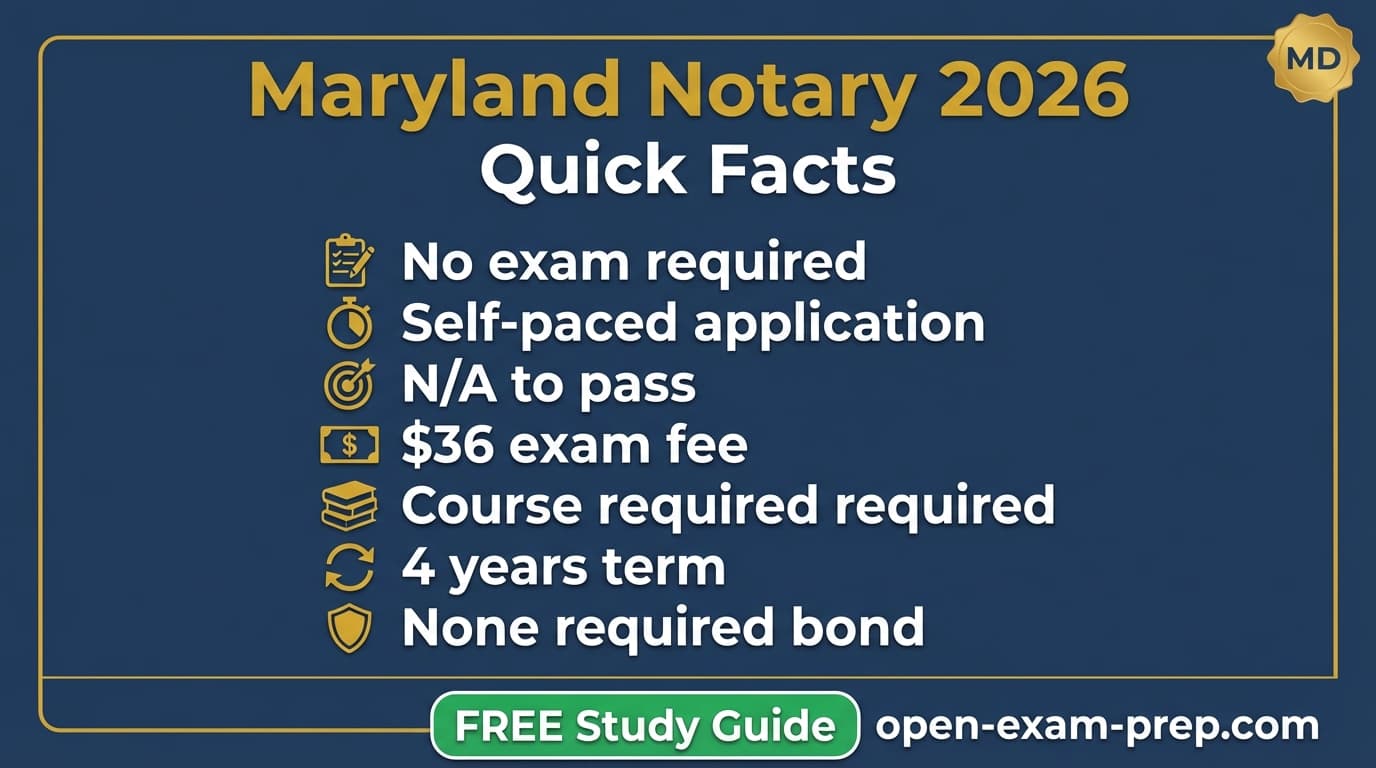
Maryland does not require a traditional exam to become a notary public. However, as of October 1, 2021, all new applicants must complete a Course of Study and pass an examination, while renewal applicants must complete a Course of Study. Maryland also requires State Senator approval of your application, making it unique among states.
Maryland Notary Requirements at a Glance
| Requirement | Details |
|---|---|
| Minimum Age | 18 years |
| Residency | Maryland resident OR employed in Maryland |
| Exam Required | Yes (as part of education course since Oct 2021) |
| Education Required | Yes - Course of Study required |
| Surety Bond | Not required |
| Commission Term | 4 years |
| Application Fee | $25 (SOS) + $11 (County Clerk) |
Why Become a Maryland Notary?
- No bond required - Lower startup costs
- 4-year commission - Long commission term
- RON authorized - Remote Online Notarization available since October 2020
- Set fee structure - Clear maximum fees ($4 per act)
- Growing demand - Constant need for notary services in the DMV area
Explore More Notary Resources
Looking for notary study materials or guides for other states? Check out our comprehensive resources. For additional education and supplies, visit the National Notary Association.
View All Notary Exam Prep Resources
Step-by-Step: How to Become a Maryland Notary
Step 1: Meet Eligibility Requirements
To become a Maryland notary public, you must:
- Be at least 18 years old
- Be of good moral character and integrity
- Be a resident of Maryland OR have a permanent place of work or practice in Maryland
- Out-of-state residents may qualify if their home state permits Maryland residents to serve as notaries (reciprocity)
Step 2: Complete the Course of Study
As of October 1, 2021, all new notary applicants must complete an approved Course of Study:
Course Requirements:
- Complete a Secretary of State-approved education course
- Pass the examination at the end of the course
- Course must be completed before submitting your application
- Cost: Varies by provider (approximately $50-$100)
Course Content Includes:
- Maryland notary laws and regulations
- Duties and responsibilities of a notary public
- Proper notarial procedures and certificate requirements
- Identity verification methods
- Journal and record-keeping requirements
Step 3: Order the Maryland Notary Handbook
Before applying, order the official Handbook for Maryland Notaries Public from the Secretary of State. This is a required resource for understanding your duties.
Step 4: Submit Your Application
Apply online through the Maryland OneStop portal:
- Create an account on Maryland OneStop
- Complete the Notary Commission Application
- Upload your education course completion certificate
- Pay the $25 application fee
Important: Your application will be sent to your State Senator for endorsement. This is a unique Maryland requirement.
Step 5: Await Senator Endorsement
After submitting your application:
- It goes to the State Senator of your district for approval
- Out-of-state applicants are reviewed by a designated Maryland senator
- Senator endorsement is required before approval
Step 6: Take the Oath of Office
Once approved by the Secretary of State:
- You have 30 days to take the Oath of Office
- Appear in person at your Circuit Court Clerk's office (in the county of your commission)
- Pay the $11 clerk fee ($10 commission fee + $1 state registration fee)
Important: Failure to qualify within 30 days revokes your commission.
Step 7: Purchase Notary Supplies
After completing the oath, purchase required supplies:
Official Notary Seal (Required):
- Embosser or rubber ink stamp
- Must be clear and photographically reproducible
- Cost: $20-$50
Required Seal Information:
- Your name exactly as commissioned
- County (or Baltimore City) of commission
- May include decorative symbols
- Must show notary's jurisdiction
Notary Journal/Register (Required):
- Maryland requires a "fair register" of all notarial acts
- May be bound paper or secure electronic format
- Must retain and provide copies if requested
- Cost: $15-$40
Maryland Notary Fees
| Service | Maximum Fee |
|---|---|
| Each notarial act | $4.00 |
| Remote Online Notarization | $4.00 (state cap) |
| Travel fees | By prior agreement |
Important Notes:
- Maryland has a clear $4.00 maximum per notarial act
- RON fees are also subject to this cap, though platform fees may be additional
- You may charge less than the maximum or waive fees entirely
Maryland-Specific Requirements
Seal Requirements
Your Maryland notary seal must meet specific requirements:
Format Options:
- Embosser (raised impression)
- Rubber ink stamp
Required Information:
- Your name exactly as on your commission
- County (or Baltimore City) of commission
- May include decorative symbols
- Must clearly show your jurisdiction
Certificate Requirement:
- Each notarization certificate must include your commission expiration date
- Example format: "My commission expires: [date]"
Journal/Register Requirements (Mandatory)
Maryland requires all notaries to maintain a "fair register" (journal) of all notarial acts:
Required Journal Entries:
- Date and time of the notarial act
- Signer's name and address
- Type of notarization performed
- Document details/description
- Fees charged
Journal Format:
- May be bound paper journal
- May be secure electronic format
- Must be prepared to furnish copies if requested
Retention:
- Must retain journals for at least 10 years
Education and Examination Requirements
New Applicants (since October 1, 2021):
- Must complete an approved Course of Study
- Must pass an examination at the end of the course
Renewal Applicants:
- Must complete a Course of Study (no exam required for renewals)
Senator Endorsement
Maryland is unique in requiring State Senator approval:
- Your application is reviewed by the State Senator of your district
- Out-of-state applicants are reviewed by a designated Maryland senator
- This adds time to the application process
Remote Online Notarization (RON) in Maryland
Maryland authorizes Remote Online Notarization (RON) effective October 1, 2020, under Senate Bill 678.
Becoming a Maryland Remote Notary
To perform RON in Maryland:
- Hold a valid Maryland notary commission in good standing
- Complete an approved remote notary training program
- Obtain a digital certificate for electronic signing
- Submit a Remote Notary Notification Form to the Secretary of State
- Select type(s) of remote notary services:
- Using an authorized RON vendor platform, AND/OR
- Using other communication technology
RON Authorized Vendors
Maryland maintains a list of authorized RON vendors on the Secretary of State website. You must use an approved platform for standard RON services.
RON Technology Requirements
- Reliable computer or tablet with webcam
- Stable internet connection
- Secure remote notarization platform complying with Maryland regulations
- Digital certificate for electronic signing
RON Training Requirements
Remote notaries must complete a training course covering:
- Remote notarization technology and procedures
- Identity verification methods
- Electronic record-keeping
- Maryland-specific RON regulations
RON Fee Cap
- Maryland's $4.00 maximum applies to RON as well
- Platform fees may be charged separately by the vendor
- Additional charges may apply depending on service providers
Types of RON Permitted
Maryland allows remote online notarization for:
- Acknowledgments
- Jurats
- Oaths or affirmations
Total Cost to Become a Maryland Notary
| Item | Cost |
|---|---|
| Education Course | $50-$100 |
| SOS Application Fee | $25 |
| County Clerk Fee | $11 |
| Notary Seal | $20-$50 |
| Journal | $15-$40 |
| Total Estimated | $121-$226 |
Note: Maryland does NOT require a surety bond, reducing startup costs.
For RON (additional):
| Item | Cost |
|---|---|
| RON Training Course | $50-$100 |
| Digital Certificate | Varies |
| RON Platform | Varies ($20-$50/month) |
| RON Additional Total | $50-$150+ |
Timeline: How Long Does It Take?
| Step | Estimated Time |
|---|---|
| Complete education course | 1-2 days |
| Submit application | 1 day |
| Senator endorsement | 1-4 weeks |
| SOS processing | 1-2 weeks |
| Take oath at County Clerk | 1 day (within 30 days of approval) |
| Order supplies | 3-5 days |
| Total | 3-6 weeks |
Note: Senator endorsement can add significant time to the process.
Renewing Your Maryland Commission
Maryland notary commissions are valid for 4 years.
Renewal Process:
- Renewal period begins 60 days before your commission expires
- You may renew up to 30 days after your expiration date
- Complete an approved Course of Study (no exam for renewals)
- Submit renewal application
- Pay the $25 SOS fee and $11 clerk fee
Important Notes:
- If you don't renew within 30 days after expiration, you must re-apply as a new notary
- New applicants (after a lapsed commission) must complete the course AND exam
- Purchase a new seal with your updated expiration date
Special Considerations
State Senator Endorsement
Maryland's unique requirement for Senator endorsement means:
- Processing takes longer than most states
- Political factors typically don't affect approval
- Contact your Senator's office if you experience delays
No Bond Required
Maryland does not require a surety bond for notaries. However:
- Consider obtaining Errors & Omissions (E&O) insurance for liability protection
- Many national bonding companies offer E&O coverage
Journal Retention
Maryland requires maintaining a journal (register) and retaining it for at least 10 years:
- Must provide copies if requested
- Serves as evidence of proper notarization
- Required for both traditional and electronic notarizations
Out-of-State Applicants
If you live outside Maryland but work in the state:
- Your home state must have reciprocity with Maryland
- You must have a permanent place of work or practice in Maryland
- A designated Maryland senator reviews your application
30-Day Oath Deadline
After SOS approval, you have exactly 30 days to:
- Appear in person at your Circuit Court Clerk's office
- Take the Oath of Office
- Pay the $11 clerk fee
Failure to meet this deadline revokes your commission, and you must start the process over.
Start Your Maryland Notary Career Today
Maryland offers a solid path to becoming a notary public with no bond requirement and clear fee structures. While the education requirement and Senator endorsement add steps, the 4-year commission term and RON authorization make Maryland an excellent state for building a notary business in the greater DMV area.

 Free CE
 Buy on Amazon
 Notary training on Notary.net
 Take courses on Udemy