How to Become a Notary Public in Kansas
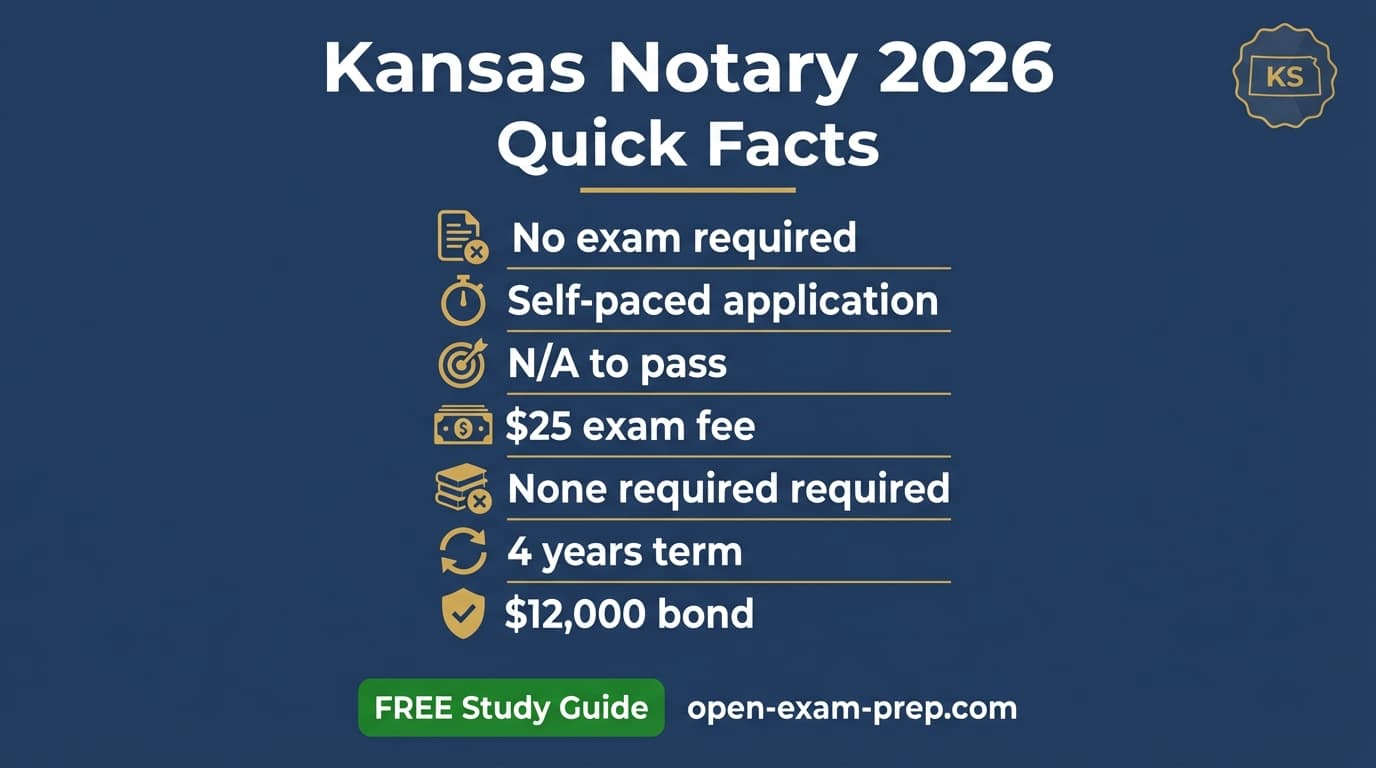
Kansas does not require an exam to become a notary public. However, Kansas requires a $12,000 surety bond and has mandatory journal requirements as of January 1, 2022, under the Revised Uniform Law on Notarial Acts (RULONA).
Kansas Notary Requirements at a Glance
| Requirement | Details |
|---|---|
| Minimum Age | 18 years |
| Residency | Kansas resident OR employed in Kansas (bordering state resident) |
| Exam Required | No |
| Education Required | No |
| Surety Bond | $12,000 |
| Commission Term | 4 years |
| Application Fee | $25 |
Why Become a Kansas Notary?
- No exam required - Straightforward application process
- 4-year commission - Long commission term
- RON authorized - Remote Online Notarization available since January 2022
- No fee caps - Can charge market rates for services
- Growing demand - Constant need for notary services
Explore More Notary Resources
Looking for notary study materials or guides for other states? Check out our comprehensive resources. For additional education and supplies, visit the National Notary Association.
View All Notary Exam Prep Resources
Step-by-Step: How to Become a Kansas Notary
Step 1: Meet Eligibility Requirements
To become a Kansas notary public, you must:
- Be at least 18 years old
- Be a legal Kansas resident OR a resident of a bordering state who regularly conducts business or is employed in Kansas
- Have no felony convictions or crimes involving fraud, dishonesty, or deceit (including diversion agreements)
- Have no history of a professional license being denied, revoked, or suspended for reasons related to fraud, dishonesty, or deceit
Step 2: Obtain Your Surety Bond
Before submitting your application, obtain a $12,000 surety bond:
- Bond Amount: $12,000 (increased from $7,500 as of January 1, 2022)
- Bond Term: 4 years (matches commission term)
- Typical Cost: $40-$60 for the 4-year term
- Provider: Must be from a state-approved surety company
Many providers include $10,000 of Errors & Omissions coverage with the bond.
Step 3: Submit Your Application
Apply through the Kansas Secretary of State:
- Complete the Notary Public Appointment Form (Form NO)
- Include your original surety bond
- Pay the $25 application fee (by credit card)
- Submit to the Secretary of State's office
Mailing Address: Kansas Secretary of State Memorial Hall, 1st Floor 120 SW 10th Avenue Topeka, KS 66612-1594
Step 4: Receive Your Commission
Once approved:
- You'll receive your Commission Certificate
- Your commission is valid for 4 years
- You may begin notarizing after obtaining your seal and journal
Step 5: Purchase Notary Supplies
After receiving your commission, purchase required supplies:
Official Notary Seal (Required):
- Rubber stamp or embosser format
- Must be clear and photographically reproducible
- Cost: $20-$50
Required Seal Information:
- Your name as commissioned
- "Notary Public"
- "State of Kansas"
- Commission expiration date
Notary Journal (Required):
- Mandatory as of January 1, 2022
- May be tangible (bound book) or electronic format
- Must retain for 10 years after the last entry
- Cost: $15-$40
Kansas Notary Fees
| Service | Maximum Fee |
|---|---|
| Notarial acts | No state maximum |
| Remote Online Notarization | No state maximum |
| Travel fees | By prior agreement |
Important Notes:
- Kansas does not set maximum fees for notarial acts
- If charging a fee, you must:
- Disclose the fee and get agreement before performing the act
- Inform the signer that a fee is permitted but not required by law
- Collect the fee at the time of the notarial act
- Record the fee in your journal
Kansas-Specific Requirements
Seal Requirements
Your Kansas notary seal must meet specific requirements:
Format Options:
- Rubber ink stamp
- Embosser
Required Information:
- Your name exactly as commissioned
- "Notary Public"
- "State of Kansas"
- Commission expiration date
Security:
- Safeguard your seal from misuse
- Destroy or disfigure your seal when your commission ends
Journal Requirements (Mandatory since January 1, 2022)
Kansas notaries must maintain a journal as of January 1, 2022:
Required Journal Entries:
- Date and time of the notarial act
- Description of the record and type of notarial act
- Full name and address of each individual for whom the act is performed
- If identity is based on personal knowledge, a statement to that effect
- If identity is based on satisfactory evidence, a description of the evidence
- The fee charged (if any)
Journal Format:
- May maintain a tangible (paper) journal - only one allowed
- May maintain electronic journals - multiple allowed
- Only the notary or Kansas Secretary of State may retain the journal
- Must retain for 10 years after the last entry
Important: As of January 1, 2022, no journal repositories (including employers) may hold your journal.
Certificate Requirements
Every notarial certificate must include:
- Your official seal impression
- Your signature
- The date of the notarial act
- Proper notarial wording for the act type
Remote Online Notarization (RON) in Kansas
Kansas authorizes Remote Online Notarization (RON) effective January 1, 2022, under SB 106 implementing the Revised Uniform Law on Notarial Acts (RULONA).
Becoming a Kansas Remote Notary
To perform RON in Kansas:
- Be an appointed Kansas notary public with a commission number
- Contract with an approved RON technology provider listed on the Kansas SOS website
- Obtain electronic signature, electronic stamp, and digital certificate
- Complete the required training and exam provided by the Secretary of State
- Print the certificate after passing the exam
- Submit the Change of Status Form NC, training certificate, and $20 fee
RON Technology Requirements
RON platforms must provide:
- Continuous audio-visual communication
- Identity verification (credential analysis + knowledge-based authentication)
- Session recording capability
- Tamper-evident electronic records
- Electronic seal affixation
RON Location Requirements
- The notary must be physically in Kansas during the RON session
- The remotely located individual can be anywhere
RON Recording Requirements
- Audio-visual recording of each RON session is mandatory
- Recording must be retained according to state requirements
- Electronic journal entries required for all RON sessions
RON Fees
- RON Registration Fee: $20
- RON Maximum Fee: No state maximum (must disclose and agree before act)
Total Cost to Become a Kansas Notary
| Item | Cost |
|---|---|
| Surety Bond (4 years) | $40-$60 |
| Application Fee | $25 |
| Notary Seal | $20-$50 |
| Journal | $15-$40 |
| Total Estimated | $100-$175 |
For RON (additional):
| Item | Cost |
|---|---|
| RON Training & Exam | Free (SOS provided) |
| RON Registration Fee | $20 |
| RON Platform | Varies ($20-$50/month) |
| RON Additional Total | $20+ |
Timeline: How Long Does It Take?
| Step | Estimated Time |
|---|---|
| Obtain surety bond | Same day (online) |
| Complete application | 1 day |
| Processing time | 1-2 weeks |
| Order supplies | 3-5 days |
| Total | 1-3 weeks |
Renewing Your Kansas Commission
Kansas notary commissions are valid for 4 years and do not automatically renew.
Renewal Process:
- File renewal paperwork 90 days before your commission expires
- Obtain a new $12,000 surety bond
- Pay the $25 renewal fee
- Submit renewal application to the Secretary of State
Important Notes:
- The state will send reminders, but it's your responsibility to renew on time
- Purchase a new seal with your updated expiration date and commission number
Special Considerations
Bond Increase
As of January 1, 2022, the surety bond amount increased from $7,500 to $12,000. All new applications and renewals require the higher bond amount.
Bordering State Residents
If you reside in a bordering state (Colorado, Missouri, Nebraska, or Oklahoma) but work in Kansas:
- You may qualify for a Kansas notary commission
- Must regularly conduct business or be employed in Kansas
- Same requirements apply (bond, journal, etc.)
Criminal Background
Certain criminal convictions will disqualify you from becoming a Kansas notary:
- Felony convictions
- Crimes involving fraud, dishonesty, or deceit
- Entering into diversion agreements for such crimes
- Having a professional license denied, revoked, or suspended for fraud-related reasons
Maintaining Your Commission
To keep your commission in good standing:
- Maintain your surety bond for the entire 4-year term
- Keep your journal secure and up to date
- Safeguard your seal
- Report any address changes to the Secretary of State
- Renew before your commission expires
Start Your Kansas Notary Career Today
Kansas offers a straightforward path to becoming a notary public with no exam required. While you'll need a $12,000 surety bond and must maintain a journal, the 4-year commission term and RON authorization make Kansas an excellent state for building a notary business.

 Free CE
 Buy on Amazon
 Notary training on Notary.net
 Take courses on Udemy