CNA Exam 2026: Your Complete Certification Guide
The CNA (Certified Nursing Assistant) exam is a two-part competency test required to add your name to your state's nurse aide registry and work as a nursing assistant in U.S. healthcare facilities. CNAs provide hands-on direct patient care under the supervision of licensed nurses, making this certification your fastest entry point into healthcare.
Most candidates take the NNAAP (National Nurse Aide Assessment Program) exam, administered by Credentia in most states. A handful of states use Prometric, D&S Diversified, or other vendors, but the structure is similar everywhere: a knowledge test plus a hands-on skills evaluation, both required by the federal OBRA '87 law.
This guide walks you through every step: how to become a CNA, exactly what is on the written and skills exams, what it costs, the registry and renewal rules, and how requirements vary by state.
How to Become a CNA in 2026 (6 Steps)
| Step | What You Do | Typical Timeline |
|---|---|---|
| 1. Meet eligibility | Be 16-18+ (varies by state), pass a background check, often a TB test/physical | Before enrollment |
| 2. Complete training | Finish a state-approved program: 75+ hours minimum (16+ clinical) | 4-12 weeks |
| 3. Apply to test | Register with your state's testing vendor (Credentia/NNAAP, Prometric, etc.) | 1-2 weeks |
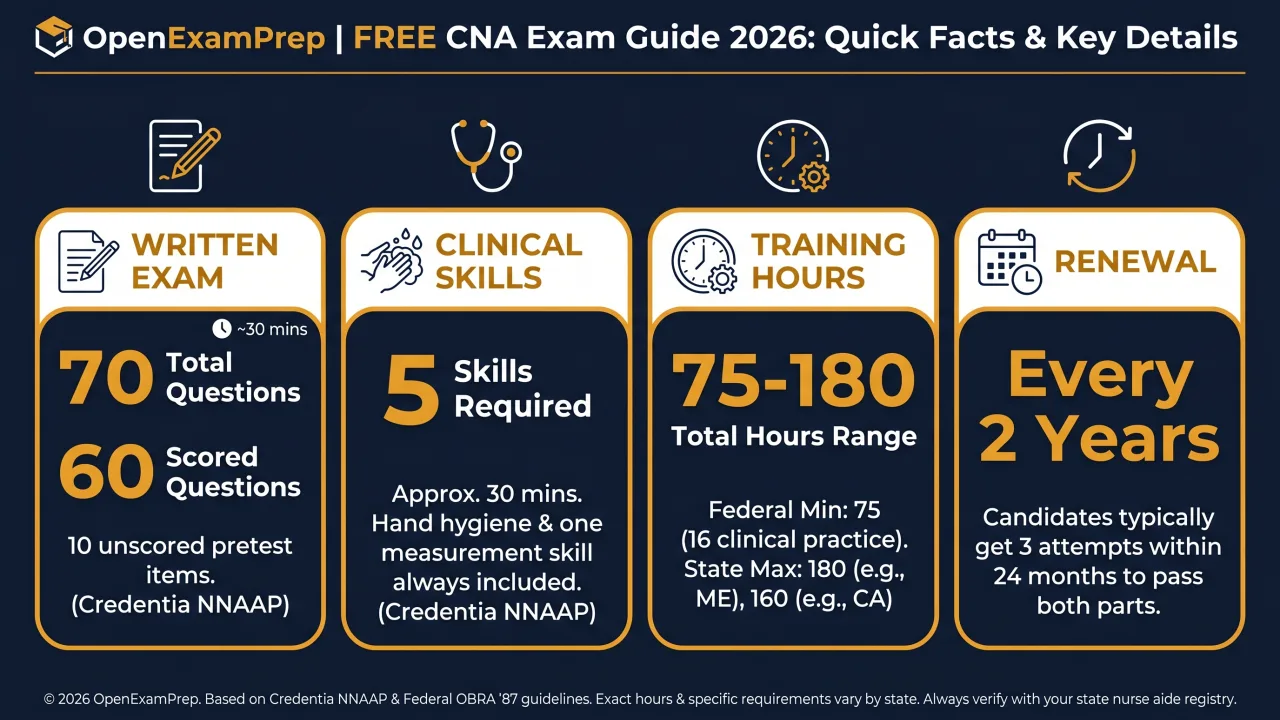
| 4. Pass the written (or oral) exam | 70 multiple-choice questions; ~70% to pass | Test day |
| 5. Pass the skills evaluation | Demonstrate 5 clinical skills correctly | Same or separate day |
| 6. Get listed on the registry | Your name is added to the state nurse aide registry; you can now work | Days to ~2 weeks |
Federal law (OBRA '87) sets the 75-hour training floor with at least 16 hours of supervised clinical practice, but many states require more - California requires 160 hours, Maine 180, and several states sit at 100-150 hours. Always confirm your state's number before enrolling.
Exam Format & Structure
| Component | Details |
|---|---|
| Written (or Oral) Exam | 70 multiple-choice items (60 scored + 10 unscored pretest) |
| Written Time | About 90 minutes (some states/vendors allow up to 120) |
| Oral Option | Available for candidates who struggle with reading English; includes a reading-comprehension component |
| Skills Evaluation | 5 clinical skills drawn from a 23-skill pool |
| Skills Time | About 30 minutes |
| Passing Standard | Per-form scaled cut score on the written; each skill scored on critical steps |
| Main Vendor | Credentia / NNAAP; also Prometric, D&S, Headmaster |
The CNA exam has two separate components you must pass:
- Written (or Oral) Examination - Tests your knowledge of nursing assistant concepts. Of the 70 questions, only 60 count toward your score; 10 are unscored pretest items being trialed for future exams.
- Clinical Skills Evaluation - You perform 5 skills in front of a trained Nurse Aide Evaluator. Hand hygiene (handwashing) is always one of the five, and at least one measurement skill (such as blood pressure, radial pulse, respirations, urine output, or weight) is always included.
The written passing standard is a scaled cut score that varies slightly by exam form, not a fixed raw percentage. As a practical study target, aim to answer at least 80% of practice questions correctly so you clear the bar comfortably on any form.
Start Your FREE CNA Prep Today
Take FREE CNA Practice Questions | Open the FREE CNA Study Guide
Our free tools cover all written content areas plus clinical-skills prep, with AI hints, instant wrong-answer explanations, and a daily free AI question limit of 10 - no credit card required.
CNA Written Exam Content Areas
The written exam tests your knowledge across 9 major content areas:
1. Role and Responsibilities (10-15%)
- CNA scope of practice and limitations
- Working within the healthcare team
- Delegation and supervision
- Chain of command
- Documentation and reporting
2. Communication (10-15%)
- Verbal and nonverbal communication
- Active listening techniques
- Communication with patients, families, and team
- Cultural sensitivity and awareness
- Reporting changes in condition
3. Infection Control (10-15%)
- Chain of infection
- Standard precautions
- Hand hygiene (most important!)
- Personal protective equipment (PPE)
- Transmission-based precautions
- Bloodborne pathogens
4. Safety and Emergency Procedures (10-15%)
- Fall prevention
- Fire safety (RACE and PASS)
- Restraint use and alternatives
- Body mechanics and safe lifting
- Emergency response
- Incident reporting
5. Personal Care Skills (15-20%)
- Bathing and showering
- Oral hygiene and denture care
- Hair care and grooming
- Dressing and undressing
- Perineal care
- Toileting and incontinence care
6. Basic Nursing Skills (15-20%)
- Vital signs measurement
- Height and weight
- Intake and output
- Positioning and transfers
- Range of motion exercises
- Catheter care
- Nutrition and feeding
7. Mental Health and Cognitive Care (5-10%)
- Dementia and Alzheimer's care
- Depression in elderly
- Anxiety and agitation
- Reality orientation
- Behavioral interventions
8. Legal and Ethical Considerations (5-10%)
- Residents' rights (OBRA)
- HIPAA and confidentiality
- Advance directives
- Informed consent
- Abuse and neglect reporting
9. Care of Special Populations (5-10%)
- Elderly (geriatric) care
- Rehabilitation patients
- Hospice and end-of-life care
- Developmentally disabled
Free Practice Questions & Study Materials
Every study set includes:
- Detailed content explanations
- NNAAP-style practice questions
- Clinical skills checklists
- Key takeaways for quick review
Clinical Skills Evaluation
The Clinical Skills Evaluation is the hands-on portion where you demonstrate nursing assistant skills on a live volunteer or actor. For most candidates this is the more nerve-wracking part of the exam, but it is highly predictable once you memorize the critical steps.
How the Skills Test Works
- Five skills: You perform exactly 5 skills from the official 23-skill NNAAP pool - not a vague 3-5 range.
- Guaranteed skills: Hand hygiene (handwashing) is always included, and at least one measurement skill (blood pressure, radial pulse, respirations, urine output, or weight) is always included. The other skills are randomly selected.
- Time limit: You have about 30 minutes to complete all five.
- Evaluation: A trained Nurse Aide Evaluator gives you an instruction card listing your five skills, then observes and scores you against a checklist.
- Critical Element Steps: Steps printed in bold on the checklist are mandatory. Skipping a Critical Element Step (for example, locking wheels before a transfer, or checking water temperature) fails that skill even if everything else is perfect.
The 23 Skills You Could Be Asked to Perform
Your five skills are drawn from this pool, so practice all of them:
| Category | Skills in the Pool |
|---|---|
| Infection Control | Hand hygiene (always), donning/doffing a gown and gloves |
| Measurement (one always) | Blood pressure, radial pulse, respirations, urinary output, weight of an ambulatory client |
| Personal Care | Bed bath/partial bath, mouth care, denture care, fingernail care, foot care, dressing a client with a weak arm, perineal care of a female client |
| Mobility & Positioning | Transfer to wheelchair with a gait/transfer belt, positioning on side, passive range-of-motion for knee/ankle or shoulder, ambulation with a transfer belt, applying anti-embolic (TED) stockings |
| Elimination & Catheter | Bedpan use, catheter care of a female client, emptying a urinary drainage bag |
| Nutrition & Hydration | Feeding a client, measuring and recording fluid output |
Hand Hygiene (Always One of Your Five Skills)
Hand hygiene is the one skill you are guaranteed to perform, and you also wash your hands before and after every other skill. Key points:
- Wet hands, apply soap
- Scrub all surfaces for at least 20 seconds
- Clean between fingers, under nails, wrists
- Rinse thoroughly, dry with paper towel
- Use towel to turn off faucet (don't recontaminate!)
Critical Steps for All Skills
These steps are mandatory - missing them fails the skill:
- Identify patient (check ID band or ask name)
- Explain procedure before starting
- Hand hygiene before and after
- Maintain privacy and dignity
- Ensure safety (bed position, side rails, call light)
Start FREE CNA Clinical Skills Practice
Our skills chapters include step-by-step procedures with critical steps highlighted for each of the 23 skills you could be asked to perform.
Cost, Attempts, and Retakes
| Item | Typical Range |
|---|---|
| Exam fee (written + skills) | About $90-$125 combined; some states charge each part separately |
| Retest fee | About $35-$60 for the part you need to repeat |
| Attempts allowed | Usually 3 attempts within 24 months of completing training |
| If you fail 3 times | Most states require you to retake the training program before testing again |
If you pass one part and fail the other, most states let you retake only the failed section rather than the whole exam, as long as you do it within the allowed window. Schedule the retake quickly so you stay inside the 24-month/3-attempt limit.
The Nurse Aide Registry and Renewal
Passing both parts does not by itself let you work - your name must be added to your state nurse aide registry, the official OBRA '87 list of certified aides. Employers verify the registry before hiring, so confirm your listing online after you pass.
| Requirement | Standard |
|---|---|
| Renewal period | Every 2 years in most states |
| Work requirement | At least 8 hours of paid nursing or nursing-related work within the 24-month period (federal OBRA minimum) |
| Lapsed certification | If you do not work the required hours, your certification can lapse and you may need to retest or retrain |
| Renewal fee | Often $0-$50, varies by state |
The 8-hours-of-paid-work rule is federal. Many states keep exactly that minimum; some require continuing education on top of it. Renewing on time is far easier than reactivating a lapsed certification.
State-Specific Requirements
CNA certification is regulated at the state level, so the details vary:
| Requirement | Range by State |
|---|---|
| Training Hours | 75 hours (federal floor) up to 180 hours (e.g., Maine) |
| Clinical Hours | 16 hours (federal floor) up to 100+ hours |
| Minimum Age | 16-18 years old |
| Background Check | Required everywhere |
| Renewal Period | Every 2 years (most states) |
| Work Requirement | 8+ hours of paid nursing work per renewal period |
Examples: California requires 160 training hours, Maine 180, while many states use the 75-hour federal minimum. Texas, Florida, and others have their own registry portals and fee schedules.
Testing Vendors by State
| Vendor | States (examples) |
|---|---|
| Credentia / NNAAP | Most states (default) |
| Prometric | FL, NY, and others |
| D&S Diversified | AZ, TN, OR, OH |
| Headmaster / Pearson VUE | IL, KS, MO, and others |
Always check your state board of nursing or nurse aide registry for the exact vendor, fee, and training hours before you enroll.
Study Timeline for CNA Exam Success
| Week | Focus | Activities |
|---|---|---|
| 1-2 | Foundation | Chapters 1-4 (Role, Communication, Infection, Safety) |
| 3-4 | Core Skills | Chapters 5-7 (Personal Care, Nursing Skills, Mental Health) |
| 5 | Specialized | Chapters 8-9 (Legal/Ethical, Special Populations) |
| 6 | Final Review | Practice tests + skills practice |
Recommended: 50-100 hours total after training program
Test-Taking Strategies
For Written Exam
- Read questions carefully - Look for keywords
- Eliminate wrong answers - Then choose best remaining
- Choose the safest answer - Patient safety is priority
- Maintain dignity - Privacy and respect matter
- Stay in scope - Know what CNAs can and cannot do
For Skills Exam
- Practice until automatic - No hesitation during test
- Talk through steps - Helps you remember and shows evaluator
- NEVER skip hand hygiene - Before AND after every skill
- Identify the patient - Every single time
- Explain procedure - Communication is key
- Don't rush - Accuracy over speed
Career Advancement: CNA to LPN/RN
CNA certification is an excellent stepping stone to nursing:
| Path | Duration | Details |
|---|---|---|
| CNA to LPN | 12-18 months | Practical nursing program |
| CNA to ADN (RN) | 2 years | Associate degree nursing |
| CNA to BSN (RN) | 4 years | Bachelor's degree nursing |
Many CNAs continue working while attending nursing school, gaining valuable experience.
Pass the CNA Exam with Confidence
Start FREE CNA Practice Questions | Open the FREE CNA Study Guide
Join thousands of nursing assistant candidates who prepared with our 100% FREE materials:
- All written content areas covered in plain language
- Clinical skills checklists with critical steps for all 23 skills
- AI-powered study assistance for instant explanations (10 free AI questions per day)
- Regularly updated for 2026 exam content
No credit card required. Start studying today.
Official Resources
- Credentia CNA Testing - Official NNAAP testing provider
- NCSBN NNAAP Information - National Council of State Boards of Nursing
- Prometric CNA Testing
- CMS Nurse Aide Registry
- Your State Board of Nursing website
Add This Clinical Review Layer Before Test Day
Use the final stretch for decision quality, not just more exposure to facts. Start each study block for FREE CNA Exam Guide 2026: Pass Written & Clinical Skills First Try by naming the task the question is really testing: recognition, prioritization, safety, communication, documentation, or workflow. Healthcare exams often hide the correct answer behind a familiar detail, so the safest habit is to pause before reading the options and predict what a competent entry-level professional would do next. That prediction keeps you from chasing the option that sounds medically interesting but does not answer the actual patient-care problem.
Build a small error log with four columns: missed topic, missed cue, correct rule, and next drill. A missed cue is more useful than a broad content label. For example, do not only write cardiovascular, infection control, medication safety, specimen handling, imaging, or professional practice. Write the actual cue you ignored: unstable finding, contraindication, timing before a procedure, patient identification, scope boundary, chain of custody, isolation wording, or documentation sequence. Review that log every two or three days and convert repeated misses into short practice sets.
Official-Source Check
Before relying on any third-party outline, compare your plan with the Credentia nurse aide testing site. Official pages and candidate handbooks are the place to confirm current eligibility language, testing vendor instructions, identification rules, rescheduling policies, accommodations steps, and any content outline changes. You do not need to memorize administrative details for every practice question, but you do need to avoid preparing from an outdated blueprint or an old retake policy. If a handbook uses different domain names than your notes, rename your notes to match the handbook so your remediation stays aligned with the exam owner.
Scenario Strategy for Clinical and Administrative Questions
Read healthcare scenarios in this order: setting, role, patient or client status, time pressure, and requested action. The role matters because many distractors are clinically reasonable but outside the expected scope for the candidate. A nursing, allied health, pharmacy, laboratory, imaging, respiratory, compliance, or management exam may ask what should be done first, what should be reported, what should be documented, or what should be delegated. Those verbs change the answer. Highlight them in practice even if the real test interface does not let you mark text the same way.
When two options both look correct, choose the one that best protects the patient, preserves specimen or data integrity, follows policy, or escalates an unsafe condition. Avoid answers that skip assessment, skip identification, skip hand hygiene or privacy safeguards, give education before immediate safety is addressed, or perform a task that belongs to another licensed professional. For management and compliance exams, translate clinical safety into system safety: risk identification, incident response, documentation, auditing, corrective action, and communication with the right stakeholder.
Practice Routing After Each Score Report
Do not retake full-length practice exams until you know what the previous one taught you. After each set, sort misses into three groups. Knowledge misses need a short content review and then ten targeted questions. Reasoning misses need rationales: write why the correct answer is safer or more aligned with the role than your answer. Speed misses need shorter timed sets, not another full review chapter.
In the last week, keep practice mixed. Real exam questions rarely announce the domain, and mixed sets force you to choose between similar procedures, symptoms, lab clues, safety steps, and communication tasks. End each day with a brief review of high-yield normal findings, urgent findings, infection prevention, medication or equipment safety, and professional boundaries that appear in your own missed-question history. The goal is not to feel as if every topic is finished. The goal is to enter the exam with a repeatable method for unfamiliar cases: identify the role, find the safety issue, rule out unsafe shortcuts, and choose the action that a careful professional could defend.


 Buy on Amazon
 Flashcards on Mometrix
 Practice exams on ExamEdge
 Take courses on Udemy