FACHE in 2026: Study Like an Executive, Not Like a Department Manager
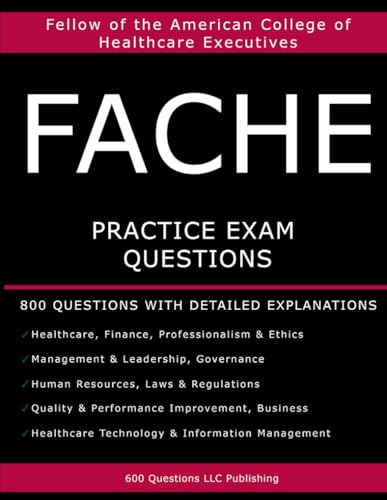
The Board of Governors Exam in Healthcare Management is the exam step in earning Fellow status with the American College of Healthcare Executives. Generic pages often reduce it to a big multiple-choice test. That misses the point. The FACHE exam is built around broad healthcare-management judgment across strategy, finance, HR, law, quality, technology, governance, ethics, and leadership. Candidates who study only their current lane, such as operations, finance, nursing administration, or quality, leave too many domains exposed.
The FACHE Process Trap
The Board of Governors Exam is only one requirement in the Fellow process. Before you treat this as a stand-alone test purchase, confirm your ACHE membership status, Fellow application, healthcare-management tenure, education, references, volunteer and continuing-education requirements, and any current waiver or campaign rules. Passing the exam does not fix a weak or incomplete Fellow application.
This matters for timing. If your application is still pending, or if you are relying on an exam-fee waiver tied to a specific application period, your study plan should match ACHE's approval and authorization sequence rather than an arbitrary test date.
What the Exam Is Designed To Measure
ACHE says the Board of Governors Exam tests a broad body of knowledge representative of professional practice in healthcare management. The word "broad" matters. A hospital CFO may need HR and quality refreshers. An operations director may need finance and governance. A clinical leader may need law, business, and information management.
The current outline, effective August 1, 2023, defines 10 knowledge areas across 200 scored questions:
| Knowledge area | Weight | Scored questions |
|---|---|---|
| Healthcare | 15% | 30 |
| Management and Leadership | 13% | 26 |
| Finance | 12% | 24 |
| Human Resources | 12% | 24 |
| Laws and Regulations | 9% | 18 |
| Quality and Performance Improvement | 9% | 18 |
| Business | 8% | 16 |
| Healthcare Technology and Information Management | 8% | 16 |
| Professionalism and Ethics | 8% | 16 |
| Governance and Organizational Structure | 6% | 12 |
Healthcare, leadership, finance, and HR together account for more than half of the scored exam. But the lower-weight domains are dangerous because they contain executive judgment topics that candidates may not encounter daily.
The Right Study Lens
For every domain, ask: what would a competent healthcare executive need to decide, evaluate, or govern? In finance, that means interpreting budgets, reimbursement, capital, revenue cycle, and supply chain consequences. In law, it means recognizing compliance risk, patient rights, HIPAA, EMTALA, Stark, antitrust, accreditation, and labor implications. In quality, it means knowing which improvement tool fits the problem and how measures affect operations.
Domain-Specific Failure Modes
| Candidate background | Likely blind spot | How to repair it |
|---|---|---|
| Finance executive | Clinical quality, patient safety, medical staff relationships | Study cases where financial choices affect outcomes and access |
| Clinical leader | Capital finance, reimbursement, contracts, governance | Practice executive tradeoffs beyond the unit level |
| Operations director | Law, HR, ethics, and information management | Build quick-reference sheets for statutes, labor issues, cybersecurity, and privacy |
| Quality or risk leader | Strategy, marketing, payer mix, business planning | Connect improvement work to market, revenue, and board-level decisions |
The exam is long enough to expose weak lanes. A candidate who is excellent in two domains but thin in the rest can still lose too many points.
A 12-Week Executive Prep Plan
Weeks 1-2: Healthcare systems, terminology, continuum of care, population health, digital health, social determinants, and care delivery models.
Weeks 3-4: Management, leadership, HR, organizational design, emergency preparedness, labor relations, staff engagement, and succession planning.
Weeks 5-6: Finance. Study reimbursement, revenue cycle, operating budgets, capital planning, financial ratios, productivity, supply chain, and payer mix.
Weeks 7-8: Law, regulation, quality, patient safety, risk management, accreditation, HIPAA, EMTALA, Stark, No Surprises Act, PDSA, Lean, Six Sigma, and HCAHPS.
Weeks 9-10: Business, strategy, marketing, contracts, health IT, cybersecurity, analytics, interoperability, governance, and medical staff relationships.
Weeks 11-12: Ethics, mixed simulations, weak-domain remediation, and 6-hour pacing. Review misses by executive decision type, not only topic.
Exam-Day Strategy for a Six-Hour Test
Six hours is generous but mentally expensive. Do not spend the first 50 questions proving you can solve every item perfectly. Move through first-pass questions decisively, flag uncertain items, and preserve mental energy for later domains. Trial questions are not identified, so treat all 230 items seriously without letting odd items derail pacing.
Readiness Criteria for a Six-Hour Executive Exam
Before scheduling, complete at least two long mixed blocks and one near-full simulation. Your target is not only accuracy; it is mental endurance across all 10 domains. A useful benchmark is steady performance above 75%-80% on mixed practice with no domain below 65%. If one domain keeps falling below that floor, do not let strong daily-work domains hide the risk.
On review, write the executive reason for each correct answer: board accountability, financial stewardship, workforce risk, legal exposure, quality outcome, strategic fit, or ethical duty. That habit aligns practice with how ACHE frames competence.
Official Sources To Check
Use ACHE's FACHE overview for the overall Fellow process and ACHE's Board of Governors Exam page for exam length, scoring structure, Pearson VUE administration, fees, retake timing, and preparation links.
Maintaining the FACHE Credential After Passing
FACHE is not a lifetime credential. ACHE requires recertification every three years. To recertify, Fellows must earn a minimum of 36 continuing education credits in the three years before applying, including at least 12 ACHE In-Person Education credits, and complete four volunteer activities (two community/civic and two healthcare-related). The recertification application carries a $200 nonrefundable fee. Alternatively, Fellows may recertify by retaking and passing the Board of Governors Exam for a $350 fee per attempt. ACHE does not offer deadline extensions, so plan continuing education early in each three-year cycle.
The FACHE Takeaway
FACHE preparation is a leadership audit. It shows whether your healthcare-management knowledge extends beyond your job description. The strongest candidates study across domains, connect decisions to organizational consequences, and practice executive-level reasoning under time.
Add This Clinical Review Layer Before Test Day
Use the final stretch for decision quality, not just more exposure to facts. Start each study block for FREE ACHE FACHE Board of Governors Exam Guide 2026 by naming the task the question is really testing: recognition, prioritization, safety, communication, documentation, or workflow. Healthcare exams often hide the correct answer behind a familiar detail, so the safest habit is to pause before reading the options and predict what a competent entry-level professional would do next. That prediction keeps you from chasing the option that sounds medically interesting but does not answer the actual patient-care problem.
Build a small error log with four columns: missed topic, missed cue, correct rule, and next drill. A missed cue is more useful than a broad content label. For example, do not only write cardiovascular, infection control, medication safety, specimen handling, imaging, or professional practice. Write the actual cue you ignored: unstable finding, contraindication, timing before a procedure, patient identification, scope boundary, chain of custody, isolation wording, or documentation sequence. Review that log every two or three days and convert repeated misses into short practice sets.
Official-Source Check
Before relying on any third-party outline, compare your plan with ACHE FACHE credential resources. Official pages and candidate handbooks are the place to confirm current eligibility language, testing vendor instructions, identification rules, rescheduling policies, accommodations steps, and any content outline changes. You do not need to memorize administrative details for every practice question, but you do need to avoid preparing from an outdated blueprint or an old retake policy. If a handbook uses different domain names than your notes, rename your notes to match the handbook so your remediation stays aligned with the exam owner.
Scenario Strategy for Clinical and Administrative Questions
Read healthcare scenarios in this order: setting, role, patient or client status, time pressure, and requested action. The role matters because many distractors are clinically reasonable but outside the expected scope for the candidate. A nursing, allied health, pharmacy, laboratory, imaging, respiratory, compliance, or management exam may ask what should be done first, what should be reported, what should be documented, or what should be delegated. Those verbs change the answer. Highlight them in practice even if the real test interface does not let you mark text the same way.
When two options both look correct, choose the one that best protects the patient, preserves specimen or data integrity, follows policy, or escalates an unsafe condition. Avoid answers that skip assessment, skip identification, skip hand hygiene or privacy safeguards, give education before immediate safety is addressed, or perform a task that belongs to another licensed professional. For management and compliance exams, translate clinical safety into system safety: risk identification, incident response, documentation, auditing, corrective action, and communication with the right stakeholder.
Practice Routing After Each Score Report
Do not retake full-length practice exams until you know what the previous one taught you. After each set, sort misses into three groups. Knowledge misses need a short content review and then ten targeted questions. Reasoning misses need rationales: write why the correct answer is safer or more aligned with the role than your answer. Speed misses need shorter timed sets, not another full review chapter.
In the last week, keep practice mixed. Real exam questions rarely announce the domain, and mixed sets force you to choose between similar procedures, symptoms, lab clues, safety steps, and communication tasks. End each day with a brief review of high-yield normal findings, urgent findings, infection prevention, medication or equipment safety, and professional boundaries that appear in your own missed-question history. The goal is not to feel as if every topic is finished. The goal is to enter the exam with a repeatable method for unfamiliar cases: identify the role, find the safety issue, rule out unsafe shortcuts, and choose the action that a careful professional could defend.
 Buy on Amazon