NMLS MLO vs Series 6
NMLS MLO and Series 6 represent two different financial product specializations, both commonly found in bank settings. MLOs specialize in mortgage lending - helping customers finance home purchases. Series 6 representatives specialize in packaged investment products - helping customers invest in mutual funds and variable annuities. Banks often cross-train employees in both areas since customers seeking mortgages may also need investment accounts, and vice versa. However, the regulatory frameworks are completely separate (NMLS vs FINRA).
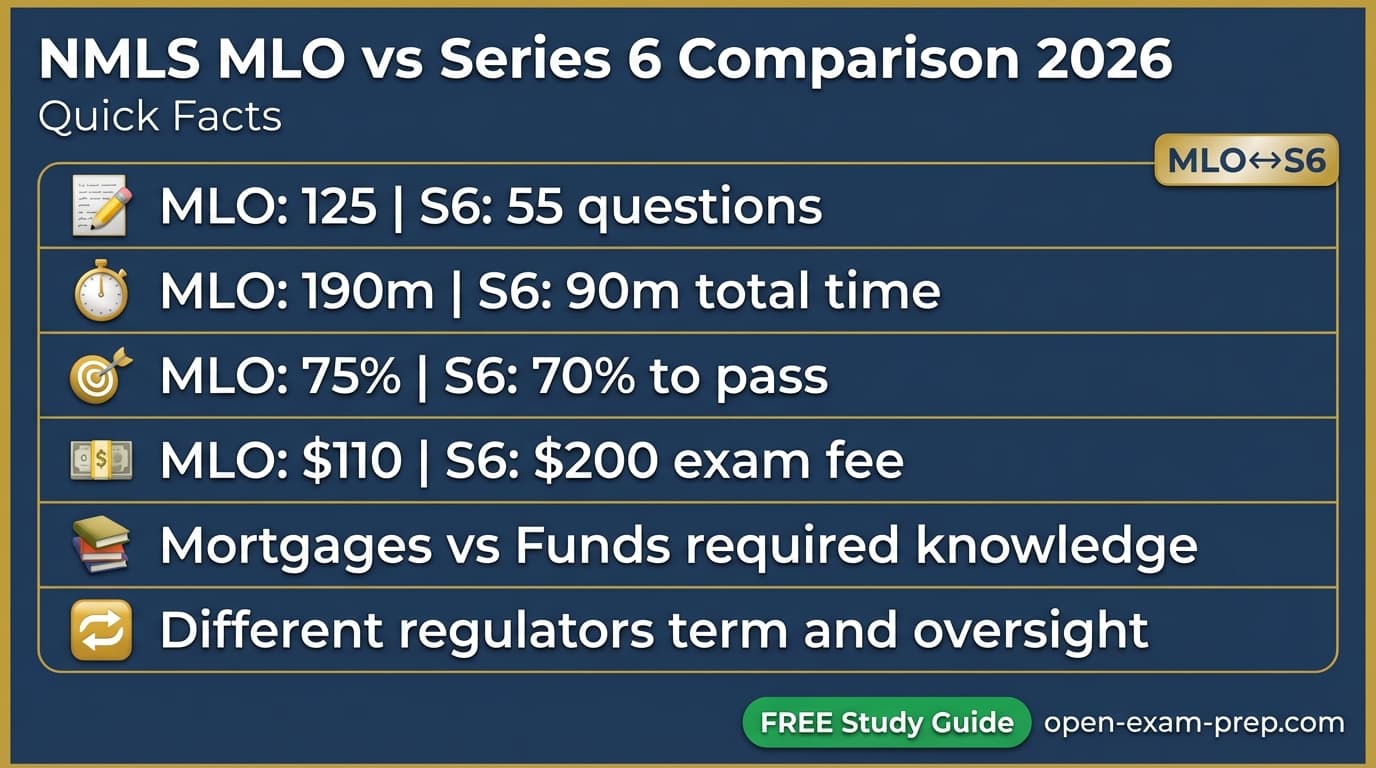
Side-by-Side Comparison
| Feature | NMLS MLO | Series 6 |
|---|---|---|
| Full Name | SAFE Mortgage Loan Originator Test | Investment Company and Variable Contracts Products Representative |
| Exam Cost | $110 | $120 |
| Passing Score | 75% (86 of 115) | 70% |
| Questions | 125 (115 scored + 10 unscored) | 50 scored + 5 unscored |
| Time Limit | 190 minutes | 90 minutes |
| Study Time | 40-80 hours | 30-50 hours |
| Difficulty | Moderate | Moderate |
| Prerequisites | 20 hours NMLS-approved pre-licensing education | SIE exam + firm sponsorship |
| Exam Body | NMLS (administered by Prometric) | FINRA |
Key Differences
- 1MLO is for mortgage lending; Series 6 is for investment products
- 2MLO regulated by NMLS/state; Series 6 regulated by FINRA
- 3MLO requires 20 hours education; Series 6 requires SIE + firm sponsorship
- 4MLO can work independently; Series 6 requires broker-dealer affiliation
- 5MLO commission is per-loan; Series 6 commission is per-product sale
- 6MLO exam is $110; Series 6 total is $200 (SIE $80 + Series 6 $120)
What Each Exam Allows You To Do
NMLS MLO
- Originate residential mortgage loans
- Work at mortgage companies, banks, credit unions
- Help homebuyers secure financing
- Earn commission on loan production
Series 6
- Sell mutual funds
- Sell variable annuities
- Sell variable life insurance
- Sell unit investment trusts
Who Should Take Each Exam?
Take the NMLS MLO if you...
- →Mortgage lending careers
- →Bank lending departments
- →Real estate professionals adding services
- →Commission-based sales professionals
Take the Series 6 if you...
- →Bank investment representatives
- →Insurance agents adding investments
- →Entry-level securities roles
- →Those in packaged product sales
Which Should You Take First?
Your employer likely determines this. Bank employees often get Series 6 first since the bank provides SIE/Series 6 sponsorship during onboarding training, then add MLO later if they work in lending. Independent professionals typically start with MLO since it doesn't require firm sponsorship. If you're choosing for yourself, MLO offers more independence and larger per-transaction commissions, while Series 6 provides steadier opportunities in established bank programs.
Frequently Asked Questions
QCan I work at a bank with both MLO and Series 6 licenses?
Yes, and many bank employees hold both. Banks appreciate employees who can serve customers across product lines. You might help a customer with their mortgage and then discuss investing their savings in mutual funds. However, you must be careful about compliance - mortgage activities are regulated by NMLS and state banking departments, while investment activities are regulated by FINRA. Banks have strict separation of duties and disclosure requirements.
QWhich license is harder to get - NMLS MLO or Series 6?
NMLS MLO is slightly harder overall. The MLO exam has a 58% first-time pass rate and covers extensive federal regulations (TILA, RESPA, ECOA, FCRA, HMDA). Series 6 alone has about a 60-70% pass rate, but you must also pass the SIE exam first. The total investment for Series 6 path (SIE + Series 6 + Series 63 for state registration) is greater than MLO alone. MLO can be obtained independently; Series 6 requires employer sponsorship.
QWhich has better earning potential - MLO or Series 6?
Top MLOs typically earn more. Successful MLOs can earn $100,000-$200,000+ in strong markets, with commission around 1% of loan amounts ($3,000-$5,000 per typical loan). Series 6 representatives at banks earn $40,000-$70,000 typically, with modest commissions on mutual fund and annuity sales. However, Series 6 income is more stable (not tied to housing market), and some Series 6 reps at large banks or insurance companies do earn six figures with large client bases.
QShould mortgage professionals add Series 6?
It depends on your career goals. Adding Series 6 lets you offer clients investment products alongside mortgages - useful for customer retention and additional income. However, it requires affiliating with a broker-dealer and following FINRA compliance rules. Many MLOs prefer to refer investment business to partners rather than manage dual compliance. If you're at a bank that encourages cross-selling, Series 6 makes sense. Independent mortgage brokers often skip it.
10 free AI interactions per day
Free exam resources
Start Studying the Exact Exam
Use the comparison to choose a path, then move into the matching practice questions, study guide, and flashcards.
Third-party resources · We may earn a commission from purchases.

NMLS Study Guide 2026-2027 - 5 Full-Length Practice Tests, SAFE MLO Exam Prep Secrets Book for the Mortgage Loan Originator Exam: [4th Edition]
By Bowling, Matthew
$39.99 · 
 MLO pre-licensing on Aceable Mortgage
 Take courses on Udemy
 Flashcards on Mometrix
Third-party resources · We may earn a commission from purchases.

Series 6 Exam Secrets Study Guide: Series 6 Test Review for the Investment Company Products/Variable Contracts Limited Representative Qualification Exam
By Series 6 Exam Secrets Test Prep Team
$56.99 ·
Study guide on Mometrix Practice exams on ExamEdge
 Prep course on Achievable
Related Exam Comparisons
Stay Updated
Get free exam tips and study guides delivered to your inbox.