CDA vs Praxis Core
CDA and Praxis Core represent pathways into two different levels of education careers. CDA credentials qualify you to work with children ages 0-5 in childcare settings (daycare centers, Head Start, preschools) - you can work immediately after earning the credential. Praxis Core is an admission test for teacher preparation programs that lead to K-12 teaching licensure - it's the first step in a multi-year process to become a licensed classroom teacher. CDA is the credential; Praxis Core is the entrance exam to eventually earn a credential.
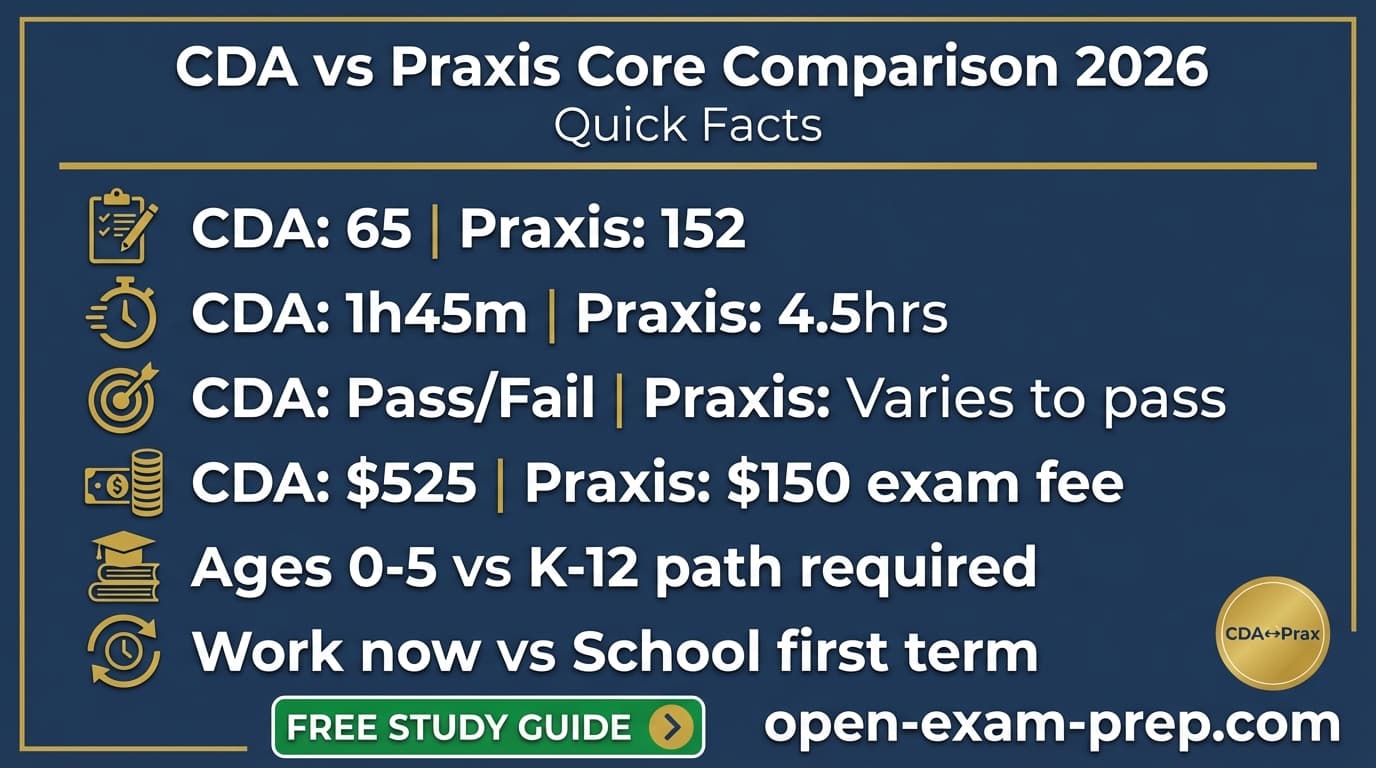
Side-by-Side Comparison
| Feature | CDA | Praxis Core |
|---|---|---|
| Full Name | Child Development Associate | Praxis Core Academic Skills for Educators |
| Exam Cost | $525 (online application) | $150 (all three) or $90 each |
| Passing Score | Pass/Fail (competency-based) | Varies by state (Reading 156-162, Writing 158-162, Math 130-150) |
| Questions | 65 multiple-choice + verification visit | 152 total (56 Reading + 40 Writing + 56 Math) |
| Time Limit | 1 hour 45 minutes (exam) | 4.5 hours total (all three) |
| Study Time | 120 hours professional education | 40-60 hours |
| Difficulty | Moderate | Moderate |
| Prerequisites | 480 hours work experience + 120 hours training + portfolio | None (for teacher prep program admission) |
| Exam Body | Council for Professional Recognition | ETS (Educational Testing Service) |
Key Differences
- 1CDA is a credential for working; Praxis Core is an exam for program admission
- 2CDA allows immediate employment; Praxis Core starts a years-long process
- 3CDA serves ages 0-5; Praxis Core leads to K-12 teaching
- 4CDA costs $525 for the credential; Praxis Core costs $150 for the tests
- 5CDA requires experience + portfolio; Praxis Core tests academic knowledge
- 6CDA is nationally recognized; Praxis Core requirements vary by state
What Each Exam Allows You To Do
CDA
- Work as lead teacher in childcare (ages 0-5)
- Meet Head Start teacher requirements
- Work in licensed childcare centers
- Qualify for higher pay in early childhood
Praxis Core
- Apply to teacher preparation programs
- Begin path to K-12 teaching license
- Meet state certification requirements
- Pursue public school teaching career
Who Should Take Each Exam?
Take the CDA if you...
- →Early childhood educators (ages 0-5)
- →Childcare workers seeking credentials
- →Head Start program employment
- →Those working with infants through preschool
Take the Praxis Core if you...
- →Aspiring K-12 teachers
- →Teacher prep program applicants
- →Those pursuing state teaching licenses
- →Bachelor degree holders entering education
Which Should You Take First?
These credentials serve different populations and career stages. Get the CDA if you want to work with young children (ages 0-5) immediately - it's practical and leads to direct employment in childcare. Take Praxis Core if you plan to complete a bachelor's degree in education and become a licensed K-12 teacher - it's an admission requirement, not a final credential. Many early childhood professionals start with CDA, work in childcare, then later pursue Praxis Core and teacher certification if they want to teach in public schools.
Frequently Asked Questions
QCan CDA experience help me get into teacher preparation programs?
CDA experience demonstrates commitment to education and provides relevant background when applying to teacher prep programs. However, you still need to pass Praxis Core for admission since it tests different things (academic skills vs. practical childcare competency). Your CDA experience might strengthen your application essays and interviews by showing you understand child development, but it doesn't substitute for Praxis Core scores.
QWhich credential leads to higher pay?
Long-term, K-12 teaching (via Praxis Core pathway) leads to significantly higher pay. Licensed teachers earn $52,000-$75,000+ on average (NEA average $74,200). CDA holders in childcare earn $31,000-$40,000 typically. However, the teaching pathway requires 4+ years of education plus student teaching before you can work. CDA lets you earn immediately while potentially pursuing further education. Some people use CDA income to fund their path to teaching certification.
QWhat's the difference in working with children?
CDA holders work with infants, toddlers, and preschoolers (ages 0-5) in care-focused settings - childcare centers, Head Start, and home-based childcare. The focus is developmental care, play-based learning, and basic school readiness. Licensed teachers (via Praxis pathway) work with children K-12 (ages 5-18) in structured educational settings with curriculum, assessments, and state standards. It's caregiving vs. formal education.
QCan I teach preschool with either credential?
It depends on the setting. CDA qualifies you for preschool positions in private childcare centers, Head Start programs, and non-public preschools - these often accept CDA as the lead teacher credential. Public school pre-K programs typically require state teaching certification (the Praxis pathway), even though you're teaching the same age group. The difference is employer type: private/nonprofit childcare accepts CDA; public school pre-K usually requires teacher certification.
10 free AI interactions per day
Free exam resources
Start Studying the Exact Exam
Use the comparison to choose a path, then move into the matching practice questions, study guide, and flashcards.

Third-party resources · We may earn a commission from purchases.

Praxis Core Study Guide 2025-2026: Complete Review + 900 Questions and Detailed Answer Explanations for the Reading 5713, Writing 5723, and Math 5733 Exams (6 Full-Length Exams)
By Test Prep, Newstone
$27.99 · 
 Study resources on Achievable
 Flashcards on Mometrix
 Practice exams on ExamEdge
Related Exam Comparisons
Stay Updated
Get free exam tips and study guides delivered to your inbox.