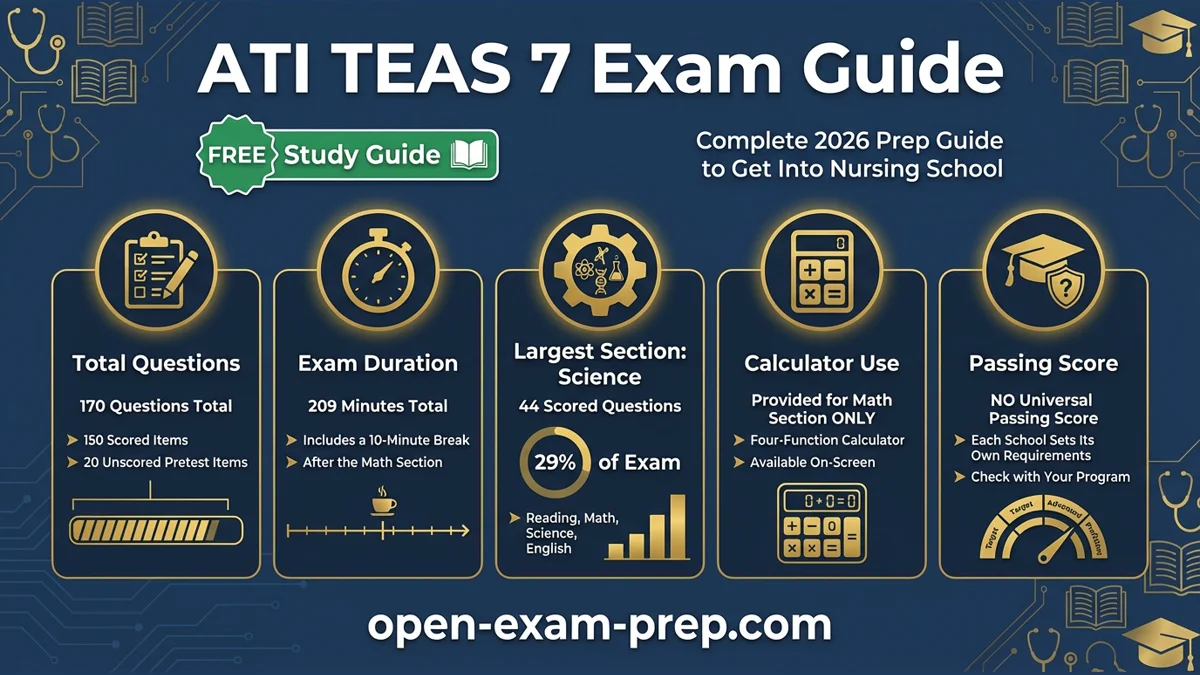
ATI TEAS 7 Exam 2026: Your Complete Guide to Nursing School Admission
The ATI TEAS (Test of Essential Academic Skills) is a standardized admission exam used by nursing and allied health programs across the United States. Administered by Assessment Technologies Institute (ATI), the TEAS evaluates your readiness for the academic demands of healthcare programs.
A strong TEAS score is often the deciding factor in competitive nursing program admissions. This guide will help you understand the exam and prepare effectively.
Exam Format & Structure
| Component | Details |
|---|---|
| Version | TEAS 7 (current) |
| Total Questions | 170 (150 scored + 20 pretest) |
| Total Time | 209 minutes (3 hours 29 minutes) |
| Sections | Reading, Math, Science, English & Language Usage |
| Question Types | Multiple choice, multiple select, fill-in-the-blank, ordered response, hot spot |
| Format | In-person at a school or PSI center, OR online (TEAS at Home with a live remote proctor) |
| Cost | Typically $60-$140 depending on the testing site (ATI's standard fee is about $115-$120) |
There is no universal passing score. ATI does not pass or fail you. Instead, each nursing or allied-health program sets its own minimum composite (cut) score, and ATI reports an Academic Preparedness Level (see Scoring below). You can take the TEAS in person at a school or PSI testing center, or online from home with a live remote proctor; both versions use the same questions, timing, and 10-minute break.
Start Your FREE TEAS Prep Today
Our comprehensive course covers all 4 content areas with practice questions, detailed explanations, and study strategies—100% FREE.
TEAS Content Areas & Question Distribution
The TEAS 7 tests four content areas in a fixed order:
1. Reading (45 questions, 55 minutes)
39 scored questions | 26% of exam
| Sub-Area | Scored Questions |
|---|---|
| Key Ideas and Details | 15 |
| Craft and Structure | 9 |
| Integration of Knowledge and Ideas | 15 |
Key Skills Tested:
- Identifying main ideas and supporting details
- Drawing conclusions and making inferences
- Understanding author's purpose and tone
- Analyzing text structure
- Evaluating arguments and evidence
- Comparing information from multiple sources
2. Mathematics (38 questions, 57 minutes)
34 scored questions | 23% of exam
| Sub-Area | Scored Questions |
|---|---|
| Numbers and Algebra | 18 |
| Measurement and Data | 16 |
Key Skills Tested:
- Operations with fractions, decimals, percentages
- Ratios and proportions
- Algebraic equations
- Unit conversions and dimensional analysis
- Statistics (mean, median, mode, range)
- Data interpretation from tables and graphs
- Basic geometry (area, perimeter, volume)
Note: A four-function calculator is provided for the Math section only.
10-Minute Break After Math Section
3. Science (50 questions, 60 minutes)
44 scored questions | 29% of exam (LARGEST SECTION!)
| Sub-Area | Scored Questions |
|---|---|
| Human Anatomy and Physiology | 18 |
| Biology | 9 |
| Chemistry | 8 |
| Scientific Reasoning | 9 |
Key Skills Tested:
- Human body systems (cardiovascular, respiratory, digestive, etc.)
- Cell structure and function
- Genetics and heredity
- Chemical reactions and properties
- Scientific method and experimental design
- Data analysis and interpretation
This is the most important section for nursing programs!
4. English and Language Usage (37 questions, 37 minutes)
33 scored questions | 22% of exam
| Sub-Area | Scored Questions |
|---|---|
| Conventions of Standard English | 12 |
| Knowledge of Language | 11 |
| Using Language and Vocabulary | 10 |
Key Skills Tested:
- Grammar and punctuation rules
- Sentence structure and clarity
- Spelling and word usage
- Vocabulary in context
- Formal vs. informal language
Free Practice Questions & Study Materials
Each chapter includes:
- Detailed content explanations
- TEAS-style practice questions
- Tables and diagrams for visual learning
- Key takeaways for quick review
- Time management strategies
TEAS Scoring Explained
You get your unofficial results immediately and the full report (usually within 48 hours). Every score is reported on a 0-100% scale, and ATI gives you several numbers:
| Score Type | Description |
|---|---|
| Total (Composite) Score | Overall equated percentage across all four sections |
| Content Area Scores | A percentage for each of the 4 sections |
| Sub-Content Scores | Raw percentages within each section (e.g., Key Ideas and Details) |
| National & Program Percentiles | How you rank versus other test-takers nationally and in your program type |
Total and content-area scores are equated (statistically adjusted across test forms), while sub-content scores are the raw percent correct.
Academic Preparedness Levels (ATI's Official Scale)
There is no pass/fail. Instead, ATI maps your total score to one of five Academic Preparedness Levels. Schools typically want applicants at Proficient or above.
| Preparedness Level | Approximate Total Score |
|---|---|
| Developmental | 0 - 40.6% |
| Basic | 41.3 - 58.0% |
| Proficient | 58.7 - 79.3% |
| Advanced | 80.0 - 91.3% |
| Exemplary | 92.0 - 100% |
Typical School Requirements
| Program Type | Minimum | Competitive |
|---|---|---|
| ADN (Associate) | 55-65% | 70%+ |
| BSN (Bachelor's) | 65-75% | 80%+ |
| Accelerated BSN | 70-80% | 85%+ |
| Graduate Entry | 75-85% | 90%+ |
Research your target schools' specific requirements! A score in the Proficient range (about 59-79%) meets most ADN and many BSN programs, but highly competitive schools often expect Advanced (80%+).
Study Timeline for TEAS Success
6-8 Week Plan (Comprehensive)
| Week | Focus | Activities |
|---|---|---|
| 1-2 | Diagnostic + Reading | Take practice test, study Chapter 2 |
| 3-4 | Mathematics | Chapter 3, daily math practice |
| 5-6 | Science | Chapter 4, focus on A&P |
| 7 | English | Chapter 5, grammar review |
| 8 | Full Review | Practice tests, weak areas |
3-4 Week Plan (Accelerated)
| Week | Focus | Activities |
|---|---|---|
| 1 | Diagnostic + Weak Areas | Take practice test, identify gaps |
| 2 | Math + Science | Focus on highest-weight sections |
| 3 | Reading + English | Complete remaining sections |
| 4 | Practice + Review | Full practice tests, final review |
Recommended: 60-120 hours total study time
Prioritize Your Study Time
Start with the Science section—it has the most questions (44 scored) and is most important for nursing programs. Human Anatomy and Physiology alone accounts for 18 questions!
Study Strategies by Section
Reading
- Practice active reading with note-taking
- Focus on identifying main ideas quickly
- Time yourself—you have about 1.2 minutes per question
Mathematics
- Practice without a calculator first, then with
- Memorize essential formulas
- Focus on word problems and unit conversions
- Master fractions, decimals, and percentages
Science
- Prioritize Anatomy & Physiology (18 questions!)
- Create flashcards for body systems
- Review scientific method and data analysis
- Understand basic chemistry concepts
English
- Review grammar rules systematically
- Practice identifying errors in sentences
- Build vocabulary through reading
- Know the difference between formal/informal language
Test-Taking Strategies
Before the Exam
- Get adequate sleep the night before
- Eat a healthy breakfast
- Arrive early (15-30 minutes)
- Bring required identification
During the Exam
- Read questions carefully before looking at answers
- Eliminate obviously wrong answers
- Don't spend too long on any one question
- Use the break wisely (stretch, use restroom)
- Answer every question (no penalty for guessing)
Time Management
| Section | Time | Per Question |
|---|---|---|
| Reading | 55 min | ~1.2 min |
| Math | 57 min | ~1.5 min |
| Science | 60 min | ~1.2 min |
| English | 37 min | ~1.0 min |
Common Mistakes to Avoid
- Spending too long on Science - Prioritize but don't obsess
- Ignoring Reading - It's still 26% of your score
- Calculator dependence - Practice mental math too
- Not practicing under timed conditions - Time pressure is real
- Skipping English review - Grammar rules matter
Retake Policies
- Many testing sites allow up to 3 attempts per year with a 30-day wait between tries, but the exact limit and wait are set by your testing site and school
- Schools may cap how many attempts they will accept
- Some schools average multiple attempts; others take your highest composite
- You pay the full fee for each attempt
- Retake policies vary by institution and site—always confirm with both before you register!
Pass the ATI TEAS with Confidence
Join thousands of aspiring nurses who achieved their target TEAS scores using our comprehensive, 100% FREE study materials. Our course includes:
- 5 complete chapters covering all content areas
- Science-focused content aligned with nursing programs
- AI-powered study assistance for instant explanations
- Regularly updated for the TEAS 7 exam
No credit card required. Start studying today.
Official Resources
Add This Clinical Review Layer Before Test Day
Use the final stretch for decision quality, not just more exposure to facts. Start each study block for FREE TEAS 7 Practice Test 2026: 500+ Questions by naming the task the question is really testing: recognition, prioritization, safety, communication, documentation, or workflow. Healthcare exams often hide the correct answer behind a familiar detail, so the safest habit is to pause before reading the options and predict what a competent entry-level professional would do next. That prediction keeps you from chasing the option that sounds medically interesting but does not answer the actual patient-care problem.
Build a small error log with four columns: missed topic, missed cue, correct rule, and next drill. A missed cue is more useful than a broad content label. For example, do not only write cardiovascular, infection control, medication safety, specimen handling, imaging, or professional practice. Write the actual cue you ignored: unstable finding, contraindication, timing before a procedure, patient identification, scope boundary, chain of custody, isolation wording, or documentation sequence. Review that log every two or three days and convert repeated misses into short practice sets.
Official-Source Check
Before relying on any third-party outline, compare your plan with ATI TEAS page. Official pages and candidate handbooks are the place to confirm current eligibility language, testing vendor instructions, identification rules, rescheduling policies, accommodations steps, and any content outline changes. You do not need to memorize administrative details for every practice question, but you do need to avoid preparing from an outdated blueprint or an old retake policy. If a handbook uses different domain names than your notes, rename your notes to match the handbook so your remediation stays aligned with the exam owner.
Scenario Strategy for Clinical and Administrative Questions
Read healthcare scenarios in this order: setting, role, patient or client status, time pressure, and requested action. The role matters because many distractors are clinically reasonable but outside the expected scope for the candidate. A nursing, allied health, pharmacy, laboratory, imaging, respiratory, compliance, or management exam may ask what should be done first, what should be reported, what should be documented, or what should be delegated. Those verbs change the answer. Highlight them in practice even if the real test interface does not let you mark text the same way.
When two options both look correct, choose the one that best protects the patient, preserves specimen or data integrity, follows policy, or escalates an unsafe condition. Avoid answers that skip assessment, skip identification, skip hand hygiene or privacy safeguards, give education before immediate safety is addressed, or perform a task that belongs to another licensed professional. For management and compliance exams, translate clinical safety into system safety: risk identification, incident response, documentation, auditing, corrective action, and communication with the right stakeholder.
Practice Routing After Each Score Report
Do not retake full-length practice exams until you know what the previous one taught you. After each set, sort misses into three groups. Knowledge misses need a short content review and then ten targeted questions. Reasoning misses need rationales: write why the correct answer is safer or more aligned with the role than your answer. Speed misses need shorter timed sets, not another full review chapter.
In the last week, keep practice mixed. Real exam questions rarely announce the domain, and mixed sets force you to choose between similar procedures, symptoms, lab clues, safety steps, and communication tasks. End each day with a brief review of high-yield normal findings, urgent findings, infection prevention, medication or equipment safety, and professional boundaries that appear in your own missed-question history. The goal is not to feel as if every topic is finished. The goal is to enter the exam with a repeatable method for unfamiliar cases: identify the role, find the safety issue, rule out unsafe shortcuts, and choose the action that a careful professional could defend.


 Buy on Amazon
 Practice exams on ExamEdge
 Take courses on Udemy
 Study guide on Mometrix