Real Estate Math Made Simple
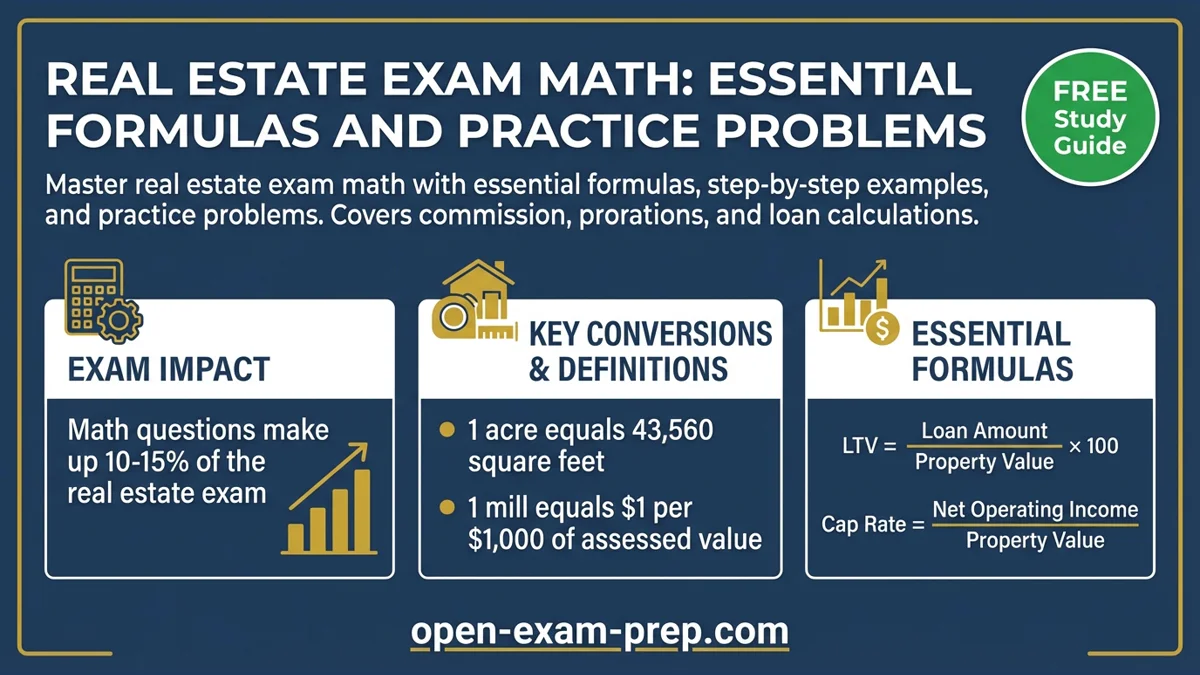
Math questions make up 10-15% of the real estate exam and are often where candidates lose valuable points. The good news? You only need to master a handful of formulas to answer most math questions correctly.
Essential Real Estate Math Formulas
The T-Bar Method
Most real estate math problems can be solved using the T-Bar formula:
Key relationships:
- $\text{Part} = \text{Total} \times \text{Rate}$
- $\text{Rate} = \frac{\text{Part}}{\text{Total}}$
- $\text{Total} = \frac{\text{Part}}{\text{Rate}}$
Commission Calculations
Formula
Example 1: Finding Commission Amount
A house sells for $350,000 with a 6% commission. What is the total commission?
Solution:
Example 2: Finding Sales Price
An agent earned $12,000 on a sale with a 5% commission. What was the sales price?
Solution:
Example 3: Commission Splits
A property sells for $400,000 at 6% commission. The listing broker receives 60% and the selling broker 40%. The listing agent gets 50% of their broker's share. What does the listing agent earn?
Solution:
- Total commission: $400,000 × 0.06 = $24,000
- Listing broker's share: $24,000 × 0.60 = $14,400
- Listing agent's share: $14,400 × 0.50 = $7,200
Property Tax Calculations
Formula
Example 4: Finding Annual Tax
Property assessed at $200,000 with a tax rate of 25 mills. What is the annual tax?
Solution:
- 25 mills = $\frac{25}{1000} = 0.025$
- Tax: $200,000 × 0.025 = $5,000
Mill Rate Conversion
- 1 mill = $1 per $1,000 of assessed value
- 1 mill = $0.001$ (or $\frac{1}{1000}$)
- 10 mills = 1%
Example 5: Converting Mill Rates
What is 35 mills expressed as a percentage and decimal?
Solution:
- Decimal: $\frac{35}{1{,}000} = 0.035$
- Percentage: $0.035 \times 100 = 3.5%$
Loan and Interest Calculations
Formulas
Example 6: Finding Monthly Interest
A $300,000 loan at 6% annual interest. What is the first month's interest?
Solution:
- Annual interest: $300,000 × 0.06 = $18,000
- Monthly interest: $18,000 ÷ 12 = $1,500
Example 7: Finding Loan Amount
Monthly interest is $875 on a loan at 7% annual interest. What is the loan amount?
Solution:
- Annual interest: $875 × 12 = $10,500
- Loan amount: $10,500 ÷ 0.07 = $150,000
Loan-to-Value (LTV) Ratio
Formula
Example 8: Finding LTV
A buyer puts $50,000 down on a $250,000 home. What is the LTV?
Solution:
- Loan amount: $250,000 - $50,000 = $200,000
- LTV calculation:
Example 9: Finding Required Down Payment
A lender requires 80% LTV on a $400,000 purchase. What down payment is needed?
Solution:
- Maximum loan: $400,000 × 0.80 = $320,000
- Down payment: $400,000 − $320,000 = $80,000
Proration Calculations
Property Tax Proration
Taxes are typically prorated based on who owns the property on the closing date.
Example 10: Seller Prepaid Taxes
Annual taxes of $3,600 were prepaid. Closing is September 15. How much does the buyer owe the seller?
Solution (using 30-day months, 360-day year):
- Daily tax: $3,600 ÷ 360 = $10/day
- Seller owned: Jan 1 - Sept 15 = 255 days
- Buyer owes for: Sept 16 - Dec 31 = 105 days
- Buyer owes seller: 105 × $10 = $1,050
Example 11: Unpaid Taxes
Annual taxes of $4,800 are unpaid. Closing is March 20. How much does the seller owe?
Solution:
- Daily tax: $4,800 ÷ 360 = $13.33/day
- Seller owned Jan 1 - March 20 = 80 days
- Seller owes: 80 × $13.33 = $1,066.40
Rent Proration
Example 12: Prorating Rent
Tenant pays $1,500/month rent in advance. Closing is on the 10th. How much rent credit does buyer receive?
Solution:
- Daily rent: $1,500 ÷ 30 = $50/day
- Buyer owns 20 days (11th-30th)
- Buyer credit: 20 × $50 = $1,000
Area and Volume Calculations
Area Formulas
| Shape | Formula |
|---|---|
| Rectangle | $L \times W$ |
| Triangle | $\frac{1}{2} \times B \times H$ |
| Circle | $\pi r^2$ where $\pi \approx 3.14$ |
| Trapezoid | $\frac{1}{2}(B_1 + B_2) \times H$ |
Example 13: Finding Lot Area
A rectangular lot is 150 feet × 200 feet. How many square feet?
Solution:
Example 14: Converting to Acres
How many acres is a 43,560 sq ft lot?
Solution:
(Note: 1 acre = 43,560 square feet)
Example 15: Calculating Building Cost
A 2,000 sq ft home costs $150 per sq ft to build. What is the total cost?
Solution:
Appreciation and Depreciation
Appreciation Formula
Example 16: Appreciation
A home worth $300,000 appreciates 5% per year. What is it worth after 1 year?
Solution:
Depreciation Formula
Example 17: Depreciation
A building valued at $400,000 depreciates 3% annually. What is it worth after 1 year?
Solution:
Capitalization Rate
Formula
Example 18: Finding Cap Rate
A property generates $50,000 NOI and is valued at $625,000. What is the cap rate?
Solution:
Example 19: Finding Property Value
An investor wants an 8% cap rate on a property with $40,000 NOI. What should they pay?
Solution:
Quick Reference Chart
| Calculation | Formula |
|---|---|
| Commission | $\text{Price} \times \text{Rate}$ |
| Annual Tax | $\text{Assessed Value} \times \text{Tax Rate}$ |
| Monthly Interest | $\frac{\text{Loan} \times \text{Rate}}{12}$ |
| LTV | $\frac{\text{Loan}}{\text{Value}} \times 100$ |
| Cap Rate | $\frac{\text{NOI}}{\text{Value}}$ |
| Area (Rectangle) | $L \times W$ |
| Acres | $\frac{\text{Sq Ft}}{43{,}560}$ |
Calculator Tips
- Know your calculator - Practice before exam day
- Write down given information - Avoid confusion
- Show your work - Helps catch errors
- Check reasonableness - Does the answer make sense?
- Don't skip math questions - They're often easier than they look!
How to Apply This Real Estate Exam Math: Essential Formulas and Practice Problems 2026 Guide to Your Own State Exam
Use this guide as a practice framework, then connect it to the candidate bulletin for the state where you are getting licensed. Real estate exams share a national foundation, but states differ in licensing agency procedure, application timing, broker sponsorship, education hours, retake rules, allowed calculators, and state-law emphasis. The safest study plan is to learn the national concept here, then ask how your state tests that same concept.
For every topic, create three lines in your notes. The first line is the general rule. The second line is a short example from a transaction. The third line is the state-specific variation you need to verify. For example, a contracts topic might start with offer, acceptance, consideration, capacity, and legality; the transaction example might involve a buyer missing a contingency deadline; the state line might note a required disclosure form, agency notice, or licensing rule. This three-line method prevents shallow memorization and makes practice questions easier to review.
Practice Routing for Better Scores
Do not treat all missed questions equally. A missed definition needs flashcards. A missed scenario needs rule application. A missed math item needs setup practice. A missed state-law question needs official-source verification. A missed reading question needs slower annotation of the stem. If you put every miss into one pile, your study plan becomes vague and your score stalls.
After each practice set, write the rule that would let you answer the question next time without seeing the choices. Then write why the best wrong answer was wrong. Real estate exams often use answer choices that are partly true but incomplete, true in another context, or true for the wrong party. Learning to reject those choices is as important as memorizing the correct rule.


 Buy on Amazon
 Flashcards on Mometrix
 Take courses on Udemy
 Pre-licensing on Colibri