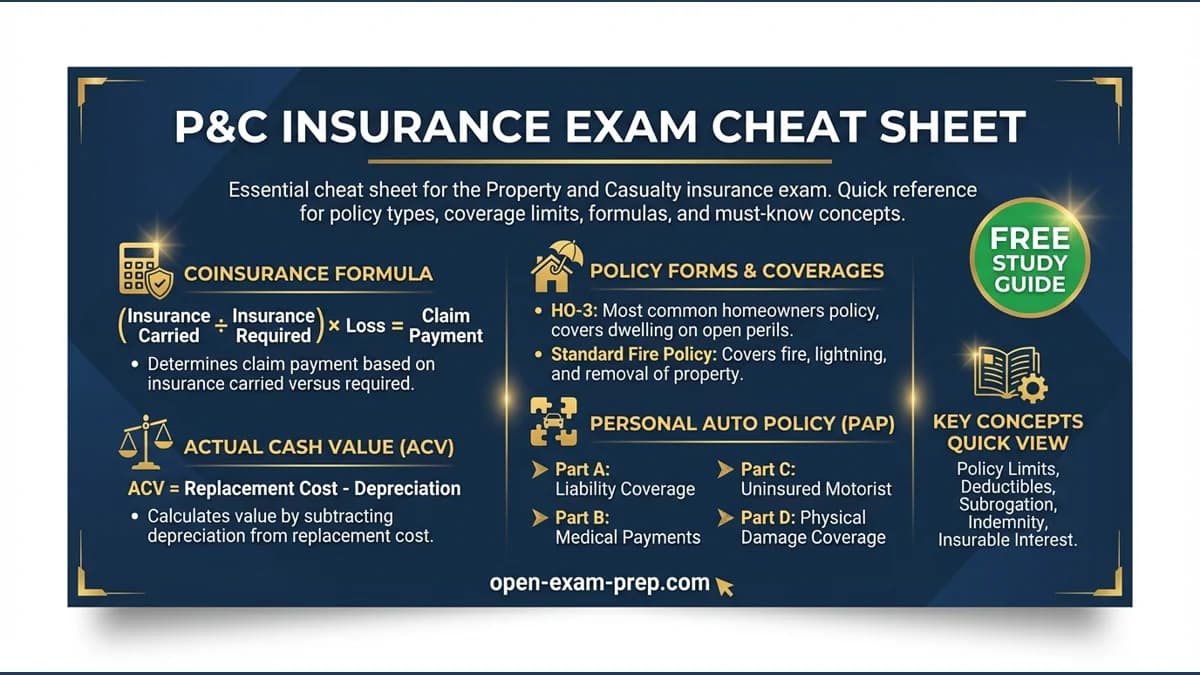
P&C Insurance Exam Cheat Sheet
This quick reference guide covers the essential concepts, formulas, and policy details you need to know for the Property and Casualty insurance exam. Bookmark this page for quick review before your exam.
Essential Formulas
Coinsurance Formula
The most tested formula on the P&C exam:
Example:
- Property value: $500,000
- Coinsurance requirement: 80%
- Insurance carried: $300,000
- Loss: $100,000
Calculation:
- Insurance required: $500,000 × 80% = $400,000
- Coinsurance ratio: $300,000 ÷ $400,000 = 75%
- Claim payment: 75% × $100,000 = $75,000 (insured pays $25,000)
Key Point: If the ratio is 100% or more, you receive the full loss (up to policy limits). If less than 100%, you become a co-insurer.
Actual Cash Value (ACV)
Example:
- Replacement cost of roof: $20,000
- Age of roof: 10 years
- Useful life: 20 years
- Depreciation: $\frac{10}{20} = 50%$
- ACV: $20,000 − $10,000 = $10,000
Pro Rata Liability (Other Insurance)
When multiple policies cover the same loss:
Loss Ratio
Combined Ratio
- Under 100% = Underwriting profit
- Over 100% = Underwriting loss
Homeowners Insurance Quick Reference
Policy Forms Comparison
| Form | Name | Dwelling Coverage | Personal Property |
|---|---|---|---|
| HO-1 | Basic | Named perils (10) | Named perils |
| HO-2 | Broad | Named perils (16) | Named perils |
| HO-3 | Special | Open perils | Named perils |
| HO-4 | Renters | N/A | Named perils |
| HO-5 | Comprehensive | Open perils | Open perils |
| HO-6 | Condo | Named perils | Named perils |
| HO-7 | Mobile Home | Same as HO-3 | Same as HO-3 |
| HO-8 | Older Home | Named perils (10) | Named perils |
Most Common: HO-3 is the standard homeowners policy used by most homeowners.
HO-3 Coverage Amounts (Standard Percentages)
| Coverage | Percentage of Coverage A |
|---|---|
| A - Dwelling | 100% (base) |
| B - Other Structures | 10% of A |
| C - Personal Property | 50% of A |
| D - Loss of Use | 30% of A (current ISO HO 00 03) |
| E - Personal Liability | $100,000 (standard minimum) |
| F - Medical Payments | $1,000 per person |
Exam Trap: In the current ISO HO 00 03 form, Coverage D (Loss of Use) is 30% of Coverage A. Older study materials sometimes list 20%. Coverage C (Personal Property) is settled on ACV by default unless a replacement-cost endorsement is added.
HO-2 / HO-3 Named Perils (Coverage C - the 16 Broad Form Perils)
Under HO-3, the dwelling (A) and other structures (B) are open perils, but personal property (C) is covered only against these 16 named perils:
- Fire or lightning
- Windstorm or hail
- Explosion
- Riot or civil commotion
- Aircraft
- Vehicles
- Smoke
- Vandalism or malicious mischief
- Theft
- Volcanic eruption
- Falling objects
- Weight of ice, snow, or sleet
- Accidental discharge of water/steam
- Sudden tearing apart (heating/AC/fire sprinkler)
- Freezing of plumbing/heating/AC
- Sudden electrical damage
Section I - Common Exclusions
- Flood (requires separate flood policy)
- Earthquake (requires endorsement)
- War and nuclear hazard
- Intentional loss
- Neglect
- Earth movement
- Power failure (off premises)
- Ordinance or law
Section II - Liability Coverage
| Coverage | What It Covers |
|---|---|
| E - Personal Liability | Bodily injury and property damage to others |
| F - Medical Payments | Medical expenses regardless of fault |
Section II Exclusions:
- Business pursuits
- Motor vehicles (covered by auto policy)
- Watercraft (certain size limits)
- Intentional injury
- Professional liability
Personal Auto Policy (PAP) Quick Reference
PAP Parts
| Part | Coverage | What It Covers |
|---|---|---|
| A | Liability | BI/PD to others you're legally liable for |
| B | Medical Payments | Medical expenses for you and passengers |
| C | Uninsured Motorist | Injuries caused by uninsured drivers |
| D | Physical Damage | Your vehicle (collision & comprehensive) |
| E | Duties After Loss | What you must do after an accident |
| F | General Provisions | Policy territory, changes, termination |
Part A - Liability Coverage
Split Limit Format: 100/300/50
- $100,000 per person bodily injury
- $300,000 per accident bodily injury
- $50,000 property damage per accident
Combined Single Limit (CSL): One limit for all BI and PD per accident
Part D - Physical Damage
| Coverage Type | What It Covers |
|---|---|
| Collision | Damage from impact with object/vehicle |
| Other Than Collision (Comprehensive) | Theft, fire, flood, vandalism, glass breakage, animal collision |
PAP - Who Is Insured
- Named insured and family members
- Anyone using your covered auto with permission
- Any person/organization liable for your use of covered auto
PAP - What Vehicles Are Covered
- Vehicles shown in declarations
- Newly acquired vehicles (automatic coverage period)
- Temporary substitute vehicles
- Non-owned vehicles used with permission
Commercial Insurance Quick Reference
Commercial General Liability (CGL) Coverages
| Coverage | What It Covers |
|---|---|
| A - Premises/Operations | BI/PD on premises or from operations |
| B - Personal/Advertising Injury | Libel, slander, false arrest, copyright infringement |
| C - Medical Payments | Medical expenses regardless of fault |
CGL - Key Exclusions
- Expected or intended injury
- Contractual liability (with exceptions)
- Liquor liability (for alcohol-related businesses)
- Workers compensation
- Pollution (sudden and accidental may be covered)
- Auto, aircraft, watercraft
- Professional liability
- Product recall
Occurrence vs. Claims-Made
| Trigger | Occurrence Policy | Claims-Made Policy |
|---|---|---|
| Coverage applies when | Incident occurs during policy period | Claim filed during policy period |
| Retroactive date | Not applicable | Must be on or after retro date |
| Tail coverage | Not needed | May be needed after cancellation |
| Best for | Most businesses | Professionals, long-tail claims |
Commercial Property Coverage Forms
| Form | Coverage |
|---|---|
| Basic | Fire, lightning, explosion, smoke, etc. |
| Broad | Basic + falling objects, weight of ice/snow, water damage |
| Special | Open perils (all risks except excluded) |
Business Income Coverage
Covers loss of income and extra expense when:
- Direct physical loss to covered property
- From a covered cause of loss
- During the period of restoration
Workers Compensation Quick Reference
Key Principles
| Principle | Description |
|---|---|
| No-fault | Benefits paid regardless of who caused injury |
| Exclusive remedy | Employee gives up right to sue employer |
| Statutory benefits | Benefits set by state law |
Workers Comp Benefits
- Medical benefits - All reasonable and necessary medical care
- Disability benefits - Wage replacement during recovery
- Death benefits - Benefits to dependents
- Rehabilitation - Vocational rehabilitation services
Disability Types
| Type | Definition |
|---|---|
| Temporary Total | Cannot work at all, expected to recover |
| Temporary Partial | Can do some work, expected to recover |
| Permanent Total | Cannot work at all, permanent condition |
| Permanent Partial | Can work but with permanent limitations |
Workers Comp Exclusions
- Intentional self-inflicted injury
- Injuries while intoxicated
- Injuries during horseplay
- Injuries while committing a crime
- Injuries outside scope of employment
Insurance Concepts Quick Reference
Core Definitions (Heavily Tested Vocabulary)
| Term | Definition |
|---|---|
| Peril | The cause of a loss (fire, theft, windstorm, collision) |
| Hazard | A condition that increases the chance or severity of a loss |
| Physical hazard | A tangible condition (icy steps, oily rags) |
| Moral hazard | Dishonesty that increases loss (e.g., arson for insurance money) |
| Morale hazard | Carelessness/indifference because insurance exists |
| Risk | Uncertainty of loss; pure risk (loss or no loss) is insurable, speculative risk is not |
| Loss | The reduction in value of an asset due to a peril |
| Adverse selection | The tendency of higher-risk applicants to seek insurance most |
| Law of large numbers | The more similar exposures insured, the more predictable losses become |
| Indemnity | Restore the insured to pre-loss financial condition - no more, no less |
| Utmost good faith | Both parties must deal honestly and disclose material facts |
Elements of an Insurable Risk (CHANCE / characteristics)
- Loss must be due to chance (accidental, not intentional)
- Loss must be definite and measurable
- Loss must be predictable (law of large numbers)
- Loss must not be catastrophic to the insurer
- The exposure must be part of a large homogeneous group
- The premium must be economically feasible
Deductibles & Limits
| Term | Meaning |
|---|---|
| Deductible | Amount the insured pays before the insurer pays; higher deductible = lower premium |
| Per-occurrence limit | Most the insurer pays for a single loss/event |
| Aggregate limit | Most the insurer pays during the entire policy period (common in CGL) |
| Sublimit | A cap within a coverage (e.g., $1,500 jewelry theft limit) |
| Self-insured retention (SIR) | Like a deductible, but the insured handles the claim up to the SIR (common with umbrellas) |
Four Essential Elements of a Legal Contract
- Offer and acceptance (agreement)
- Consideration (premium for the promise to pay)
- Legal purpose
- Competent parties
Insurance contracts are also aleatory (unequal dollar exchange), adhesion (take-it-or-leave-it, ambiguity favors the insured), unilateral (only the insurer makes an enforceable promise), and conditional (the insured must meet conditions to collect).
Insurable Interest
| Type | When Required |
|---|---|
| Property insurance | At time of loss |
| Life insurance | At time of application |
Subrogation
After paying a claim, the insurer can recover from the responsible third party.
Example: Your insurer pays for your car damage. They can then sue the at-fault driver to recover the payment.
Indemnification Principle
Insurance pays to restore you to pre-loss condition—no more, no less.
Negligence Elements (Must prove all four)
- Duty - Defendant owed a duty of care
- Breach - Defendant breached that duty
- Cause - Breach caused the injury
- Damages - Actual damages occurred
Types of Agents
| Type | Authority | Represents |
|---|---|---|
| Captive/Exclusive | One company only | One insurer |
| Independent | Multiple companies | Multiple insurers |
| Direct Writer | Company employee | Their employer |
| Broker | Represents insured | The customer |
Binder
A binder is temporary evidence of insurance coverage until the actual policy is issued. It provides immediate protection.
Policy Structure
Standard Policy Parts
- Declarations - Who, what, when, where, how much
- Insuring Agreement - What the insurer promises to do
- Conditions - Rules both parties must follow
- Exclusions - What is NOT covered
- Definitions - Meaning of terms used
- Endorsements - Modifications to the policy
Key Numbers to Remember
| Item | Number |
|---|---|
| Standard coinsurance requirement | 80% |
| HO-3 Other Structures | 10% of Coverage A |
| HO-3 Personal Property | 50% of Coverage A |
| HO-3 Loss of Use | 30% of Coverage A |
| Standard personal liability (Coverage E) | $100,000 |
| Medical payments to others (Coverage F) | $1,000 per person |
| Special limit on money/coins/bullion | $200 |
| Special limit on securities/deeds | $1,500 |
| Special limit on watercraft (incl. trailers) | $1,500 |
| Special limit on jewelry/watches/furs (theft) | $1,500 |
| Special limit on silverware (theft) | $2,500 |
| Special limit on firearms (theft) | $2,500 |
| Special limit on business property (on premises) | $2,500 |
| Flood/earthquake | Not covered (separate policy/endorsement) |
| NFIP flood policy waiting period | 30 days |
| Workers comp - pure contributory negligence jurisdictions | AL, MD, NC, VA, DC |
Dwelling Fire (DP) Quick Reference
Dwelling Fire policies cover residences not eligible for a homeowners policy (rentals, non-owner-occupied, older or seasonal homes). Unlike HO forms, DP policies do NOT automatically include liability or theft - those are added by endorsement.
| Form | Name | Dwelling Perils | Notes |
|---|---|---|---|
| DP-1 | Basic | Named (~9 perils: fire, lightning, internal explosion; EC/VMM by endorsement) | Settles on ACV; no theft |
| DP-2 | Broad | Named (broader list incl. EC, VMM, falling objects, weight of ice/snow, water) | Settles on replacement cost |
| DP-3 | Special | Open perils on dwelling & other structures; named perils on contents | Most like HO-3; broadest DP form |
Burden of Proof (heavily tested): On named-perils forms the insured must prove a covered peril caused the loss. On open-perils (all-risk) forms the insurer must prove an exclusion applies to deny the claim.
Negligence & Tort Quick Reference
| Concept | Definition |
|---|---|
| Pure contributory negligence | A plaintiff even 1% at fault recovers nothing (AL, MD, NC, VA, DC) |
| Pure comparative negligence | Recovery reduced by % of fault; can recover even if 99% at fault |
| Modified comparative negligence | No recovery if plaintiff is 50% or 51%+ at fault (most states) |
| Vicarious liability | Liability for another's acts (e.g., employer for employee) |
| Absolute/strict liability | Liability without fault (e.g., dangerous activities, defective products) |
| Res ipsa loquitur | "The thing speaks for itself" - negligence inferred from the event |
| Last clear chance | Negligent plaintiff may still recover if defendant had final chance to avoid harm |
Vacancy vs. Unoccupancy
| Term | Meaning | Effect |
|---|---|---|
| Vacant | No occupants AND no contents/furnishings | Coverage often suspended after 60 days (e.g., vandalism, glass, water, theft excluded) |
| Unoccupied | Furnished but no people present (e.g., on vacation) | Generally still covered |
Common Exam Traps
- Named perils vs. Open perils - Know which policies use which
- Occurrence vs. Claims-made - Understand the coverage trigger
- ACV vs. Replacement Cost - Know which pays what
- Coinsurance penalty - Calculate correctly
- When insurable interest is required - Property (at loss) vs. Life (at application)
- PAP parts - Know what each part covers
- Flood and earthquake - NOT covered by standard homeowners
Ready to Study More?
This cheat sheet covers the essentials. The fastest way to lock in these facts is to practice exam-style questions until the formulas and forms are automatic:
Want it explained? Use the free AI tutor below (10 free questions a day) to drill coinsurance math, HO vs DP forms, or any concept on this sheet.
Frequently Asked Questions
What is the coinsurance clause?
The coinsurance clause requires you to carry insurance equal to a specified percentage (usually 80%) of your property's value. If you carry less, you become a co-insurer and receive reduced claim payments calculated by the coinsurance formula.
What's the difference between collision and comprehensive coverage?
Collision covers damage to your car from impact with another vehicle or object (including rollover). Comprehensive (Other Than Collision) covers everything else: theft, fire, flood, vandalism, falling objects, and animal collisions.
What does an umbrella policy cover?
An umbrella policy provides additional liability coverage above your auto and homeowners policy limits. It typically starts at $1 million and provides broader coverage for claims that might be excluded by underlying policies.
What is the difference between named insured and additional insured?
The named insured is the person/entity named on the policy declarations with full policy rights. An additional insured is added by endorsement and receives liability coverage only, without policy control or premium obligations.


 Buy on Amazon
 Take courses on Udemy
 Online course on Mometrix
 Prep course on Achievable