NCLEX-PN 2026: Your Complete Guide to Practical Nurse Licensure
The NCLEX-PN (National Council Licensure Examination for Practical Nurses) is the standardized exam required for Licensed Practical Nurse (LPN) or Licensed Vocational Nurse (LVN) licensure in all US states and territories. Administered by the NCSBN (National Council of State Boards of Nursing), this exam tests your minimum competency for safe, effective practical nursing practice.
Whether you're called an LPN (most states) or LVN (California and Texas), passing the NCLEX-PN is your gateway to a rewarding healthcare career.
Exam Format & Structure (2026 Test Plan)
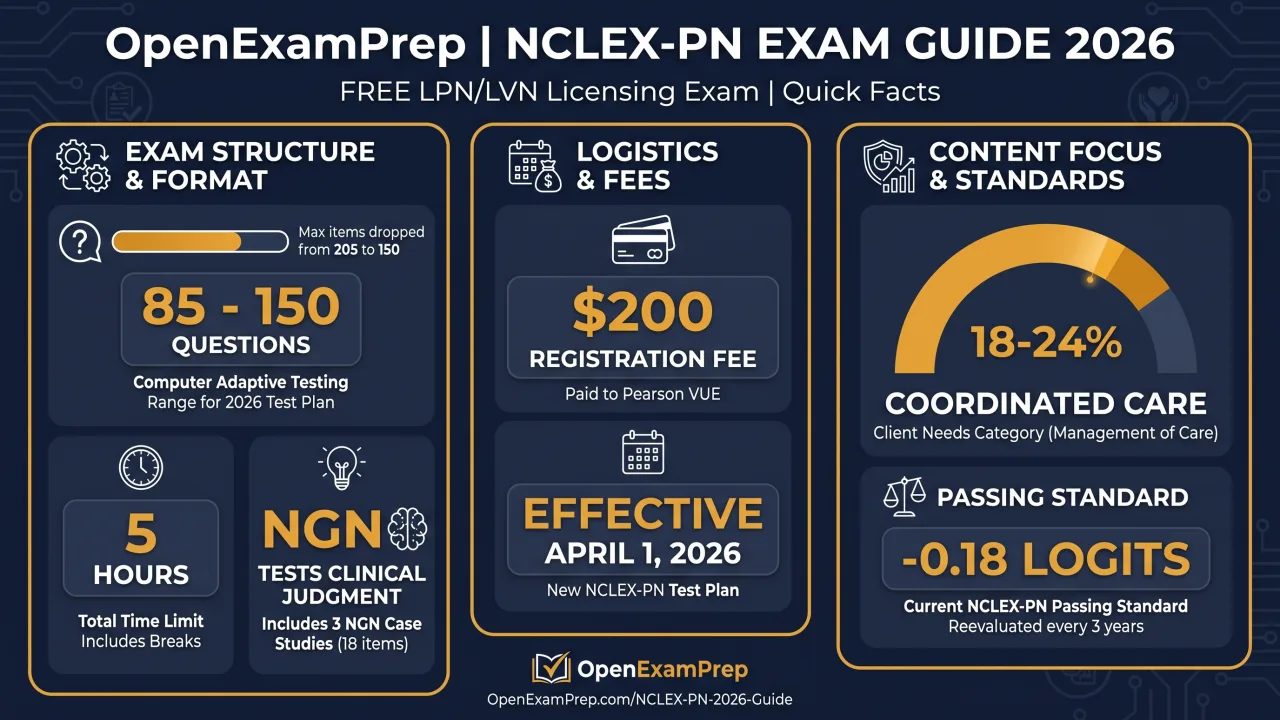
The 2026 NCLEX-PN test plan took effect April 1, 2026 and runs through March 31, 2029. The most important change for 2026 candidates: the maximum number of items dropped to 150 (it was 205 under prior plans). Verify the latest details on the 2026 NCLEX-PN Test Plan before test day.
| Component | Details |
|---|---|
| Number of items | 85 minimum to 150 maximum (variable, adaptive) |
| Item breakdown (min-length exam) | 52 content items + 18 case-study items + 15 unscored pretest items = 85 |
| Time Limit | 5 hours maximum (includes all breaks) |
| Passing Standard | Pass/Fail; -0.18 logits (current standard) |
| Exam Fee | $200 (paid to Pearson VUE at registration) |
| Eligibility | Graduate from a board-approved practical nursing program |
| Testing | Year-round at Pearson VUE centers |
The NCLEX-PN uses Computer Adaptive Testing (CAT), which selects each item based on your ability estimate from previous answers. The exam ends as soon as the computer is 95% confident that you are above (pass) or below (fail) the passing standard. Because of this, many candidates finish at or near the 85-item minimum, while others continue toward the 150-item maximum. Exam length is not an indicator of pass or fail-you can pass or fail at any length.
2026 update: The maximum is now 150 items, not 205. Every exam includes 15 unscored pretest items and three NGN clinical-judgment case studies (18 items). The passing standard is reevaluated every three years and is currently -0.18 logits.
Start Your FREE NCLEX-PN Prep Today
Our comprehensive course covers all 8 content areas with practice questions, clinical scenarios, and NGN item types—100% FREE.
NCLEX-PN Content Areas (2026 Test Plan)
The NCLEX-PN organizes content into four Client Needs categories, two of which are split into subcategories-for 8 content areas total. The percentage ranges below are taken directly from the 2026 test plan; any single exam may vary up to plus or minus 3% per area.
Safe and Effective Care Environment (28-40%)
Coordinated Care (18-24%)
- Collaboration with healthcare team members
- Continuity of care and client advocacy
- Delegation and supervision (PN scope)
- Ethical practice and legal rights
- Advance directives and confidentiality
Safety and Infection Prevention and Control (10-16%)
- Accident and injury prevention
- Standard and transmission-based precautions
- Emergency response procedures
- Safe medication administration
- Surgical asepsis and sterile technique
Health Promotion and Maintenance (6-12%)
- Developmental stages and transitions
- Health screening and disease prevention
- Lifestyle choices and self-care
- Ante/intra/postpartum care
- Aging process and immunizations
Psychosocial Integrity (9-15%)
- Therapeutic communication
- Coping mechanisms and grief/loss
- Mental health concepts
- Crisis intervention
- Cultural awareness and end-of-life care
Physiological Integrity (33-57%)
This is the largest category overall, spanning four subcategories:
Basic Care and Comfort (7-13%)
- Nutrition and oral hydration
- Mobility and positioning
- Rest, sleep, and personal hygiene
- Elimination care
- Non-pharmacological comfort measures
Pharmacological Therapies (10-16%)
- Medication administration
- Dosage calculations
- Expected and adverse effects
- Pain management
- IV therapy basics
Reduction of Risk Potential (9-15%)
- Lab values interpretation
- Vital signs and assessments
- Potential complication recognition
- Therapeutic procedures
- Changes in patient condition
Physiological Adaptation (7-13%)
- Body system alterations
- Fluid and electrolyte imbalances
- Medical emergencies
- Unexpected responses to therapies
Free Practice Questions & Study Materials
Each chapter includes:
- Detailed content explanations
- NCLEX-style practice questions
- NGN case study scenarios
- Clinical judgment exercises
- Key takeaways for quick review
NCLEX-PN vs NCLEX-RN: Key Differences
| Aspect | NCLEX-PN | NCLEX-RN |
|---|---|---|
| License Type | LPN/LVN | RN |
| Education | 12-18 months | 2-4 years |
| Questions (2026) | 85-150 | 85-150 |
| Scope | Focused, under RN supervision | Broader, independent practice |
| Coordinated Care Weight | 18-24% | 15-21% (Management) |
LPNs work under the supervision of RNs or physicians and have a more focused scope of practice. This is reflected in the exam—NCLEX-PN emphasizes coordinated care and following established care plans rather than creating them.
Next Generation NCLEX (NGN) for PN
The NCLEX-PN now includes Next Generation item types that measure clinical judgment using the NCSBN Clinical Judgment Measurement Model (NCJMM):
The 6 Cognitive Skills
- Recognize Cues - Identify relevant patient data
- Analyze Cues - Determine significance of data
- Prioritize Hypotheses - Rank possible explanations
- Generate Solutions - Identify interventions
- Take Action - Implement the best actions
- Evaluate Outcomes - Assess effectiveness
NGN Question Types
- Extended Multiple Response - Select all that apply (SATA)
- Matrix/Grid Items - Multiple decision points in a table
- Drag-and-Drop / Drop-Down (Cloze) - Sequence, categorize, or complete statements
- Highlight - Identify key information directly in the text or chart
- Bowtie - Single item linking actions, conditions, and parameters to monitor
- Trend - Evaluate changes in client data over time
- Case Studies - Unfolding clinical scenarios (each is a 6-item set)
Every 2026 NCLEX-PN includes three NGN case studies (18 items total). Each case study contains six items mapped one-to-one to the six steps of the NCSBN Clinical Judgment Measurement Model. Stand-alone NGN items such as bowtie and trend can also appear outside the case studies.
Study Timeline for NCLEX-PN Success
| Phase | Focus | Duration |
|---|---|---|
| Foundation | Content review (all 8 areas) | 3-4 weeks |
| Application | Practice questions + rationales | 2 weeks |
| Integration | Case studies + NGN items | 1 week |
| Final Review | Weak areas + test strategies | 1 week |
Recommended: 150-300 hours total, 50-100 questions daily in final weeks
Test-Taking Strategies for NCLEX-PN
For Standard Questions
- Read the stem carefully - Identify what's being asked
- Remember PN scope - What can LPNs do independently?
- Apply ABCs - Airway, Breathing, Circulation priority
- Use Maslow's Hierarchy - Physiological before psychological
- Eliminate obviously wrong answers - Then choose best option
For NGN Case Studies
- Read the entire scenario - Understand the full picture
- Identify trends - Changes in condition over time
- Stay in scope - LPNs report, not diagnose
- Connect assessment to interventions - Clinical reasoning
- Evaluate systematically - Did the intervention work?
Common Mistakes to Avoid
- Acting beyond scope - Know what LPNs can and cannot do
- Changing answers - First instinct is usually correct
- Reading into questions - Answer based on information given
- Focusing on medical knowledge only - NCLEX tests nursing judgment
- Ignoring the "report to RN" option - It's often correct for LPNs
Career Advancement: LPN to RN Bridge
After passing the NCLEX-PN, many LPNs pursue RN licensure through bridge programs:
- LPN-to-ADN Programs - Typically 1 year
- LPN-to-BSN Programs - Typically 2 years
- Online/Hybrid Options - Available in many states
Bridge programs give credit for your LPN education and experience, making the path to RN faster than starting from scratch.
Pass the NCLEX-PN with Confidence
Join thousands of practical nursing graduates who passed their NCLEX-PN using our comprehensive, 100% FREE study materials. Our course includes:
- 9 complete chapters covering all content areas
- Clinical judgment practice aligned with NGN
- AI-powered study assistance for instant explanations
- Regularly updated for the 2026 test plan
No credit card required. Start studying today.
Official Resources
- NCSBN (National Council of State Boards of Nursing)
- NCLEX Official Website
- 2026 NCLEX-PN Test Plan
- Pearson VUE Registration
Add This Clinical Review Layer Before Test Day
Use the final stretch for decision quality, not just more exposure to facts. Start each study block for FREE NCLEX-PN Exam Guide 2026: Pass Your LPN/LVN Licensing Exam by naming the task the question is really testing: recognition, prioritization, safety, communication, documentation, or workflow. Healthcare exams often hide the correct answer behind a familiar detail, so the safest habit is to pause before reading the options and predict what a competent entry-level professional would do next. That prediction keeps you from chasing the option that sounds medically interesting but does not answer the actual patient-care problem.
Build a small error log with four columns: missed topic, missed cue, correct rule, and next drill. A missed cue is more useful than a broad content label. For example, do not only write cardiovascular, infection control, medication safety, specimen handling, imaging, or professional practice. Write the actual cue you ignored: unstable finding, contraindication, timing before a procedure, patient identification, scope boundary, chain of custody, isolation wording, or documentation sequence. Review that log every two or three days and convert repeated misses into short practice sets.
Official-Source Check
Before relying on any third-party outline, compare your plan with NCSBN NCLEX site. Official pages and candidate handbooks are the place to confirm current eligibility language, testing vendor instructions, identification rules, rescheduling policies, accommodations steps, and any content outline changes. You do not need to memorize administrative details for every practice question, but you do need to avoid preparing from an outdated blueprint or an old retake policy. If a handbook uses different domain names than your notes, rename your notes to match the handbook so your remediation stays aligned with the exam owner.
Scenario Strategy for Clinical and Administrative Questions
Read healthcare scenarios in this order: setting, role, patient or client status, time pressure, and requested action. The role matters because many distractors are clinically reasonable but outside the expected scope for the candidate. A nursing, allied health, pharmacy, laboratory, imaging, respiratory, compliance, or management exam may ask what should be done first, what should be reported, what should be documented, or what should be delegated. Those verbs change the answer. Highlight them in practice even if the real test interface does not let you mark text the same way.
When two options both look correct, choose the one that best protects the patient, preserves specimen or data integrity, follows policy, or escalates an unsafe condition. Avoid answers that skip assessment, skip identification, skip hand hygiene or privacy safeguards, give education before immediate safety is addressed, or perform a task that belongs to another licensed professional. For management and compliance exams, translate clinical safety into system safety: risk identification, incident response, documentation, auditing, corrective action, and communication with the right stakeholder.
Practice Routing After Each Score Report
Do not retake full-length practice exams until you know what the previous one taught you. After each set, sort misses into three groups. Knowledge misses need a short content review and then ten targeted questions. Reasoning misses need rationales: write why the correct answer is safer or more aligned with the role than your answer. Speed misses need shorter timed sets, not another full review chapter.
In the last week, keep practice mixed. Real exam questions rarely announce the domain, and mixed sets force you to choose between similar procedures, symptoms, lab clues, safety steps, and communication tasks. End each day with a brief review of high-yield normal findings, urgent findings, infection prevention, medication or equipment safety, and professional boundaries that appear in your own missed-question history. The goal is not to feel as if every topic is finished. The goal is to enter the exam with a repeatable method for unfamiliar cases: identify the role, find the safety issue, rule out unsafe shortcuts, and choose the action that a careful professional could defend.

 1 Job Wiki
 Buy on Amazon
 Take courses on Udemy
 Study guide on Mometrix
 Practice exams on ExamEdge