How to Become a Notary Public in Illinois
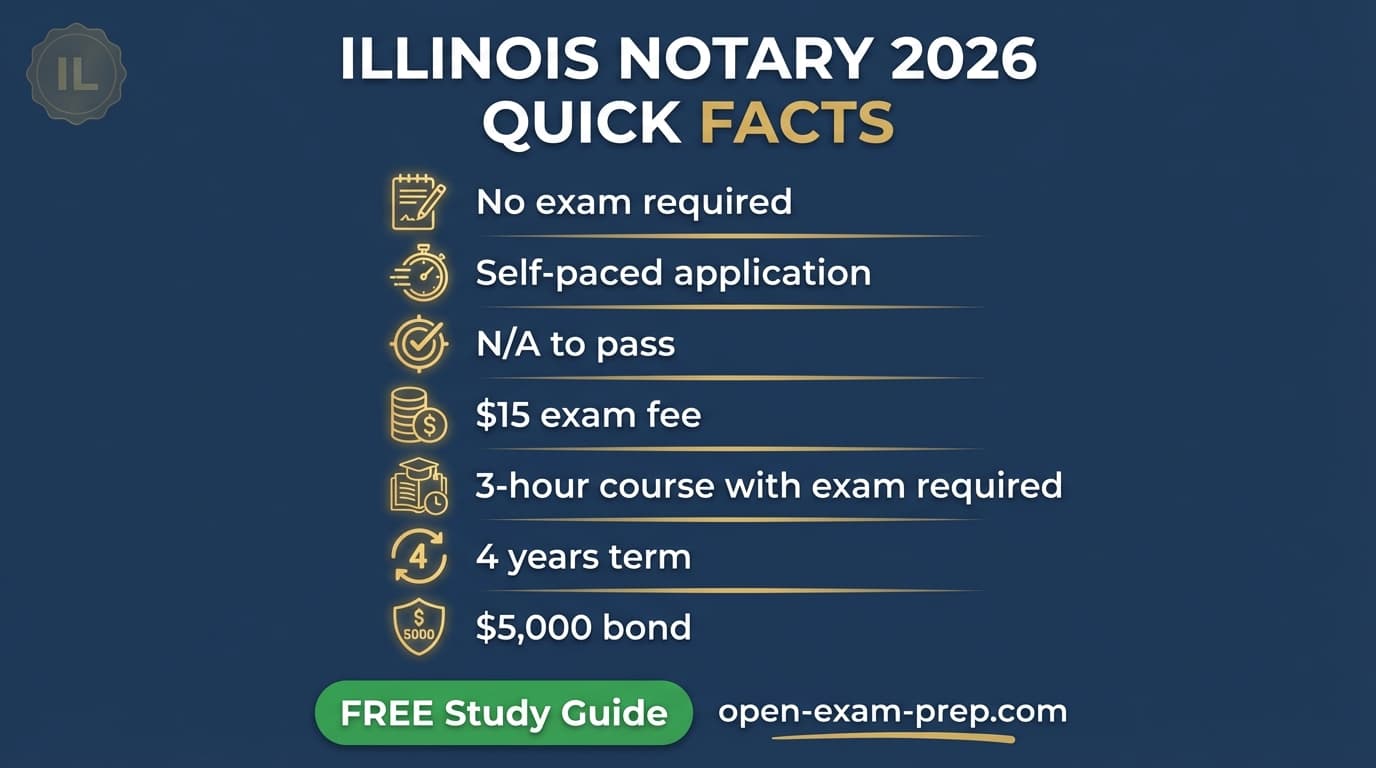
Illinois does not require a separate state exam to become a notary public. However, since January 1, 2024, all new applicants (and most renewing notaries) must complete a 3-hour education course and pass a 50-question final exam with at least 85%. This change came from Public Act 102-0160, the overhaul of the Illinois Notary Public Act that took effect July 1, 2022, with electronic and remote notarization rules following on June 5, 2023. Applications are processed by the Illinois Secretary of State Index Department, and Illinois residents must now apply online. See the official rules at the Illinois Secretary of State notary page.
Illinois Notary Requirements at a Glance
| Requirement | Details |
|---|---|
| Minimum Age | 18 years |
| Residency | Illinois resident (or work in IL) |
| Exam Required | No (education course with exam required) |
| Education Required | Yes - 3-hour course with exam |
| Surety Bond | $5,000 (traditional); $25,000-$30,000 (RON) |
| Commission Term | 4 years (residents); 1 year (non-residents) |
| Application Fee | $15 (traditional); $40 (with electronic notary) |
Why Become an Illinois Notary?
- No separate exam - Course includes examination component
- Large market - Third most populous state with high demand
- RON authorized - Remote Online Notarization available
- Reasonable fees - Up to $5 per traditional act, $25 for electronic/RON
- 4-year commission - Long term reduces renewal frequency
- Electronic notary option - Expand your services with e-notarization
Explore More Notary Resources
Looking for notary study materials or guides for other states? Check out our comprehensive resources. For additional education and supplies, visit the National Notary Association.
View All Notary Exam Prep Resources
Step-by-Step: How to Become an Illinois Notary
Step 1: Meet Eligibility Requirements
To become an Illinois notary public, you must:
- Be at least 18 years old
- Be a United States citizen or lawful permanent resident
- Be a resident of Illinois OR have a principal place of work/business in Illinois
- Be able to read and write English
- Have not had a notary commission revoked or suspended during the past 10 years
Step 2: Complete Mandatory Education Course
Effective January 1, 2024, all notary applicants must complete an approved course:
Course Requirements:
- 3-hour state-approved notary course (online or in person)
- Pass the final 50-question exam (true/false and multiple-choice) with a score of at least 85%
- You get 3 attempts to pass; fail all three and you must retake the full course
- Your completion certificate is valid for 2 years - you must apply for your commission within that window
- Course must be completed before submitting your application
Course Content Includes:
- Illinois Notary Public Act provisions
- Duties and responsibilities of a notary public
- Proper notarial procedures
- Journal and record-keeping requirements
- Avoiding unauthorized practice of law
Exemptions (as of January 1, 2025):
- Licensed attorneys in Illinois
- Judges
- Employees of licensed attorneys or judges
- Must provide signed statement confirming status and understanding of the Illinois Notary Public Act
Step 3: Obtain Your Surety Bond
Before submitting your application, obtain the appropriate surety bond:
Traditional Notary Only:
- Bond Amount: $5,000
- Bond Term: 4 years
- Typical Cost: $20-$50
Traditional + Electronic/Remote Notary:
- Bond Amount: $25,000 (if adding to existing $5,000 bond) or $30,000 (new combined bond)
- Bond Term: 4 years
- Typical Cost: $55-$100
The bond protects the public from potential financial loss due to improper notarial conduct.
Step 4: Submit Your Application
Apply through the Illinois Secretary of State. Illinois residents must apply online at the SOS notary application portal (paper applications are only allowed with a hardship exemption):
- Complete the Notary Public Application online
- Include your education course completion certificate
- Include your original surety bond
- Pay the appropriate filing fee
Filing Fees:
- Notary Public only: $15
- Notary Public + Electronic Notary Public: $40
- Adding Electronic Notary (already commissioned): $25
Submit to: Illinois Secretary of State Index Department 111 E. Monroe Street Springfield, IL 62756
Step 5: Receive Your Commission
Once approved:
- You'll receive your Commission Certificate
- Your commission is valid for 4 years (residents) or 1 year (non-residents)
- You may begin notarizing after obtaining supplies
Step 6: Purchase Notary Supplies
After receiving your commission, purchase required supplies:
Official Notary Stamp (Required):
- Format: Rectangular rubber stamp only
- Maximum Size: 1" x 2.5"
- Border: Serrated or milled edge
- Ink Color: Black ink only
- Cost: $20-$50
Required Stamp Information:
- "Official Seal"
- Your name as commissioned
- "Notary Public"
- "State of Illinois"
- "Commission No. [your number]"
- "My commission expires [full date]"
Notary Journal (Required):
- Required since June 5, 2023
- Paper or electronic format permitted
- Must record all notarial acts
- Cost: $15-$40
Illinois Notary Fees
| Service | Maximum Fee |
|---|---|
| Traditional notarial act | $5.00 |
| Electronic/Remote notarial act | $25.00 |
| Homeless certification forms | $0.00 (effective Jan 1, 2026) |
| Travel fees | Reasonable (by agreement) |
Important Notes:
- You may charge less than the maximum or waive fees entirely
- Must disclose fees before performing the notarial act
- Electronic notaries may charge reasonable fees for copies of journal entries or recordings
- Effective January 1, 2026: No fee for notarizing Illinois SOS Homeless Status Certification forms
Illinois-Specific Requirements
Stamp Requirements
Your Illinois notary stamp must meet strict specifications:
Format:
- Rectangular rubber stamp only (no embossers for primary seal)
- Maximum size: 1" x 2.5"
- Serrated or milled-edge border
- Black ink only
Required Information:
- "Official Seal"
- Your name exactly as commissioned
- "Notary Public"
- "State of Illinois"
- "Commission No. [number]"
- "My commission expires [full date, e.g., January 1, 2030]"
Placement:
- Near your signature
- Must not obscure any writing
- Must produce a legible imprint
Journal Requirements (Mandatory)
Illinois requires all notaries to maintain a journal since June 5, 2023:
Format Options:
- Paper journal (bound book)
- Electronic journal
- Multiple journals permitted
Required Journal Information:
- Notary's name, commission number, and expiration date
- Office address
- Disposition statement
- Abbreviation key (if used)
- Notary's signature
For Each Notarial Act:
- Date and time of the act
- Type of notarial act performed
- Type of document notarized
- Signer's name and address
- Method of identification used
- Fee charged (if any)
- Signer's signature (for certain acts)
Security Requirements:
- Keep journal secure at all times
- Notify SOS Index Department within 10 business days if journal is lost, stolen, or compromised
Certificate Requirements
Every notarial certificate must include:
- Your official stamp impression (black ink)
- Your signature
- The date of the notarial act
- Proper notarial wording for the act type
Remote Online Notarization (RON) in Illinois
Illinois authorizes Remote Online Notarization (RON) and Electronic Notarization.
Becoming an Illinois Electronic/Remote Notary
To perform electronic and remote notarizations:
- Hold a valid Illinois notary commission in good standing
- Complete additional training for electronic notarization
- Obtain the higher bond:
- $25,000 additional bond (if adding to existing commission)
- $30,000 combined bond (for new applicants)
- Pay the additional fee: $25 (adding) or $40 (combined application)
- Select an approved RON platform
RON Technology Requirements
Electronic notarization platforms must:
- Provide continuous audio-visual communication
- Support identity verification (credential analysis + KBA)
- Record the entire notarial session
- Create tamper-evident electronic records
- Maintain compliant electronic journals
Electronic Journal Requirements
Electronic notaries must maintain an electronic journal that:
- Records audio-video communication sessions
- Is under exclusive notary control
- Is secure and tamper-evident
- Retains records for the required period
RON Fees
- Maximum fee per electronic/RON act: $25.00
- Reasonable fees may be charged for providing copies of journal entries or recordings
Total Cost to Become an Illinois Notary
Traditional Notary Only:
| Item | Cost |
|---|---|
| Education Course | $50-$100 |
| Surety Bond (4 years) | $20-$50 |
| Application Fee | $15 |
| Notary Stamp | $20-$50 |
| Journal | $15-$40 |
| Total Estimated | $120-$255 |
Traditional + Electronic Notary:
| Item | Cost |
|---|---|
| Education Course | $50-$100 |
| Combined Bond ($30,000) | $55-$100 |
| Combined Application Fee | $40 |
| Notary Stamp | $20-$50 |
| Journal | $15-$40 |
| RON Platform | Varies ($20-$50/month) |
| Total Estimated | $180-$330+ |
Timeline: How Long Does It Take?
| Step | Estimated Time |
|---|---|
| Complete education course | 1 day (3 hours) |
| Obtain bond | Same day (online) |
| Complete application | 1 day |
| Processing time | 2-4 weeks |
| Order supplies | 3-5 days |
| Total | 2-5 weeks |
Renewing Your Illinois Commission
Illinois notary commissions are valid for 4 years (residents) or 1 year (non-residents).
Renewal Process:
- Complete a new education course (unless exempt as attorney/judge)
- Obtain a new surety bond
- Submit renewal application before expiration
- Pay the renewal fee
Important: Your commission expires at midnight on the expiration date. There is no grace period - you cannot notarize after your commission expires.
Note: Purchase a new stamp with your updated expiration date and commission number.
Special Considerations
Non-Resident Notaries
If you work in Illinois but reside elsewhere:
- You may qualify for an Illinois notary commission
- Commission term is 1 year (not 4 years)
- Must have a principal place of work/business in Illinois
- Same education and bond requirements apply
Attorney Exemptions (2025)
Effective January 1, 2025, the following are exempt from education/exam requirements:
- Licensed Illinois attorneys
- Judges
- Employees of licensed attorneys or judges
Must provide a signed statement confirming status and understanding of the Notary Public Act.
Lost or Compromised Journal
If your journal is lost, stolen, or compromised:
- Notify the SOS Index Department within 10 business days
- Document the circumstances
- Begin a new journal immediately
Start Your Illinois Notary Career Today
Illinois provides a clear path to becoming a notary public with its education course requirement ensuring all notaries are properly trained. The state's robust RON program makes Illinois an excellent choice for building a modern notary business.

 Free CE
 Buy on Amazon
 Notary training on Notary.net
 Take courses on Udemy