How to Pass the SIE Exam on Your First Try
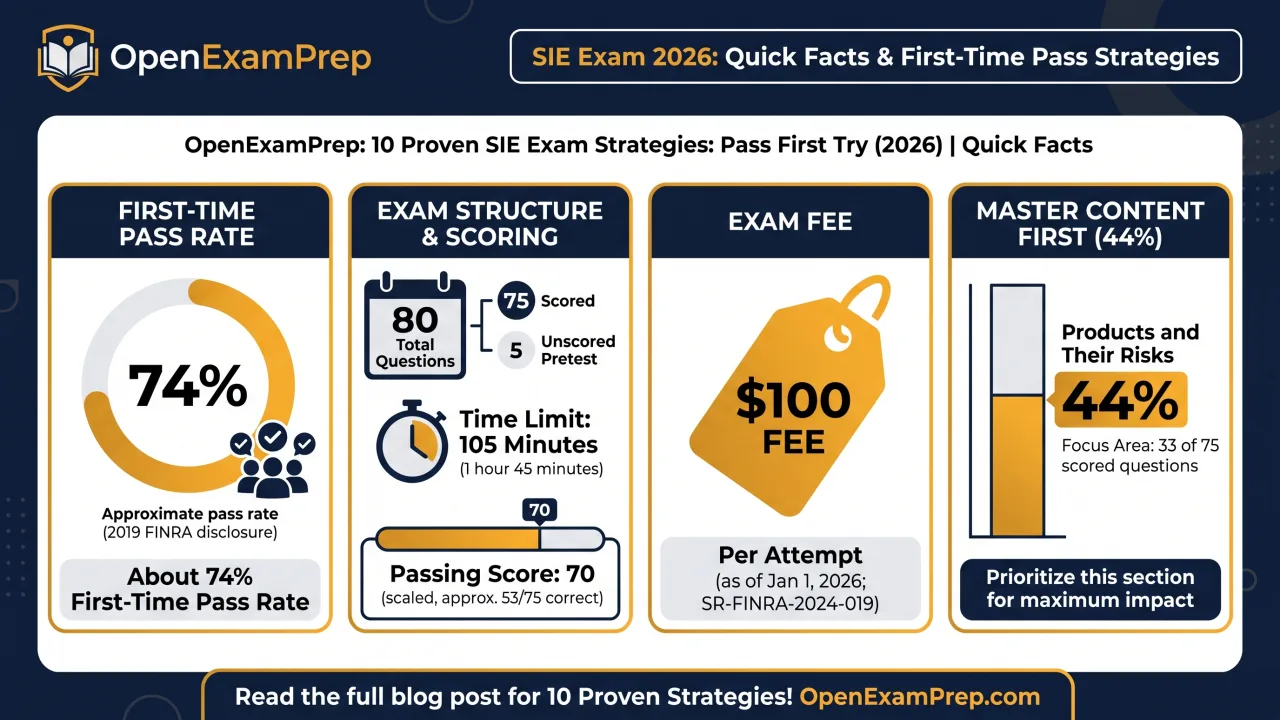
The SIE exam has about a 74% first-time pass rate — meaning roughly 1 in 4 candidates fail their first attempt. That 74% figure comes from a FINRA disclosure covering 58,264 first-time candidates in the program's early years (2019); FINRA no longer publishes an updated annual SIE pass rate, so ~74% remains the best available official benchmark. This guide shares the exact strategies used by those who pass on their first try, so you can join the passing majority.
Whether you're a college student, career changer, or financial professional, these 10 proven strategies will help you pass the SIE exam with confidence.
Ready to start practicing? Try our free SIE practice questions with 500+ exam-style questions and AI-powered explanations.
Quick Overview: What You Need to Pass
| Requirement | Details |
|---|---|
| Exam Fee | $100 per attempt (effective Jan 1, 2026; raised from $80) |
| Total Questions | 80 (75 scored + 5 unscored pretest) |
| Passing Score | 70 (on a 0-100 scaled score; ~53 of 75 scored correct) |
| Time Limit | 1 hour 45 minutes (105 minutes) |
| Recommended Study Time | 40-80 hours over 4-6 weeks |
| Practice Questions | Minimum 500 (aim for 800+) |
| Practice Exam Score | 80%+ before scheduling |
| Eligibility | Anyone 18+ — no firm sponsorship required |
| Result Validity | 4 years |
Score vs. rate, don't confuse them: The passing score (70) is the grade you personally need. The pass rate (~74%) is the share of candidates who clear that bar. Two different numbers that get mixed up constantly.
SIE Exam Format at a Glance (FINRA Official)
The Securities Industry Essentials (SIE) exam is a FINRA introductory-level exam for prospective securities industry professionals. FINRA reduced the unscored pretest count from 10 to 5 effective October 27, 2025, leaving 80 total questions (75 scored + 5 unscored). The scored count, passing score, and time limit did not change.
| Section | Weight | Scored Questions |
|---|---|---|
| (1) Knowledge of Capital Markets | 16% | 12 |
| (2) Understanding Products and Their Risks | 44% | 33 |
| (3) Understanding Trading, Customer Accounts and Prohibited Activities | 31% | 23 |
| (4) Overview of the Regulatory Framework | 9% | 7 |
| Total | 100% | 75 |
Source: FINRA SIE Content Outline.
FINRA Pass-Rate Table
FINRA does not publish a refreshed annual SIE pass rate. The widely cited ~74% first-time figure is a historical disclosure (58,264 first-time candidates, as of August 2019). The overall pass rate across all attempts that period was 82%.
| Metric | Figure | Source |
|---|---|---|
| First-time pass rate | ~74% | FINRA disclosure (58,264 first-time candidates, 2019) |
| Overall pass rate (all attempts) | ~82% | FINRA disclosure (67,445 exams, 2019) |
| Passing score | 70 (0-100 scaled) | FINRA SIE exam page |
| Scored questions to pass | ~53 of 75 | Derived from 70% threshold |
For context against other FINRA exams (approximate pass rates from test-prep providers, since FINRA does not officially publish these):
| Exam | Approx. Pass Rate | Scored Qs | Passing Score |
|---|---|---|---|
| SIE | ~74% | 75 | 70 |
| Series 7 | ~72% | 125 | 72 |
| Series 63 | ~82% | 60 | 72 |
| Series 66 | ~73% | 100 | 73 |
| Series 6 | ~58% | 50 | 70 |
Fee, Retake, and Career Payoff
What the SIE Costs
The SIE exam fee is $100 per attempt, paid to FINRA at enrollment. The fee rose from $80 to $100 effective January 1, 2026 (FINRA fee schedule SR-FINRA-2024-019). The fee is non-refundable, and each retake costs another $100. Cancellation/reschedule within 2 business days costs $100; 3-10 business days out costs $50.
Retake Waiting Periods
If you fail, FINRA imposes mandatory waits between attempts:
| Failed Attempt | Required Wait (Current) |
|---|---|
| 1st fail | 30 days |
| 2nd fail | 30 days |
| 3rd fail and beyond | 180 days |
Pending change: On June 29, 2026, FINRA filed an amendment to Rule 1210 (effective immediately upon filing) to shorten these waits to 15 days after the 1st/2nd fail and 60 days after the 3rd+. FINRA stated the new waits will become operational on a future implementation date announced in a Regulatory Notice, so the 30/30/180 schedule above remains the operative rule until that notice is published.
There is no lifetime cap on SIE attempts.
Career Payoff (BLS)
Passing the SIE is the first step to registering with a FINRA-member firm. Securities, commodities, and financial services sales agents (BLS SOC 41-3031) earn a median annual wage of $78,140 (May 2024 BLS data). The lowest 10% earned under $47,080; the highest 10% earned over $215,210. BLS projects employment of 514,500 (2024) to grow to 531,600 by 2034 — about 17,100 new jobs, 3% growth. In the securities/financial investments industry specifically, the median wage was $103,370.
10 Proven Strategies to Pass the SIE Exam
Strategy 1: Master "Products and Their Risks" First (44% of Exam)
Nearly half your exam score comes from one section. Master these product types before anything else:
Must-Know Products:
- Equity Securities - Common stock, preferred stock, rights, warrants, ADRs
- Debt Securities - Corporate bonds, government bonds, municipal bonds, yield calculations
- Packaged Products - Mutual funds, ETFs, UITs, variable annuities
- Options - Calls, puts, basic strategies, max gain/loss calculations
- Alternative Investments - REITs, DPPs, hedge funds
Pro Tip: Spend your first 2 weeks focusing exclusively on products. Don't move on until you can answer product questions with 80%+ accuracy.
Strategy 2: Use the 500-Question Rule
Candidates who complete 500+ practice questions have an 85%+ pass rate. Here's how to structure your practice:
| Week | Questions | Focus Area |
|---|---|---|
| Week 1-2 | 150 | Products and Their Risks |
| Week 3 | 100 | Trading, Accounts, Prohibited Activities |
| Week 4 | 75 | Capital Markets |
| Week 5 | 50 | Regulatory Framework |
| Week 6 | 125+ | Full practice exams (mixed topics) |
Quality over quantity: Don't just answer questions - review every single wrong answer. Understand why the correct answer is right and why your answer was wrong.
Strategy 3: Follow the 80% Rule Before Scheduling
Never schedule your exam until you score 80%+ on practice exams consistently.
Here's why this matters:
- Practice exams are slightly easier than the real thing
- Test anxiety typically costs you 5-10%
- An 80% practice score gives you a comfortable buffer above the 70 passing threshold
The scheduling sequence:
- Take your first practice exam after Week 4
- Score below 80%? Keep studying and retest in 3-4 days
- Score 80%+? Take another practice exam to confirm
- Score 80%+ twice in a row? Schedule your exam for 3-5 days out
Strategy 4: Study in Topic Blocks (Not Random)
Random studying leads to confusion. Instead, study topics in focused blocks:
Week-by-Week Study Plan:
| Week | Topics | Hours |
|---|---|---|
| Week 1 | Equity Securities, Debt Securities | 10-12 |
| Week 2 | Packaged Products, Options, Alternatives | 10-12 |
| Week 3 | Customer Accounts, Trading, Order Types | 8-10 |
| Week 4 | Prohibited Activities, Suitability | 8-10 |
| Week 5 | Capital Markets, Economic Factors, Regulators | 6-8 |
| Week 6 | Full Practice Exams, Weak Area Review | 10-12 |
Daily Schedule:
- Morning (1 hour): Learn new material
- Evening (1-2 hours): Practice questions on today's topics + review yesterday's weak areas
Strategy 5: Learn the FINRA Question Style
SIE questions follow predictable patterns. Recognize these question types:
Type 1: "Which of the following" (Most Common)
"Which of the following is NOT a characteristic of common stock?"
Strategy: Eliminate obviously wrong answers first. Usually 2 answers are clearly wrong.
Type 2: Calculation Questions
"An investor buys 100 shares at $50. What is the maximum loss?"
Strategy: Write down the formula before calculating. Double-check your math.
Type 3: "Best" or "Most Likely" Questions
"Which security is BEST suited for an investor seeking income?"
Strategy: Multiple answers may seem correct - choose the MOST correct based on the specific scenario.
Type 4: Regulatory Questions
"Under FINRA rules, what is the maximum..."
Strategy: Memorize key numbers: holding periods, filing deadlines, dollar thresholds.
Struggling with a concept? Our AI Study Assistant can explain any topic in depth. Just click "Ask AI" on any practice question.
Strategy 6: Create a "Cheat Sheet" of Key Numbers
The SIE tests many specific thresholds and rules. Memorize these:
| Concept | Key Number |
|---|---|
| SIE passing score | 70 (scaled, ~53/75 scored) |
| SIE exam fee | $100 (effective Jan 1, 2026) |
| SIE retake wait (1st/2nd fail) | 30 days |
| SIE retake wait (3rd+ fail) | 180 days |
| SIE result validity | 4 years |
| Control stock Rule 144 holding period | 6 months |
| Affiliate stock Rule 144 holding period | 6 months |
| Regulation D accredited investor income | $200K individual / $300K joint |
| Regulation D accredited investor net worth | $1 million (excluding primary residence) |
| Municipal bond tax exemption | Federal income tax (most) |
| T-bill maturities | 4, 13, 26, 52 weeks |
| Options contract size | 100 shares |
| Options expiration | Third Friday of the month |
Strategy 7: Use Active Recall, Not Passive Reading
Passive reading is the #1 mistake failing candidates make.
Instead of reading the same chapter 5 times, use active recall:
- Read once to understand the concept
- Close the book and write down what you remember
- Answer practice questions on that topic immediately
- Review wrong answers and repeat
This method is 3x more effective than passive reading according to learning science research.
Tools for active recall:
- Practice question banks (like our free SIE practice questions)
- Flashcard apps with spaced repetition
- Teaching concepts out loud to yourself
Strategy 8: Know What Trips Up Most Candidates
Avoid these common traps that fail roughly 26% of test-takers:
Trap 1: Ignoring "Products" section
- It's 44% of the exam - you cannot pass without mastering it
Trap 2: Confusing similar products
- Mutual funds vs. ETFs vs. UITs
- Common stock vs. preferred stock
- Callable vs. puttable bonds
Trap 3: Forgetting regulatory details
- SEC vs. FINRA vs. MSRB jurisdiction
- Registration requirements
- Prohibited activities
Trap 4: Rushing the exam
- 105 minutes / 80 total questions (75 scored + 5 unscored) ≈ 1.3 minutes per question
- That's enough time - use it
Trap 5: Changing answers
- Your first instinct is usually correct
- Only change if you misread the question
Strategy 9: Simulate Real Exam Conditions
Take at least 3 practice exams under realistic conditions:
Exam simulation checklist:
- Set a 1 hour 45 minute timer
- No phone, no breaks, no notes
- Quiet environment
- Complete all 80 questions (75 scored + 5 unscored)
- Review every wrong answer after
Why this matters:
- Builds mental stamina for 105 minutes
- Identifies time management issues
- Reduces test anxiety through familiarity
- Shows if you're truly ready
Strategy 10: Use Test Day Strategies
On exam day, use these proven techniques:
Before the exam:
- Arrive 30 minutes early
- Bring two forms of ID (one government-issued with photo)
- Light breakfast - avoid heavy foods that cause drowsiness
- Quick review of your "cheat sheet" in the parking lot
During the exam:
- Read each question twice (the last sentence often has the key)
- Eliminate obviously wrong answers first
- Flag difficult questions and return to them
- Never leave a question blank (no penalty for guessing)
- Watch your time - check at questions 25, 50, and 65
Time management:
- Questions 1-25: Should complete in ~35 minutes
- Questions 26-50: Should complete in ~35 minutes
- Questions 51-80: Should complete in ~35 minutes
- Leave 5-10 minutes to review flagged questions
Common Questions About Passing the SIE
How hard is the SIE exam really?
The SIE is moderately difficult. With a ~74% first-time pass rate, it is more approachable than the Series 7 (~72% pass rate) but still requires dedicated study. Most candidates with proper preparation pass on their first attempt.
Can I pass the SIE exam in 2 weeks?
It's possible but not recommended. Candidates who rush preparation have significantly higher failure rates. A 4-6 week timeline allows for better retention and confidence. If you must accelerate, study 4-5 hours daily and complete 500+ practice questions.
What if I fail the SIE exam?
If you fail, you must wait 30 days before retaking (after the 1st or 2nd fail; 180 days after the 3rd). Use this time to review your score report for weak areas, increase your practice-question volume, and score 85%+ on practice exams before rescheduling. Note: FINRA filed a June 29, 2026 amendment to shorten waits to 15/60 days, but the implementation date was not yet announced at publish time.
Is the SIE exam harder than a college finance class?
The SIE covers broader material than most college courses but at a shallower depth. The challenge is the volume of topics - you need to know something about many subjects rather than deep knowledge of a few.
Your 6-Week Study Plan to Pass the SIE
| Week | Focus | Daily Hours | Milestone |
|---|---|---|---|
| 1 | Equity + Debt Securities | 2-3 | Complete 50 practice questions |
| 2 | Packaged Products + Options | 2-3 | Complete 100 practice questions |
| 3 | Trading + Customer Accounts | 2-3 | Complete 50 practice questions |
| 4 | Prohibited Activities + Suitability | 2-3 | First practice exam (target: 70%+) |
| 5 | Capital Markets + Regulatory | 2 | Second practice exam (target: 75%+) |
| 6 | Full Exams + Weak Areas | 2-3 | Third practice exam (target: 80%+) → Schedule exam |
Start Practicing Now
Ready to put these strategies into action? Here's how to get started:
Free SIE Practice Questions
- 500+ exam-style questions covering all four exam sections
- Detailed explanations for every answer
- AI tutor to explain any concept you don't understand
- Progress tracking by topic area
More SIE Resources
- SIE Exam Pass Rate 2026 - Understand the statistics
- How Long to Study for the SIE - Plan your timeline
- Best SIE Exam Prep Courses 2026 - Compare study options
- Financial Terms Glossary - Master key vocabulary
Key Takeaways
- Focus on Products - It's 44% of your score
- 500+ practice questions - Quality practice is the #1 predictor of success
- 80% rule - Don't schedule until you hit 80% on practice exams
- Active recall - Stop passive reading, start practicing
- Simulate real conditions - Take full timed practice exams
The SIE exam is absolutely passable on your first try. Follow these strategies, put in the work, and you'll join the ~74% who succeed.
Good luck with your SIE exam!

 Buy on Amazon
 Flashcards on Mometrix
 Take courses on Udemy
 Prep course on Achievable