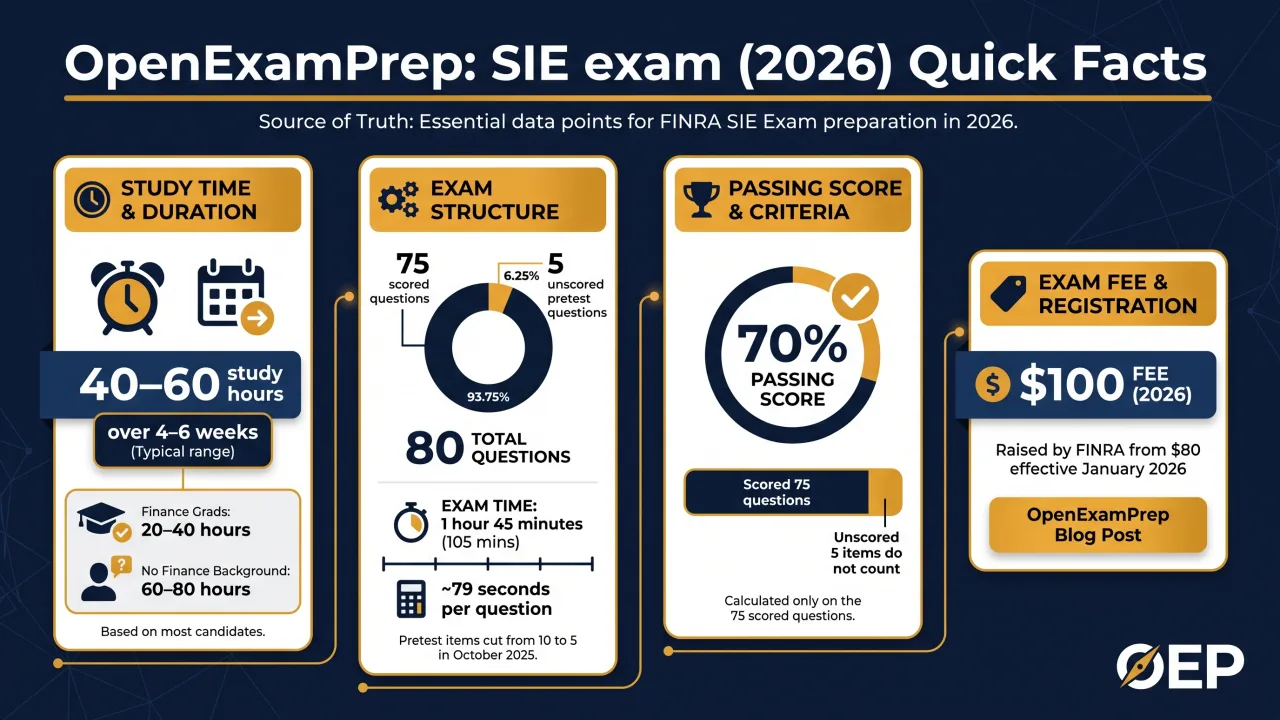
How Long to Study for the SIE Exam: Quick Answer
Most candidates need 40-60 hours of study over 4-6 weeks to pass the SIE exam. However, your ideal timeline depends on your background, study efficiency, and schedule.
| Your Background | Recommended Hours | Timeline |
|---|---|---|
| Finance degree or work experience | 30-40 hours | 3-4 weeks |
| Some business/financial knowledge | 40-60 hours | 4-6 weeks |
| No finance background | 60-80+ hours | 6-8 weeks |
SIE Exam Facts You Should Know First (2026)
Build your study plan around the current exam structure. These details are confirmed on the FINRA SIE exam page:
| Detail | Current standard (2026) |
|---|---|
| Questions | 80 total: 75 scored + 5 unscored pretest |
| Time limit | 1 hour 45 minutes |
| Passing score | 70 (on the 75 scored questions) |
| Exam fee | $100 (raised from $80 effective January 2026) |
| Eligibility | Anyone 18 or older; no firm sponsorship required |
| Result validity | 4 years |
Two recent changes to note. Effective October 27, 2025, FINRA cut the number of unscored pretest questions from 10 to 5, so the exam is now 80 questions instead of 85 (the scored count stayed at 75). Separately, the exam fee rose from $80 to $100 effective January 2026. Older study guides and infographics still show 85 questions and an $80 fee, so verify any number against FINRA before you schedule.
With 105 minutes for 80 questions, you have roughly 79 seconds per question. That pace is generous, so your study time should target accuracy and concept mastery, not speed drills.
Factors That Determine Your Study Time
1. Prior Knowledge & Education
Your existing knowledge significantly impacts preparation time:
Shorter Study Time (30-40 hours):
- Finance, economics, or business degree
- Work experience in banking or financial services
- Previously studied for other securities exams
- Strong understanding of basic investment concepts
Standard Study Time (40-60 hours):
- General college degree
- Some exposure to investing (personal portfolio)
- Business-adjacent career (accounting, law, etc.)
- Comfortable with financial terminology
Longer Study Time (60-80+ hours):
- No college degree in related field
- Limited exposure to financial concepts
- Career change from unrelated industry
- English as a second language
2. Study Efficiency
How you study matters as much as how long:
| Study Method | Effectiveness | Time Required |
|---|---|---|
| Practice questions with review | High | Less time needed |
| Active note-taking and recall | High | Moderate time |
| Video courses + practice | Medium-High | Moderate time |
| Reading textbook only | Low | More time needed |
| Passive video watching | Low | Much more time |
Pro tip: Candidates who use active recall and practice questions learn the same material in 30-40% less time than passive readers.
3. Your Available Schedule
| Daily Availability | Weekly Hours | Weeks to Complete |
|---|---|---|
| 1-2 hours | 7-14 hours | 6-8 weeks |
| 2-3 hours | 14-21 hours | 4-5 weeks |
| 4-5 hours | 28-35 hours | 2-3 weeks |
| Full-time study | 40+ hours | 1-2 weeks |
Recommended SIE Study Schedules
4-Week Study Schedule (Standard)
Best for: Candidates with some financial knowledge, 2-3 hours daily
| Week | Focus | Hours |
|---|---|---|
| Week 1 | Products & Risks (Part 1) + Capital Markets | 12-15 |
| Week 2 | Products & Risks (Part 2) + Trading & Accounts | 12-15 |
| Week 3 | Regulatory Framework + Review weak areas | 10-12 |
| Week 4 | Practice exams + Final review | 12-15 |
| Total | 46-57 hours |
Daily Breakdown (Week 1 Example):
- Monday: Capital Markets basics (2 hours)
- Tuesday: Types of securities (2 hours)
- Wednesday: Equity securities deep dive (2 hours)
- Thursday: Debt securities (2 hours)
- Friday: Practice questions + review (2 hours)
- Weekend: Catch up + practice quiz (3 hours)
6-Week Study Schedule (Thorough)
Best for: Beginners or candidates with limited daily time (1-2 hours)
| Week | Focus | Hours |
|---|---|---|
| Week 1 | Capital Markets fundamentals | 8-10 |
| Week 2 | Products & Risks (Equities) | 10-12 |
| Week 3 | Products & Risks (Fixed Income, Options) | 10-12 |
| Week 4 | Trading & Customer Accounts | 10-12 |
| Week 5 | Regulatory Framework + Review | 8-10 |
| Week 6 | Practice exams + Final review | 12-15 |
| Total | 58-71 hours |
2-Week Intensive Schedule (Accelerated)
Best for: Finance professionals, those with prior exam experience
| Week | Focus | Hours |
|---|---|---|
| Week 1 | All content areas (high-speed coverage) | 25-30 |
| Week 2 | Practice exams + targeted review | 20-25 |
| Total | 45-55 hours |
⚠️ Warning: This accelerated schedule has higher failure risk. Only attempt if you have strong prior knowledge.
Study Time by Topic Area
Allocate study time proportional to exam weights:
| Topic Area | Exam Weight | Recommended Hours (50-hour plan) |
|---|---|---|
| Understanding Products and Their Risks | 44% | 22 hours |
| Trading, Customer Accounts & Prohibited Activities | 31% | 15 hours |
| Knowledge of Capital Markets | 16% | 8 hours |
| Overview of the Regulatory Framework | 9% | 5 hours |
What Each Section Covers
Products and Their Risks (44%) — Largest section, spend the most time here:
- Equity securities (stocks, ADRs, rights, warrants)
- Debt securities (bonds, treasuries, munis)
- Packaged products (mutual funds, ETFs, UITs)
- Options basics
- Alternative investments
- Risk types and characteristics
Trading & Accounts (31%):
- Order types and trade execution
- Account types and features
- Customer account documentation
- Prohibited activities and ethical practices
Capital Markets (16%):
- Primary and secondary markets
- Market participants
- Economic factors
- Types of markets
Regulatory Framework (9%):
- SRO structure (FINRA, MSRB, SEC)
- Registration requirements
- Prohibited conduct
When to Start Taking Practice Exams
Start practice exams 2 weeks before your scheduled test date.
| Practice Exam Phase | When | Goal Score |
|---|---|---|
| First diagnostic exam | 2 weeks before | Baseline (often 50-65%) |
| Practice exam 2 | 10 days before | 70%+ |
| Practice exam 3 | 1 week before | 75%+ |
| Practice exams 4-5 | 3-5 days before | 80%+ |
| Final review | 1-2 days before | 80%+ |
If your practice scores are below 75% one week before your exam, consider rescheduling.
Signs You Need More Study Time
Add 1-2 more weeks if you experience:
- ❌ Practice exam scores consistently below 70%
- ❌ Struggling with an entire topic area
- ❌ Frequently missing more than 1 day of study
- ❌ Unable to explain concepts in your own words
- ❌ High stress or test anxiety
- ❌ Getting questions wrong you previously got right
Signs You're Ready
You're ready for the real exam when:
- ✅ Scoring 80%+ on full-length practice exams consistently
- ✅ Can explain key concepts without notes
- ✅ Comfortable with all four topic areas
- ✅ Managing time well on practice tests (finishing with 15+ minutes left)
- ✅ Missing questions are random, not clustered in one topic
Sample Study Plan Template
Here's a template you can customize:
Week 1-2: Foundation Building
- Read/watch content for Products & Risks
- Take notes on key concepts
- Complete 50-100 practice questions per topic
- Review all incorrect answers thoroughly
Week 3-4: Topic Completion
- Finish remaining content areas
- Continue practice questions (aim for 200+ total)
- Identify weak areas from practice question performance
Week 5 (if needed): Targeted Review
- Focus on weak areas identified
- Re-read content for challenging topics
- Practice questions specifically in weak areas
Final 1-2 Weeks: Exam Simulation
- Take 3-5 full-length practice exams
- Simulate real test conditions (timed, no interruptions)
- Review every wrong answer
- Light review of all topics
Tips to Maximize Study Efficiency
-
Study in focused blocks — 25-50 minute sessions with breaks are more effective than marathon sessions
-
Use active recall — Don't just re-read. Quiz yourself frequently
-
Practice questions daily — Aim for 20-30 questions per study session
-
Review wrong answers immediately — Understanding why you missed a question is more valuable than getting it right
-
Study your weak areas more — It's tempting to review what you know, but focus on gaps
-
Create a consistent schedule — Same time each day builds habit and retention
Start Your SIE Exam Prep Today
Ready to begin your study journey? Our free SIE exam prep includes:
- All four topic areas covered comprehensively
- Practice questions throughout
- No signup or credit card required
- Study at your own pace
Frequently Asked Questions
How many hours should I study for the SIE exam?
Most candidates need 40-60 hours of total study time. Those with finance backgrounds may need only 30-40 hours, while complete beginners should plan for 60-80+ hours.
Can I pass the SIE exam without studying?
No. The SIE exam covers specific regulatory knowledge and securities concepts that require dedicated study. Even experienced finance professionals should study at least 20-30 hours to learn FINRA-specific rules and terminology.
Is 1 week enough to study for the SIE exam?
One week is generally not enough unless you have an extensive finance background and can dedicate 40+ hours that week. Most candidates need 4-6 weeks to properly prepare and achieve high pass rates.
What is the best way to study for the SIE exam?
The best approach combines: 1) Reading/watching content, 2) Taking detailed notes, 3) Completing 300+ practice questions, 4) Taking multiple timed practice exams, and 5) Thoroughly reviewing all mistakes.
Official-Source Check Before You Schedule
Treat this article as a study map, not a substitute for the current SIE exam candidate materials. For securities exams, keep the FINRA qualification exam pages and the current candidate handbook open as the source of truth for enrollment, exam windows, permitted materials, and topic outlines. Requirements can change by testing window, jurisdiction, sponsor update, or delivery vendor, and those changes often affect small details candidates overlook: identification rules, retake timing, calculator policy, reference materials, continuing-education language, application approvals, and the exact way domains are named.
Before you pay for an exam date, make a one-page source checklist. Put the official exam page, candidate handbook, content outline or blueprint, fee page, accommodation instructions, and reschedule policy in one place. Then compare your prep materials against that checklist. If a prep book, course, or old post disagrees with the sponsor, follow the sponsor. This is especially important for candidates returning after a failed attempt because they may be studying from notes built around an older outline.
How To Read The Blueprint Without Overstudying
Do not read the SIE exam outline like a table of contents. Read it like a risk map. Each domain tells you what the exam writer is allowed to test, but the action verbs tell you how the topic may appear. A verb such as identify usually points to recognition. A verb such as apply, analyze, evaluate, calculate, determine, or recommend means the question can require judgment, sequencing, or multi-step reasoning.
Use four passes through the outline. First, mark topics you already use at work. Second, mark topics you recognize but cannot explain without notes. Third, mark topics that have unfamiliar vocabulary. Fourth, mark topics that combine two skills, such as a rule plus a calculation or a policy plus a scenario. The fourth group deserves the most practice because it is where candidates often feel prepared while still missing points.
For the SIE exam, route your weekly study around these high-friction buckets:
- regulatory definitions and prohibited conduct
- customer profile and suitability facts
- product risk, compensation, and liquidity
- supervision, disclosure, and recordkeeping triggers
The goal is not to give every line of the outline equal time. The goal is to convert weak, testable behaviors into repeatable decisions. If a topic is easy in isolation but difficult inside a mixed set, it belongs in your active rotation until it stays stable under time pressure.
Scenario Strategy For Hard Questions
Most candidates miss hard SIE exam questions for one of three reasons: they answer the first familiar phrase, they ignore a limiting condition, or they spend too long trying to make every answer choice perfect. A better method is to treat each customer scenario as a short professional decision.
Start by naming the task in plain English. Ask: what is the exam actually asking me to decide? Then identify the controlling facts. Separate facts that change the answer from facts that merely describe the setting. Next, predict the principle before looking at the options. Even a rough prediction reduces the chance that an attractive distractor pulls you away from the rule, process, or judgment being tested.
When two answer choices remain, compare them against the exact role you are playing in the prompt. Are you acting as a supervisor, adviser, technician, manager, applicant, analyst, auditor, clinician, inspector, or public-facing professional? Exam writers often make the second-best option sound reasonable for the wrong role. If the question asks for the next action, prefer the answer that preserves safety, compliance, documentation, client interest, or process control before jumping to a final conclusion.
For finance, securities, tax, and accounting candidates, the most expensive misses usually come from reading too quickly. A phrase such as discretionary authority, temporary difference, fiduciary account, private placement, tax adjustment, or client objective changes the answer even when the numbers look familiar. Build the habit of circling the controlling fact before you calculate, recommend, or choose a rule. If the prompt includes both a numerical detail and a conduct detail, decide which one controls the question before touching the answer choices. That discipline prevents a common trap: solving the math correctly while answering the wrong professional question.
Practice Routing And Score Repair
Use practice questions as diagnostic data, not as a score-chasing game. After each timed block, tag every miss with one primary cause: content gap, vocabulary gap, careless reading, calculation setup, scenario judgment, or pacing. If you tag everything as content, your remediation will be too broad. If you tag every miss carefully, your next study block becomes obvious.
A strong remediation cycle has three steps. First, reread only the smallest source section that explains the miss. Second, write a one-sentence rule in your own words. Third, answer two or three nearby questions without notes. If you can only answer the original question after seeing the explanation, you have recognized the answer rather than repaired the skill.
Use mixed sets earlier than feels comfortable. Topic-by-topic drills build confidence, but the real exam rarely announces which rule is being tested. A mixed set forces you to identify the domain before solving. That recognition skill is part of readiness. Start with short mixed sets, then grow into longer timed blocks as your accuracy stabilizes.
Final Two-Week Readiness Plan
Two weeks before exam day, stop measuring progress by pages completed. Measure it by repeatable performance. Your target is not one lucky high score; it is several timed blocks where the same weak area no longer appears in the miss log.
During the first week, run alternating blocks: one targeted weak-area set, one mixed timed set, one review block, and one short recall session. The recall session should be closed-book. Write definitions, formulas, procedures, rule triggers, or decision steps from memory, then check them against the official outline and your notes.
During the final week, reduce new material. Keep daily contact with the hardest topics, but shift toward confidence, pacing, and clean execution. Rework missed questions from your log, especially the ones you missed twice. Review administrative requirements, testing location rules, remote-proctor rules if applicable, identification, permitted materials, and break policy. Those logistics are not content knowledge, but they can still disrupt performance if you handle them late.
Common Traps To Avoid
The first trap is passive rereading. Rereading feels productive because the material becomes familiar, but familiarity does not prove you can choose correctly under pressure. Convert reading into retrieval: close the source, explain the rule, then apply it.
The second trap is treating every miss as equal. A careless one-off miss needs a prevention habit. A repeated domain miss needs a study block. A pacing miss needs timed drills. A vocabulary miss needs flashcards or a glossary. Different misses require different repairs.
The third trap is delaying full-length or longer timed practice until the last few days. Longer practice exposes fatigue, sequencing problems, and weak time allocation. Find those problems while there is still time to fix them.
The fourth trap is ignoring why the right answer is right. For each reviewed item, write why the correct answer wins and why the best distractor fails. That second sentence is where durable learning happens.
When You Are Ready
You are ready for the SIE exam when you can explain the core domains without reading the outline, complete timed sets without rushing the final questions, and identify your miss patterns before checking the score report. You should also be able to say what you will do if the first ten questions feel harder than expected. The answer should be simple: slow down, return to the task, identify controlling facts, eliminate role-inconsistent options, and keep moving.
Passing is usually less about finding a secret resource and more about building a reliable loop: official source, focused study, timed practice, miss analysis, and targeted repair. Keep that loop tight, and every practice session has a job.

 Buy on Amazon
 Flashcards on Mometrix
 Take courses on Udemy
 Prep course on Achievable