Free NCLEX-RN Practice Test 2026 (Next Generation NCLEX)
This is a free, fully rationaled NCLEX-RN practice test built for the Next Generation NCLEX (NGN) and the 2026 NCLEX-RN Test Plan that took effect April 1, 2026. Every question below is organized by the actual Client Needs category the NCSBN tests, includes a full rationale explaining why the correct answer is right and the distractors are wrong, and reflects how the live exam is scored. No signup, no credit card, no paywall.
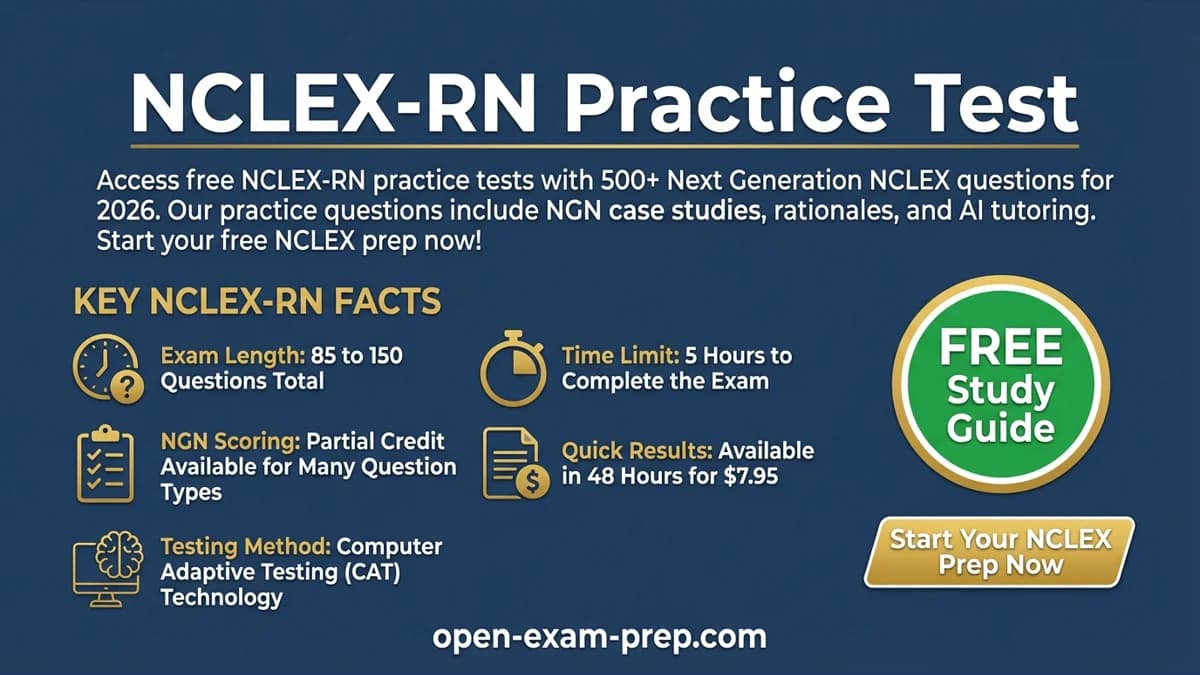
The NGN went live on April 1, 2023, adding case studies, bow-tie, matrix, and other item types that score clinical judgment. The exam is delivered by Computer Adaptive Testing (CAT) through Pearson VUE: you get between 85 and 150 items and up to 5 hours, and you pass when the engine is 95% confident your ability is above the passing standard of 0.00 logits (the standard NCSBN set in 2023 and has upheld through March 31, 2029). This page explains all of that in plain language and then lets you practice it.
How the NCLEX-RN Actually Works in 2026
| What you need to know | Detail |
|---|---|
| Item count | 85 minimum, 150 maximum (CAT decides) |
| Time limit | 5 hours (includes tutorial and breaks) |
| Delivery | Computer Adaptive Testing via Pearson VUE |
| Passing standard | 0.00 logits, 95% confidence rule (through March 31, 2029) |
| Registration fee | $200 (paid to Pearson VUE) |
| Retake wait | Minimum 45 days between attempts |
| Quick Results | Unofficial result ~48 hours after exam for $7.95 (not offered in every state, e.g. California) |
| Test plan in effect | 2026 NCLEX-RN Test Plan, effective April 1, 2026 |
There is no fixed percentage you must score. CAT recalculates your estimated ability after each item, choosing the next item near your current level. The test stops when it is statistically certain (95% confidence) you are above or below 0.00 logits, when you hit 150 items, or when the 5-hour clock runs out. This is why two candidates can both pass with very different question counts.
What Changed in the 2026 Test Plan
The big shift was already done in April 2023, when the NGN launched. The 2026 NCLEX-RN Test Plan (effective April 1, 2026, through March 31, 2029) kept the Client Needs category percentages the same as the 2023 plan and refreshed the underlying nursing activity statements based on the most recent RN practice analysis. If you studied from a 2023-2025 NGN-aligned bank, the structure you learned still applies. The passing standard also remains 0.00 logits, so the difficulty bar is unchanged.
Free NCLEX-RN Practice Questions by Client Needs Category
The NCLEX-RN blueprint has four major Client Needs areas; Physiological Integrity splits into four subcategories. Practice each area below, then run a mixed adaptive set to mirror the real exam.
Management of Care (15-21%) - the single largest stand-alone area
This area tests delegation, prioritization, advance directives, informed consent, confidentiality, and continuity of care. It is the highest-yield non-physiological category, so master it.
Q. A charge nurse is delegating tasks on a medical-surgical unit. Which task is appropriate to assign to unlicensed assistive personnel (UAP)?
A. Teaching a newly diagnosed diabetic to self-inject insulin B. Assessing a post-operative patient's surgical dressing C. Recording the intake and output of a stable patient D. Evaluating a patient's response to a new pain medication
Answer: C. Recording I&O for a stable patient is a routine, standardized task with a predictable outcome, which falls within the UAP scope. Teaching (A), assessing (B), and evaluating (D) all require nursing judgment and cannot be delegated to a UAP. Remember the rule: you can delegate tasks, but never the nursing process steps of assessment, planning, evaluation, or patient teaching.
Safety and Infection Prevention and Control (10-16%)
This covers standard and transmission-based precautions, surgical asepsis, error prevention, restraints, and emergency response.
Q. A nurse is caring for a patient with active pulmonary tuberculosis. Which personal protective equipment is required before entering the room?
A. Surgical mask and gown B. N95 respirator and a negative-pressure room C. Gloves and goggles only D. Sterile gown and sterile gloves
Answer: B. Tuberculosis spreads by the airborne route, requiring a fit-tested N95 respirator (or higher) and placement in an airborne infection isolation (negative-pressure) room. A surgical mask (A) does not filter airborne particles. Gloves and goggles (C) address contact and droplet splash, not airborne spread. Sterile attire (D) is for surgical asepsis, not isolation.
Health Promotion and Maintenance (6-12%)
Developmental stages, prenatal and newborn care, aging, and health screening live here.
Q. At a well-child visit, a nurse assesses a 12-month-old. Which developmental milestone would the nurse expect?
A. Walks up stairs holding a rail B. Speaks in two- to three-word sentences C. Pulls to stand and may take first steps D. Has 16 teeth
Answer: C. At 12 months a child typically pulls to stand, cruises, and may take first independent steps; expressive language is usually a few single words. Climbing stairs (A) and short sentences (B) are closer to 24 months. Sixteen teeth (D) is roughly a 24-month finding; a 12-month-old usually has about 6-8 teeth.
Psychosocial Integrity (6-12%)
Therapeutic communication, crisis intervention, mental health concepts, abuse, and coping.
Q. A patient newly diagnosed with cancer says, "There's no point in any of this treatment." What is the nurse's best therapeutic response?
A. "Don't give up - many people beat this." B. "You sound discouraged. Can you tell me more about how you're feeling?" C. "Your doctor is one of the best, so you're in good hands." D. "You should focus on staying positive for your family."
Answer: B. Reflecting the patient's feeling and inviting them to elaborate is open-ended, patient-centered therapeutic communication. False reassurance (A, C) and shifting focus to the family with "should" (D) block expression and dismiss the patient's emotions.
Physiological Integrity (39-63% combined - the heaviest area)
Physiological Integrity is the largest chunk of the exam. It has four subcategories:
- Basic Care and Comfort (6-12%) - nutrition, mobility, elimination, rest, non-pharmacological comfort
- Pharmacological and Parenteral Therapies (13-19%) - medication administration, dosage calculation, IV therapy, blood products, central lines
- Reduction of Risk Potential (9-15%) - lab values, diagnostics, complications, vital-sign interpretation
- Physiological Adaptation (11-17%) - fluid/electrolyte balance, hemodynamics, pathophysiology, medical emergencies
Q (Pharmacological). A patient on a heparin infusion has an aPTT three times the control value and visible gum bleeding. Which medication should the nurse anticipate administering?
A. Vitamin K (phytonadione) B. Protamine sulfate C. Fresh frozen plasma D. Calcium gluconate
Answer: B. Protamine sulfate is the reversal agent for heparin. Vitamin K (A) reverses warfarin, not heparin - a classic distractor. FFP (C) replaces multiple clotting factors but is not the specific heparin antidote. Calcium gluconate (D) treats hypocalcemia and hyperkalemia. Pair the drug with its antidote: heparin/protamine, warfarin/vitamin K, opioids/naloxone, benzodiazepines/flumazenil, acetaminophen/acetylcysteine.
Q (Reduction of Risk). A nurse reviews labs for a patient on furosemide. Which value requires immediate intervention?
A. Sodium 138 mEq/L B. Potassium 2.8 mEq/L C. Creatinine 0.9 mg/dL D. Hemoglobin 13 g/dL
Answer: B. A potassium of 2.8 mEq/L is hypokalemia (normal 3.5-5.0) and is dangerous because it predisposes to lethal cardiac dysrhythmias - and furosemide, a loop diuretic, actively wastes potassium. Sodium (A), creatinine (C), and hemoglobin (D) are all within normal limits.
How the Next Generation NCLEX (NGN) Item Types Work
The NGN tests clinical judgment using the NCSBN Clinical Judgment Measurement Model (NCJMM), operationalized in six cognitive steps: Recognize Cues, Analyze Cues, Prioritize Hypotheses, Generate Solutions, Take Action, Evaluate Outcomes. Unlike traditional dichotomous items (right or wrong), most NGN item types use polytomous scoring so you can earn partial credit.
| NGN item type | What it asks you to do | Scoring |
|---|---|---|
| Case study (unfolding) | One client scenario with 6 linked items, one per NCJMM step | Each item scored individually; partial credit |
| Bow-tie | Pull together the condition, two actions, and two parameters to monitor | Scored 0/1 dyad style; partial credit |
| Matrix/grid | Mark multiple cells true/false or appropriate/not (e.g. anticipated vs contraindicated) | +/- or Rationale scoring; partial credit |
| Extended multiple response | Select all that apply from a longer list | +/- scoring; partial credit |
| Drop-down (cloze) | Complete sentences by choosing from in-line menus | Each blank scored; partial credit |
| Drag-and-drop | Order or categorize responses | Each placement scored; partial credit |
| Highlight | Click the relevant findings inside a chart or note | Each selection scored; partial credit |
| Trend | Compare data across multiple time points to spot change | Scored per the model used; partial credit |
Three scoring rules to know: +/- (plus/minus) deducts for wrong selections, so do not blindly select everything; 0/1 gives all-or-nothing per dyad; Rationale scoring links a cause to its effect. Because partial credit exists, answer every part of a multi-component item - a half-right matrix still earns points.
A worked NGN-style bow-tie
Scenario. A 68-year-old arrives with crushing substernal chest pain radiating to the left arm, diaphoresis, BP 158/94, HR 110, SpO2 92% on room air, and ST-segment elevation on ECG.
- Condition (center): Acute myocardial infarction (STEMI).
- Actions to take (left): Administer aspirin 162-325 mg chewed; apply oxygen to keep SpO2 above 94%. (Not: give a large oral meal; ambulate the patient.)
- Parameters to monitor (right): Cardiac rhythm/troponin; pain level and ST segments. (Not: bowel sounds; deep tendon reflexes.)
Notice the reasoning chain: recognize the cues (chest pain + ST elevation + risk profile), prioritize the hypothesis (STEMI over GERD or anxiety), then take the actions that protect the myocardium. That is exactly what the NGN scores.
A Study Strategy That Actually Moves Your Pass Probability
Volume alone does not pass the NCLEX - decision quality does. Use these evidence-based habits:
- Practice in the exam's language. Decide what the stem is really asking - first action, priority, what to report, what to delegate, contraindicated vs anticipated. Those verbs change the answer.
- Predict before you peek. Cover the options, predict what a safe entry-level nurse would do, then find the matching choice. This blocks attractive-but-wrong distractors.
- Use a framework when prioritizing. ABCs (Airway, Breathing, Circulation), then Maslow, then the nursing process (assess before intervene), then safety/acute-over-stable.
- Keep a missed-cue log. Record the exact cue you ignored - unstable vital sign, drug-lab interaction, isolation type, scope boundary - not just the broad topic. Convert repeat misses into short drills.
- Drill rationales, not just answers. Write one sentence on why the right answer is safer than yours. Reading rationales is how strong free banks (and ours) build clinical judgment.
- Mix categories in the final week. Real items do not announce their domain. Mixed adaptive sets force you to discriminate between similar drugs, labs, and safety steps.
There is no magic practice percentage, but candidates who consistently work questions at or above medium difficulty with rationales, and who close their own missed-cue gaps, walk in with a repeatable method instead of memorized trivia.
Free vs Paid NCLEX Prep: What You Actually Need
Paid platforms (UWorld, Archer, Kaplan) are excellent and offer huge banks with deep rationales - but you do not need to spend hundreds to build clinical judgment. A free, rationaled, NGN-focused bank plus disciplined review of your misses covers the same skills. Use this page and our free NCLEX-RN practice bank as your core, add the official NCSBN sample items for interface familiarity, and reserve any paid bank for extra volume if your weak areas need it.
Official-Source Check Before Test Day
Always confirm administrative details against the official NCLEX site and your state board: eligibility, the Authorization to Test (ATT) window, ID requirements, rescheduling rules, and accommodations. Quick Results availability and timing differ by jurisdiction. Do not prepare from an outdated blueprint - this page is aligned to the 2026 test plan effective April 1, 2026.
Begin your free NCLEX-RN practice test now -> - rationaled questions, NGN case studies, all Client Needs categories, plus an AI tutor for instant explanations. No signup required.

 4 Job Wiki
 Buy on Amazon
 Take courses on Udemy
 Prep course on Achievable
 Study guide on Mometrix