Cosmetology State Board Exam 2026: Your Complete Guide
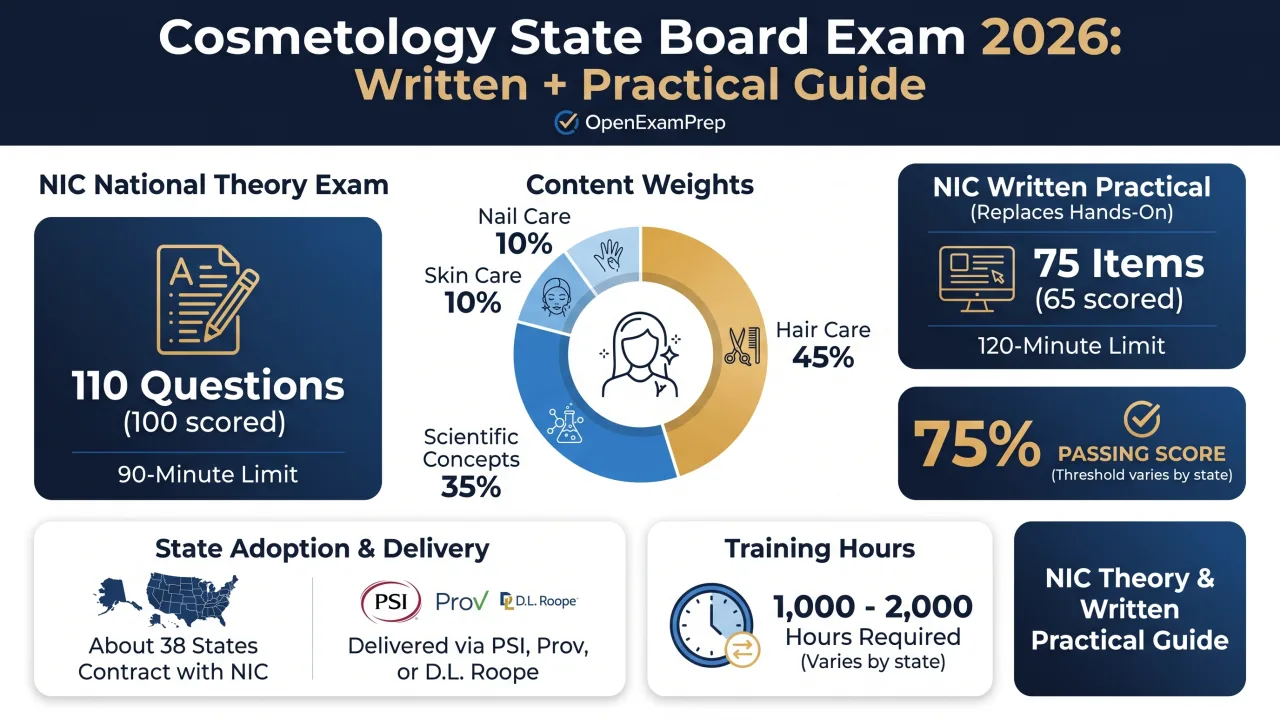
The Cosmetology State Board Exam is a standardized certification test required to work as a licensed cosmetologist in the United States. Administered by the National Interstate Council of State Boards of Cosmetology (NIC) in over 38 states, this exam ensures that beauty professionals meet safety and competency standards before serving clients.
Whether you dream of becoming a hairstylist, salon owner, makeup artist, or beauty educator, passing the cosmetology state board exam is your first step toward an exciting career in the beauty industry.
Exam Format & Structure
| Component | Details |
|---|---|
| Theory (Written) Exam | 110 multiple-choice questions (100 scored + 10 pilot) |
| Theory Time | 90 minutes |
| Hands-On Practical | Live skills demonstration on a mannequin (used by some states) |
| Practical Time | About 2.5-3 hours |
| Written Practical | 75 items (65 scored), 120 minutes - replaces hands-on practical in many states |
| Passing Score | Typically 75% (varies by state) |
| Testing Organization | NIC, delivered via PSI, Prov, or D.L. Roope (about 38 states) |
The NIC offers three separate cosmetology exams, and the combination you take depends on your state:
- National Theory (Written) Examination - 110 items (100 scored), 90 minutes. Tests cosmetology science, techniques, and safety.
- National Practical Examination - Hands-on skills demonstrated on a mannequin in front of an evaluator.
- National Written Practical Examination - A computer-based exam of 75 items (65 scored), 120 minutes, that uses photos and video to test practical judgment. A growing number of states use this instead of the hands-on practical.
Most candidates take the Theory exam plus EITHER the hands-on Practical OR the Written Practical. The written exams are commonly offered in English, Spanish, Korean, and Vietnamese, though available languages vary by state and vendor (PSI, Prov, or D.L. Roope).
Start Your FREE Cosmetology Prep Today
Our comprehensive course covers all 4 content areas for the written exam plus practical skills preparation—100% FREE.
Written Exam Content Areas
The theory exam tests your knowledge across 4 major content areas, weighted per the official NIC Candidate Information Bulletin (CIB):
1. Scientific Concepts (35%)
This section covers the core science behind cosmetology:
- Microbiology - Bacteria, viruses, fungi, and parasites
- Infection Control - Sanitation, disinfection, and sterilization
- OSHA/EPA Regulations - Safety standards and chemical handling
- Basic Chemistry - pH levels, chemical reactions, product formulations
- Anatomy and Physiology - Hair, skin, and nail structure
- Electricity Basics - Safety with electrical equipment
2. Hair Care and Services (45%)
The most heavily weighted section, covering all hair-related services:
- Consultation and Analysis - Client assessment and communication
- Draping Techniques - Proper client preparation
- Haircutting - Shears, razors, clippers, and blending techniques
- Hair Styling - Blow drying, curling, updos, and thermal styling
- Chemical Texture Services - Permanent waving and relaxers
- Hair Coloring - Color theory, application, and correction
- Shampooing and Conditioning - Proper techniques and product selection
- Scalp Treatments - Disorders and treatments
3. Skin Care and Services (10%)
Essential esthetics knowledge for cosmetologists:
- Facial Procedures - Cleansing, exfoliation, and massage
- Hair Removal - Waxing techniques and safety
- Makeup Application - Color theory and application techniques
- Skin Analysis - Types, conditions, and contraindications
- Basic Electricity - Facial equipment safety
- Contraindications - When NOT to perform services
4. Nail Care and Services (10%)
Foundational nail technology knowledge:
- Manicure Procedures - Filing, shaping, and polish application
- Pedicure Procedures - Foot care and sanitation
- Nail Product Chemistry - Acrylics, gels, and natural nail care
- Nail Disorders - Recognition and when to refer to physician
- Infection Control - Tool sanitation and disinfection
Free Practice Questions & Study Materials
Each chapter includes:
- Detailed content explanations
- NIC-style practice questions
- Practical skills checklists
- Key takeaways for quick review
Practical Examination
The Practical Examination is the hands-on portion where you demonstrate cosmetology skills on a mannequin. This is often considered the more challenging part of the exam.
How the Practical Exam Works
- Timed Sections: You complete specific tasks within time limits
- Mannequin-Based: All services performed on approved mannequin head/hand
- Strict Proctoring: Evaluators observe and score your performance
- Critical Steps: Missing critical safety steps = automatic failure
- Sanitation Throughout: Continuous disinfection is mandatory
Skills Tested on the Practical Exam
| Service | Key Tasks |
|---|---|
| Haircutting | Blended layered haircut using shears and razor, minimum 1" removal |
| Permanent Waving | Rod placement, protective cream application, test curl |
| Hair Coloring | 1/2" color retouch using 1/4" subsections, bowl and brush method |
| Chemical Relaxer | Virgin relaxer application and 1.5" retouch technique |
| Styling | Thermal styling, wet sets, or blow dry styling |
| Skin Care | Basic facial procedures (in some states) |
| Nail Care | Manicure procedures (in some states) |
Critical Requirements for All Services
These steps are mandatory—missing them fails the section:
- Sanitation Station Setup - Proper disinfection supplies displayed
- Hand Washing - Before and between services
- Tool Disinfection - Viricidal, bactericidal, and fungicidal wipes only (NO spray disinfectants)
- Proper Draping - Chemical draping for chemical services
- Safety Precautions - Gloves for chemicals, proper handling
Important: For the hands-on practical, only disinfecting WIPES are permitted. Spray disinfectants are not allowed and will be confiscated at the testing center.
Written Practical: The Hands-On Replacement
Many states have dropped the live, mannequin-based practical in favor of the NIC National Written Practical Examination - a computer-based test of 75 items (65 scored), 120 minutes that uses photos and video to test the same practical judgment without a hands-on demonstration. If your state uses this format, you take two written exams (Theory + Written Practical) on the computer and never style a mannequin at the testing center.
States That Eliminated the Hands-On Practical
The shift away from the live practical is real. California eliminated its hands-on practical exam under SB-803 (effective January 2022) and now licenses on the written exams alone, and Florida has no state practical exam for cosmetologists. Other states continue to require the live mannequin practical (for example, Texas requires both a written and a hands-on practical). Always confirm your state board's current exam format before scheduling.
Start FREE Practical Skills Practice
Our skills chapters include step-by-step procedures with critical steps highlighted for each skill commonly tested on the exam.
State-Specific Requirements
Cosmetology licensing is regulated at the state level, meaning requirements vary significantly:
| Requirement | Range by State |
|---|---|
| Training Hours | 1,000-2,000 hours |
| Minimum Age | 16-18 years old |
| Education | High school diploma or GED (most states) |
| Background Check | Required in most states |
| Apprenticeship Option | Available in some states (2x school hours) |
| Renewal Period | Every 1-2 years |
Training Hours by State (Selected Examples)
| State | Required Hours |
|---|---|
| California | 1,000 hours |
| Florida | 1,200 hours |
| Texas | 1,000 hours |
| New York | 1,000 hours |
| Georgia | 1,500 hours |
| Hawaii | 1,800 hours |
| Idaho | 2,000 hours |
| Oregon | 1,450 hours |
The national average is 1,400-1,600 hours according to the American Association of Cosmetology Schools (AACS).
States Using NIC Exams
Over 38 states are contracted with NIC for standardized testing, including: Washington, Ohio, Maine, South Carolina, Virginia, Montana, New Hampshire, Missouri, and many more.
Some states like Texas, New York, and California may include additional state law questions on their exams.
Study Timeline for Cosmetology Exam Success
| Week | Focus | Activities |
|---|---|---|
| 1-2 | Scientific Concepts | Microbiology, infection control, chemistry, anatomy |
| 3-4 | Hair Services | Haircutting theory, chemical services, color theory |
| 5 | Skin & Nails | Facials, waxing, manicure/pedicure procedures |
| 6 | Practical Skills | Hands-on practice on mannequin |
| 7 | State Laws | Your state-specific regulations and requirements |
| 8 | Final Review | Practice tests + timed practical sessions |
Recommended: 100-150 hours of self-study after completing cosmetology school
Test-Taking Strategies
For Written Exam
- Know your percentages - Focus most study time on Hair Care (45%) and Scientific Concepts (35%)
- Learn infection control thoroughly - Safety questions appear across all sections
- Understand chemistry basics - pH, chemical reactions, product interactions
- Memorize key terminology - Scientific and technical terms
- Practice time management - 110 questions in 90 minutes = less than 1 minute per question
For Practical Exam
- Practice until automatic - No hesitation during test
- Set up station perfectly - First impressions matter
- Maintain sanitation continuously - Wipe tools between EVERY use
- Work clean and organized - Evaluators notice your workspace
- Don't rush - Accuracy and safety over speed
- Verbalize if allowed - Some states let you talk through steps
- NEVER use spray disinfectant - Wipes only per NIC rules
Career Advancement: Beyond the Chair
Cosmetology certification opens doors to numerous career paths:
| Career Path | Description | Potential Earnings |
|---|---|---|
| Hair Stylist | Cut, color, and style hair in salons | $30,000-$60,000+ |
| Salon Manager | Oversee operations, staff, and clients | $40,000-$70,000 |
| Salon Owner | Run your own business | $50,000-$150,000+ |
| Cosmetology Educator | Teach at beauty schools | $35,000-$55,000 |
| Platform Artist | Demonstrate products for brands | $50,000-$100,000+ |
| Esthetician | Specialize in skin care services | $35,000-$65,000 |
| Makeup Artist | Film, TV, fashion, or bridal makeup | $40,000-$100,000+ |
| Color Specialist | Advanced hair coloring expert | $50,000-$80,000+ |
Job Outlook: The Bureau of Labor Statistics projects 5% employment growth for barbers, hairstylists, and cosmetologists from 2024 to 2034 - faster than the average for all occupations.
Specialization Options
- Master Colorist - Advanced color certifications
- Extension Specialist - Hair extension application
- Texture Expert - Natural hair and curl specialists
- Bridal Stylist - Wedding hair and makeup
- Editorial Stylist - Fashion and magazine work
Pass the Cosmetology Exam with Confidence
Join thousands of beauty professionals who passed their cosmetology state board exam using our comprehensive, 100% FREE study materials. Our course includes:
- Complete written exam coverage for all 4 content areas
- Practical skills checklists with critical steps
- AI-powered study assistance for instant explanations
- NIC-style practice questions updated for 2026
No credit card required. Start studying today.
Official Resources
- NIC Testing - National Interstate Council
- Milady - Cosmetology Education
- Your State Board of Cosmetology website
- Bureau of Labor Statistics - Cosmetologists

 Free CE
 Buy on Amazon
 Flashcards on Mometrix
 Practice exams on ExamEdge